What Is a UNESCO World Heritage Site? Meaning, Criteria, Selection Process and Protection
A UNESCO World Heritage Site is often treated as a global badge for somewhere beautiful, ancient or famous. That description misses what the designation actually means. World Heritage is a formal international conservation status created under the 1972 Convention concerning the Protection of the World Cultural and Natural Heritage. A property is placed on the World Heritage List because the World Heritage Committee concludes that it possesses Outstanding Universal Value, satisfies at least one of ten selection criteria and has adequate conditions for its long-term protection and management.
The distinction matters. A place can be historically important without being a World Heritage Site. A nationally treasured monument can remain outside the List. A World Heritage property does not become the property of UNESCO, and inscription does not remove the sovereignty of the country in which it is located. The system is fundamentally about identifying a limited group of cultural and natural properties whose significance is considered exceptional beyond national boundaries and then creating an international framework intended to protect the qualities for which they were recognised.
As of September 2026, UNESCO’s official World Heritage List contains 1,273 properties in 173 States Parties: 991 cultural, 240 natural and 42 mixed properties. Fifty-eight are currently on the List of World Heritage in Danger, while three properties have been delisted. The Convention itself has 196 States Parties. These figures change as the World Heritage Committee adds properties, modifies existing inscriptions or, very rarely, removes a property from the List.
What Does “Outstanding Universal Value” Actually Mean?
Outstanding Universal Value, usually abbreviated as OUV, is the central concept in the entire World Heritage system. UNESCO’s Operational Guidelines define it as cultural or natural significance so exceptional that it transcends national boundaries and is of common importance to present and future generations of humanity.
That does not mean every person in every country must regard the site as equally beautiful or personally meaningful. World Heritage is not an international popularity contest. A nomination has to demonstrate why the property matters within a comparative global framework.
A country therefore cannot make a convincing nomination merely by arguing that a site is extremely important to its own national history. It must explain why the property represents something exceptional when compared with relevant places elsewhere.
That international comparison is one reason World Heritage status is intentionally selective.
A Famous Place Is Not Automatically a World Heritage Site
Fame and World Heritage status often overlap, which creates confusion. The Taj Mahal, Great Barrier Reef and Angkor are internationally famous and are World Heritage properties. But fame is not itself a selection criterion.
A place may attract millions of visitors and still not possess the specific combination of Outstanding Universal Value, integrity or authenticity, protection and management necessary for inscription.
The opposite is also possible. Some World Heritage properties are relatively unfamiliar to international tourists but possess exceptional archaeological, ecological, geological or cultural significance.
The designation therefore answers a different question from “Is this place famous?”
It asks: does this property meet the Convention’s international standard for exceptional cultural or natural heritage, and can the values justifying recognition be protected?
There Are Ten World Heritage Selection Criteria
To qualify for inscription, a nominated property must satisfy at least one of ten criteria contained in the Operational Guidelines. UNESCO has used a unified set of ten criteria since revisions to the Guidelines took effect in the mid-2000s.
Criteria (i) to (vi) primarily concern cultural heritage. They include masterpieces of human creative genius; important exchanges of human values; exceptional testimony to cultural traditions or civilisations; outstanding examples of architecture, technology or landscapes illustrating significant stages in human history; traditional settlements or land-use systems; and direct associations with events, traditions, beliefs or artistic and literary works of outstanding universal significance.
Criteria (vii) to (x) address natural heritage. They cover exceptional natural beauty or phenomena, major stages of Earth’s history, significant ecological and biological processes, and habitats of exceptional importance for biodiversity conservation.
A property may meet several criteria. More criteria, however, do not automatically make a site “better” than one inscribed under only one.
World Heritage is not a ranking table.
Cultural, Natural and Mixed World Heritage Properties
World Heritage properties are generally described as cultural, natural or mixed.
Cultural properties can include monuments, groups of buildings, archaeological sites, historic cities, industrial heritage, cultural landscapes and other places demonstrating cultural significance.
Natural properties can include ecosystems, geological formations, forests, mountains, marine environments, fossil sites and habitats important to biodiversity.
Mixed properties meet both cultural and natural requirements.
As of September 2026, UNESCO lists 991 cultural properties, 240 natural properties and 42 mixed properties.
The categories are useful administratively, but reality can be more complicated. A landscape can be ecologically significant while also containing generations of human cultural practice. World Heritage increasingly has to deal with places where nature and culture cannot be cleanly separated.
Meeting One Criterion Is Not Enough
A common misunderstanding is that a country only needs to prove that its site meets one of the ten criteria.
The full test is more demanding.
UNESCO states that properties must demonstrate Outstanding Universal Value while also meeting relevant requirements concerning integrity, authenticity, protection and management.
This prevents the criteria from functioning as a loose checklist.
A spectacular historic structure whose important features have been almost completely destroyed may have difficulty demonstrating integrity. A heavily reconstructed cultural property may raise difficult questions about authenticity. An exceptional natural ecosystem without credible long-term protection can face problems even if its scientific significance is obvious.
World Heritage recognition therefore concerns both significance and stewardship.
What Does Integrity Mean?
Integrity broadly concerns whether the property contains the elements necessary to express its Outstanding Universal Value and whether those elements remain sufficiently intact.
For a natural site, this can involve whether the ecosystem is large and complete enough for ecological processes to continue.
For an archaeological or cultural landscape, it can involve whether the physical and spatial relationships needed to understand the property remain present.
A site can therefore lose important heritage value without its most famous monument physically collapsing.
A road, quarry, tower, dam or uncontrolled development can fragment a landscape or alter relationships essential to why the property was originally considered exceptional.
What Does Authenticity Mean?
Authenticity is particularly relevant to cultural properties. It asks whether the attributes through which cultural value is expressed can credibly convey that significance.
This can involve materials, design, workmanship, location, setting, traditions, techniques, use or other culturally relevant attributes.
Authenticity should not be reduced to the idea that “nothing can ever change.” Historic places often contain multiple layers and continue to function as living environments.
The question is whether changes allow the property to continue communicating the values for which it is significant rather than turning it into an invented imitation of heritage.
Protection and Management Are Part of the World Heritage Test
A nomination also needs credible long-term protection and management.
That may involve national heritage laws, protected-area legislation, planning controls, conservation programmes, environmental regulation, visitor management, disaster planning, ecological monitoring and community participation.
The nomination is therefore not simply an argument that a place is exceptional.
It is also an argument that the State Party has a realistic system for keeping it exceptional.
This is one of the most important differences between World Heritage status and a ceremonial award.
Countries Nominate Sites; UNESCO Does Not Simply Choose Them
Another persistent misconception is that UNESCO employees travel around the world discovering beautiful places and adding them to the List.
That is not how the normal nomination system works.
Only countries that are States Parties to the World Heritage Convention can submit nominations for properties within their territories. UNESCO describes the process as beginning with the State Party rather than with UNESCO independently selecting the property.
This means World Heritage recognition is partly dependent on national heritage policy, technical capacity, funding and political willingness.
An internationally significant property may remain unlisted because the relevant country has never nominated it.
Step One: The Property Must Reach the Tentative List
The first mandatory step is inclusion on the country’s Tentative List.
A Tentative List is an inventory of properties a State Party considers to have potential Outstanding Universal Value and may wish to nominate in future years. UNESCO states that a World Heritage nomination will not be considered unless the property has already been included on that State Party’s Tentative List.
Tentative Lists are therefore much more significant than their name suggests.
They represent the pipeline from which future nominations normally emerge.
As of 2026, UNESCO reports that 190 of the Convention’s 196 States Parties have submitted a Tentative List.
Communities and Indigenous Peoples Are Supposed to Be Involved Early
World Heritage practice has increasingly moved away from treating nominations solely as technical exercises conducted by governments and specialists.
UNESCO’s current Operational Guidelines encourage States Parties to prepare Tentative Lists with broad participation involving site managers, local and regional authorities, communities, Indigenous Peoples, NGOs and other rights-holders and stakeholders.
Where a proposed Tentative List site affects the lands, territories or resources of Indigenous Peoples, current guidance calls for consultation and cooperation through their representative institutions to obtain free, prior and informed consent before inclusion.
This matters because international recognition can significantly change a place.
Planning rules may tighten. Tourism can grow. Land use can become contested. Development decisions may change.
People who live with the heritage therefore have an interest long before the World Heritage Committee votes on inscription.
The Upstream Process Can Begin Even Earlier
UNESCO also operates a voluntary Upstream Process through which States Parties can seek advice and dialogue from the World Heritage Centre and Advisory Bodies during early stages of considering possible nominations.
It is not the same as the Preliminary Assessment and is not mandatory.
The idea is to identify problems early, improve technical capacity and reduce the risk of investing enormous resources in a nomination whose underlying concept is unlikely to succeed.
This reveals how demanding nominations can be.
The final dossier may require years of research, comparison, consultation, mapping and management planning.
Preliminary Assessment Is Now a Mandatory Stage
An important part of the modern process is the Preliminary Assessment.
UNESCO describes it as a mandatory desk-based process in which Advisory Bodies provide early guidance on whether the proposed property appears capable of demonstrating Outstanding Universal Value, including questions of integrity or authenticity and, where information is available, protection and management.
The Preliminary Assessment must occur before the full nomination. UNESCO’s Operational Guidelines specify that its outcome must be provided at least one year before the State Party can submit the complete nomination dossier.
This stage is especially important because older descriptions of the World Heritage process may omit it.
A modern explanation of how properties reach the List should not.
The Full Nomination Is Both an Argument and a Management Plan
After the Preliminary Assessment, the State Party can proceed with a full nomination.
The nomination dossier has to define the proposed property, establish its boundaries, explain the attributes conveying its Outstanding Universal Value, identify the criteria being claimed and demonstrate integrity or authenticity along with protection and management arrangements.
It also requires comparative analysis. A country needs to explain why this property deserves recognition within an international context rather than simply documenting why it matters nationally.
Completed nomination files received by the World Heritage Centre by the relevant annual deadline undergo a completeness check before being forwarded for expert evaluation. UNESCO currently specifies 1 February of the year preceding the Committee session at which inscription is sought as the standard deadline for complete nominations.
The dossier is therefore not an application for a tourism badge.
It is a technical conservation case.
Who Evaluates a World Heritage Nomination?
The World Heritage Convention has three formal Advisory Bodies: ICOMOS, IUCN and ICCROM.
The International Council on Monuments and Sites (ICOMOS) evaluates cultural nominations.
The International Union for Conservation of Nature (IUCN) evaluates natural nominations.
ICCROM, the International Centre for the Study of the Preservation and Restoration of Cultural Property, advises the Committee particularly on conservation, training and capacity-building matters.
UNESCO’s current nomination process states that ICOMOS and IUCN independently evaluate relevant nominations over approximately 14 months, including specialist review, evaluation missions and opportunities for supplementary information.
These evaluations lead to recommendations.
They do not themselves make the final inscription decision.
The World Heritage Committee Makes the Final Decision
Formal decisions belong to the World Heritage Committee, an intergovernmental body that meets annually.
After reviewing the nomination and the Advisory Body evaluation, the Committee can inscribe the property, refer or defer the nomination for additional work or information, or decide not to inscribe it.
This means expert recommendations matter enormously, but the final decision occurs within an intergovernmental process.
World Heritage is therefore both technical and diplomatic.
Understanding that dual character helps explain why inscription debates can sometimes become politically contentious.
A World Heritage Site Does Not Become UNESCO Property
The name “UNESCO World Heritage Site” sometimes creates the impression that UNESCO acquires ownership or control of the place.
It does not.
The property remains within the territory and legal jurisdiction of the relevant State Party. The World Heritage Convention works through commitments undertaken by sovereign states rather than transferring property to an international organisation.
A privately owned building does not automatically become UNESCO-owned.
A national park does not become international territory.
A historic city does not cease being governed by its country and local authorities.
What changes is the international commitment attached to protecting the property's Outstanding Universal Value.
Inscription Is the Beginning of a Responsibility
World Heritage status is sometimes described as though the process ends when the Committee announces inscription.
In conservation terms, that is when another phase begins.
Once a site becomes a World Heritage property, the State Party is expected to take effective measures for its protection, conservation and presentation and to keep the Committee informed about its condition.
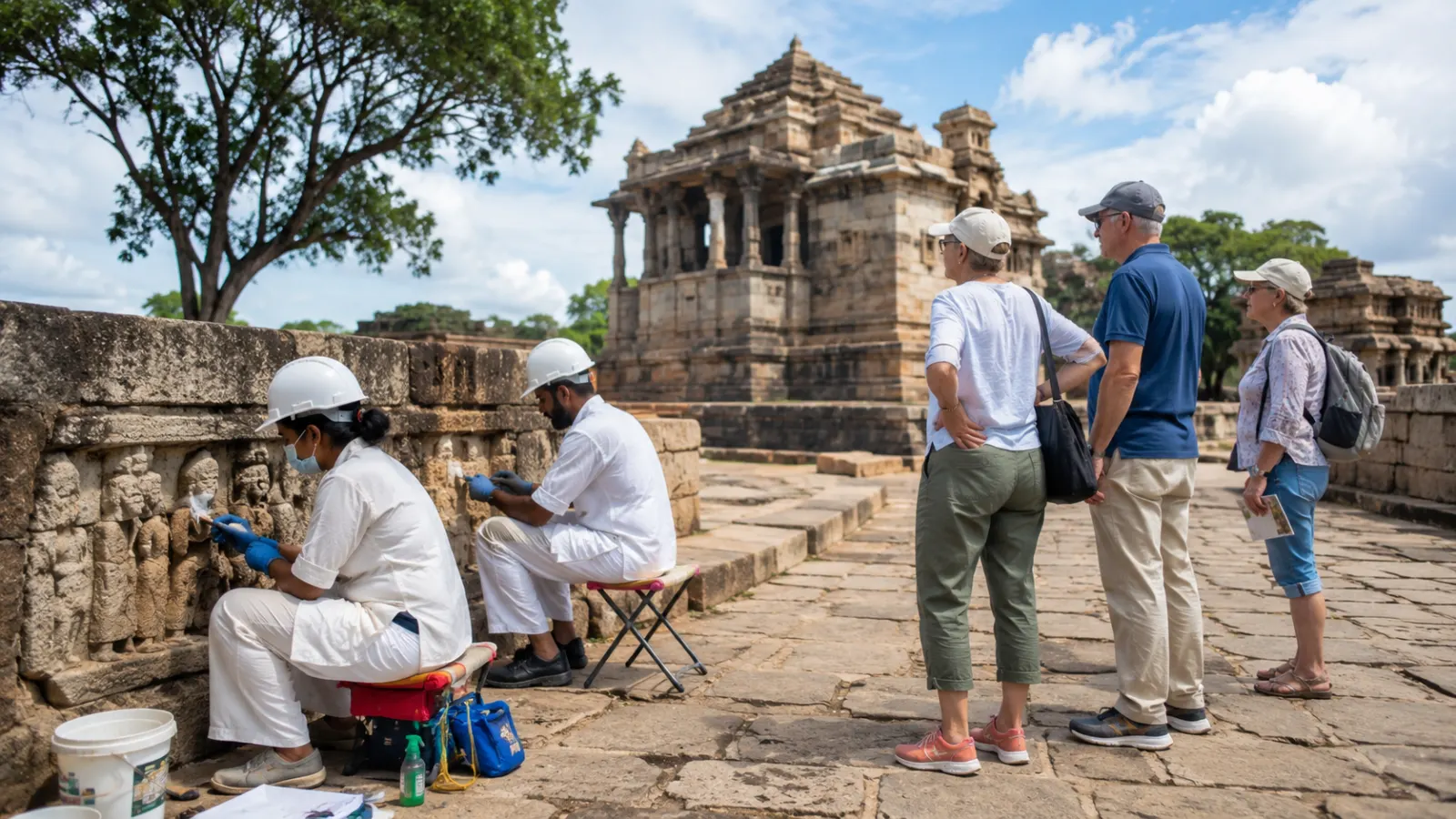
Management can include conservation work, ecological monitoring, planning controls, regulation of development, visitor management, community participation, disaster-risk planning and other site-specific measures.
The challenge is to maintain the attributes that justified Outstanding Universal Value while allowing living places and ecosystems to function.
World Heritage Boundaries Matter
A World Heritage nomination does not simply identify a famous monument by name.
It defines the property spatially.
Boundaries determine which areas are formally included in the inscription. Depending on the circumstances, buffer zones and wider planning arrangements can also be important for protecting the setting or processes on which Outstanding Universal Value depends.
This matters because heritage damage can occur outside the walls of a monument.
A tower may remain physically untouched while a nearby high-rise development transforms a historic skyline. A wetland may remain formally protected while upstream development changes its water supply. A cultural landscape can be altered by roads or industrial development immediately beyond its boundary.
World Heritage conservation therefore often requires thinking beyond the object tourists photograph.
What Is Periodic Reporting?
World Heritage properties remain subject to monitoring after inscription.
Periodic Reporting is one of the Convention’s core monitoring mechanisms. States Parties periodically report on implementation of the Convention and the condition and management of their World Heritage properties. UNESCO’s current fourth cycle of Periodic Reporting runs from 2026 to 2030.
Periodic Reporting provides a broad recurring review rather than responding only after a crisis develops.
Its purpose is partly to identify long-term patterns, implementation problems and emerging conservation needs.
What Is Reactive Monitoring?
Reactive Monitoring is different.
UNESCO defines it as reporting to the World Heritage Committee on the state of conservation of specific World Heritage properties that are under threat.
This can be triggered by deterioration, major development proposals, infrastructure projects, conflict, environmental damage or other circumstances that could affect Outstanding Universal Value.
States Parties are expected to inform the Committee about major restorations or new construction that could affect a World Heritage property before irreversible decisions are made.
Reactive Monitoring is therefore one reason major developments near famous World Heritage properties can become international conservation issues.
What Is the List of World Heritage in Danger?
The List of World Heritage in Danger identifies World Heritage properties facing serious threats to the values for which they were inscribed.
As of September 2026, UNESCO lists 58 properties in danger.
The Danger List is often described politically as an embarrassment or punishment. That interpretation misses much of its conservation purpose.
Danger listing can concentrate international attention on a property, define corrective measures, mobilise expertise and strengthen the case for urgent intervention.
Threats can include armed conflict, natural disasters, uncontrolled development, abandonment, environmental deterioration and other serious pressures.
The objective is ideally to correct the danger sufficiently that the property can eventually leave the Danger List while remaining on the World Heritage List.
Can UNESCO Remove a World Heritage Site From the List?
Yes.
Deletion is rare, which is precisely why it is significant.
UNESCO’s current List records three delisted properties.
Reactive Monitoring procedures allow the World Heritage Committee to consider deletion when a property has deteriorated to the point that it has irretrievably lost the characteristics that justified its inscription.
The possibility of delisting demonstrates that World Heritage is not simply a lifetime award.
The designation depends on preserving Outstanding Universal Value.
If the defining value disappears irreversibly, the rationale for the status can disappear with it.
Does UNESCO Stop All Development at World Heritage Sites?
No.
Many World Heritage properties are living cities, working cultural landscapes, inhabited settlements or large natural environments. Development, infrastructure and adaptation may be necessary.
The relevant question is whether proposed change would damage the Outstanding Universal Value of the property.
A new building may be compatible in one location and seriously harmful in another. Transport infrastructure can improve residents’ lives while creating unacceptable effects if poorly designed.
World Heritage conservation is therefore not based on the principle that nothing may ever change.
It is based on managing change without destroying the significance for which the property received international recognition.
Tourism Is Not the Purpose of World Heritage Status
World Heritage inscription can increase international visibility and visitor numbers. Governments and tourism organisations often promote the designation heavily.
But tourism is not the central purpose of the Convention.
The Convention is a framework for identification, protection, conservation, presentation and transmission of exceptional cultural and natural heritage to future generations.
Tourism can support that mission by producing jobs, revenue and political interest in conservation.
It can also undermine it.
Overtourism can produce congestion, physical wear, waste, pressure on infrastructure, rising housing costs and changes to local commercial life.
A nomination strategy built primarily around attracting more tourists therefore risks confusing a possible consequence of World Heritage status with its purpose.
Residents Do Not Become Less Important Because Heritage Becomes “World” Heritage
The word world can produce another misunderstanding: once a place is globally recognised, international tourists somehow become more important than the people who live there.
Many World Heritage properties are living communities.
Residents may work, worship, raise families, farm, fish or maintain cultural traditions inside the recognised landscape.
Current World Heritage guidance increasingly stresses participation by communities, Indigenous Peoples and other rights-holders during nomination and management.
This is not merely a matter of fairness.
Long-term protection frequently depends on the people who actually live with the property.
Conservation that protects historic architecture while making the neighbourhood economically impossible for its residents can preserve physical fabric while damaging living cultural relationships.
World Heritage Recognition Does Not Override Local Rights
World Heritage properties can overlap with Indigenous territories, private ownership, agricultural land, religious sites and inhabited landscapes.
Inscription does not automatically erase existing property or community rights.
The more difficult issue is how conservation rules, development restrictions, tourism and land use interact after international recognition.
This is precisely why consultation before nomination matters.
The stronger the involvement of communities and rights-holders during preparation, the less likely World Heritage status is to arrive as an external set of obligations imposed after the political celebration is over.
Transboundary Sites Show What “World” Heritage Can Mean
Some World Heritage properties extend across the territories of more than one country.
UNESCO currently identifies 51 transboundary or transnational properties.
These properties make the international logic of the Convention especially visible.
An ecosystem does not necessarily stop at a political border. An ancient route can cross several modern states. Architectural movements, forests, migration systems and geological formations can form one heritage story across national jurisdictions.
Such properties require coordination because one country’s management decisions can affect the Outstanding Universal Value shared with another.
World Heritage Can Provide International Cooperation and Assistance
The Convention is more than a list.
It also establishes mechanisms through which States Parties can request international assistance relating to the protection, conservation, presentation or rehabilitation of qualifying heritage. Article 13 of the Convention provides for such requests to be considered by the World Heritage Committee.
Technical knowledge, training, monitoring and international cooperation can therefore accompany designation.
This does not mean UNESCO pays for every restoration or assumes management responsibility for every listed property.
The primary responsibility remains with the State Party.
Why Are There So Many More Cultural Than Natural Sites?
The current List contains 991 cultural properties compared with 240 natural and 42 mixed properties.
The imbalance reflects the historical development of the List, nomination patterns, geography, institutional capacity and the way cultural and natural heritage systems evolved.
It should not be interpreted as evidence that cultural heritage is inherently more important than natural heritage.
UNESCO has long pursued strategies intended to make the List more representative and balanced.
The composition of the List itself is therefore an ongoing heritage-policy issue rather than a neutral map of the world’s most important places.
Why Isn’t Every Important Place a World Heritage Site?
Because the World Heritage List is selective by design.
A site may be extremely important locally or nationally without demonstrating Outstanding Universal Value under the Convention.
A government may never nominate it.
The property may not yet have adequate protection.
The comparative case may be weak.
Or another heritage system may simply be more appropriate.
The Convention itself explicitly states that the fact a property is not included on the World Heritage List should not be interpreted to mean that it lacks value for purposes outside World Heritage inscription.
This is a crucial point.
UNESCO recognition is not the test of whether heritage deserves protection.
Local, regional and national conservation systems remain essential.
World Heritage Is Not a Ranking of Civilisations
The World Heritage List should also not be read as a scoreboard in which countries with more inscriptions possess more valuable cultures.
The number of properties reflects nomination history, national resources, conservation institutions, boundaries, serial nominations and many other factors.
One country may have dozens of inscriptions while another has only a few.
That says little about the comparative worth of their cultures.
The Convention’s purpose is protection of selected properties with Outstanding Universal Value—not ranking countries according to cultural prestige.
What Should Visitors Look for at a World Heritage Site?
The most useful question is not simply, “What should I photograph?”
Ask why the property was inscribed.
Which criteria does it satisfy?
What does UNESCO’s Statement of Outstanding Universal Value identify as exceptional?
Which attributes need to survive for that value to remain?
What threats does the site face?
How is tourism managed?
Do people still live or work there?
Understanding these questions changes a World Heritage visit from collecting famous landmarks into understanding why the international conservation system considers the place significant.
Common Misconceptions About UNESCO World Heritage Sites
“UNESCO owns World Heritage Sites.” False. The property remains under the sovereignty and jurisdiction of the country concerned.
“UNESCO chooses sites on its own.” Normally false. States Parties develop and submit nominations.
“Any very old monument can qualify.” False. Age alone does not demonstrate Outstanding Universal Value.
“A site only needs to meet one criterion.” Incomplete. It also needs to satisfy relevant integrity, authenticity, protection and management requirements.
“Once listed, a site can never lose its status.” False. Delisting is possible when Outstanding Universal Value is irretrievably lost.
“The Danger List means UNESCO has given up on the site.” False. Danger listing is intended to focus attention and corrective action.
“World Heritage status is mainly a tourism award.” False. Conservation is the Convention’s central purpose.
“A place not on the List is not important heritage.” False. World Heritage is only one level of heritage recognition.
Frequently Asked Questions
What is a UNESCO World Heritage Site? It is a cultural, natural or mixed property inscribed on the World Heritage List because the World Heritage Committee has determined that it possesses Outstanding Universal Value and satisfies the Convention’s requirements.
How many UNESCO World Heritage Sites are there? As of September 2026, UNESCO lists 1,273 World Heritage properties: 991 cultural, 240 natural and 42 mixed, located in 173 States Parties.
What does Outstanding Universal Value mean? It means cultural or natural significance considered so exceptional that it transcends national boundaries and is of common importance to present and future generations of humanity.
How many criteria are there for World Heritage selection? There are ten criteria, and a property must satisfy at least one while also meeting relevant requirements concerning integrity, authenticity, protection and management.
What are the three types of World Heritage Site? Cultural, natural and mixed properties.
Who nominates a World Heritage Site? States Parties to the World Heritage Convention nominate properties within their territories.
Can a city or individual apply directly to UNESCO? The formal nomination has to proceed through the relevant State Party under the World Heritage Convention rather than an individual independently obtaining inscription.
What is a Tentative List? It is the inventory of properties a State Party may consider for future World Heritage nomination. A property normally must be on the Tentative List before nomination.
Is Preliminary Assessment now mandatory? Yes. UNESCO’s current nomination process includes a mandatory Preliminary Assessment before the full nomination dossier.
Who evaluates nominations? ICOMOS evaluates cultural nominations and IUCN evaluates natural nominations, while ICCROM is another formal Advisory Body with major responsibilities in conservation and capacity building.
Who makes the final decision? The World Heritage Committee makes the formal inscription decision.
Does UNESCO own World Heritage Sites? No. Inscription does not transfer ownership or sovereignty to UNESCO.
Can people still live in World Heritage Sites? Yes. Many World Heritage properties are living cities, settlements and cultural landscapes.
Can development occur inside or near a World Heritage property? Potentially, but projects must be considered in relation to their possible effect on Outstanding Universal Value.
What is a World Heritage buffer zone? It is an area outside or around the formally inscribed property that may help protect its setting or other attributes contributing to its significance.
What does “World Heritage in Danger” mean? It identifies an inscribed property facing serious threats and can help focus monitoring, corrective measures and international assistance.
How many World Heritage Sites are currently in danger? UNESCO’s current List identifies 58 properties in danger.
Can UNESCO remove World Heritage status? Yes. Three properties are currently recorded as delisted, and the Committee can delete a property when the characteristics supporting its inscription have been irretrievably lost.
Does becoming a World Heritage Site automatically bring UNESCO funding? No. International assistance mechanisms exist, but inscription does not mean UNESCO assumes all conservation costs.
Does World Heritage status guarantee preservation? No. Conflict, climate change, development, tourism, poor management and other pressures can still damage listed properties. The Convention provides monitoring and international mechanisms, not absolute protection.
Is UNESCO World Heritage status permanent? It can last indefinitely when Outstanding Universal Value is maintained, but the status is not unconditional.
The World Heritage Label Represents a Responsibility
The World Heritage emblem is easily turned into a tourism logo.
Its deeper meaning is more demanding.
A State Party has argued that a property possesses significance beyond its own borders. Specialists have assessed the claim. The World Heritage Committee has accepted it. The country then carries an obligation to protect the attributes that made the property worthy of inscription.
Recognition and responsibility therefore arrive together.
The more successful World Heritage status becomes at attracting attention, investment and tourism, the more important that responsibility can become.
The Central Idea
A UNESCO World Heritage Site is not simply one of the world’s “best places.”
It is a property recognised through a formal international conservation process because its cultural or natural significance has been judged to possess Outstanding Universal Value. To reach the List, a property normally moves from a national Tentative List through mandatory Preliminary Assessment and a detailed nomination, expert evaluation and finally a decision by the World Heritage Committee.
Inscription does not make UNESCO the owner.
It does not freeze the place permanently.
It does not guarantee unlimited funding.
And it does not mean every unlisted place is unimportant.
What inscription does is create an international commitment around a specific argument:
this property contains cultural or natural value considered exceptional enough that its loss would matter beyond the borders of the country in which it exists.
That argument carries consequences.
The property must be managed.
Development needs to consider its Outstanding Universal Value.
Its condition can be monitored.
Serious threats can lead to inclusion on the Danger List.
And in extreme circumstances, loss of the defining values can ultimately lead to deletion from the World Heritage List.
World Heritage is therefore best understood not as a medal awarded to the past, but as a conservation responsibility directed toward the future.
The most important question attached to the emblem is not:
“Why is this place famous?”
It is:
“What is so exceptional here that humanity has agreed it should be protected—and are we actually protecting it?”