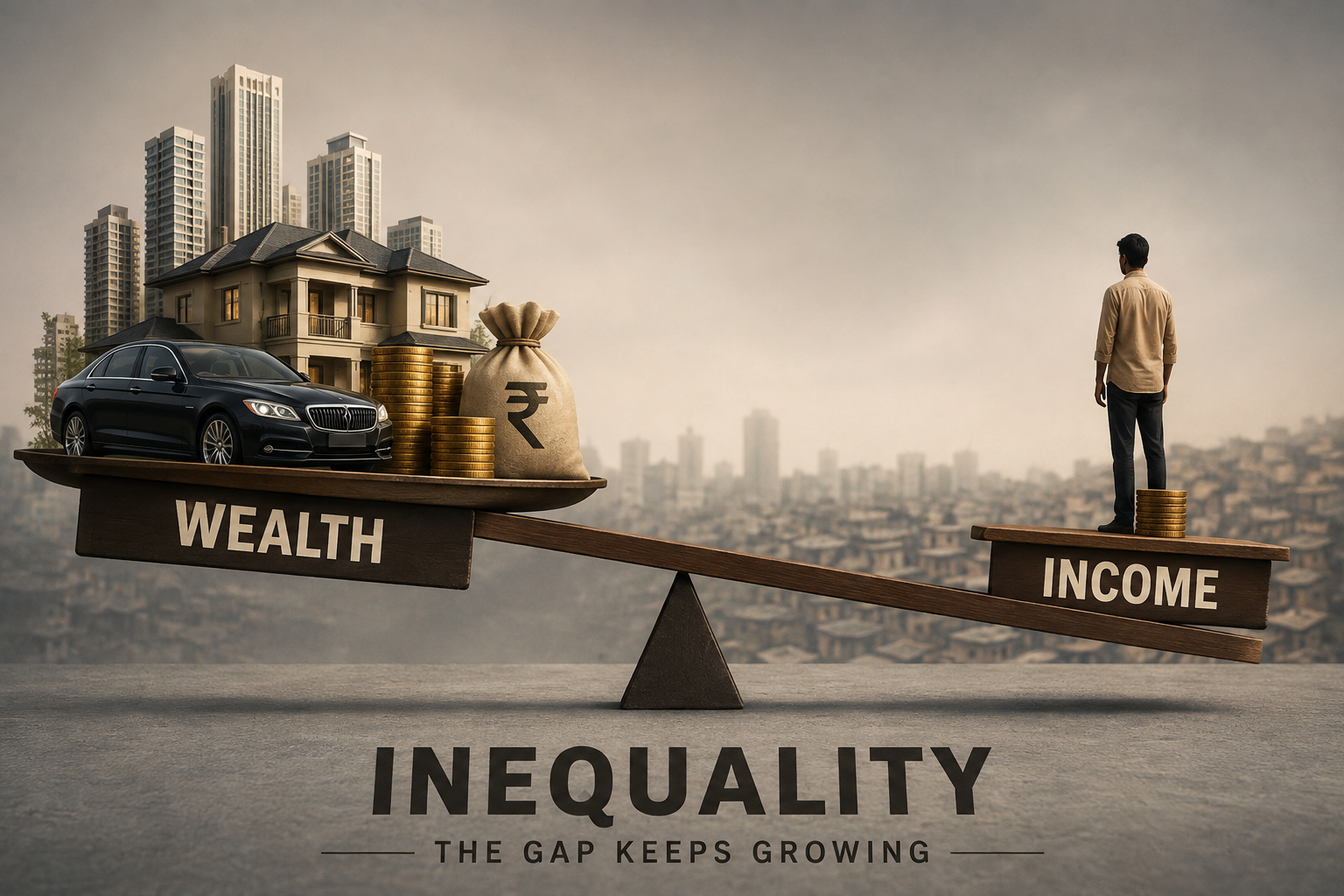
Inequality is one of the most discussed words in economics, but it is also one of the most misunderstood. People often speak about rich and poor as if there is only one gap. In reality, there are at least two major gaps that matter: income inequality and wealth inequality.
Income inequality is the unequal distribution of the money people receive over a period of time. It includes salaries, wages, business income, rent, interest, dividends, pensions and transfers. It is a flow. It tells us what people are earning or receiving this month, this year or during a defined period.
Wealth inequality is the unequal distribution of what people own after subtracting what they owe. It includes land, houses, financial assets, business ownership, gold, retirement savings, inherited assets and other property. It is a stock. It tells us what people have accumulated over time.
The difference sounds technical, but it changes the entire way we understand an economy. A person may have a high income but low wealth. A young doctor, lawyer, entrepreneur or corporate professional may earn well but still be repaying education loans, home loans or business debt. Another person may have modest annual income but large inherited property, land or financial assets. One is income-rich but not yet wealth-rich. The other may be income-moderate but asset-rich.
This is why inequality debates become weak when they treat income and wealth as the same thing. They are connected, but they are not identical. Income can build wealth, but only if some income is saved and invested. Wealth can generate income through rent, dividends, interest and capital gains. Over time, wealth can reproduce itself even without active labour. That is the core reason wealth inequality usually becomes more concentrated than income inequality.
A salaried worker earns by selling time, skill and effort. A wealth-holder earns partly because assets work in the background. A flat can produce rent. Shares can produce dividends and capital gains. A business can produce profit. Land can appreciate. Gold can store value. These asset returns can accumulate while the owner sleeps, studies, travels or retires. Labour income usually stops or reduces when work stops. Asset income may continue.
This does not mean wealth is immoral. Savings, enterprise, investment and inheritance are all part of economic life. The problem begins when asset ownership becomes so concentrated that opportunity itself becomes unequal. If a child born into an asset-owning family begins life with housing security, better schooling, networks and inheritance, while another child begins life with debt, unstable rent and poor public services, the race is not starting at the same line.
Income inequality is often more visible. People notice salary gaps. They compare monthly income, job packages, bonuses, daily wages and professional fees. Wealth inequality is less visible because assets are hidden in property titles, private companies, financial portfolios, trusts, family holdings and intergenerational transfers. A low-profile landlord may be wealthier than a high-salary executive. A small business owner may report uneven income but own valuable commercial property. Appearances can deceive.
Measurement also differs. Income inequality is commonly studied through household surveys, tax data, consumption data and indicators such as the Gini coefficient. Wealth inequality is harder to measure because asset valuation is complicated. Land and property values differ by location and liquidity. Private businesses are not always transparently valued. Gold and informal assets may be underreported. Debt must be subtracted. Rich households may have more ways to organise ownership through companies, family structures and tax planning.
The Gini coefficient is often used to summarise inequality, where a lower score indicates more equal distribution and a higher score indicates greater inequality. But even the Gini must be read carefully. Is it measuring income, consumption or wealth? Is it before tax or after tax? Is it based on household survey data or tax records? A single number cannot carry the full story.
For a developing country like India, the distinction matters deeply. A country can reduce extreme poverty and still face high inequality. Millions of people may move above subsistence, yet the top groups may accumulate assets much faster. This creates a complex picture: living standards can improve at the bottom while relative economic distance grows at the top. Both facts can be true.
Income inequality affects immediate living standards. It shapes whether families can pay rent, buy food, access healthcare, educate children and handle emergencies. When wages stagnate but prices rise, income inequality becomes a daily pressure. It shows up in nutrition, schooling, commuting, housing and debt.
Wealth inequality affects long-term security and power. It shapes who can survive job loss, who can start a business, who can buy a home, who can fund private education, who can move to a better city and who can influence politics. Wealth is not only purchasing power. It is bargaining power.
Two households may earn the same monthly income but live completely different financial lives. One owns its home and has no debt. The other pays rent and EMIs. One has parental support during crisis. The other supports parents and siblings. One has land or gold to liquidate in emergency. The other uses credit cards or informal loans. Equal income does not mean equal economic security.
This also explains why middle-class anxiety can rise even when incomes improve. If asset prices rise faster than wages, a young working person may feel that the future is moving away. Housing becomes unaffordable. Education becomes expensive. Healthcare becomes risky. Retirement becomes uncertain. The issue is not only how much is earned today; it is whether income can realistically be converted into wealth.
Wealth inequality can also influence politics. Asset owners often have more time, networks, legal advice, institutional access and campaign influence. When wealth concentration becomes too high, democracy faces a quiet pressure: formally equal citizens may become materially unequal participants. The vote remains equal, but the ability to shape debate may not be equal.
The policy responses are different. To address income inequality, governments often focus on wages, employment, education, labour rights, income support, taxation and public services. To address wealth inequality, policy must examine inheritance, property taxation, land records, access to credit, financial inclusion, capital gains taxation, affordable housing and asset-building for lower-income groups.
Public services are central to both. Good government schools reduce the effect of parental wealth on opportunity. Public healthcare prevents illness from destroying family savings. Affordable transport connects workers to jobs. Digital payments and bank accounts reduce exclusion. Legal security over land and property helps poorer households convert possession into recognised assets.
Tax policy also matters, but it must be designed carefully. If taxes are too weak, concentration grows. If taxes are badly designed, investment and compliance may suffer. The serious question is not whether all wealth is bad. It is whether an economy allows productive wealth creation while preventing extreme, inherited and unaccountable concentration from locking others out.
The most important editorial point is that income is the river, wealth is the reservoir. Income flows in and out. Wealth stores power over time. A society may look at the river and think it understands inequality, but the reservoir may reveal the deeper structure.
For individuals, this distinction is financially useful. A good salary is not the same as financial independence. Wealth is built through saving, investing, insurance, debt control, skill growth and asset ownership. But individual discipline alone cannot solve structural inequality. A person can save responsibly and still face impossible housing prices, poor public services or unequal inheritance conditions.
For policymakers, the lesson is sharper. Growth matters, but the distribution of both income and assets matters too. A country cannot build a stable middle class if incomes rise slowly while asset ownership concentrates rapidly. Nor can it create equal opportunity if wealth passes through generations without broad access to education, health, housing and capital.
Wealth and income inequality are therefore not competing concepts. They are two windows into the same economic structure. Income tells us who is receiving money now. Wealth tells us who has accumulated security, freedom and power. A serious economy must look through both windows.
The public debate should stop asking only, "Who earns more?" It must also ask, "Who owns more, who owes more, who inherits more, and who has a real chance to build assets?" That is where the deeper story of inequality begins.
Disclaimer
This article is for general educational and editorial use. It is not tax, investment, legal or policy advice. Inequality data varies by source, methodology, survey design and reporting year. Editors should verify all data points from official or primary datasets before publication.