Digital Divide Explained: Access, Skills and Meaningful Connectivity
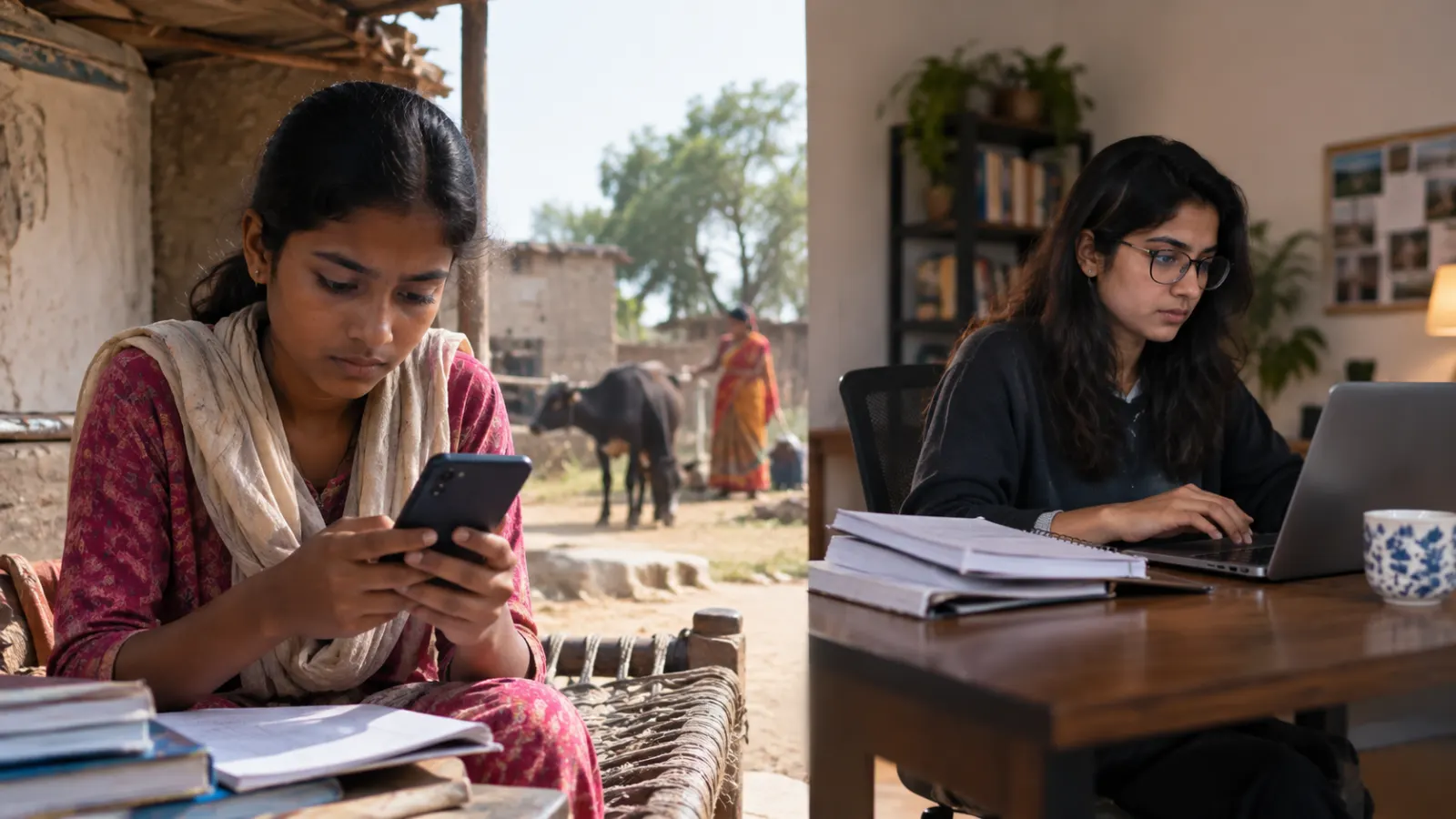
The digital divide is no longer adequately described as a simple gap between people who are online and people who are offline. That distinction still matters, but modern digital inequality runs through several layers at once. A person may technically use the internet through an ageing smartphone, weak mobile signal and expensive prepaid data while lacking the skills or privacy needed to complete a job application, manage finances or study online. Another person may have fibre broadband, several personal devices, cloud software and the ability to use artificial intelligence tools productively. Both appear in statistics as internet users, but their practical opportunities are very different.
The scale of basic connectivity progress is nevertheless remarkable. International Telecommunication Union estimates for 2025 show that about 6 billion people, or 74% of the world's population, use the internet. Yet approximately 2.2 billion people remain offline, and 96% of them live in low- and middle-income countries. More than 96% of the global population is now covered by a mobile-broadband network, showing why simple infrastructure coverage no longer tells the whole story.
ITU increasingly describes the policy objective as universal and meaningful connectivity. Its framework goes beyond whether a network exists and asks whether connectivity is fast and reliable, available when needed, affordable, accessible through an appropriate device, supported by sufficient digital skills and safe to use. Weakness in any one of those dimensions can limit the value of the others.
The digital divide is therefore better understood as a capability gap. Infrastructure is the foundation, but meaningful participation also depends on money, devices, knowledge, accessibility, language, time, privacy and increasingly the ability to use advanced digital tools.
Connectivity Is Only the First Layer of Digital Inequality
The most visible digital divide remains the absence of a usable connection. Remote communities, low-income regions, conflict-affected areas and sparsely populated places can be expensive to connect because fibre, towers, electricity and backhaul infrastructure must cover large distances for relatively few customers. Satellites and mobile networks can reduce some geographic barriers, but resilient connectivity still requires physical infrastructure, reliable power and functioning institutions.
Even here, the headline coverage number can hide enormous differences. A basic 3G connection and reliable fibre or 5G broadband may both qualify as internet access, yet they support very different activities. High-quality video learning, telemedicine, software development, remote work, cloud applications and large file transfers depend on speed, latency, data allowances and reliability. ITU reported in 2025 that 5G coverage had reached more than half of the global population, but deployment remained disproportionately concentrated in high-income countries. A typical user in a high-income country was generating nearly eight times as much mobile data as a user in a low-income country, an indicator of how different actual digital use can be even after connection occurs.
Geography continues to shape that divide. Globally, 85% of urban residents used the internet in 2025 compared with 58% of rural residents. In low-income countries, the contrast was much sharper: only around 14% of rural residents were online. Rural connectivity problems can combine lower population density, weaker electricity systems, fewer repair services and lower commercial incentives for network investment.
Affordability creates another divide even when infrastructure is physically available. The relevant question for a low-income household is not simply the advertised monthly price of a mobile or broadband plan but how much of household income must be devoted to staying connected. ITU's 2025 data showed continued declines in internet prices, but only around two-thirds of economies had reached the Broadband Commission's affordability benchmark. Access remained unaffordable in around 60% of low- and middle-income countries under the measures highlighted in ITU's 2025 reporting.
Devices create another constraint. Smartphones have brought internet access to billions of people, but they are not substitutes for every digital tool. Writing a long report, coding, manipulating spreadsheets, completing complex government forms or editing professional files can be substantially more difficult on a small touchscreen. Shared devices introduce additional problems: one phone may have to serve several family members, with limited time, privacy and storage available to each person.
Device age matters too. An old computer or smartphone may technically connect to the internet while being unable to run newer applications or receive current security updates. Device affordability therefore belongs within digital-equity policy alongside data prices and broadband infrastructure.
This is why ITU's meaningful-connectivity framework explicitly includes devices as a separate dimension. Connectivity is not truly meaningful if the available hardware cannot support what someone needs to do online.
Skills, Gender, Age, Disability and Language Shape What Access Becomes
Once a person has connectivity and a device, a second set of inequalities appears around what they can actually do with them.
Digital skill does not mean merely knowing how to open an app. Useful participation can involve finding reliable information, creating documents, managing files, protecting passwords, recognising scams, adjusting privacy settings, troubleshooting devices, using productivity software and communicating safely. More advanced participation may require spreadsheets, coding, data analysis, digital marketing or increasingly the effective use of artificial intelligence.
ITU's 2025 reporting suggests that basic communication skills are much more widespread than advanced capabilities involving online safety, problem-solving and content creation. That gap becomes increasingly important as employment, finance and government services move beyond simple messaging and browsing.
The gender digital divide has narrowed globally but remains substantial. In 2025, ITU estimated that 77% of men were online compared with 71% of women. The difference was considerably larger in some lower-income regions. Network availability alone cannot explain this pattern. Income, educational opportunity, device ownership, control over household technology, safety concerns and social norms can all affect whether women gain meaningful digital access.
Age creates another layer. Around 82% of people aged 15 to 24 used the internet in 2025, compared with 72% of the rest of the population. Older adults, particularly the oldest groups, remain less connected in many countries. This gap is not biologically fixed. Better service design, training, larger interfaces, accessible authentication methods and patient technical support can make digital systems much easier to use.
Disability can create exclusion even when a household possesses excellent broadband and modern devices. A website that cannot be navigated with a keyboard, an application that does not work with a screen reader, a video without captions or an interface with poor contrast can effectively remove access after the network connection has already been provided. Digital accessibility is therefore part of mainstream digital inclusion, not a specialised concern for a small number of users.
Language matters in similar ways. Connectivity is less useful when government services, educational material, search results or technical support are unavailable in languages a person understands well. Improvements in machine translation and speech technology may reduce some linguistic barriers, but representation remains uneven, particularly for languages with fewer digital resources.
These disadvantages can accumulate. A low-income woman in a rural community may face weak connectivity, expensive data, shared-device access and lower digital confidence at the same time. A person with a disability may encounter the same affordability constraints as everyone else and then face inaccessible software on top of them.
The digital divide therefore often mirrors existing social inequalities rather than replacing them.
Education, Work, Finance and Public Services Turn Digital Gaps Into Opportunity Gaps
The consequences of unequal connectivity become larger as institutions redesign themselves around online access.
Education provides one of the clearest examples. Two students can attend the same school while having radically different opportunities once they go home. One may have a personal laptop, quiet workspace and unlimited broadband. Another may share a parent's phone and carefully ration mobile data. Both students may technically have “internet access,” but only one can easily participate in long video lessons, conduct research, write assignments or use educational software whenever needed.
The same problem appears in employment. Job advertisements, applications, interviews, training and professional networking increasingly occur online. Workers with reliable broadband and stronger digital skills can search wider labour markets and participate in remote or hybrid work. Someone dependent on intermittent public Wi-Fi may possess excellent occupational skills yet struggle to complete digital recruitment processes.
Small businesses face parallel pressures. Digital payments, e-commerce, online advertising, cloud accounting and communication platforms can expand markets and lower transaction costs. But a business without reliable connectivity, digital skills or logistics infrastructure can lose customers as competitors move online.
Finance creates both opportunity and risk. Digital banking and payments can reduce transaction costs and extend services into places where conventional bank branches are scarce. But people without suitable devices, digital identity or stable connectivity may become more excluded as physical services disappear. New users may also face fraud, deceptive interfaces and predatory products. Financial inclusion therefore requires connectivity, skills, accessible design and consumer protection together.
The stakes become particularly high when government services move online. Tax filing, welfare applications, identity documents, healthcare appointments and education enrolment can become faster and cheaper when digitised. But if digital access is unequal, administrative efficiency for the majority can turn into institutional exclusion for the minority.
Governments therefore need to think beyond “digital by default” toward digital with alternatives. Assisted service centres, telephone help, accessible interfaces and workable offline routes may remain essential where participation is unequal.
Digital exclusion can also affect civic voice. Political information, public consultations and communication with government increasingly occur online. Citizens with poor connections or limited digital literacy may receive information later, find it harder to organise and be less visible to institutions that increasingly monitor online participation.
The divide is therefore no longer merely about technology.
It can influence who studies effectively, who finds work, who reaches markets, who obtains government services and whose political voice is easiest to hear.
AI Is Creating a New Digital Divide on Top of the Existing One
Artificial intelligence raises the stakes because the advantages of digital participation are no longer limited to access to information.
Generative AI can assist with writing, coding, translation, research, data analysis, customer service and administrative work. People who have reliable connectivity, suitable devices, strong foundational literacy and the ability to evaluate AI output may gain substantial productivity advantages. Those without those foundations can be excluded from an increasingly important layer of digital capability.
ITU's 2025 Global Connectivity Report explicitly warns of a possible “multi-speed” digital world in which people with infrastructure, skills and resources disproportionately drive and benefit from AI innovation while marginalised communities fall further behind.
This is important because every technological generation changes the definition of adequate access.
Twenty years ago, an internet café might have been enough to give someone meaningful access to email and web browsing. Today, serious remote work may require a private computer, stable video connection, cloud applications, secure accounts and uninterrupted access throughout the day. Tomorrow, productive participation may increasingly require AI literacy and access to computational services that were previously optional.
The digital divide is therefore dynamic.
Closing one gap does not freeze equality permanently.
Artificial intelligence also introduces a data divide. Advanced systems are built from and evaluated against large quantities of data. Communities that are poorly represented in digital datasets can receive less accurate language systems, weaker public services or products that do not reflect their circumstances. Participation in the digital economy increasingly concerns not only whether people can consume information but whether their languages, communities and experiences are represented within the data used to build new technologies.
Time and privacy matter too. Someone who gets thirty minutes of public computer access at a library possesses a connection, but not the same capability as somebody with a private laptop available throughout the day. Serious study, confidential financial administration, job applications and remote work require autonomy as well as technology.
Resilience is another emerging component. A community may appear fully connected until a storm, electricity failure, cable break or conflict disables its only network route. As healthcare, payments and government communication become digitally dependent, redundant connectivity and reliable power become part of social resilience rather than mere telecommunications engineering.
Closing the Digital Divide Means Measuring What People Can Actually Do
Policy can fail when governments celebrate infrastructure targets that no longer reflect the real barrier.
Building mobile towers matters where communities remain uncovered. But once basic coverage is widespread, other bottlenecks become more important: service quality, affordability, device ownership, digital skills, security, accessible design and relevant content.
ITU's current framework captures this shift by defining meaningful connectivity through six interconnected dimensions: quality, availability, affordability, devices, skills and security. A country can therefore make genuine progress in network coverage while still leaving large numbers of people unable to participate effectively.
Closing the divide requires a correspondingly broad policy toolkit.
Infrastructure investment remains essential, particularly in remote and low-income areas. Competition policy can influence broadband prices and service quality. Device financing, refurbishment programmes and public purchasing can address hardware affordability. Schools and adult-education systems can build digital skills. Accessible-design requirements can make services usable for people with disabilities. Local-language content and interfaces can widen participation. Consumer-protection policy can reduce fraud and exploitation as inexperienced users enter digital markets.
Public access remains useful too. Libraries, schools, community centres and public Wi-Fi can create important entry points, particularly for people who cannot yet afford private connections. But shared access should complement rather than substitute for affordable personal connectivity where education, employment and administration require frequent or confidential use.
Measurement also has to evolve continuously. Counting whether someone used the internet during a recent period provides useful information about basic adoption, but it cannot measure whether that person has enough bandwidth for video calls, a device suitable for work, the skills to identify fraud or the privacy necessary to manage personal finances.
The better question is increasingly:
What can people reliably accomplish with the digital access they have?
That shift matters because digital technology has moved from an optional communication tool into infrastructure for education, work, finance, government and civic life.
The digital divide is therefore not simply a telecommunications problem.
It is a social inequality expressed through technology.
About 6 billion people being online is a major global achievement, but the next stage is harder than connecting the first billions. It requires ensuring that an internet connection translates into genuine capability.
That means reliable networks.
Affordable service.
Appropriate devices.
Skills.
Accessibility.
Security.
Relevant content.
And enough autonomy to use them.
The objective is no longer merely to make the internet technically reachable.
It is to make meaningful digital participation realistically possible for everyone.