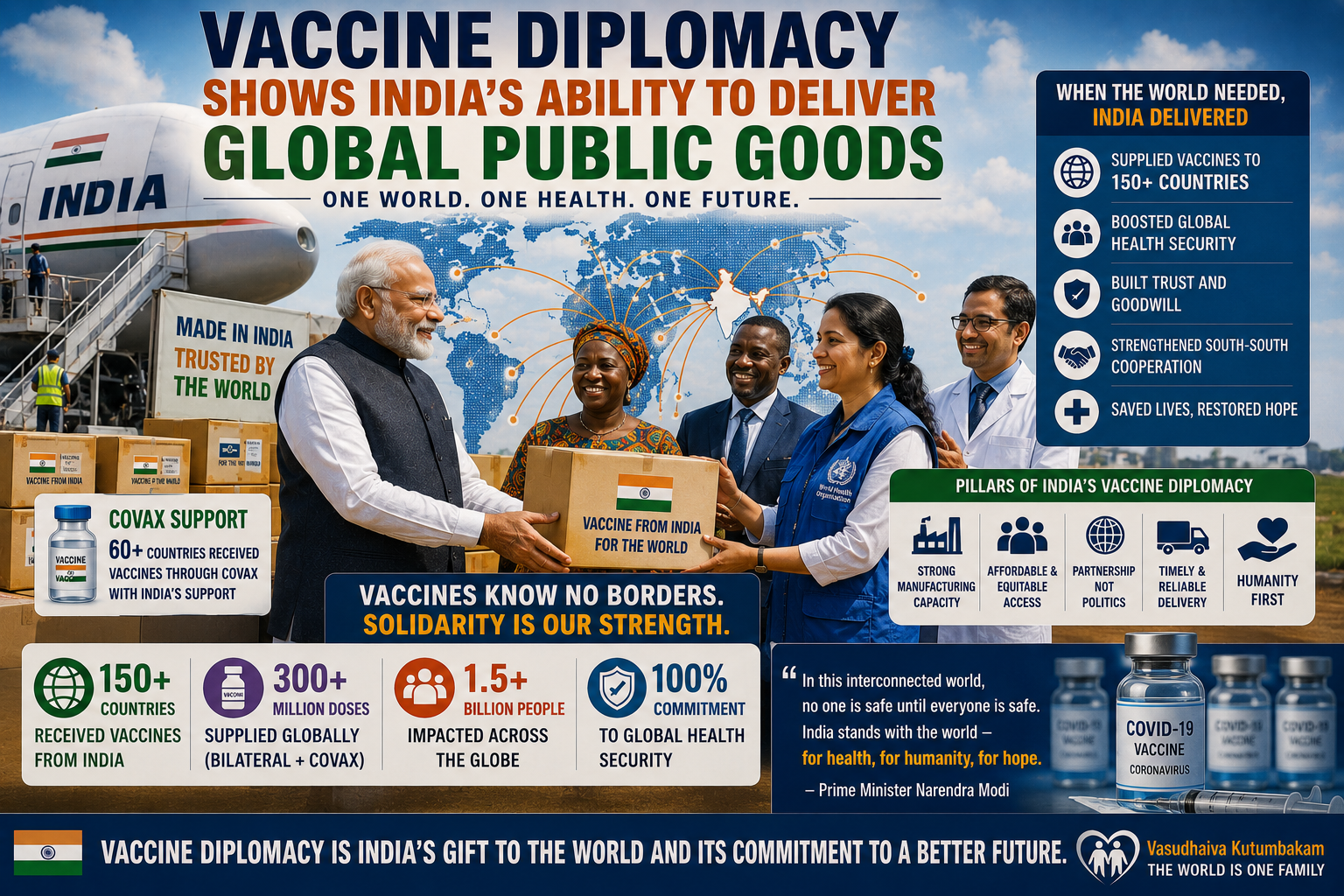
India’s vaccine diplomacy demonstrated that global public goods do not have to come only from the world’s richest countries. During the COVID-19 pandemic, India used its pharmaceutical manufacturing capacity to supply vaccines, medicines and medical assistance to countries across the world, particularly developing economies that feared being left behind in the global race for doses.
The experience strengthened India’s reputation as the “pharmacy of the world” and gave New Delhi a powerful example of development diplomacy backed by actual delivery. But it also exposed the limits of health solidarity. Domestic emergencies, raw-material shortages, intellectual-property constraints, export restrictions and geopolitical competition showed that generosity is sustainable only when production capacity and supply chains are resilient.
The larger lesson is therefore not simply that India supplied vaccines abroad. It is that health security itself has become an instrument of foreign policy and global influence.
Health Has Become a Measure of Strategic Credibility
The pandemic changed the meaning of national power.
Military strength, economic size and diplomatic influence remain important, but COVID-19 demonstrated that countries are also judged by whether they can manufacture and distribute essential goods during a global emergency.
Vaccines became strategic assets.
Countries that controlled vaccine technology, manufacturing capacity, raw materials and logistics gained influence over the pace at which societies could reopen and economies could recover. Countries without those capabilities were forced to wait, negotiate or depend on external suppliers.
India entered this environment with an important advantage: a large pharmaceutical industry and decades of experience producing affordable medicines and vaccines at scale.
Through Vaccine Maitri and other channels, India sought to use that capacity not only to meet domestic requirements but also to supply partner countries.
Government statements cited in the draft said India shared nearly 300 million vaccine doses with around 100 countries during the pandemic.
The diplomatic value of those doses cannot be measured simply through volume.
Timing mattered. Countries remember which partners helped when hospitals were under pressure, borders were closing and vaccine supplies were scarce.
That is why health assistance can create a type of strategic credibility that conventional diplomacy often struggles to manufacture.
Why Vaccine Diplomacy Mattered
Vaccine diplomacy mattered for several reasons that go beyond the immediate health emergency.
1. It Exposed the Politics of Global Health Equity
During the early phases of vaccine distribution, wealthy countries secured large supplies while many developing countries struggled to obtain doses.
Governments with purchasing power could sign advance agreements with pharmaceutical companies and reserve production before vaccines were widely available.
Countries with fewer resources often had much less bargaining power.
This exposed a hierarchy in global health: access to life-saving technology could depend heavily on national income and manufacturing capacity.
India’s vaccine outreach allowed it to argue that health security should not be treated as a privilege reserved for wealthy societies.
For many countries across the Global South, that message carried political significance because it reflected their wider concerns about inequality in international institutions.
2. Assistance Built Trust
Foreign policy is partly about memory.
Countries remember which partners appeared during moments of vulnerability.
Vaccines, medicines, oxygen equipment and medical assistance can create goodwill because they affect ordinary lives directly. Unlike many diplomatic initiatives, their impact is tangible.
A vaccine shipment arriving during a shortage is visible. A medical team responding during an emergency is remembered.
That does not mean recipients forget strategic interests. But assistance delivered during crisis can deepen political trust and create a foundation for wider relationships in trade, education, technology and security.
3. Vaccine Diplomacy Created Institutional Experience
Distributing vaccines internationally required more than producing vials.
It involved regulatory approvals, export procedures, cold-chain logistics, airport handling, customs coordination, public communication, digital certification and cooperation among governments and international institutions.
Those capabilities matter because future health emergencies will require the same institutional systems.
The pandemic therefore provided countries with a large-scale test of whether their public-health and diplomatic machinery could operate together.
4. It Strengthened India’s Global South Narrative
India frequently presents itself as a voice and partner of the Global South.
Such claims are more credible when they are supported by delivered public goods.
Diplomatic solidarity is easy to announce in summit declarations. It becomes more meaningful when vaccines, medicines, technology or training actually reach partner countries.
Vaccine diplomacy therefore gave India an example of solidarity expressed through capacity rather than rhetoric.
Manufacturing Capacity Became Soft Power
India’s pharmaceutical manufacturing base became one of its most important sources of soft power during the pandemic.
Soft power is often associated with culture, education, entertainment or political values. The pandemic demonstrated that productive capacity can also create influence.
A country capable of manufacturing medicines or vaccines at affordable prices can become strategically important to countries that cannot produce them domestically.
This gives manufacturing a diplomatic dimension.
India’s advantage came partly from the scale of its pharmaceutical sector and its long-standing role in supplying generic medicines to developing countries.
Vaccine diplomacy extended that reputation.
But manufacturing-based soft power differs from cultural soft power in one crucial respect: it depends on physical capacity.
A cultural product can continue circulating even during a supply disruption. A vaccine cannot.
Factories need raw materials, equipment, electricity, regulatory approvals, workers, transport and functioning international supply chains.
India’s future health diplomacy will therefore depend on strengthening the industrial foundation beneath its diplomatic ambitions.
The Domestic Crisis Exposed the Limits of Vaccine Diplomacy
India’s vaccine outreach also revealed a fundamental limitation.
When the country faced a devastating domestic wave of COVID-19, pressure increased to prioritise supplies for Indian citizens.
That was politically and ethically understandable. Every government has a primary responsibility to protect its own population.
But the episode demonstrated how quickly international health commitments can collide with domestic necessity.
A country may want to behave as a global supplier, yet a severe internal emergency can force resources inward.
This is not unique to India.
During the pandemic, governments around the world imposed export controls, competed for protective equipment, secured vaccine supplies and prioritised domestic populations.
The broader lesson is that public-goods diplomacy cannot depend solely on political intention.
It requires surplus capacity.
A country can sustain large-scale international assistance only when its domestic system is resilient enough to continue supplying others during its own crisis.
Supply Chains Are Part of Health Sovereignty
Vaccines may be manufactured inside one country, but their production usually depends on international supply chains.
Raw materials, specialised chemicals, bioreactor components, glass vials, syringes, filters, laboratory equipment, cold-chain systems and other inputs may originate in multiple countries.
This creates vulnerabilities.
A manufacturer may possess production expertise yet still face shortages if critical inputs are restricted or delayed.
During a global emergency, governments may impose export controls on precisely the products everyone needs at once.
This means vaccine security is not simply about having factories.
It is about understanding the entire production chain.
Raw Materials Matter
A country that depends heavily on imported critical inputs can find its production capacity constrained at the moment it is needed most.
India therefore needs to identify critical pharmaceutical and vaccine inputs and build greater resilience through diversified suppliers, strategic inventories and domestic manufacturing where economically practical.
Logistics Matter
Vaccines also need storage, transportation and cold-chain systems.
A country can manufacture millions of doses but still fail to deliver them effectively if transport and storage systems are weak.
Health diplomacy therefore depends on logistics almost as much as manufacturing.
Regulation Matters
Products cannot simply cross borders because a government wants to donate them.
Recipient countries need regulatory confidence in safety, quality and effectiveness.
Stronger regulatory cooperation can reduce delays during emergencies while maintaining public-health safeguards.
Global Health Equity Requires More Than Donations
The pandemic also demonstrated that donations alone cannot solve structural inequality.
Donated vaccines can save lives during emergencies, but they do not automatically create long-term health sovereignty.
If developing countries remain dependent on a small number of production centres, future emergencies will recreate the same vulnerability.
The deeper solution is distributed capacity.
Countries across Africa, Asia and Latin America need stronger manufacturing facilities, regulatory institutions, public-health laboratories, disease-surveillance networks, research partnerships and trained health professionals.
This changes the meaning of health diplomacy.
The objective should gradually move from supplying products to helping countries build systems capable of producing and managing those products themselves.
Such an approach may appear less dramatic than emergency shipments, but its strategic impact is potentially much larger.
Regional Vaccine Manufacturing Is the Next Step
One of the strongest lessons from COVID-19 is that the world needs more geographically distributed health-manufacturing capacity.
Dependence on a handful of production hubs creates risk.
A disruption in one region can affect the entire world.
India can help build a more resilient system through regional manufacturing partnerships.
Africa
African countries have strong reasons to expand local vaccine and pharmaceutical production. India can contribute technical training, manufacturing experience, quality-control knowledge and partnerships with Indian pharmaceutical companies.
South Asia
Regional health capacity in neighbouring countries can directly benefit India because infectious diseases cross borders quickly.
Stronger surveillance, testing and manufacturing capabilities across South Asia would improve collective health security.
Latin America and the Caribbean
Partnerships in generic medicines, vaccine production and medical technologies could deepen India’s relationships in regions where affordable healthcare remains an important development priority.
Small and Vulnerable States
Smaller countries may not need full-scale vaccine factories, but they can benefit from regional procurement systems, emergency stockpiles, digital health infrastructure and stronger cold-chain capacity.
The objective should not be to reproduce identical factories everywhere.
It should be to create enough distributed capability that no region becomes completely dependent on distant suppliers during a global crisis.
Regulatory Capacity Is as Important as Manufacturing
A country can build a pharmaceutical factory and still remain dependent if it lacks the institutions required to regulate products safely.
Regulators determine whether medicines and vaccines meet quality standards. They inspect manufacturing facilities, evaluate clinical evidence, authorise products and monitor safety after approval.
Weak regulatory capacity can slow local manufacturing and undermine public confidence.
India can make regulatory cooperation a major component of its health diplomacy.
Train Regulators
Indian institutions can provide technical training in product evaluation, manufacturing inspection, pharmacovigilance and quality control.
Build Laboratory Capacity
Partner countries need laboratories capable of independently testing medicines and vaccines.
Support Harmonisation
Regional regulatory cooperation can help countries reduce duplication without lowering safety standards.
Strengthen Public Communication
Regulatory institutions also need to explain decisions clearly. Misinformation can damage vaccination programmes even when supplies are available.
Health diplomacy therefore has an institutional dimension that extends far beyond exporting finished products.
Digital Health Logistics Can Strengthen Vaccine Delivery
India’s pandemic response also demonstrated the growing relationship between health systems and digital infrastructure.
CoWIN provided a digital layer for vaccination registration, scheduling and certification during the COVID-19 campaign.
The important international lesson is not that every country should copy CoWIN exactly.
It is that large immunisation programmes increasingly require digital coordination.
Registration and Scheduling
Digital systems can help governments organise appointments and manage demand.
Inventory Management
Authorities can monitor where vaccines are available and identify shortages.
Certification
Digital certificates can simplify verification where proof of vaccination is required.
Disease Surveillance
Connected public-health systems can help identify outbreaks and support faster response.
Supply-Chain Visibility
Digital tracking can help monitor vaccine movement from production facilities to storage centres and clinics.
But digital health systems also require privacy safeguards, cybersecurity and alternatives for citizens without reliable internet access.
Technology should support public health rather than create a new barrier to it.
Intellectual Property and Technology Access Remain Difficult Questions
Vaccine diplomacy also reopened long-standing debates over intellectual property.
Developing countries argued during the pandemic that exceptional health emergencies required wider access to technologies and manufacturing knowledge.
Pharmaceutical companies and some governments argued that intellectual-property protections support innovation and investment in research.
The tension is real.
Without incentives for innovation, future medicines may be harder to develop. But a global health emergency also raises questions about whether life-saving technologies should remain inaccessible because countries lack purchasing power or manufacturing rights.
The practical challenge is therefore to build mechanisms that accelerate technology sharing during emergencies while maintaining incentives for research.
Licensing, technology-transfer agreements, pooled research, public financing and regional manufacturing partnerships can all contribute.
India has a strong interest in these debates because its pharmaceutical sector benefits from both innovation and broad access to affordable medicines.
Vaccine Diplomacy Also Became Geopolitical Competition
Health assistance during the pandemic did not occur outside geopolitics.
China, the United States, European countries, Russia and India all used vaccines and medical assistance as part of their wider international engagement.
Recipient countries were therefore navigating two realities at once.
They urgently needed medical supplies, but those supplies also carried diplomatic meaning.
This does not mean assistance was inherently cynical.
States frequently pursue humanitarian and strategic objectives simultaneously.
A government can genuinely want to save lives while also recognising that helping another country creates goodwill.
The important question is whether health assistance respects recipient-country needs or becomes overly tied to political alignment.
India’s strongest position is to present itself as a reliable partner rather than demand exclusive strategic loyalty in exchange for health cooperation.
Health Diplomacy Should Not Become Image-Building Alone
One criticism of vaccine diplomacy is that governments sometimes emphasise international image while domestic health systems remain under pressure.
That criticism should be taken seriously.
Public diplomacy becomes unsustainable when citizens believe international commitments are being prioritised over urgent domestic needs.
India must therefore balance international ambition with domestic preparedness.
This means expanding production, strengthening hospitals, improving surveillance and maintaining emergency reserves so that assisting other countries does not become politically incompatible with protecting Indians.
The strongest health diplomacy begins with credible domestic capacity.
A country that manages its own health emergencies effectively will be more trusted when it offers expertise abroad.
India Administered Vaccines at Extraordinary Scale
India’s domestic vaccination programme also became part of its international credibility.
Government statements cited in the original draft said India administered more than 220 crore COVID-19 vaccine doses domestically.
That scale required more than vaccine production.
It required distribution across cities, towns and villages, trained health workers, cold-chain management, public communication and digital coordination.
The achievement showed that India possesses experience not only in producing health products but also in delivering them to a very large and diverse population.
For other developing countries, this implementation experience can be valuable.
Many health systems struggle not because a technology does not exist, but because they lack the administrative structures necessary to deploy it at population scale.
India can therefore share lessons in mass immunisation, logistics and public-health administration alongside vaccines and medicines.
India Should Move From Vaccine Diplomacy to Health-Systems Diplomacy
The next phase of India's health diplomacy should be broader than vaccines.
Emergency shipments create goodwill, but strong health systems create resilience.
India can build longer-term partnerships around several areas.
Vaccine and Pharmaceutical Manufacturing
Indian companies and institutions can support regional production and technology partnerships.
Generic Medicines
Affordable medicines remain one of India’s strongest contributions to global health.
Telemedicine
Digital health platforms can connect patients and medical professionals across large distances where specialist care is limited.
Disease Surveillance
Earlier identification of outbreaks benefits both partner countries and India.
Medical Training
Doctors, nurses, laboratory specialists and public-health officials require continuous professional development.
Regulatory Cooperation
Better regulators improve medicine quality, manufacturing capability and public confidence.
Digital Health Systems
India can share lessons from population-scale digital health coordination while respecting local legal and institutional conditions.
Health-system diplomacy would make India's international role less dependent on episodic emergencies.
Health Diplomacy Is Also Enlightened Self-Interest
Helping partner countries strengthen health systems is not simply charity.
Disease does not respect political borders.
An outbreak spreading through a neighbouring country can quickly become an Indian public-health problem. Weak surveillance in one region can delay detection of new pathogens. Poor access to treatment can allow disease transmission to continue.
Health-system cooperation therefore improves collective security.
India benefits when neighbouring and partner countries have stronger laboratories, vaccination systems, hospitals and disease-surveillance networks.
This is enlightened self-interest.
A safer neighbourhood is safer for India. Better global surveillance gives Indian authorities more warning. Stronger pharmaceutical supply chains reduce the risk of global shortages.
Health diplomacy is therefore both humanitarian and strategic.
Emergency Stockpiles Need Clear Rules
The pandemic showed the importance of preparedness before crisis begins.
India should consider maintaining stronger emergency reserves of critical health products and raw materials.
These can include vaccines where practical, essential medicines, protective equipment, diagnostic supplies and manufacturing inputs.
But reserves alone are not enough.
Clear protocols are needed for when strategic stockpiles can be released domestically or internationally.
Define Domestic Thresholds
Governments need clear indicators showing when domestic requirements must take priority.
Create Export Protocols
Partners should understand the circumstances under which supplies may be reduced during emergencies.
Maintain Transparency
Unexpected restrictions can damage trust. Clear communication can reduce diplomatic uncertainty.
Rotate Inventories
Medical stockpiles have expiration dates. Inventory needs continuous management rather than simply being stored indefinitely.
Preparedness becomes credible when systems are established before emergency decisions are required.
Research and Development Must Become a Strategic Priority
Manufacturing existing products is valuable, but long-term health power also depends on innovation.
India needs stronger research capability in vaccines, diagnostics, therapeutics and emerging infectious diseases.
Expand Public Research
Public institutions can support research that may not immediately attract commercial investment.
Strengthen Industry-University Partnerships
Pharmaceutical companies, biotechnology firms and universities can work together on new platforms and technologies.
Invest in Emerging Pathogens
Future pandemics may come from viruses or bacteria for which commercial markets do not yet exist.
Build Platform Technologies
Flexible vaccine platforms can reduce the time required to respond to new pathogens.
Strengthen Clinical Research
Large, well-regulated clinical-trial networks can accelerate development while maintaining ethical safeguards.
Health diplomacy will be strongest when India is not only manufacturing global health products but increasingly developing them.
Five Principles for Stronger Health Public-Goods Diplomacy
India’s future health diplomacy should rest on several principles.
1. Build Regional Capacity, Not Permanent Dependence
Partner countries should gradually gain greater ability to manufacture, regulate and distribute essential health products themselves.
2. Protect Domestic Resilience
International commitments should be backed by enough production and emergency capacity to remain sustainable during domestic crises.
3. Diversify Supply Chains
Critical health production should not depend excessively on a small number of foreign suppliers or production centres.
4. Combine Physical and Digital Infrastructure
Manufacturing should be connected with logistics, surveillance, certification and digital-health systems.
5. Treat Health Cooperation as a Long-Term Partnership
Emergency assistance should lead to durable relationships in research, training, regulation and health-system development.
The larger objective is to move from episodic generosity to institutionalised cooperation.
What India Should Do Next
India can turn the lessons of Vaccine Maitri into a broader health-security strategy.
1. Build Regional Vaccine and Generic-Medicine Partnerships
Indian public and private institutions should support manufacturing partnerships in regions where production remains limited.
2. Strengthen Regulatory Capacity in Partner Countries
Training regulators and laboratories can improve product quality and make local manufacturing more sustainable.
3. Maintain Emergency Reserves and Transparent Export Protocols
India should build enough resilience to respond internationally without unexpectedly undermining domestic supply.
4. Connect Health Diplomacy With Digital Logistics
Digital certification, inventory management, disease surveillance and supply-chain tracking should become part of health partnerships.
5. Invest in Research and Raw-Material Resilience
India must strengthen both the innovation end of the pharmaceutical industry and the supply chains required to manufacture products at scale.
6. Expand Health-Workforce Training
Doctors, nurses, laboratory professionals and public-health administrators can become a major component of India's development partnerships.
7. Support Surveillance Networks
Early detection of infectious diseases should become a regional and global public good.
The Risks India Must Avoid
India’s health diplomacy will face several structural risks.
Domestic Emergencies Can Force Retrenchment
If domestic health systems become overwhelmed, governments will naturally prioritise citizens. International commitments must therefore be built on genuine surplus capacity.
Diplomacy Can Be Mistaken for Public Relations
Health assistance loses credibility if partners believe programmes are designed primarily for publicity. Delivery matters more than branding.
Supply Bottlenecks Can Undermine Commitments
Manufacturing promises mean little if raw materials, equipment or logistics become unavailable.
Intellectual-Property Constraints Can Limit Scale
Technology-transfer arrangements need to be planned before crises rather than negotiated only after emergencies begin.
Future Pandemics May Move Faster
A more transmissible or dangerous pathogen could spread faster than diplomatic decision-making. Prepared systems will therefore matter more than improvised cooperation.
Recognising these risks does not weaken the case for health diplomacy. It makes the strategy more realistic.
Three Futures for Global Health Cooperation
The pandemic leaves the world with three broad possibilities.
The Best Scenario: Regional Health Networks Become Stronger
Countries invest in diversified manufacturing, disease surveillance, research, regulatory capacity and emergency stockpiles. India becomes an important partner in training, technology and affordable supply.
Global health security becomes less dependent on a handful of countries.
The Weak Scenario: The World Returns to Complacency
Governments remember the pandemic politically but fail to make structural investments.
Manufacturing remains concentrated, stockpiles decline and health systems return to normal until another emergency arrives.
The Worst Scenario: Vaccine Nationalism Returns
A future outbreak produces another scramble for supplies. Wealthy countries secure production first, export restrictions spread and developing countries are again pushed to the back of the queue.
The difference between these futures will depend largely on what governments build before the next emergency begins.
Why This Matters to India
India’s health diplomacy has direct domestic consequences.
A stronger pharmaceutical industry supports Indian jobs, exports and research. More resilient supply chains reduce the risk of shortages. Regional disease surveillance gives India earlier warning of outbreaks. Stronger neighbouring health systems reduce cross-border public-health risks.
There is also a wider strategic benefit.
Countries that associate India with affordable medicines, vaccines, technical expertise and reliable assistance are more likely to see it as a valuable development partner.
Health cooperation can support broader relationships in trade, technology, education and diplomacy.
This makes healthcare one of the rare areas where humanitarian objectives and national interest can reinforce each other.
From Vaccine Diplomacy to Global Health Capacity
India’s vaccine diplomacy demonstrated that countries of the Global South can produce global public goods.
That was important.
But the more important question is what happens next.
Future health diplomacy cannot depend on emergency shipments alone. Vaccines must be supported by research. Manufacturing must be supported by resilient supply chains. Distribution must be supported by logistics. Digital systems must be supported by privacy and cybersecurity. Partner countries must develop their own regulatory and institutional capacity.
Most importantly, cooperation must begin before crisis.
Public goods created only after an emergency starts will always arrive under pressure. Systems created beforehand can respond faster and more fairly.
India’s strongest future role is therefore not simply to remain the pharmacy of the world. It is to become a partner in building health capacity across the Global South.
Vaccine Maitri showed what India could deliver when the world urgently needed supplies. The next test is whether that experience can be transformed into durable institutions, regional manufacturing networks, research partnerships and stronger public-health systems.
The central lesson of the pandemic is simple: health security cannot be national when disease is global.
If India can turn episodic vaccine diplomacy into sustained health-systems diplomacy, it can strengthen both global public goods and its own strategic position before the next crisis arrives.