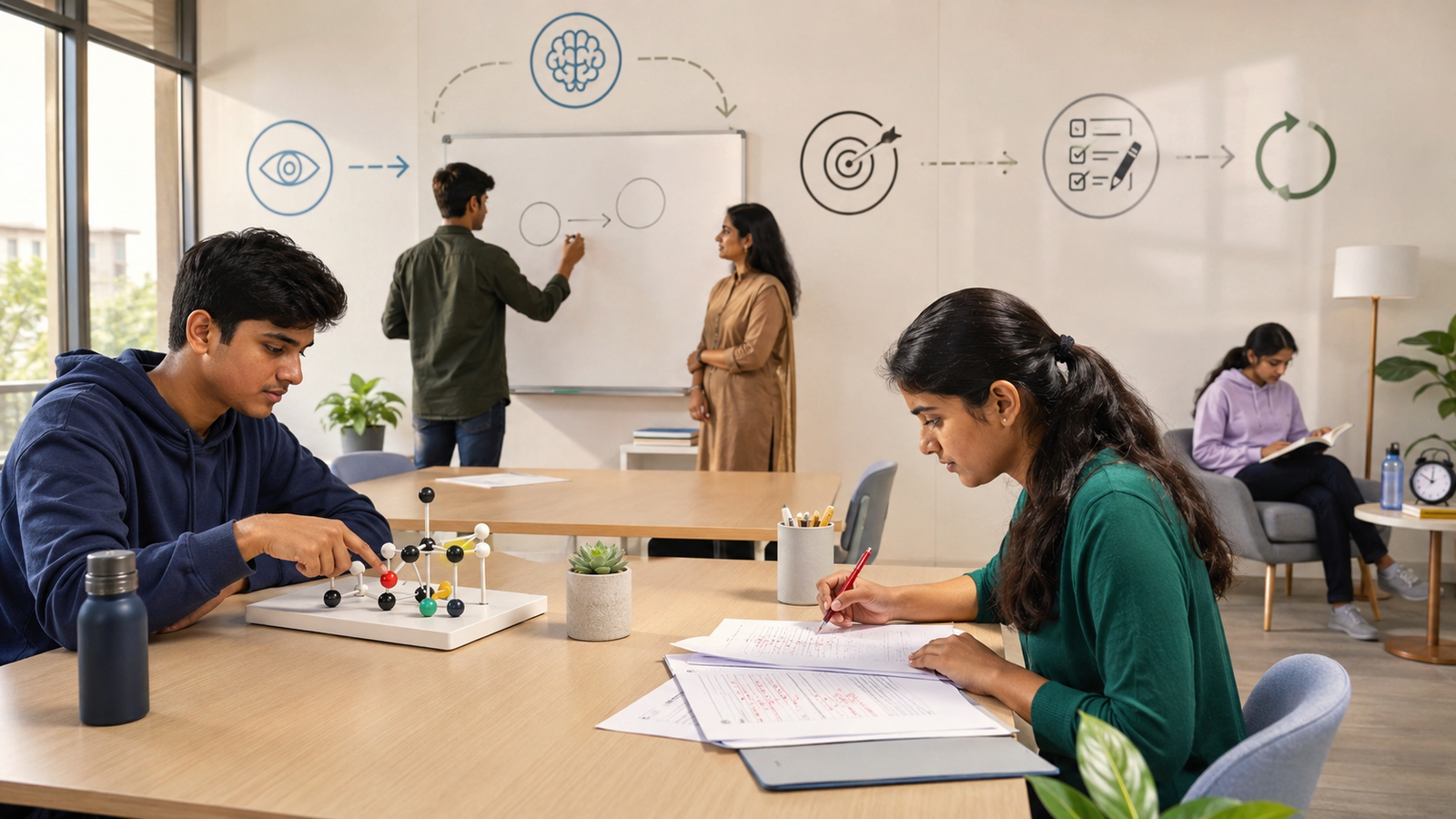
Learning can feel mysterious. A student sits in a classroom, listens carefully, reads the textbook, writes notes, and still forgets the material. Another student appears to understand quickly and remembers more with less visible effort. This difference is often explained through talent, intelligence, or discipline. Those factors matter, but they do not fully explain learning. Learning is not magic. It is a biological, psychological, and behavioural process.
The science of learning studies how people acquire, store, retrieve, and apply knowledge. It combines cognitive psychology, neuroscience, education research, memory studies, motivation research, and classroom evidence. Its core message is practical: the way students study changes how well they learn. Learning is not simply the amount of time spent with material. It is the quality of mental activity during that time.
At the centre of learning is attention. The brain cannot deeply process everything that enters the senses. Attention acts like a gatekeeper. It decides what receives mental energy and what remains background noise. This is why distracted studying is so weak. A student may sit with a book for two hours, but if attention is moving between messages, music, notifications, worries, and the page, the brain receives broken signals. Broken attention produces broken encoding.
Encoding is the process by which information is turned into memory. Not all encoding is equal. Shallow encoding happens when a student only sees words or repeats them mechanically. Deep encoding happens when the student asks what the idea means, how it connects to prior knowledge, why it matters, and how it can be used. For example, memorising the phrase “photosynthesis produces glucose” is shallow if the student cannot explain light energy, chlorophyll, carbon dioxide, water, and the role of glucose in plant life. Deep encoding creates meaning, structure, and association.
This is why prior knowledge matters so much. The brain learns new information by attaching it to existing networks. A student who already understands basic economics will learn inflation, monetary policy, and fiscal policy more easily than a student encountering all three for the first time. Prior knowledge acts like hooks. Without hooks, new information floats. With hooks, new information attaches and becomes retrievable.
The science of learning also explains why rereading feels good but often disappoints. Rereading increases familiarity. Familiarity is the feeling that material is known because it looks recognisable. But exams usually require recall, explanation, application, comparison, or problem-solving. Familiarity can fool students. They look at a page and think, “I know this.” But when the book is closed, the answer disappears. This gap between recognition and recall is one of the most important lessons in learning science.
Retrieval practice solves this problem. Retrieval means pulling information from memory. When students test themselves, answer questions, write from memory, explain without notes, or solve problems, they practise the exact skill required later. Research by Karpicke and Roediger helped popularise the idea that retrieval is not merely a way to measure learning. Retrieval itself strengthens learning. The act of trying to remember changes future remembering.
This insight changes the meaning of testing. Many students see tests as judgment. The science of learning sees low-stakes testing as training. A quiz is not only a score. It is a learning tool. A blank-page recall exercise is not only a check. It is a memory-building event. A flashcard is not only revision. It is a retrieval prompt. The smarter question is not “Have I read this?” but “Can I retrieve this without support?”
Another major principle is spacing. The spacing effect means that learning is usually stronger when study sessions are distributed over time rather than compressed into one session. The American Psychological Association defines the spacing effect as the advantage of distributed practice over massed practice. This matters because many students rely on massed practice, also known as cramming. Cramming may create short-term performance, but it often produces weak long-term retention.
Spacing works because forgetting and retrieval interact. If a review happens too soon, it may be too easy and add little strength. If it happens too late, the material may be lost and require relearning. A well-spaced review creates desirable difficulty. The student has to work to retrieve the information, but the task remains possible. This effort tells the brain that the information is useful and should be strengthened.
A third principle is feedback. Learning without feedback is like practising archery in the dark. The student may repeat actions, but cannot see whether they are improving. Feedback helps the learner compare performance with the target. It reveals misconceptions, careless errors, memory gaps, and weak application. Good feedback is specific. “Work harder” is not useful feedback. “You confused the cause of the event with its consequence” is useful. “Your essay lacks examples” is useful. “You understand the formula but are selecting the wrong formula for mixed problems” is useful.
Feedback also matters because errors are not enemies. Errors are information. A student who never tests never sees errors. A student who sees errors early can correct them before the exam. This is why mock tests, practice papers, peer review, and teacher comments matter. They turn invisible weakness into visible data.
Learning also requires transfer. Transfer means using knowledge in a new situation. A student may understand a solved example but fail when the numbers, wording, or context changes. This happens because the student learned the surface pattern but not the underlying principle. To improve transfer, learners must compare examples, solve varied problems, ask why a method works, and practise mixed questions. Interleaving can help because it forces the learner to choose the correct method instead of repeating the same method mechanically.
Motivation is another part of learning science, but it is often misunderstood. Students wait for motivation before studying. In reality, motivation often follows action. Starting a task reduces resistance. Progress creates confidence. Feedback creates direction. A small completed session can produce more motivation than a long motivational video. The learning system should not depend only on mood. It should depend on routine, environment, and clear next actions.
Emotion affects learning as well. Anxiety can narrow attention and consume working memory. Boredom can reduce engagement. Shame can make students avoid testing themselves. Confidence can improve persistence, but overconfidence can reduce preparation. A healthy learner does not need to feel excited all the time. A healthy learner needs enough emotional stability to face difficult material, make mistakes, and return to the task.
Working memory is one reason learning can feel difficult. Working memory is the mental space used to hold and manipulate information in the moment. It is limited. When a student tries to learn too many new elements at once, working memory becomes overloaded. This is why complex topics should be broken into parts. First learn definitions. Then relationships. Then examples. Then questions. Then mixed application. Good teaching reduces unnecessary load and increases meaningful challenge.
This also explains why multitasking damages study. Switching between tasks uses working memory and attention. A student who studies while checking messages repeatedly is not doing two tasks efficiently. The student is paying a switching cost again and again. The result is slower learning, weaker memory, and more fatigue. Single-tasking is not old-fashioned. It is cognitively efficient.
Sleep is a silent part of learning. During sleep, the brain helps stabilise and reorganise memories. NIH educational material explains that sleep strengthens memories formed during the day and helps connect new memories with earlier ones. Poor sleep does not only make students tired. It weakens attention, emotional control, decision-making, and memory consolidation. For serious learners, sleep is not a reward after studying. It is part of studying.
The science of learning also challenges the myth of learning styles. Many students say they are visual learners, auditory learners, or kinesthetic learners. People do have preferences, and different formats can help different content. Diagrams are useful for processes. Audio may help language pronunciation. Practice is necessary for physical skills. But the stronger principle is not matching everything to a fixed identity. The stronger principle is matching the method to the material. Learn geography with maps. Learn mathematics with problems. Learn history with timelines and causation. Learn language with speaking, listening, reading, and writing.
A good learning system therefore includes multiple modes: input, processing, retrieval, feedback, and application. Input gives raw material. Processing gives meaning. Retrieval builds memory. Feedback corrects errors. Application builds transfer. If any part is missing, learning weakens. A student who only consumes lectures lacks retrieval. A student who only memorises facts lacks application. A student who only solves tests without review repeats mistakes. Balance matters.
For practical use, students can apply a simple learning cycle. Before studying, preview the topic and create questions. During study, focus on meaning and structure. After study, close the source and recall. Within twenty-four hours, test again. Within the week, revise through spaced practice. After that, apply the topic through mixed questions. Finally, review mistakes and update the plan. This cycle turns learning into a repeatable process.
Teachers and parents can also use learning science. Instead of praising only long hours, they can ask better questions. Can the student explain without notes? Can the student solve new problems? What mistakes are repeating? Is revision spaced? Is the student sleeping enough? Is the study environment focused? These questions lead to better support than vague pressure.
The science of learning does not remove effort. It makes effort intelligent. Students still need discipline, patience, and practice. But they do not have to depend on blind repetition. They can study in ways that match how attention, memory, feedback, and consolidation actually work.
In the end, learning is not simply putting information into the brain. It is building a system that helps the brain notice, encode, retrieve, correct, connect, and use knowledge. Once students understand this, they stop asking only, “How many hours should I study?” They begin asking the better question: “What should my mind be doing during those hours?” That question is the beginning of smarter education.