Women Asked for Safer Public Spaces. Should the Answer Be Restricted Park Access After Sunset?
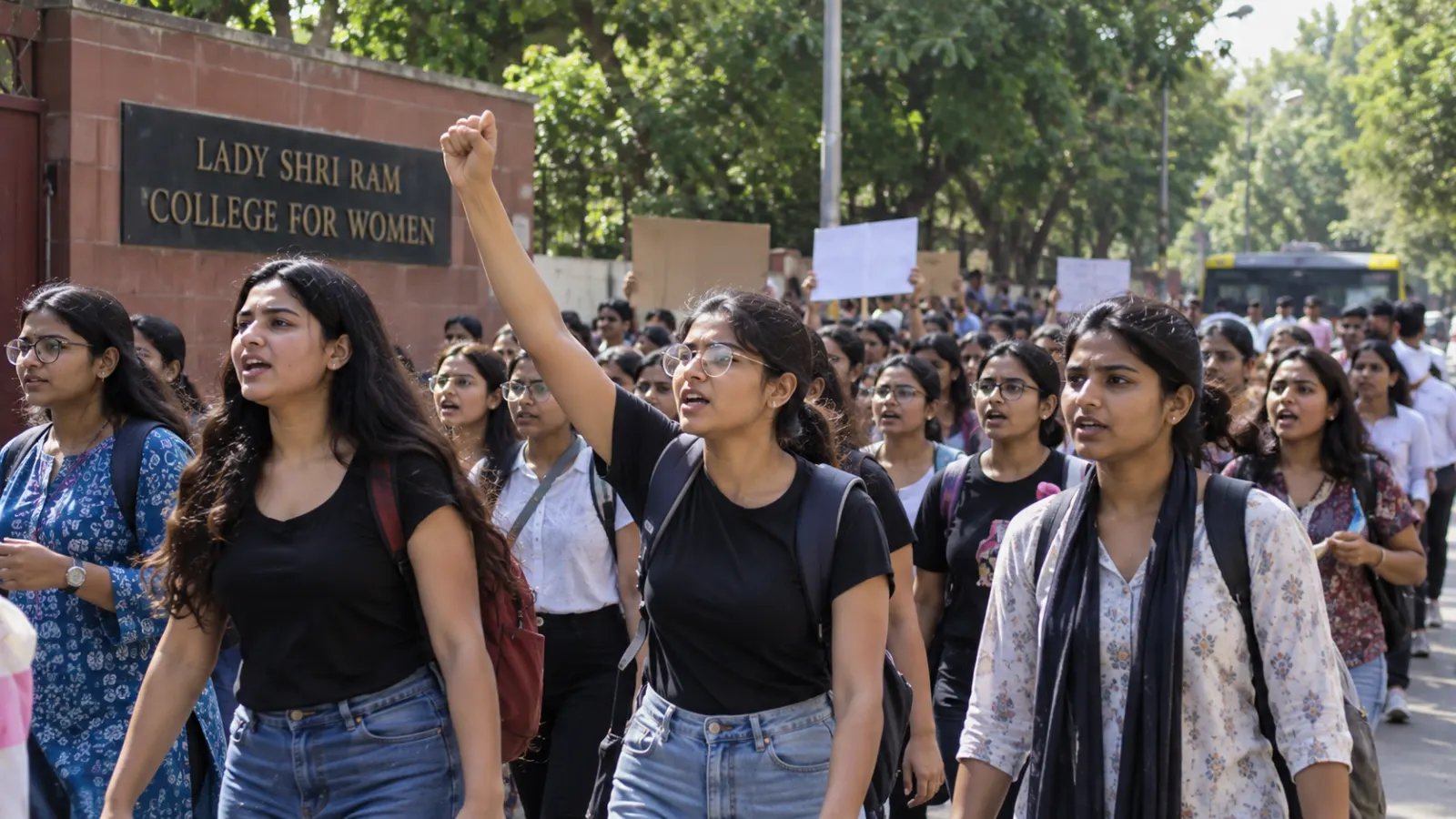
Women students in Delhi marched demanding safer streets, functioning police booths, better lighting, reliable CCTV coverage and the freedom to move through public spaces without fear. Within hours, authorities announced a series of measures for Delhi’s parks following the alleged sexual assault of a 17-year-old girl at Aastha Kunj Park near Kalkaji. Among them was a decision by the Delhi Development Authority to introduce tighter access controls after sunset at parks with multiple gates.
That sequence has created an important public-policy question. When a public space becomes unsafe after dark, should authorities reduce access to it, or should they invest in making that space safe enough to remain genuinely public?
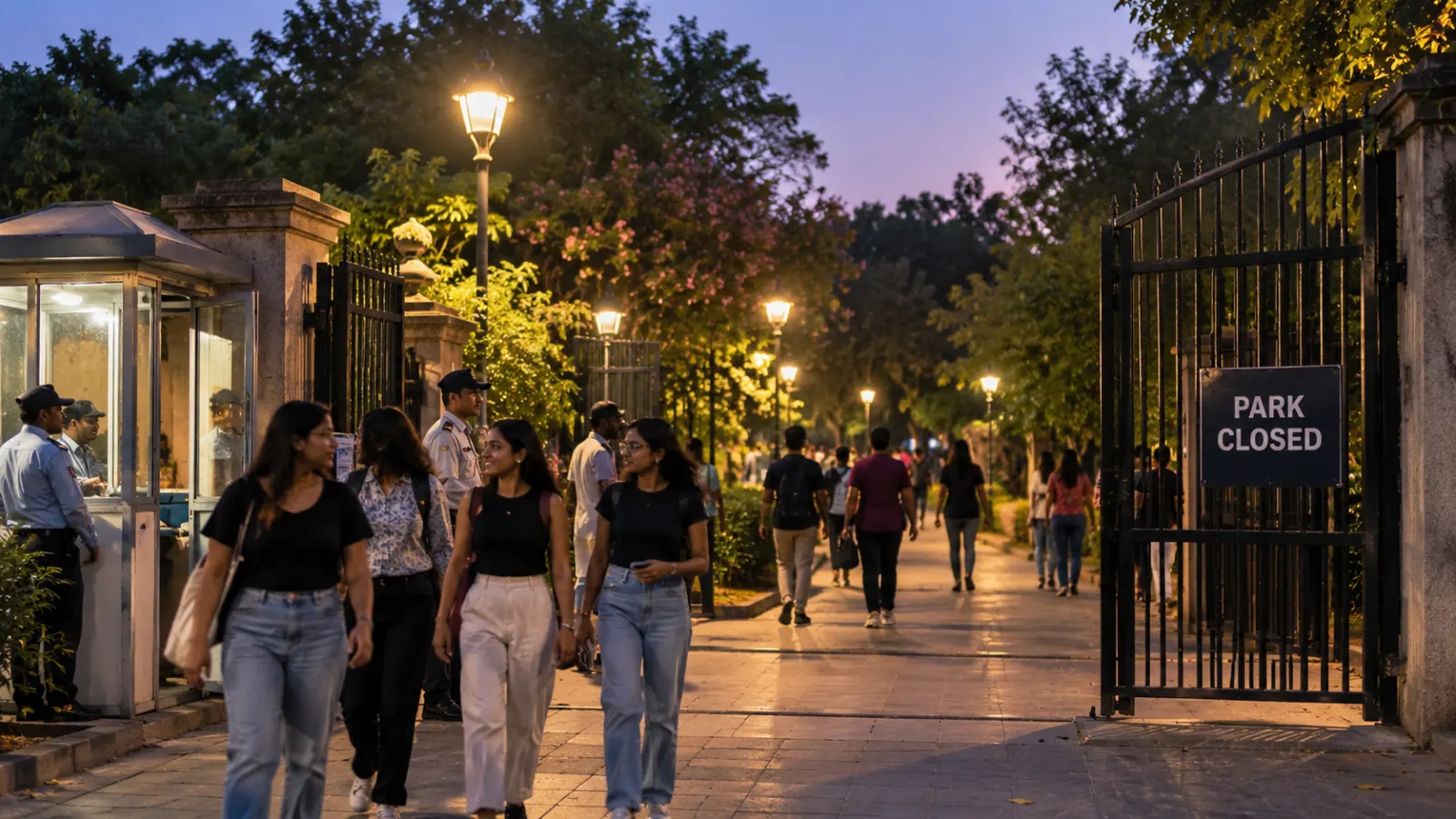
The answer is more complicated than the headline suggests. The DDA has not announced that women will be banned from parks after sunset, nor has it ordered all parks to close at sundown. According to the authority’s reported directions, parks with multiple entrances will move to controlled access during late hours: some gates may be restricted after sunset and before the park’s normal closing time so visitors enter and exit through selected, monitored points. The measures apply to visitors generally.
The same security package includes additional lighting, CCTV cameras, stronger monitoring of guards, more personnel at vulnerable locations, night patrols and safety-information boards. Delhi’s Lieutenant Governor has also ordered a wider safety audit of parks focusing on lighting, security, patrolling and cleanliness.
The controversy, therefore, is not simply about whether a gate should remain open. It is about a larger tension in women's safety policy: when danger appears in a public space, who should lose freedom because of it—the potential offender, or everyone trying to use that space?
What Delhi authorities have actually ordered
Aastha Kunj became the focus of intense scrutiny after a 17-year-old girl was allegedly sexually assaulted there on the evening of September 21, 2026. Police said three men approached the girl and her male friend while posing as police officers, separated them and allegedly assaulted the girl. The three accused have since been arrested, while the allegations remain subject to investigation and judicial proceedings.
Reports from the park subsequently highlighted serious security vulnerabilities, including dark stretches and concerns about surveillance and patrolling. Against that background, the DDA ordered immediate changes across parks under its control rather than waiting for the completion of the broader safety audit.
The measures include controlled access through selected gates after sunset at parks with multiple entrances, more security personnel at vulnerable points, identification and illumination of dark areas, expanded CCTV coverage, tighter checks on guards and increased coordination with Delhi Police for night patrols. Visitors are also expected to be advised to remain on well-lit pathways in the evening.
Seen purely as security management, the logic is understandable. A sprawling park with many entrances is difficult to monitor. Reducing the number of active gates at night can concentrate guards, cameras and police attention at fewer points. Controlled entry can also make it easier to know who is entering a park and to respond quickly when suspicious activity is reported.
But public-space policy involves more than security efficiency.
A park is not an airport terminal or a private building. It is part of a city’s shared civic infrastructure. Restricting access therefore raises questions about accessibility, freedom and whether safety measures gradually change the character of a public space.
Students were demanding more freedom, not simply more restrictions
The timing of the decision matters because it followed protests led by students from Lady Shri Ram College for Women and other universities.
More than 200 students participated in a September 23 solidarity march, with some reports estimating larger participation. Students raised concerns about poor lighting, inadequate CCTV coverage, insufficient police patrolling and the functioning of the Pink Police booth near LSR. Their slogans included demands for the ability to walk home and use public spaces without fear.
That distinction matters.
When women demand safety, the demand is not necessarily for greater supervision of their own behaviour. It is often a demand for greater freedom made possible by safer environments.
A woman asking for a well-lit street is not asking to be told not to use that street after 8 pm. A student asking for functioning police patrols is not necessarily asking authorities to shorten the hours during which she can use public spaces. A demand for safety can therefore become distorted if the principal institutional response is simply to restrict access to the location where the crime occurred.
The current DDA measures are broader than that—they include lighting, policing and surveillance as well as access control. But the debate is important because cities repeatedly face the temptation to manage danger by managing potential victims.
Restricting access can have a legitimate security rationale
There is a serious argument in favour of controlled access.
Large urban parks can be particularly difficult to secure after dark. Dense vegetation, poor illumination, damaged boundaries and multiple unattended entry points can create locations where both victims and offenders are difficult to see. Security staff spread across numerous gates may be less effective than personnel concentrated at a smaller number of monitored entrances.
From this perspective, closing some gates is not necessarily a restriction on women’s freedom. If the park itself remains open and accessible through designated entrances, authorities may view the measure as similar to closing unused building entrances at night while retaining a staffed main entrance.
Controlled access can also complement other measures. A functioning CCTV system is more useful when major entry and exit routes are predictable. Police patrols can respond more effectively when security personnel know where visitors are entering. Emergency assistance can be easier to coordinate if guards are stationed at known access points.
The DDA has said the objective is to keep parks safe and accessible for women, children, senior citizens and other visitors. It has paired entry controls with additional lighting, surveillance and patrolling rather than presenting restricted gates as a complete solution.
There is therefore a meaningful difference between closing a few unmonitored entrances and closing public parks to women or to everyone after sunset.
Those distinctions should not disappear in public discussion.
But restricting space can also shift the burden away from the real problem
The opposing concern is equally substantial.
Safety policies can become problematic when they make ordinary citizens surrender access because authorities have failed to secure the environment.
Imagine a park containing six gates, of which four are dark and poorly monitored. One solution is to close those four gates. Another is to illuminate them, repair the boundary, install functional surveillance and ensure adequate staffing.
The first may be faster and cheaper.
The second preserves more access.
In the short term, restricted entry may reduce opportunities for unnoticed criminal activity. In the long term, however, it can create a governance incentive to solve unsafe infrastructure through closure rather than improvement.
That possibility matters especially for women because restrictions justified in the language of safety have historically fallen disproportionately on them.
Families tell daughters to return home earlier because streets are unsafe. Colleges impose stricter hostel curfews on women because travelling at night is dangerous. Women are told not to visit isolated parks, not to use certain routes and not to travel alone.
Each precaution may have a rational safety explanation. Collectively, however, they can produce an unequal city: men retain relatively unrestricted access to public life while women learn to organise their movements around danger.
That is why women's-rights debates frequently distinguish between protection and autonomy.
A policy can genuinely attempt to protect someone while still limiting that person's freedom.
The question is whether the restriction is necessary, proportionate and temporary—or whether it becomes a substitute for fixing the underlying safety failure.
The real issue is not sunset; it is what happens after sunset
There is nothing inherently unsafe about darkness.
Risk rises when darkness combines with poor urban management: broken lights, inadequate surveillance, isolated pathways, absent guards, poorly maintained boundaries, inaccessible emergency assistance and weak police presence.
Reports following the Aastha Kunj incident describe precisely these kinds of concerns across Delhi parks. The Lieutenant Governor's safety audit has therefore been directed to examine lighting, security, regular patrolling and cleanliness rather than simply park timings.
This points toward a useful way of evaluating the new policy.
If selected gates are closed temporarily while lighting, CCTV systems and staffing are repaired, controlled access may function as an immediate risk-reduction measure.
If gates remain permanently closed because authorities never improve those locations, the same measure begins to look less like security management and more like shrinking access to public space.
Implementation will determine which interpretation proves more accurate.
This is why the next few weeks matter more than the announcement itself.
Do dark stretches actually receive floodlights? Are CCTV cameras functioning rather than merely installed? Do guards remain present throughout their shifts? Are Pink Police and regular patrols visible during vulnerable hours? Are broken boundary walls repaired? Can visitors easily reach emergency assistance?
Those are measurable questions.
Women’s safety policy often focuses on behaviour because infrastructure is harder
There is a practical reason governments, families and institutions often fall back on restrictions: changing behaviour is easier than changing environments.
Telling someone not to enter an unsafe park costs almost nothing.
Installing lighting across a large park costs money.
Closing a gate is straightforward.
Maintaining CCTV cameras, guards and patrols every day requires continuous administration.
Issuing a curfew takes one order.
Building a city where women can travel safely at different hours requires transport, policing, urban planning and social change working together.
This creates what might be called the restriction trap. A temporary precaution becomes the normal policy because it is administratively easier than addressing the reason the precaution became necessary.
The same pattern can appear at home. A family may find it easier to tell a daughter not to travel at night than to arrange safe transport or challenge harassment. The intention may genuinely be protective, but the practical consequence is that her freedom becomes conditional on other people's behaviour.
Public policy should therefore be evaluated not only by whether it reduces immediate risk but also by who bears the cost of that risk reduction.
Public spaces matter to women for reasons beyond recreation
Parks can appear optional compared with roads, workplaces or public transport. But access to public space is closely connected with citizenship.
People use parks for exercise, conversation, dating, reading, walking, community activities and simply spending time outside the home without having to purchase anything.
That last point is important.
Much urban leisure takes place in commercial spaces such as cafés, restaurants, shopping centres and cinemas. Those places require money. Parks are among the comparatively few urban environments where people can spend time without being customers.
For young adults, low-income residents, domestic workers, elderly people and students, that accessibility matters.
Women who already face greater scrutiny of their movement may have fewer informal public spaces available to them. If parks become socially or institutionally inaccessible after dark, the effect is not merely recreational. It can reinforce the idea that women's legitimate presence in the city has a time limit.
This is partly why LSR students' slogans focused not simply on protection but on the right to walk and occupy public space.
Safety and freedom do not have to be opposing choices
The debate can become distorted if it is presented as a choice between two extremes.
One extreme says any restriction is inherently oppressive and authorities should leave parks completely open regardless of immediate security risks.
The other says safety justifies whatever restrictions authorities consider necessary.
Neither approach adequately addresses the problem.
Cities regularly manage public spaces through closing times, controlled entrances, security checks and temporary restrictions. Such measures can be reasonable. What matters is whether they are evidence-based, proportionate and combined with investment that tackles the underlying danger.
A stronger model of women's safety would therefore ask authorities to do both things at once: manage immediate risk and preserve the long-term objective of equal access.
That can mean temporarily limiting poorly monitored entrances while rapidly installing lighting and CCTV. It can mean positioning guards at active gates without turning the park into an intimidating checkpoint. It can mean increasing police visibility without subjecting couples or women to moral policing. It can mean patrolling vulnerable stretches rather than simply warning women not to enter them.
Most importantly, it requires measuring success differently.
Success should not be defined as fewer women entering parks after sunset.
It should be defined as fewer crimes occurring while women continue to use those spaces freely.
There is another danger: security must not become moral policing
The circumstances of the Aastha Kunj case make this issue particularly sensitive because the accused allegedly approached the teenage girl and her male friend while pretending to be police officers. According to police accounts reported by NDTV, they used that claimed authority to threaten and separate the teenagers before the alleged assault.
This means future security arrangements must avoid reproducing the dynamic they are supposed to prevent.
More guards and police presence should mean greater protection against harassment and violence. It should not mean couples being routinely interrogated about why they are together, women being questioned about clothing or timing, or adults being treated as suspicious merely because they are using a park after dark.
Security and moral policing are not the same thing.
A guard asking someone to leave because the park has reached its officially published closing time is enforcing a neutral rule.
A guard deciding that a woman should not be in a park with a male companion because he disapproves of the relationship is enforcing his personal morality.
That boundary needs to remain clear.
The test will be whether Delhi creates safer parks or simply more closed gates
The immediate measures announced after Aastha Kunj contain both restrictive and enabling elements.
Restricted entry through some gates reduces access.
Better lighting increases access.
More surveillance may increase security.
Better patrols can deter crime.
Properly staffed entrances can improve emergency response.
The overall effect will depend on which of these measures receives sustained attention.
If Delhi uses controlled entry as a temporary tool while repairing unsafe infrastructure, strengthening policing and restoring confidence in public spaces, the policy may be understood primarily as risk management.
If gate closures become the lasting answer while dark spots, broken surveillance and weak staffing remain unresolved, critics will have stronger grounds to argue that the city has managed the victims' access rather than the conditions that made the space unsafe.
The LSR protesters were not demanding a city in which women never encounter risk. No city can guarantee that.
Their broader demand was for a city where women do not have to surrender ordinary freedoms because institutions have failed to make public space reasonably safe.
That creates a useful standard against which Delhi's new measures can be judged.
After sunset, the goal should not merely be fewer open gates. It should be safer public space behind them.