Delhi Gang-Rape Case and LSR Protest: Why Women’s Safety Is Back at the Centre of Debate
Hundreds of students took to the streets of South Delhi on September 23 after the alleged gang rape of a 17-year-old girl at Aastha Kunj Park near Kalkaji Mandir. What began as a criminal case quickly developed into a wider conversation about women's safety, policing, dark public spaces and a familiar question that has followed women in Indian cities for decades: should women be expected to restrict their movements because public spaces are unsafe, or should those spaces be made safe enough for women to use them freely?
According to Delhi Police, the teenager had visited Kalkaji Mandir with a 17-year-old male friend on September 21 and later entered Aastha Kunj Park. Three men allegedly approached the two teenagers while pretending to be police officers, used threats and legal language to intimidate them and separated them. The girl subsequently reported being sexually assaulted. Police registered a case under relevant provisions of the Bharatiya Nyaya Sanhita and the Protection of Children from Sexual Offences Act, and all three accused were arrested the following day. The allegations will have to be established through the investigation and judicial process.
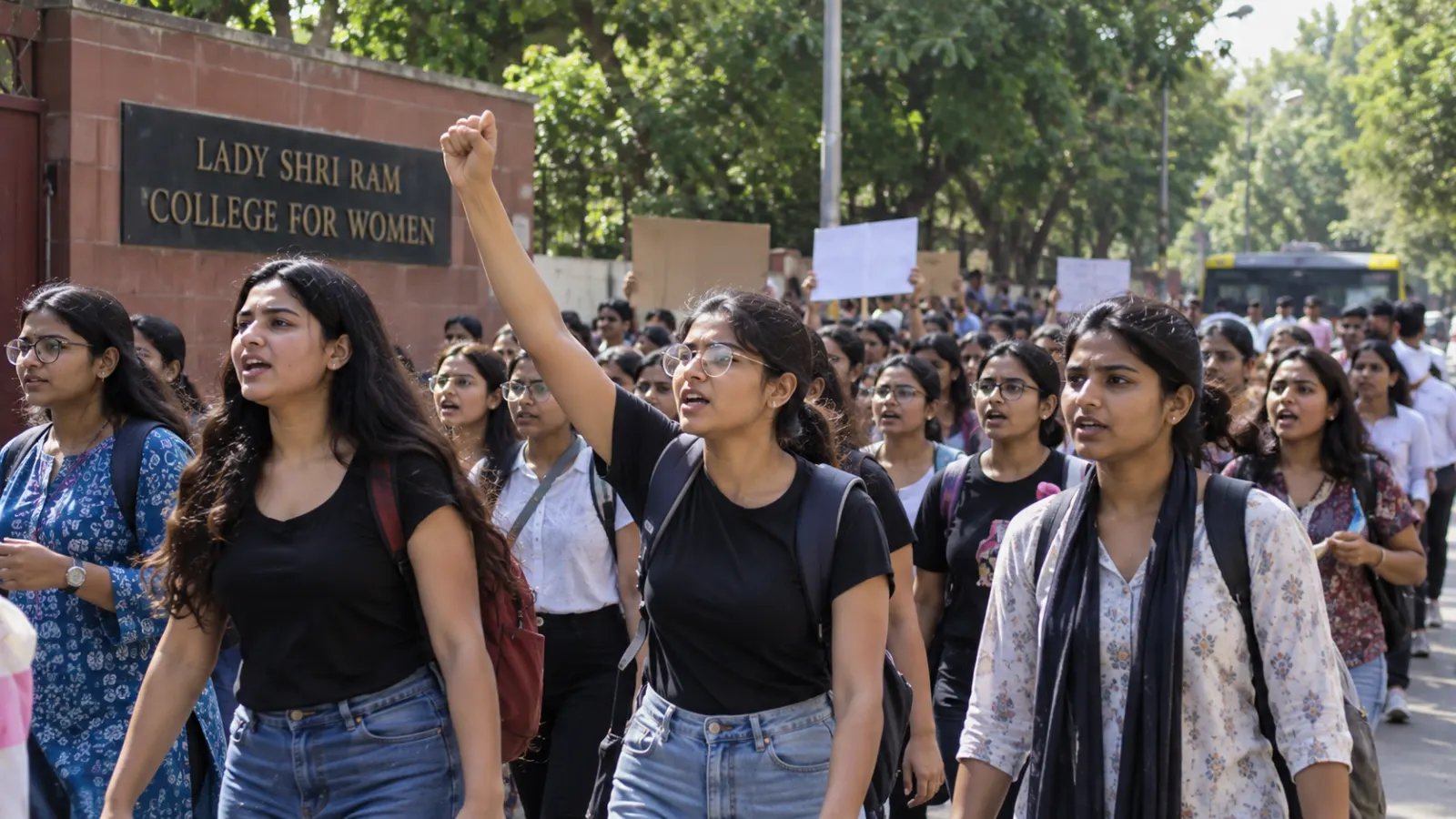
The incident occurred close to Lady Shri Ram College for Women, bringing an already familiar fear directly into the daily environment of thousands of students. On September 23, around 200 students from LSR, Miranda House, Gargi College, Dr B R Ambedkar University and other institutions joined a protest march demanding safer public spaces. Reuters also reported hundreds participating in the demonstration, with students calling for greater freedom to move through the city without fear.
The protest was about more than one crime
It would be easy to understand the LSR protest simply as an emotional response to one particularly serious case. But the concerns raised by students were much more specific.
Before the march, LSR students held an online general-body meeting attended by around 400 students. They identified what they described as practical safety failures around the campus: inadequate availability of PCR vans, a Pink Police booth they said was not functioning, poor street lighting on frequently used roads, vehicles occupying pedestrian paths, insufficient monitoring of vulnerable stretches and weaknesses in communication between police, college authorities, security staff and students.
These complaints matter because sexual violence cannot be explained by infrastructure alone, but infrastructure can affect opportunities for crime, people's ability to seek assistance and whether public spaces feel usable after dark. Lighting does not eliminate misogyny. CCTV does not prevent every assault. Police patrols cannot be present everywhere. But a poorly illuminated park with weak surveillance and little visible security can create conditions in which offenders believe they are less likely to be observed or interrupted.
Reporting on Aastha Kunj Park has subsequently highlighted similar concerns. Police investigators told Hindustan Times that the park contained dark areas, its CCTV system was malfunctioning and patrolling was absent. Local accounts cited in the report also suggested that at least one accused had previously been seen harassing couples, although those earlier incidents had apparently not resulted in formal police complaints.
This changes the conversation from the vague demand to "make Delhi safer" to questions that can actually be examined. Were lights functioning? Was surveillance operational? Were complaints being recorded? Was patrolling adequate? Did different agencies responsible for the area communicate? When deficiencies were identified previously, were they corrected?
Those are institutional questions rather than slogans.
Why telling women to be more careful is not enough
One of the strongest ideas emerging from the student protest concerned responsibility.
Women and girls are routinely given safety instructions: do not travel alone late at night, share your location, stay in groups, avoid isolated areas, keep emergency numbers ready, choose well-lit routes and remain alert around strangers. Some of this advice can reduce immediate risk and should not simply be dismissed.
But there is a deeper problem when precaution becomes the principal social response to violence.
Students interviewed during the LSR protest described being told to move in groups and spoke about feeling unsafe during routine journeys around college. Some said harassment concerns were not limited to a particular back lane or park but were part of their everyday experience of commuting through the city.
There is an important difference between telling someone how to reduce personal risk and constructing a society in which the person must continually sacrifice freedom because institutions cannot reduce the underlying danger.
If a road is dark, the solution cannot permanently be that women should stop using the road.
If harassment occurs outside a college, the lasting solution cannot be that female students should leave earlier.
If parks become unsafe after sunset, the answer cannot simply be that women should not enter parks after sunset.
Such precautions may sometimes be rational in the short term. But when they become permanent expectations, the burden of crime gradually moves from the potential offender and the institutions responsible for public safety to the person most at risk.
That is why the LSR protest has also become part of a broader debate about patriarchy. Students used slogans against patriarchal norms and objected to the idea that women's movement should be policed in response to violence.
The alleged use of police authority adds another disturbing dimension
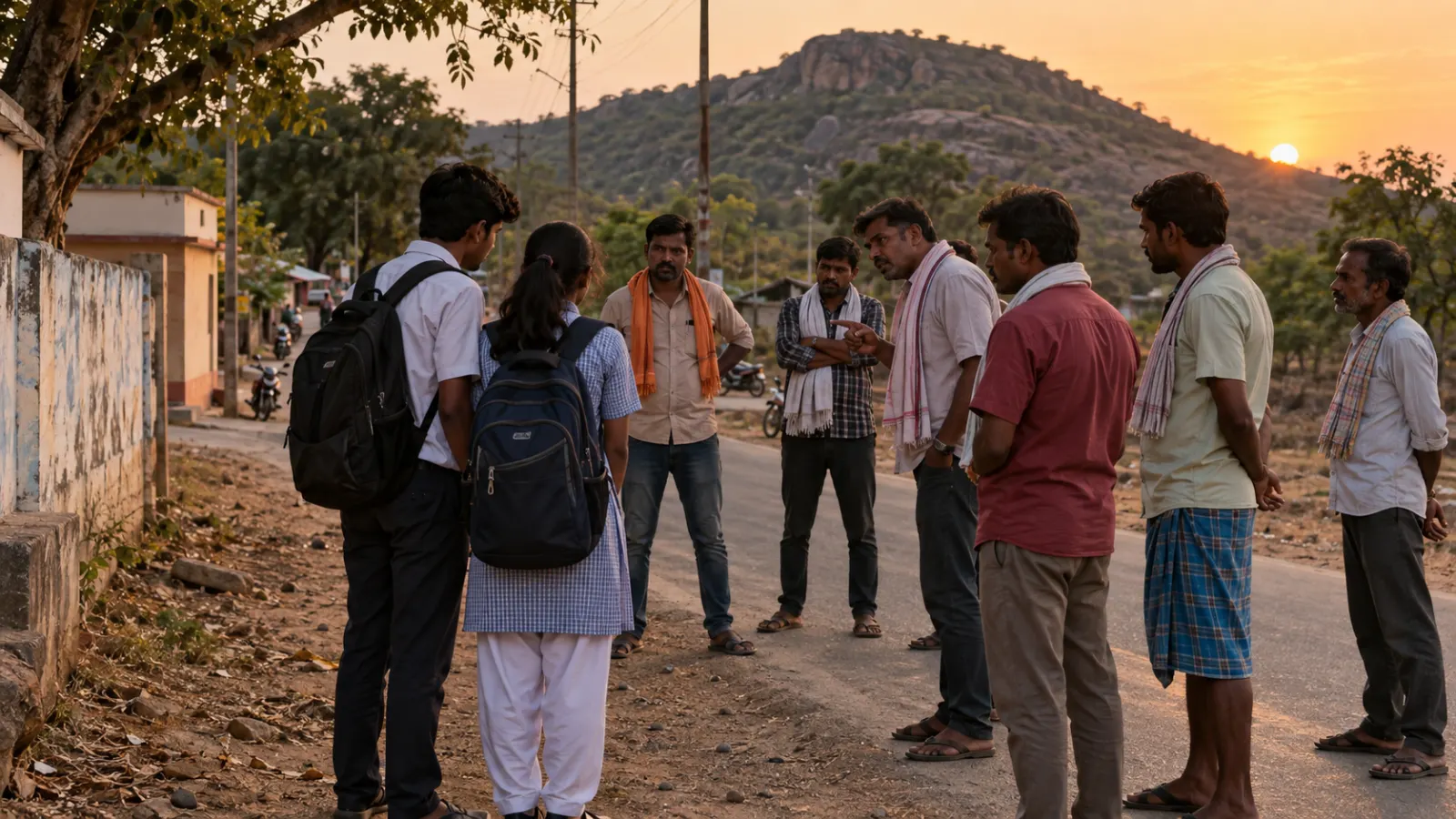
The circumstances described by police make this case particularly significant. The accused allegedly did not approach the teenagers merely as strangers. They reportedly pretended to be police officers and used the language of law and authority to intimidate them.
That alleged tactic exploited something larger than physical strength: fear of authority and fear of social consequences.
Teenagers confronted by adults claiming to be police may believe they have little choice but to cooperate. When a boy and girl are together, threats to inform parents or accuse them of wrongdoing can become especially powerful in a social environment where adolescent relationships themselves may attract stigma.
This is where moral policing and sexual violence can intersect in a particularly troubling way. A couple can first be made to feel as though they have done something wrong. Once shame and fear are established, the person pretending to enforce morality or law acquires leverage.
The principle should be clear: being in a park with a friend does not transfer authority over a person's body to anyone else.
For minors, parents and child-protection systems legitimately have responsibilities that differ from those involving consenting adults. But even where a teenager has broken a family rule or entered an unsuitable location, that cannot justify intimidation, assault or sexual violence.
From the 2012 Delhi case to another student protest
Several protesters explicitly connected the latest case with memories of the December 2012 Delhi gang rape, which triggered enormous demonstrations and major amendments to India's sexual-offence laws. One participant told The Indian Express that the latest case made her feel that fundamental safety concerns remained unresolved more than a decade later. That is the protester's assessment rather than an objective finding that “nothing has changed,” but it captures the frustration visible in the march.
India's legal framework did change substantially after 2012. Laws dealing with sexual offences were expanded, punishments were strengthened and institutional mechanisms received much greater public attention. The current case also demonstrates that police can move rapidly: all three accused were arrested within roughly a day of the reported assault.
But law operates primarily after an offence has occurred.
Prevention requires something broader: urban design, functioning lights and cameras, visible policing, safe transport, responsive complaint systems, institutional accountability and social norms that do not normalise harassment or blame victims.
This distinction explains why students can simultaneously demand strict action in a particular criminal case and argue that arrests alone do not resolve their broader concerns.
Authorities have now promised preventive measures
Following the case, Delhi Lieutenant Governor Taranjit Singh Sandhu directed officials to conduct a safety audit of parks across Delhi within a week, according to a PTI report. The directions included attention to lighting, security, cleanliness and regular patrolling, while Delhi Police was asked to strengthen beat patrols and deploy Pink Police personnel around parks.
LSR's administration has also said it is strengthening campus security, monitoring CCTV systems and requesting increased police patrols around adjoining lanes, the back gate and nearby parks.
These measures address several of the practical issues raised by students. Their effectiveness, however, will depend on implementation over time rather than their announcement immediately after a high-profile crime.
A Pink Booth helps only if it is staffed when assistance is needed. A CCTV camera contributes little if it does not work. A streetlight does not improve safety if months pass before a failure is repaired. A patrol system matters only if it is sufficiently frequent and predictable to create genuine deterrence.
The larger institutional challenge is therefore maintenance. Public attention becomes intense after a serious crime and gradually fades. Effective safety systems must continue functioning after the cameras and protests have moved elsewhere.
Women's freedom and women's safety should not be competing ideas
The debate triggered by the Delhi case ultimately contains a contradiction that appears repeatedly in conversations about women's security.
When violence occurs, women are often advised to become less visible in public space: avoid parks, avoid late evenings, travel with others and reduce exposure to risk. At the individual level, such advice may sometimes be sensible.
At the social level, however, applying it indefinitely produces an uncomfortable result.
Public space technically remains available to everyone, but the cost of using it becomes much higher for women.
A male student may decide to stay after college for theatre practice, meet friends or walk home without treating each decision as a calculation about whether society will later blame him if something happens. A female student frequently has to make additional calculations about lighting, transport, timing, clothing, companionship and reputation.
That difference is itself a form of unequal freedom.
The protesters' demand for azaadi, or freedom, should therefore not be understood simply as a demand to ignore danger. In the context of the march, it expressed an argument that women should not have to trade ordinary civic freedom for personal safety. Reuters reported placards asserting bodily autonomy and demanding the ability to go out at night without fear.
Safety and freedom should reinforce one another. A safe city is not one in which women remain indoors. It is one in which women can participate in public life without being required to organise their existence around the possibility of violence.
The important question comes after the protest ends
The criminal investigation will continue separately, and the guilt of the accused must be determined through the legal process. The survivor, being a minor, is also entitled to particularly strong privacy protections, and public discussion should avoid material that could identify her.
The protest raises a different question.
What happens next?
If the Pink Booth becomes reliably staffed, vulnerable streets are illuminated, CCTV systems work, parks receive regular patrols, complaints about harassment are acted upon and students receive timely safety information, the response will have produced measurable institutional changes.
If attention fades and the same shortcomings are rediscovered after the next serious crime, another protest will probably ask the same questions again.
The LSR students who marched this week were therefore not only demanding justice in one case. They were challenging a recurring assumption about women's safety: that women should continually modify their lives to accommodate unsafe environments.
Personal caution will always have a place in risk management. But it cannot substitute for functioning public institutions or respect for women's equal claim to streets, parks, campuses and transport.
The more meaningful measure of women's safety is not how effectively women learn to avoid public space.
It is how freely they can use it without fear.