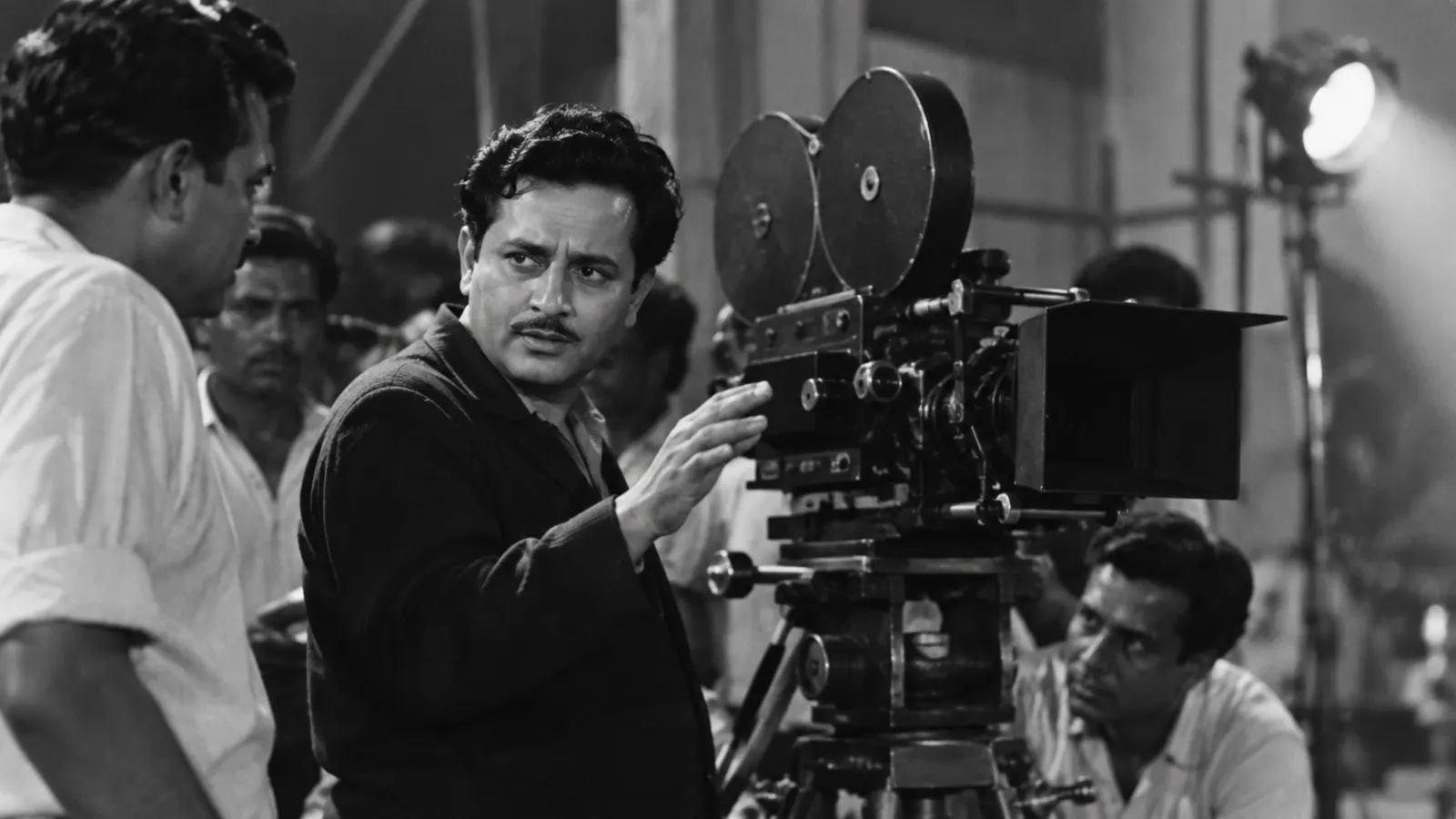
R. D. Burman: The Composer Who Turned the Studio Into an Instrument
R. D. Burman, known almost universally as Pancham, changed Hindi film music not by abandoning melody for novelty but by expanding what a film song could be made from. A rhythm pattern, a breathy vocal texture, the attack of an electric guitar, a brass phrase, the resonance of an unexpected object or the emerging possibilities of electronic instruments could matter almost as much as the tune itself. In his best work, composition did not end when the melody was written. Arrangement, instrumentation, recording technique and performance were all part of the musical idea.
This approach helped turn the recording studio itself into an instrument. Burman did not invent hybridity in Indian cinema; composers before him had already incorporated jazz, Latin rhythms, Western orchestration, Indian classical traditions and regional folk music. What he did was push that hybrid logic into a new era. His strongest recordings could sound experimental without ceasing to be accessible, and modern without requiring a clean break from the musical traditions that came before them.
That distinction explains why reducing Pancham to “the man who Westernised Hindi film music” is inadequate. His music emerged from a Bombay studio culture built through migration, regional traditions, imported records, new recording technology and a highly skilled community of arrangers and session musicians. Bengali and northeastern musical influences could coexist with electric guitar, Latin percussion and synthesizers. Folk phrasing could meet rock rhythms. Indian melodic structures could sit inside arrangements shaped by jazz, pop or psychedelia.
The result was not cultural purity, and that was precisely its strength.
From S. D. Burman's World to a Sound of His Own
Rahul Dev Burman was born on 27 June 1939 in Calcutta to composer-singer Sachin Dev Burman and Meera Dev Burman. Growing up in a professional musical family gave him extraordinary access to musicians, repertories and the working methods of film composition. It also placed him under the shadow of one of Indian cinema's most respected composers. Being S. D. Burman's son gave Pancham an entry into the industry, but it did not guarantee that audiences, filmmakers or musicians would recognise him as an independent creative figure.
His musical education therefore developed partly through apprenticeship. He learned instruments, worked around his father's recording sessions and absorbed how film music was constructed around scenes, actors and recording limitations. Film composition demanded knowledge that could not easily be learned from notation alone: how long a prelude should continue before dialogue, how a singer's register changes orchestration, how instrumental colour can alter the emotional meaning of a scene and how a melody changes once microphones, musicians and a recording room become part of it.
Burman's first released film as an independent music director was Chhote Nawab in 1961, produced by Mehmood. It established the beginning of a career separate from his father's, but the decisive breakthrough came with Vijay Anand's Teesri Manzil in 1966. The film's score matched Shammi Kapoor's physical energy with driving percussion, guitar, brass and highly dynamic playback singing. Mohammed Rafi's voice became an essential part of that musical architecture, carrying melody while also matching the actor's athletic screen presence.
The importance of Teesri Manzil lies partly in how naturally the music integrated international pop vocabulary into Hindi cinema. Rock-and-roll gestures, drum patterns and electric instrumentation did not simply sit on top of Indian songs as decorative foreign additions. They were reorganised around Hindi lyrics, Indian melodic sensibility, choreography and a particular cinematic personality. Burman was learning how to make imported sounds feel local without pretending they had no international history.
This became one of his defining strengths. He listened widely but composed for the screen in front of him.
The Hidden Collective Behind the Pancham Sound
The mythology of the genius composer can make film music appear more solitary than it was. Bombay's recording industry relied on exceptional arrangers, conductors, instrumentalists, singers and engineers who worked across composers and brought their own musical knowledge into the studio. Jazz-club musicians, military-band players, Indian classical instrumentalists, percussion specialists and technically adventurous studio players all contributed to what audiences eventually heard as one composer's “sound.”
Burman's importance becomes clearer, not smaller, when this collective is restored to the story. Musicians such as Manohari Singh and Kersi Lord were part of the wider sonic environment in which Pancham worked. The composer's skill included choosing collaborators, imagining textures and giving musicians enough room to turn unusual ideas into arrangements that could actually be performed and recorded. Innovation was often social: someone proposed a sound, another person found the instrument or technique capable of producing it, and the studio collectively transformed the idea into music.
This was particularly important as electronic instruments entered Indian film studios. Access to imported equipment was limited, expensive and inconsistent, so experimentation often required improvisation. Musicians adapted available instruments, altered conventional techniques and sometimes used ordinary objects when they produced the desired texture. The famous electronic and psychedelic qualities associated with songs such as “Dum Maro Dum” therefore belong not to one isolated inventor but to a network of composers, performers and technicians exploring what contemporary recording could do.
Burman nevertheless played a distinctive role within that network because he was unusually interested in sound itself. The character of a recording could come from rhythm before melody, timbre before lyric or a carefully chosen interruption before a full instrumental statement. A particular percussion groove could establish rebellion or swagger. A bass pattern could make a romantic hero seem more mobile and modern. A sudden silence could create tension because the preceding bars had trained the listener to expect continuation.
Rhythm was central to this approach. Burman used drum kits, hand percussion, Latin-derived patterns, Indian rhythmic traditions, claps and unconventional sources to shape scenes. As urban Indian audiences became increasingly familiar with rock, soul, funk, psychedelic music and international pop during the late 1960s and 1970s, these rhythmic choices acquired social meaning. They became associated with cars, clubs, college youth, hotel interiors, new forms of romance and a more restless cinematic masculinity.
Hare Rama Hare Krishna and “Dum Maro Dum” remain obvious examples. The song's drone, percussion, vocal attitude and electronic colour became inseparable from its countercultural imagery. But the recording's significance is not simply that it sounded Western or technologically new. Its sound belonged specifically to the youth culture represented on screen.
Pancham's studio experimentation therefore worked best when sound and situation reinforced one another.
Kishore Kumar, Asha Bhosle and the Many Voices of Pancham
Burman's long association with Kishore Kumar became one of the defining composer-singer partnerships of Hindi cinema. Kishore's conversational delivery, elastic phrasing and distinctive tonal grain suited Burman's interest in rhythm and character. During the rise of Rajesh Khanna, the combination became especially powerful, helping construct a style of romantic male performance that was intimate, informal and recognisably different from earlier cinematic ideals.
Yet reducing R. D. Burman's music to Kishore Kumar would obscure much of his range. He worked with Mohammed Rafi, Lata Mangeshkar, Manna Dey and other leading singers, often selecting voices according to the needs of a scene rather than insisting on one permanent vocal identity. The singer was not simply a delivery mechanism for melody. Voice carried age, personality, sensuality, humour and star association.
His collaboration with Asha Bhosle was even more closely linked to his experimental reputation. She could move through cabaret, pop, folk inflection, sensuality and intimate melodic singing without sounding trapped inside one ideal of female playback sweetness. Their professional partnership predated their marriage and should not be reduced to their personal relationship. Asha already possessed a major independent career; what made the collaboration distinctive was the meeting of two highly flexible musical imaginations.
Burman's relationship with lyricists was just as important. Anand Bakshi could provide direct, popular language suited to mass romantic cinema. Majrooh Sultanpuri brought wit and rhythmic ease. Gulzar's elliptical and interior writing drew out a quieter Pancham in films such as Aandhi, Khushboo, Kinara and Ijaazat. These collaborations complicate the familiar picture of R. D. Burman as a composer defined by energetic beats and sonic tricks.
He understood space.
With Gulzar, a pause could carry as much emotional information as an instrumental phrase. The arrangement could retreat behind a lyric rather than competing with it. Melancholy, hesitation and intimacy could be created through restraint.
This quieter side connects directly to Burman's melodic gifts. His reputation for experimentation can make it easy to overlook how many of his strongest tunes are structurally simple enough to remember after one hearing. Films such as Kati Patang and Amar Prem demonstrate that sophisticated arrangement did not require complicated melody. Pancham's durability comes partly from combining familiar emotional contours with unexpected sonic surroundings.
A composer dependent purely on novelty risks ageing when yesterday's experimental sound becomes today's standard equipment. Burman's strongest work survives because the experiment usually sits on top of a song that still functions when the unusual instrumentation is stripped away.
Sholay, Background Score and Music as World-Building
Popular memory understandably concentrates on songs, but a film composer also works in the spaces where nobody is singing. Background score can build suspense, attach a musical identity to a character or alter the meaning of a landscape without producing a track that listeners later hum.
Sholay demonstrates this side of Burman's cinematic imagination. The film demanded music capable of moving between friendship, romance, comic relief, menace, action and the vastness of its fictional setting. Sound was central to the scale of the production, and Burman's work had to function both as memorable song and as dramatic atmosphere.
“Mehbooba Mehbooba,” sung by Burman himself, showed how willing he was to treat the human voice as another texture. His rough, grainy delivery was far removed from conventional ideas of polished playback singing, but it belonged perfectly to the song's world. His occasional vocal performances remind us that Pancham's fascination with timbre extended to his own voice.
Background scoring required another kind of discipline. A standalone song can rely on a complete melody and lyric. A film score often works through fragments, recurring motifs, rhythm and sonic signals that never become full songs. These elements help explain why Burman's musical imagination was fundamentally cinematic rather than merely record-oriented.
This aspect of his career also reinforces the importance of technology. The 1960s and 1970s saw significant developments in Indian recording studios: magnetic tape made editing and overdubbing more practical, microphones improved and electronic instruments slowly widened the available palette. Burman responded to these changes enthusiastically, but technology never removed the need for musical judgment.
The studio could provide more options.
The composer still had to decide which option belonged in the scene.
Borrowing, International Influence and the Limits of Hero Worship
Burman's wide listening also makes the question of borrowing impossible to avoid. Hindi film composers worked in a commercial culture where international records circulated, folk melodies travelled across regions and musical ideas were routinely adapted. Listeners have identified examples in Burman's catalogue that resemble earlier foreign recordings in melody, rhythm or arrangement.
The subject deserves more precision than either fan defence or blanket accusation.
There is a difference between working in a genre, borrowing an instrumentation style, adapting a rhythmic pattern, quoting a short phrase and reproducing a highly specific melody or arrangement without acknowledgement. Some comparisons reveal only shared musical vocabulary. Others can raise legitimate questions about uncredited replication.
No single judgement can resolve every case in a career as large as Burman's. Claims should be examined individually.
Admiration should not exempt a celebrated composer from scrutiny, but scrutiny should not convert every international influence into theft. Popular music has always developed through circulation, adaptation and recombination. The meaningful question is often not whether a musical element existed somewhere before, but what happened when it entered a different language, film situation, arrangement and cultural context.
This is also why describing Burman simply as an importer of Western pop is historically incomplete. His musical formation was Bengali as well as Bombay-based. He inherited repertories and sensibilities from the world of S. D. Burman while working inside a multilingual film industry populated by musicians carrying regional traditions into the city.
His hybridity was biographical before it became stylistic.
Decline, 1942: A Love Story and the Making of the Pancham Legend
R. D. Burman's commercial position weakened during parts of the 1980s. Popular taste changed, producers turned toward other composers and electronic technology altered the economics of film-music production. Sounds that had once required adventurous musicians and specialist studio knowledge could increasingly be reproduced through newer synthesizers and programmed rhythm.
The irony is important. Innovators can help create the vocabulary through which later generations make them appear outdated.
Pancham did not stop producing important work, but he was no longer automatically at the centre of mainstream Hindi-film music. Personal health and professional uncertainty added to the difficulty. This phase complicates the later mythology of an uninterrupted career in which every experiment immediately became a classic.
Retrospectives naturally select the successes.
Burman also scored unsuccessful films, worked on projects audiences forgot and made choices that did not become influential. Restoring those failures makes the career more credible. A commercial film composer works under deadlines, imperfect information and changing tastes. Innovation does not arrive with a guarantee that audiences will recognise it.
Burman died on 4 January 1994 before the release of 1942: A Love Story. The soundtrack's success after his death created one of the most poignant reversals in Hindi film-music history. An industry that had sometimes treated Pancham as belonging to an earlier era was suddenly celebrating songs whose melodic clarity seemed to prove that the musical imagination itself had not disappeared.
The posthumous revival continued through tribute concerts, reissues, remixes, advertisements and younger composers openly citing him as an influence. From the 1990s onward, his catalogue became raw material for a new economy of sampling and nostalgia.
That second life kept the songs visible but also changed how they were heard. A remix can preserve a melody while removing the subtle arrangement that originally gave it meaning. A familiar hook can be detached from the actor, lyric, film narrative and analogue recording environment for which it was created.
Historical listening therefore requires asking not only whether an R. D. Burman track still sounds good, but how it sounded relative to other mainstream music available at the time.
Many elements once associated with Pancham's modernity—electric bass, drum-kit grooves, electronic keyboards, layered percussion and sudden changes of texture—eventually became ordinary parts of Indian popular music. That normalisation is itself evidence of influence.
Innovation often succeeds when later listeners stop noticing that the innovation ever happened.
R. D. Burman's Legacy Was Curiosity Organised by Craft
R. D. Burman's enduring importance is not that he invented every sound later associated with him. He did not. Nor is it that everything he borrowed or experimented with was automatically original simply because he recombined it inside Hindi cinema.
His deeper contribution was understanding the possibilities of the collective studio.
He knew that arrangement could tell a story. He valued musicians capable of translating strange ideas into playable sound. He could use a bass line to define movement, a flute to create emotional distance, a singer's grain to shape personality or silence to create tension. His work linked the discipline of large acoustic studio ensembles with an emerging age of amplification, electric instruments and electronic sound.
That bridge position helps explain why musicians with very different styles continue to admire him.
Pancham's lesson was never one genre.
It was a method: listen widely, protect the melody, understand the dramatic situation, know what individual musicians can do and treat arrangement as part of composition rather than decoration.
This is also why the claim that he simply “Westernised” Hindi film music ultimately fails. His modernity emerged through recombination rather than replacement. Bengali and folk traditions could coexist with jazz, rock and Latin rhythm. Indian percussion could lock with drum kit. Acoustic intimacy could sit beside electronic experimentation.
The result belonged to a Bombay modernity built from migration, technology and collaboration.
Contemporary composers have tools Burman could scarcely have imagined. Digital audio workstations provide virtually unlimited tracks, editing, sampled instruments and effects. But technological abundance does not automatically answer the musical questions Pancham's best recordings answer so well: Why should this sound enter now? What does this rhythm tell us about the character? How much arrangement can the lyric bear? When should music stop?
Those questions are why his strongest work remains instructive.
The sound effects were memorable.
The synthesizers were exciting.
The rhythms changed Hindi film music.
But R. D. Burman's real achievement was more fundamental:
he understood that a film song is not merely a melody surrounded by instruments. The entire recording can become the composition.