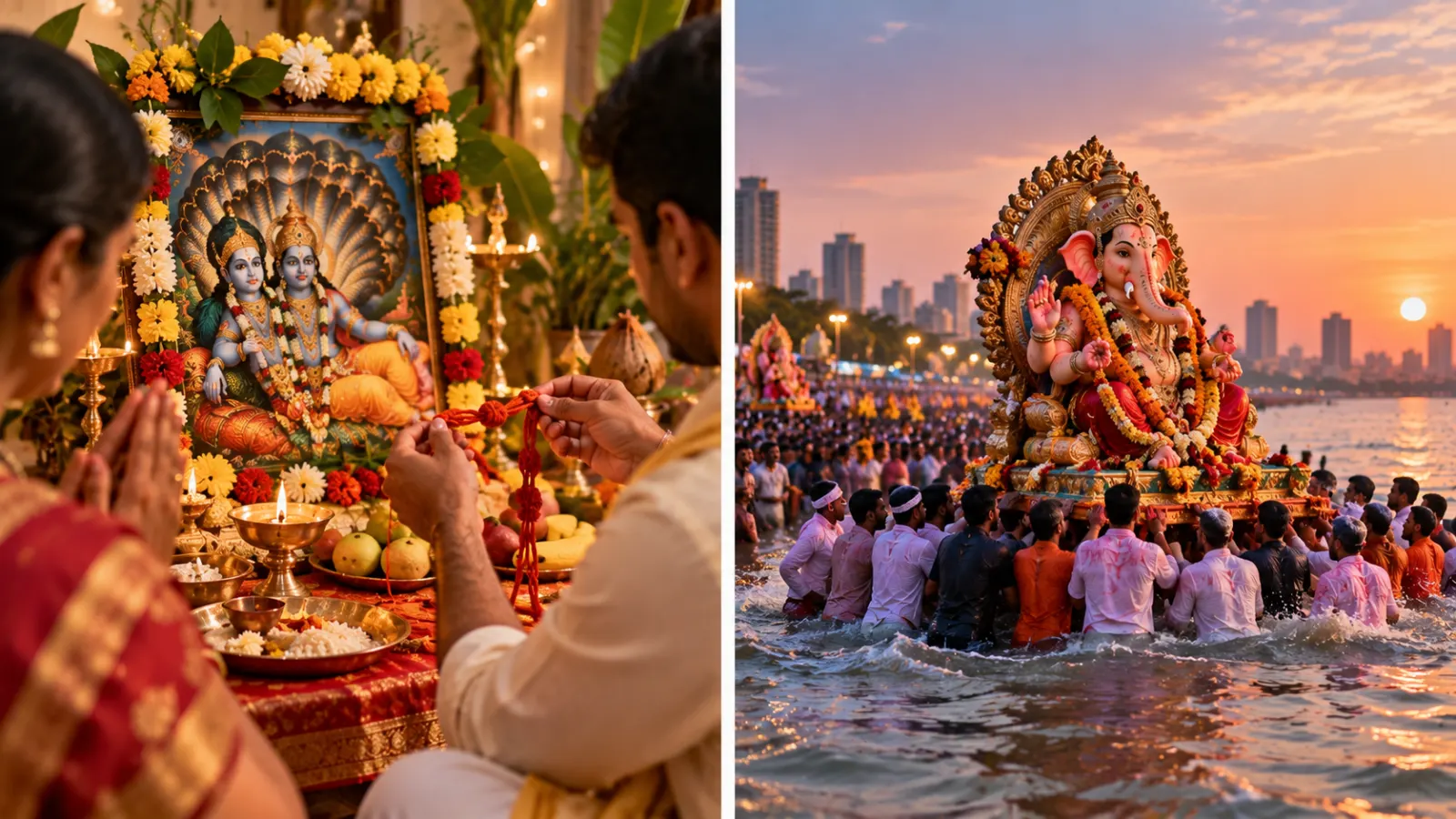
Anant Chaturdashi 2026: Date, Significance, Puja and Ganesh Visarjan
Anant Chaturdashi 2026 will be observed on Friday, September 25. The festival falls on the Chaturdashi, or fourteenth lunar day, of the Shukla Paksha in the Hindu month of Bhadrapada. It is associated primarily with the worship of Lord Vishnu in his Anant, or infinite, form, while in many parts of India the same day also marks the culmination of Ganeshotsav through Ganesh Visarjan.
For Delhi, the Chaturdashi Tithi begins at about 11:18 pm on September 24 and ends at 11:06 pm on September 25. Because the Chaturdashi prevails after sunrise on September 25, the festival is observed on Friday. Panchang timings can vary slightly by location, so devotees following a specific regional tradition should use timings calculated for their city.
What does Anant Chaturdashi mean?
The word Anant means endless, eternal or infinite. In the religious context of the festival, it refers to Lord Vishnu as Anant, representing continuity, stability and the infinite nature of the divine.
Chaturdashi means the fourteenth lunar day. Anant Chaturdashi is therefore the day on which devotees worship the Anant form of Vishnu and, according to family and regional traditions, may observe a vrat, perform puja and tie the sacred Anant Sutra.
The festival should not be understood only as another name for Ganesh Visarjan. The two observances coincide, but they have distinct religious traditions. Anant Chaturdashi is a Vishnu-centred observance in its own right, while Ganesh Visarjan marks the ceremonial conclusion of Ganeshotsav.
Why is the Anant Sutra tied?
One of the best-known rituals associated with Anant Chaturdashi is the tying of a sacred thread traditionally known as the Anant Sutra or Anant Dhaga.
The thread traditionally contains 14 knots. In religious interpretation, these knots are associated with the number fourteen and are commonly explained as representing the fourteen worlds described in Hindu cosmology. Devotees worship Lord Vishnu before tying the thread and regard it as a symbol of divine protection, commitment and remembrance of the Anant form of Vishnu.
Customs surrounding the thread vary between communities and families. Some traditions specify which arm it should be tied on for men and women, while others follow inherited household practices. Because Hindu ritual customs differ considerably across regions, such details are better treated as tradition-specific rather than universal rules.
The larger symbolism is easier to understand: the thread acts as a physical reminder of a religious vow and of the devotee's relationship with the divine.
The story behind Anant Chaturdashi Vrat
A traditional Anant Chaturdashi Vrat Katha tells the story of Sushila and Sage Kaundinya.
According to the traditional narrative, Sushila learned about the Anant Vrat from women performing worship and tied the fourteen-knotted sacred thread after observing the ritual. Kaundinya later removed the thread in anger. The story describes a subsequent loss of prosperity and his eventual search for Lord Anant, followed by repentance and restoration.
Another part of the traditional narrative connects the vrat with the Mahabharata. Lord Krishna is said to have advised Yudhishthira to observe the Anant Vrat during the Pandavas' period of hardship.
These accounts belong to the festival's religious tradition and should be understood as sacred narratives rather than historical records. Their role is to communicate ideas about faith, humility, perseverance and the fulfilment of a vow.
How Anant Chaturdashi is traditionally observed
Practices differ by region, but devotees observing Anant Chaturdashi commonly begin the day with bathing and preparation for worship. A puja is performed for Lord Vishnu in his Anant form, and some traditions also include reverence for Sheshnag and Yamuna.
Offerings may include flowers, incense, lamps, fruit and food prepared according to family custom. After worship, the Anant Sutra is tied while prayers are offered.
Many devotees also observe a vrat. Some take only fruits during the day, while others follow a one-meal fast or another form prescribed by family tradition. There is no single fasting pattern followed by every Hindu community.
The emphasis of the observance is traditionally placed on devotion, discipline and keeping the religious vow with sincerity rather than merely performing the external ritual.
Why Ganesh Visarjan happens on Anant Chaturdashi
For millions of devotees, particularly in Maharashtra and other regions with major public Ganeshotsav celebrations, Anant Chaturdashi is immediately associated with Ganesh Visarjan.
Ganesh Chaturthi in 2026 fell on September 14, and the major concluding Visarjan takes place on September 25, Anant Chaturdashi.
During Ganeshotsav, idols of Lord Ganesha are installed in homes and public pandals and worshipped over a period that varies according to family or community tradition. Some devotees perform visarjan after one-and-a-half days, while others choose the third, fifth or seventh day. The most prominent concluding immersion takes place on Anant Chaturdashi.
The immersion is accompanied in many places by processions, devotional music and chants before the idol is respectfully immersed according to local rules and customs.
The farewell is emotionally significant because Ganesh Visarjan combines celebration with separation. Devotees bid farewell to Ganesha while expressing the hope that he will return the following year.
Anant Chaturdashi and Ganesh Visarjan are related, but not identical
Because Ganesh Visarjan receives enormous public attention, the original Vishnu-related importance of Anant Chaturdashi can sometimes be overlooked.
The distinction is useful:
Anant Chaturdashi centres on Lord Vishnu in his Anant form, Anant Vrat and the sacred thread.
Ganesh Visarjan marks the conclusion of Ganeshotsav and the immersion of Ganesha idols.
They occur on the same day in the festival calendar, which has brought the two traditions together in contemporary public observance.
Understanding both dimensions gives a more complete picture of September 25.
The symbolism of infinity, vows and letting go
The two major religious traditions associated with the day also create an interesting symbolic contrast.
Anant Chaturdashi invokes Anant—the infinite and enduring. Its sacred thread represents continuity and commitment.
Ganesh Visarjan, meanwhile, involves respectfully letting go of an image that has been worshipped with devotion for days.
One ritual therefore emphasises continuity; the other visibly expresses impermanence and return.
For devotees, these ideas need not contradict one another. Hindu religious traditions frequently use temporary physical forms to express ideas regarded as timeless. An idol may be immersed, while devotion continues. A festival ends, while the values associated with it are expected to remain.
This is one reason the day carries both solemn and celebratory emotions.
Environmental responsibility during Ganesh Visarjan
Modern Ganesh Visarjan also raises an important environmental question.
Large-scale idol immersion can affect rivers, lakes and coastal waters depending on the materials used in idols, paints, decorations and offerings. Many cities therefore increasingly encourage clay idols, artificial immersion tanks and collection systems for flowers and other materials.
Religious observance and environmental responsibility do not have to be treated as opposing ideas. The underlying purpose of visarjan can be preserved while reducing avoidable pollution.
Families using small idols can follow local municipal instructions regarding designated immersion sites or artificial tanks. Public mandals likewise have an important responsibility to comply with crowd-control, safety and environmental regulations.
This is particularly relevant on Anant Chaturdashi because major immersion processions can draw exceptionally large crowds. Mumbai's transport authorities, for example, have made special operational changes for September 25, 2026, because of anticipated Ganesh Visarjan crowds.
What makes Anant Chaturdashi significant in 2026?
Anant Chaturdashi 2026 falls on Friday, September 25, with Chaturdashi continuing through most of the day. For devotees of Vishnu, it is a day of Anant worship, vrat and the sacred thread. For Ganesh devotees, it marks the major concluding day of Ganeshotsav.
The festival therefore occupies an unusual place in the Hindu calendar. It brings together two distinct traditions—one centred on the idea of the eternal and another centred on ceremonial farewell.
Beyond the rituals, the day carries a broader theme that remains understandable even outside its religious context: some things are meant to be held onto, while others must eventually be released.
For devotees observing Anant Chaturdashi, the sacred thread symbolises continuity of faith. For those participating in Ganesh Visarjan, immersion represents farewell with the expectation of return.
Together, those traditions make Anant Chaturdashi one of the most symbolically layered festival days of the year.