Language is often treated as a tool for communication, but in culture it is much more than that. Language is the system through which a community names the world, remembers its past, teaches its children, expresses emotion, organises social relations, preserves knowledge and imagines the future. A language is not simply a set of words. It is a cultural home.
Every culture needs language because meaning must be shared. Food, rituals, laws, songs, jokes, prayers, kinship, morality, work and identity all depend on language. A community may dance, build, paint or perform without written words, but even these practices are usually surrounded by spoken instruction, stories, names, praise, criticism and memory. Language gives culture continuity by allowing one generation to speak to the next.
The first role of language in culture is naming. When a community names plants, seasons, relationships, emotions, tools, rituals, places and social roles, it does more than label objects. It organises reality. A language may have fine distinctions for kinship, weather, crops, colours, honour, ritual status, landscapes or moral behaviour because those things matter in that culture. What a language names carefully reveals what a community has learned to notice.
For example, agricultural communities often carry rich vocabularies for soil, rain, seasons, seeds and livestock. Fishing communities may have detailed words for tides, winds, boats and marine life. Religious communities may preserve technical words for ritual, doctrine and sacred experience. Urban youth may generate slang for technology, dating, status and humour. Language grows where life is dense. It records the priorities of a society.
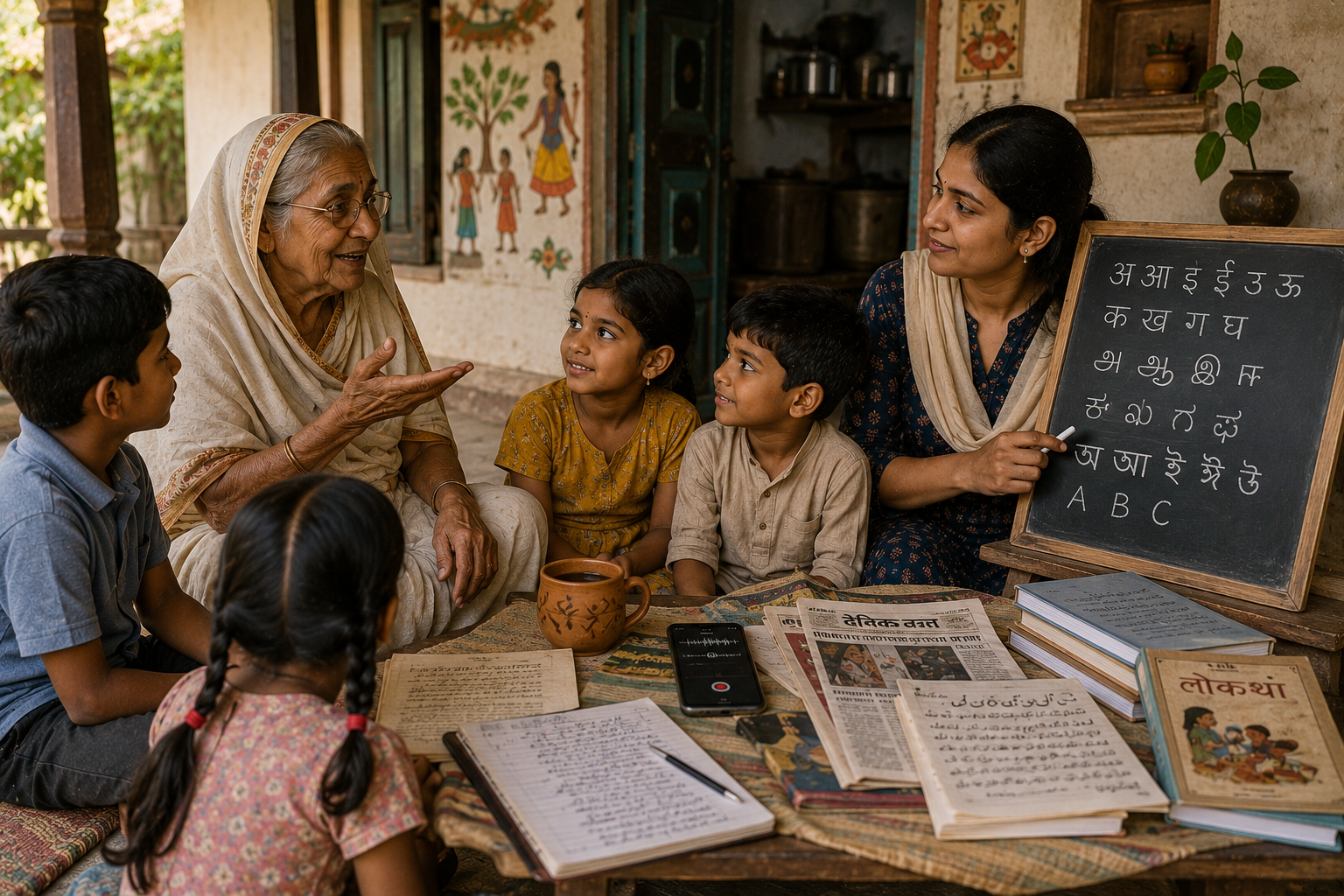
Language also carries memory. Oral histories, myths, epics, proverbs, lullabies, jokes, blessings, curses and folk songs all depend on language. A proverb can compress generations of observation into one line. A folk tale can teach moral lessons without formal instruction. A lullaby can carry regional rhythm and family tenderness. A prayer can preserve a sacred worldview. When these forms are translated, meaning may survive, but emotional texture often changes.
This is why people feel differently about their mother tongue. A person may be fluent in several languages, but the language of childhood often carries emotional depth. It is the language in which people first hear comfort, warning, affection, discipline, gossip and belonging. It may not be the most economically useful language, but it may be the most intimate. When people say a word “cannot be translated,” they usually mean that the word carries cultural experience beyond dictionary meaning.
Language is also central to identity. People often recognise each other through accent, dialect, vocabulary and script. A language can identify region, class, caste, tribe, generation, education, migration history and community belonging. Even within the same language, dialects can signal social worlds. The way someone speaks can make them feel at home or make them feel judged. Language is therefore both bridge and boundary.
This boundary can be gentle or harsh. Shared language can create instant belonging. Two strangers hearing their mother tongue in a foreign city may feel immediate connection. But language difference can also produce exclusion. People may be mocked for accents, denied services, disadvantaged in courts, silenced in classrooms or treated as less intelligent because they do not speak a dominant language. Language is never only linguistic; it is social power.
Education shows this power clearly. Children learn best when they understand the language of instruction. UNESCO has repeatedly emphasised the importance of multilingual education and notes that a large share of the world’s population still lacks access to education in a language they speak or understand. When a child is forced to learn through an unfamiliar language too early, the child may appear weak despite being intelligent. The problem is not ability; it is access to meaning.
Mother tongue-based education is therefore not sentimental. It is pedagogical and cultural. It allows children to build concepts in a language they know, while gradually learning additional languages. It also tells the child that their home language has dignity. A school that treats a child’s language as worthless does not merely teach a curriculum; it teaches shame. A school that recognises linguistic diversity strengthens inclusion.
Language also shapes social hierarchy. Some languages are treated as prestigious because of state power, colonial history, religion, economic mobility or elite education. Others are treated as local, backward, rural or informal. This hierarchy affects jobs, marriage, confidence and public participation. A person who speaks a dominant language may move easily through institutions. A person who does not may face invisible barriers.
In many postcolonial societies, language carries the memory of colonial rule and modern aspiration. English, French, Spanish, Portuguese or other colonial languages may become associated with education, law, administration and global mobility. At the same time, local languages remain central to home, emotion, folk culture and political identity. This creates a complicated language economy: people may need a global language for opportunity while needing a mother tongue for rootedness.
Language is also political because states must choose official languages, school languages, court languages and administrative languages. These choices can include or exclude communities. A state that recognises many languages may protect diversity but face administrative complexity. A state that promotes one language may build unity but risk suppressing minorities. Language policy is therefore not a technical issue; it is about citizenship, dignity and power.
Scripts add another layer. A script is not merely a writing system. It often carries religious, historical or civilisational identity. Communities may become deeply attached to scripts because they connect people to sacred texts, literary traditions, inscriptions, manuscripts and visual culture. Script debates can become emotional because changing a script may feel like breaking historical continuity. The written form of language becomes part of cultural memory.
Language also shapes how people relate to elders, strangers and authority. Many languages have honorifics, formal pronouns, kinship terms and speech levels that encode respect and hierarchy. The difference between “tu,” “tum” and “aap” in Hindi, or similar distinctions in other languages, is not only grammatical. It expresses intimacy, age, status, distance and politeness. Language teaches people social position through everyday speech.
Humour depends deeply on language. Jokes, puns, satire and irony often rely on local meanings. A joke may fail in translation because the cultural context is missing. Political memes, street slogans, film dialogues and internet slang reveal how language produces shared laughter. When people laugh together at a phrase, they confirm membership in a cultural world. Humour is one of the most informal but powerful forms of cultural bonding.
Language also preserves ecological and practical knowledge. Indigenous and local languages often contain knowledge of plants, animals, landscapes, healing practices, weather patterns and sustainable living. When a language declines, this knowledge may become fragile. UNESCO has noted that languages are repositories of histories, cultures and identities, and the disappearance of languages can take away cultural and intellectual heritage. This is why language loss is not only a linguistic issue but a cultural and ecological issue.
Migration changes the role of language. In migrant families, older generations may speak the heritage language while younger generations shift toward the dominant language of school and work. This can create emotional distance. Grandparents may struggle to share stories with grandchildren. Children may understand rituals but not the language of prayers. Parents may insist on mother tongue at home to preserve identity, while children respond in the dominant language. The family becomes a site of language negotiation.
Diaspora communities often create institutions to protect language: weekend schools, cultural associations, religious classes, online lessons, children’s books and community events. These efforts show that language does not survive automatically after migration. It needs spaces of use. A language spoken only by elders but not by children becomes vulnerable. Transmission requires daily life, not only symbolic pride.
Digital technology has created both danger and opportunity. Dominant languages benefit heavily from search engines, artificial intelligence, translation tools, keyboards, fonts, subtitles and online content. Smaller languages may be invisible online, making them less attractive to younger speakers. At the same time, technology can help document endangered languages, create digital dictionaries, record elders, produce learning apps and connect scattered speakers. UNESCO’s recent language work highlights that technology can either support linguistic diversity or accelerate language disappearance.
Language also changes constantly. New words enter through technology, cinema, politics, migration and youth culture. Purists often fear that borrowing corrupts language, but borrowing is part of linguistic life. Languages have always absorbed, adapted and transformed words. The real danger is not change; it is abandonment. A living language can borrow and still remain strong. A language is in trouble when people stop using it with children.
One misconception is that language is only a vehicle for culture. In reality, language is part of culture itself. The choice of words, tone, silence, address, metaphor and storytelling style all reflect cultural values. Some cultures value direct speech; others value indirectness. Some prize verbal eloquence; others value restraint. Some use elaborate greetings; others prefer efficiency. Language does not merely describe culture; it performs culture.
Another misconception is that multilingualism weakens national unity. In fact, multilingual societies can be strong when diversity is managed with fairness. A person can speak a mother tongue at home, a regional language in public, a national language for citizenship and a global language for work. Multiple languages do not divide a society automatically. Inequality, disrespect and forced hierarchy divide societies. Respectful multilingualism can widen participation.
The role of language in culture is therefore foundational. Language gives names to experience, carries memory, teaches values, creates belonging, organises power, protects knowledge and shapes identity. It lives in formal literature and casual gossip, sacred chants and street slang, school textbooks and family jokes. It is both inheritance and daily practice.
When a society protects its languages, it protects more than vocabulary. It protects ways of seeing. When it humiliates a language, it humiliates the people who carry it. When it allows children to learn in languages they understand, it expands dignity and opportunity. When it documents endangered speech, it preserves human knowledge.
Language is culture speaking. It is how memory becomes sound, how belonging becomes conversation, and how a community tells the world: this is what we have seen, suffered, loved, believed and learned.
The role of language can also be seen in silence. Cultures do not only teach people what to say; they teach when not to speak. Silence before elders, silence in grief, silence during prayer, silence in disagreement or silence as protest can carry very different meanings. In one setting, silence may show respect. In another, it may indicate fear. In another, it may signal refusal. Language therefore includes the cultural management of speech and non-speech. A society’s rules about who may speak, who must listen and whose words count reveal its deeper power structure.
Translation further shows why language is central to culture. Translation can build bridges, but it cannot always carry every layer of meaning. Words related to kinship, honour, devotion, shame, hospitality, caste, tribe, ecological knowledge or spiritual experience may have no exact equivalent in another language. A translator must often explain a cultural world, not just replace a word. This is why literature in translation can travel globally but still leave readers aware that something of the original rhythm, intimacy or social code remains rooted in the source language.
Language also influences how societies imagine time and memory. Some communities organise stories around ancestors; some around progress; some around sacred cycles; some around historical trauma. The verbs, metaphors and narrative structures available in a language help shape how experience is told. This does not mean language traps thought completely, but it does mean language guides attention. It makes some distinctions easy to express and others harder. Culture then grows through the repeated use of these distinctions.
For editors and educators, the key point is that language policy is cultural policy. Decisions about classroom language, subtitles, public signage, court translation, official forms, news media and digital tools decide whose knowledge becomes visible. A society that protects many languages is not merely preserving diversity as decoration. It is widening the number of people who can participate with dignity. Language inclusion is therefore not a favour to minorities; it is a condition of democratic culture.