Urban Farming: Benefits, Limits and Its Role in Resilient Cities
Urban farming brings food production into the places where most people increasingly live. Vegetables may grow in community plots, herbs on rooftops, fruit trees in residential compounds, produce in school gardens and commercial crops in greenhouses or hydroponic systems. Around the edges of cities, peri-urban farms can operate at much larger scales and supply nearby markets. Together, these activities challenge the familiar assumption that agriculture begins only after the city ends.
The Food and Agriculture Organization uses a broad concept of urban and peri-urban agriculture that includes food production and related activities within cities and their surrounding regions. That breadth matters because urban farming is not one technology or one type of project. A family growing vegetables in a small plot, a cooperative managing a community garden and a commercial hydroponic operation may all be forms of urban agriculture, but they have very different costs, objectives and environmental effects.
The strongest case for urban farming is therefore not that cities can grow everything they consume. Dense urban areas will continue to depend on regional, national and international food systems for much of their grain, oils, livestock feed and other staples. Urban farming is more useful when understood as one additional layer of the food system: a way to produce some fresh and perishable foods locally, use certain urban spaces productively, create livelihoods, support education and strengthen connections between residents and food production.
Its value depends less on whether farming occurs inside a city than on how well the system is designed.
Urban Farming Takes Many Different Forms
Community gardens are among the most familiar forms of urban agriculture. Residents may share a common growing space or manage individual plots within the same site. These gardens can produce vegetables, herbs and fruit while creating spaces for neighbourhood interaction, education and recreation.
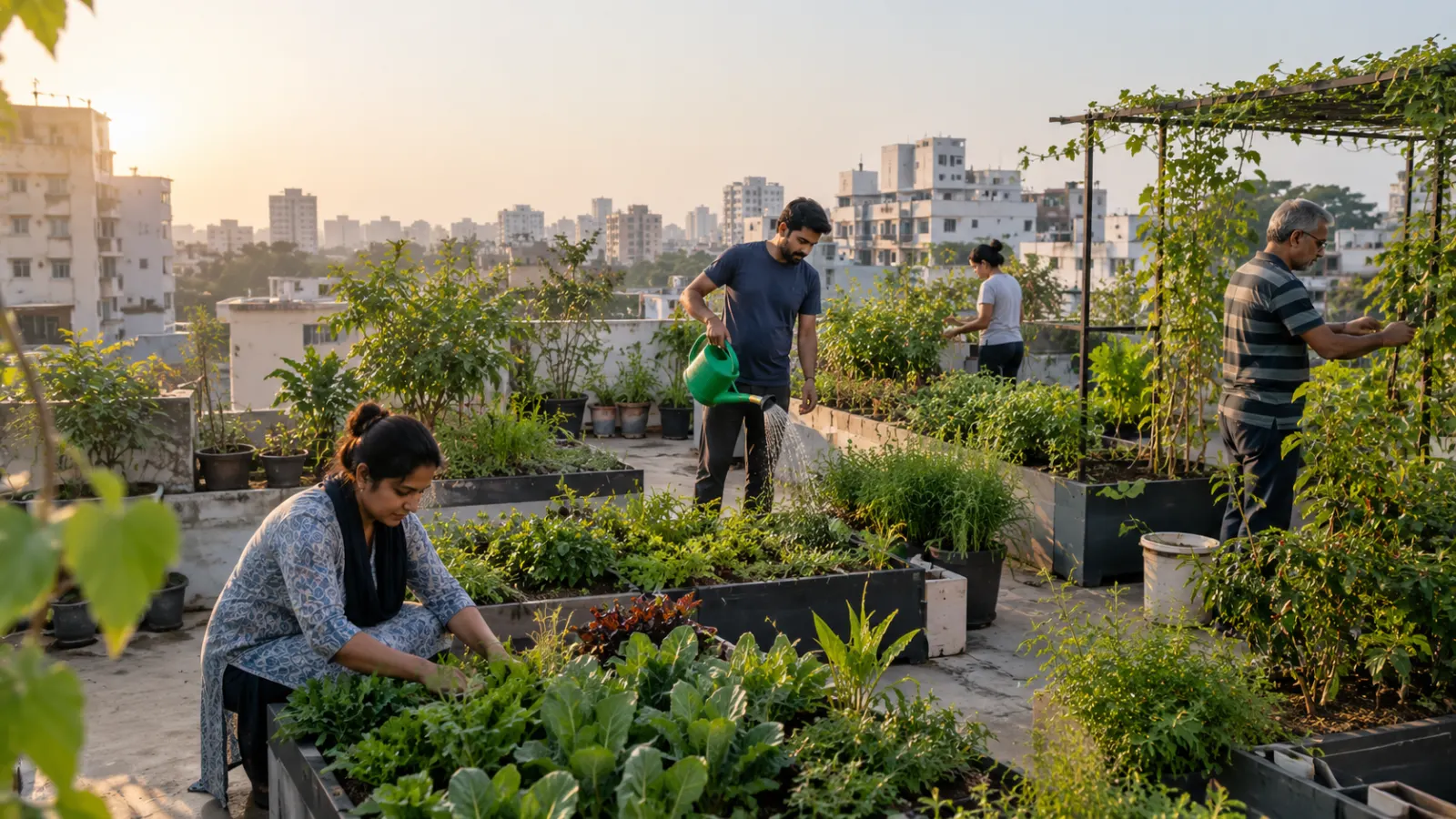
Rooftop farming uses a different kind of underused space. Flat roofs can receive abundant sunlight and may be suitable for containers, raised beds, greenhouses or other systems where building structure, waterproofing, drainage and safe access permit them. Rooftops can be especially attractive in dense neighbourhoods where open land is scarce, but a roof that appears empty is not automatically suitable for agriculture. Loading capacity, wind exposure, irrigation, maintenance and access all have to be considered.
Hydroponic and other controlled-environment systems can reduce dependence on conventional soil and allow growers to manage water and nutrients more precisely. Commercial operators may use greenhouses, vertical growing systems or containers to produce high-value crops close to consumers. These systems can make productive use of limited land, but they also require equipment, technical knowledge, dependable water and, in some cases, significant energy.
Schools, hospitals, housing complexes and public institutions may operate smaller gardens whose main purpose is not commercial production. A school garden can teach children where food comes from. A hospital or housing estate may use a garden for recreation, nutrition education or community activity. Peri-urban farms on the outskirts of cities, meanwhile, can retain more conventional agricultural characteristics while benefiting from proximity to large urban markets.
These models should not be judged by the same standard. A neighbourhood garden may succeed because it improves community interaction and access to fresh vegetables even if its financial return is small. A commercial greenhouse, by contrast, must usually demonstrate that production can cover substantial operating costs. The objective of the project determines the appropriate measure of success.
Fresh Food, Livelihoods and Community Benefits
Urban farming can shorten the distance between the production and consumption of certain foods. This is especially relevant for leafy vegetables, herbs, some fruits and other products whose quality may decline relatively quickly after harvest. Produce grown nearby can sometimes move from farm to consumer with less delay than food travelling through long distribution networks.
For households with suitable land or growing space, small-scale production may also reduce spending on some foods during productive seasons. Commercial farms can generate employment in cultivation, nursery operations, processing, packing, distribution and direct marketing. Peri-urban producers may gain access to large consumer markets without being located deep within the city itself.
Yet food production is only one part of the potential value. Urban gardens can become places where residents exchange skills, children learn about agriculture and communities maintain knowledge about how food is grown. They can make food production visible in urban environments where many consumers otherwise encounter agriculture only through shops and packaged products.
These social and educational benefits help explain why yield alone is an incomplete measure of urban farming. A community garden producing a modest quantity of vegetables may still provide recreation, learning, social contact and environmental functions. Conversely, a technologically impressive indoor farm producing large quantities of food may provide few of those broader community benefits.
This distinction also matters for food security. Producing food within a city does not automatically mean that residents who need nutritious food most will gain access to it. Produce may remain expensive, land may be located in wealthier districts, or growers may lack reliable ways to distribute surplus production. Food security depends on affordability, distribution, income and access as well as physical production.
Urban agriculture therefore works best when it is connected to the larger food system rather than treated as an isolated gardening initiative.
Environmental Benefits Depend on How Food Is Grown
Productive green spaces can perform several functions simultaneously. Vegetation can shade surfaces, growing areas may absorb some rainfall, composting can return certain organic materials to productive use, and flowering plants can provide habitat for insects. Gardens may also create green spaces in neighbourhoods where residents have limited access to vegetation.
This multifunctionality can be particularly valuable in cities where land is scarce. A space that contributes to food production, recreation, education and stormwater management may provide benefits that are difficult to capture through agricultural output alone.
But urban farming should not automatically be labelled sustainable simply because food is grown near consumers. Environmental performance depends on the crop, climate, growing system, source of inputs and infrastructure required to maintain production.
Irrigated gardens can increase water demand. Greenhouses may require heating or cooling. Indoor farms using artificial lighting can consume substantial electricity. Fertilisers and imported growing media carry environmental costs of their own. A technologically intensive production system may therefore have a larger resource footprint than its location suggests.
The same caution applies to assumptions about food miles. Shorter transport distances can be useful, particularly for highly perishable produce, but transport is only one component of a food system's environmental impact. Production methods, energy use, storage, waste and inputs can sometimes matter just as much or more.
The question is therefore not simply whether food was grown inside the city. It is whether the entire production system uses resources effectively compared with the alternatives available.
Soil, Water and Food Safety Are Fundamental
Urban farming introduces a challenge that cannot be solved through enthusiasm alone: not every vacant urban plot is safe for food production.
Land within cities may have been exposed to decades of traffic, industrial activity, construction waste or other sources of contamination. Some pollutants, including heavy metals such as lead, can remain in soil long after the original source has disappeared. Irrigation water can also create risks when it contains pathogens or harmful chemicals.
Site assessment is therefore an essential part of responsible urban agriculture. Depending on local conditions, growers may need soil testing, raised beds filled with clean soil, barriers separating crops from contaminated ground, carefully managed compost or reliable sources of irrigation water.
The type of crop and the pathway of exposure also matter. Contaminated dust settling on leafy vegetables presents a different problem from substances entering plants through roots. Produce that is eaten raw may require different hygiene precautions from crops that are processed or cooked.
Urban livestock creates its own set of concerns. Where permitted, animals can contribute food, manure and livelihoods, but poor management can create odour, waste, animal-welfare or disease problems. Local rules regarding livestock, pesticide use, wastewater, compost and food sales therefore form part of the urban farming system rather than unnecessary obstacles outside it.
In fact, the concentration of people in cities makes clear public-health standards especially important. Urban agriculture should be integrated into food-safety systems, not romanticised as an activity that exists beyond regulation.
Land and Economics Often Determine Whether Urban Farms Survive
A vacant urban plot can appear plentiful and inexpensive until land values increase. Community gardens are sometimes established on temporary land that later becomes attractive for housing, offices or infrastructure. Projects that take years to establish can therefore disappear quickly if growers have no secure tenure.
Commercial operators face an even more difficult economic calculation. Urban land and labour are frequently more expensive than their rural equivalents. Rooftop farms may incur costs for structural assessment, waterproofing, insurance, access and irrigation. Controlled-environment farms may need substantial capital investment and continuing expenditure on energy, equipment and technical staff.
These pressures help explain why visually impressive projects are not always financially durable.
Long-term urban farming therefore depends partly on institutional arrangements. Growers may need leases long enough to justify investment, zoning that permits appropriate agricultural activity, access to training or extension services, reliable markets and realistic business plans.
Public programmes can use different standards because their goals may be different. A city may support a community garden because it provides recreation, education, nutrition programmes or green space even if the garden could never survive as a commercial agricultural business. That does not make the project unsuccessful. It means its purpose is partly social rather than purely financial.
Problems arise when objectives remain unclear. A community programme should not be judged as though it were a venture-funded agricultural company, and a commercial farm should not rely indefinitely on social benefits to avoid questions about whether its business model is viable.
Urban farming becomes easier to evaluate when cities and growers first decide what problem they are trying to solve.
Policy, Resilience and Equity Shape the Larger Impact
Municipal policy can determine whether urban agriculture remains a collection of temporary experiments or becomes a stable part of neighbourhood life. Land-use planning can designate space for community gardens, establish procedures for temporary use of vacant land, permit appropriate rooftop structures or protect productive agricultural areas around urban boundaries.
Building regulations influence whether rooftop projects can operate safely. Public-health rules affect irrigation, compost, livestock and food sales. Waste policy can determine whether suitable organic material is available for composting. Market rules and transport infrastructure influence whether farmers can efficiently reach consumers.
No single policy creates urban farming, but many ordinary administrative decisions affect whether growers can operate with confidence.
Climate resilience adds another dimension. A network of urban gardens cannot replace the enormous food flows supplying a modern city, particularly during a large disruption. But local production can provide some fresh food, maintain agricultural knowledge and strengthen community organisation. Preserving productive farms around cities may also create additional supply routes and reduce complete dependence on distant producers.
The resilience benefit is therefore better understood as diversification than self-sufficiency. Cities become more resilient when they have multiple food sources, functioning wholesale markets, cold chains, transport links, safe water systems and productive relationships with surrounding agricultural regions.
Equity is equally important. Urban agriculture can become highly visible in affluent neighbourhoods while residents in food-insecure areas continue to lack land, water, tools or reliable access to nutritious food. A programme cannot claim broad social impact simply because gardens exist somewhere within the city.
Public policy can address this by making land-access procedures transparent, supporting cooperatives, extending training and technical assistance, and considering underserved neighbourhoods when allocating public resources. Where urban farming receives government support, the distribution of benefits should form part of the evaluation.
Urban Farming Is One Layer of a Resilient Food System
Urban farming is neither a gimmick nor a complete answer to the challenge of feeding cities. Both extremes misunderstand what it can realistically do.
Cities will continue to rely heavily on farms and food systems extending far beyond their boundaries. Dense urban areas cannot provide enough land to produce all the grains, oils, animal feed and other staples consumed by millions of residents. Wholesale markets, transport networks, cold storage, regional farms and national food systems therefore remain essential.
Urban agriculture can complement those systems. It can produce fresh foods close to consumers, create livelihoods, provide education, reuse some underused spaces, support community activity and add environmental functions to urban landscapes. Peri-urban agriculture can strengthen connections between cities and nearby productive land. Community gardens can create benefits that extend far beyond the amount of food harvested.
But those advantages depend on safe soil and water, realistic economics, secure access to land, appropriate regulation and clear objectives. A rooftop farm is not automatically sustainable because it sits above a city. A hydroponic system is not automatically efficient because it uses advanced technology. A community garden is not automatically equitable because it is open in principle.
The most useful way to understand urban farming is therefore as part of a broader urban food strategy. Its contribution is strongest when cities connect local production with regional agriculture, markets, infrastructure, public health, planning and social policy.
Urban farming does not have to feed an entire city to matter. Its value lies in doing particular things well—producing suitable foods, strengthening local connections, using selected spaces productively and adding another source of flexibility to a food system that will always operate across multiple scales.