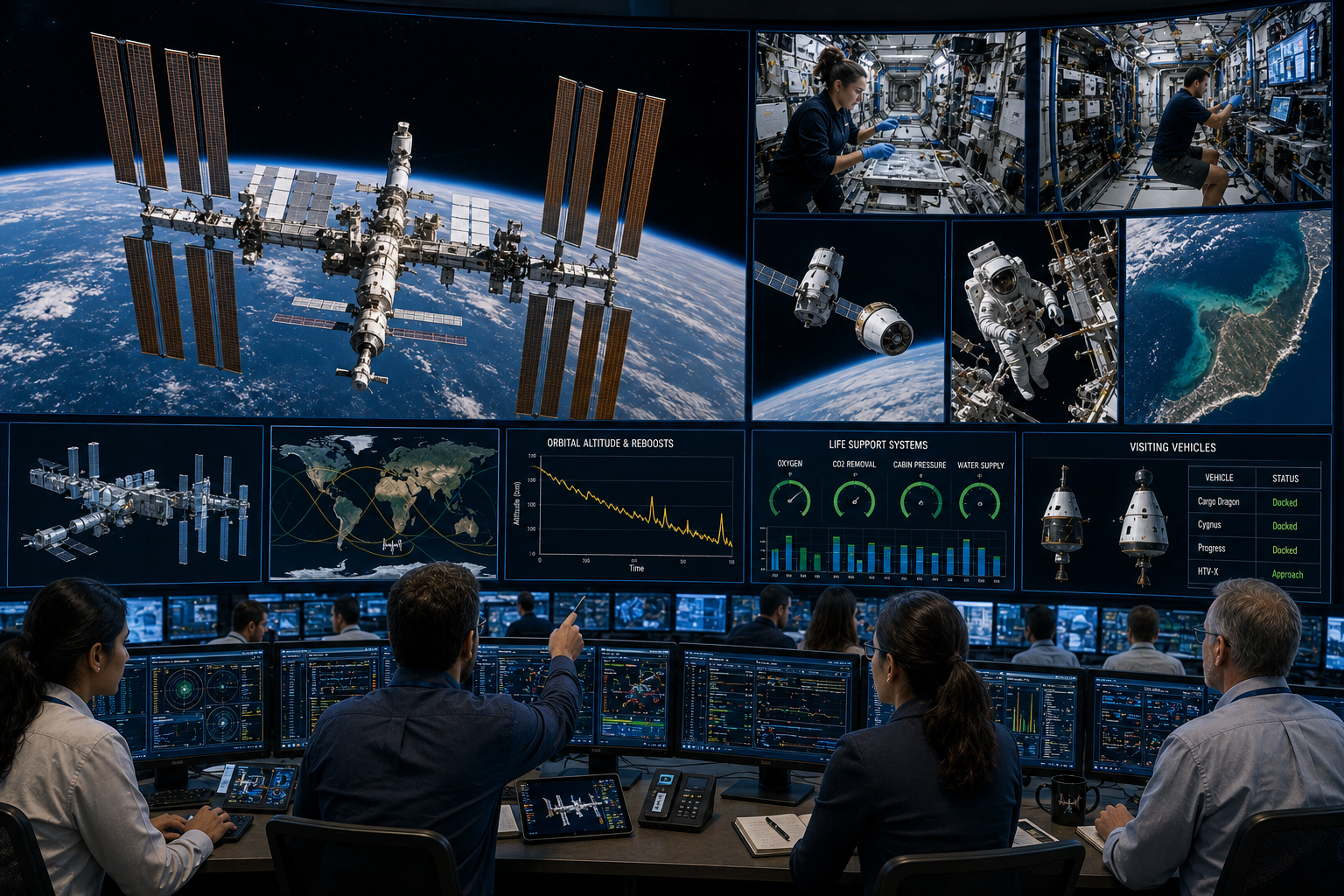
The International Space Station is often described as a home in space, but that phrase only captures part of its importance. It is also a laboratory, engineering platform, diplomatic project, observation post and training ground for future missions. It circles Earth so quickly that crews see multiple sunrises and sunsets in a single day, yet it remains close enough to be part of Earth’s technological system.
What the ISS Is
The International Space Station, or ISS, is a large spacecraft in low Earth orbit. It is not a single rocket or a simple capsule. It is a complex structure made of pressurised modules, truss sections, solar arrays, radiators, docking ports, robotic systems and scientific equipment. It was assembled in space over many years through multiple missions, with different nations contributing modules, hardware, crews and operations.
Why It Is in Orbit
The ISS stays in orbit for the same reason other satellites do: it has enough forward speed that it continuously falls around Earth rather than directly back to the surface. It is still under the influence of gravity. The crew and station are in free fall together, which creates the experience commonly called microgravity. This environment is central to the station’s scientific value.
What Microgravity Means
Microgravity does not mean there is absolutely no gravity. It means the effects of gravity are greatly reduced from the point of view of the people and objects inside the station. Fluids behave differently. Flames burn differently. Muscles and bones respond differently when they do not have to support body weight in the usual way. Materials can form, mix or crystallise differently. These changes make the ISS a unique research environment.
What Astronauts Do There
Astronauts on the ISS do far more than float for dramatic photographs. Their work includes conducting experiments, maintaining station systems, exercising to protect health, operating robotic equipment, communicating with mission control, performing spacewalk preparations and managing supplies. Much of the job is disciplined routine. A spacecraft that supports human life must be monitored constantly, because air, water, temperature, electricity and communication are all engineered systems.
Science on the Station
The station supports experiments in biology, medicine, physics, materials science, Earth observation, combustion, fluid behaviour and technology testing. Researchers use it to study how living organisms respond to space conditions, how human health changes in long-duration flight, and how equipment performs beyond Earth. The value of the ISS is not only in single discoveries. It is in creating a long-term platform where science can be repeated, improved and compared over time.
Engineering Behind the Station
Keeping the ISS alive is an engineering achievement. Solar arrays generate electrical power. Radiators release heat. Life-support systems manage air and water. Docking systems allow visiting spacecraft to arrive with crew, equipment and supplies. Communication systems connect the station to Earth. Robotic arms assist with cargo handling and external maintenance. Even the orientation of the station must be controlled so power, temperature and communication remain stable.
Why Reboosts Are Needed
Although the ISS is above most of the atmosphere, it is not above all of it. Thin atmospheric particles create drag, gradually reducing the station’s altitude. Periodic reboosts use visiting spacecraft or station systems to raise the orbit. Without such corrections, the station would slowly lose height and eventually re-enter the atmosphere. This is a reminder that low Earth orbit is active, not empty.
Final Takeaway
The International Space Station matters because it turns space from a place visited briefly into a place where humans can live, work, repair systems and conduct long-term science. It teaches engineers how to maintain complex machines in orbit and helps scientists study life and materials in microgravity. Above all, it shows that space exploration is not only about distance. It is also about learning how to operate responsibly beyond Earth.