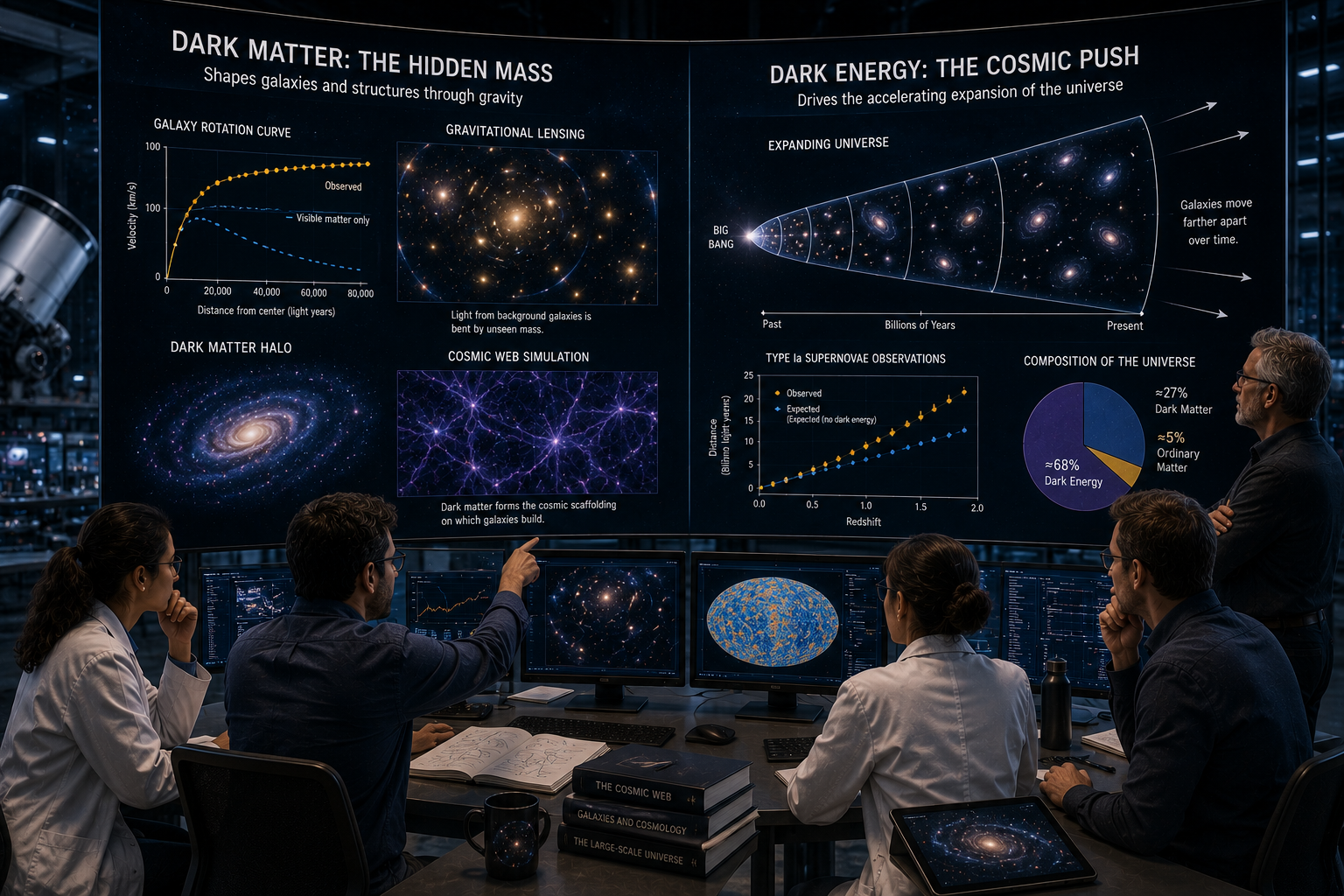
The most familiar parts of the universe are stars, planets, moons, dust clouds and galaxies glowing across the night sky. Yet modern cosmology suggests that this visible world is only a small part of the whole cosmic inventory. Two mysterious ideas - dark matter and dark energy - dominate the scientific picture of the universe. Their names sound similar, but they refer to very different problems.
Why “Dark” Does Not Mean Evil or Magical
In physics and astronomy, dark usually means not directly visible in ordinary light. Dark matter is called dark because it does not shine, absorb or reflect light in the familiar way. Dark energy is called dark because its nature is unknown and because it is inferred from cosmic behaviour rather than seen directly. The word is therefore a label for ignorance and invisibility, not a claim that these things are supernatural.
What Dark Matter Seems to Do
Dark matter appears to act mainly through gravity. Galaxies rotate in ways that cannot be fully explained by the visible stars and gas alone. Galaxy clusters behave as if they contain more mass than telescopes can see. Light from distant objects can be bent by gravity as it passes massive clusters, and this gravitational lensing also indicates extra unseen mass. These clues suggest that something invisible contributes significantly to the gravitational structure of the universe.
Why Dark Matter Matters for Galaxies
Without dark matter, it would be much harder to explain how galaxies formed and stayed organised. Dark matter may provide a gravitational framework into which ordinary matter falls. Gas can cool, collect and form stars inside these structures. In that sense, dark matter is not a minor detail. It may be part of the scaffolding that helped turn the early universe into a web of galaxies, clusters and voids.
What Dark Energy Seems to Do
Dark energy is connected to a different observation: the universe’s expansion is accelerating. If gravity from matter were the only major influence, scientists would expect expansion to slow down over time. Instead, observations show that the expansion is speeding up. Dark energy is the name given to whatever is driving, or at least describing, that acceleration. It may be a property of space itself, but its true nature remains unknown.
The Difference Between Them
Dark matter pulls. Dark energy pushes, or more carefully, it is associated with accelerated expansion. Dark matter helps explain extra gravitational attraction inside and around galaxies. Dark energy helps explain why the large-scale expansion of the universe is speeding up. Dark matter clumps around cosmic structures; dark energy appears to be spread through space more uniformly. Confusing them is easy because both are invisible, but scientifically they solve different puzzles.
How Scientists Study What They Cannot See
Scientists do not need to see something directly to infer its existence. We infer wind from moving leaves, magnetic fields from iron filings and exoplanets from changes in starlight. In the same way, astronomers infer dark matter from gravitational effects and dark energy from expansion history. The challenge is to move from inference to deeper explanation: what particles, fields or physical laws actually produce these effects?
Why the Mystery Is Still Open
Dark matter and dark energy are not solved topics. Many experiments search for possible dark matter particles. Astronomers map galaxies and gravitational lensing to measure its distribution. Large surveys study supernovae, galaxy clustering and cosmic background radiation to understand dark energy. Some scientists also investigate whether modified theories of gravity could explain part of the evidence. The field remains active because the stakes are enormous: it concerns the basic contents and fate of the universe.
Final Takeaway
Dark matter and dark energy reveal how incomplete a purely visible view of the universe is. Dark matter is inferred from hidden gravitational mass shaping galaxies and clusters. Dark energy is linked to the accelerating expansion of space. Together they force a humbling conclusion: the luminous universe we see through telescopes may be only the most obvious layer of a much larger cosmic reality.