Carbon as the Planetary Accounting System
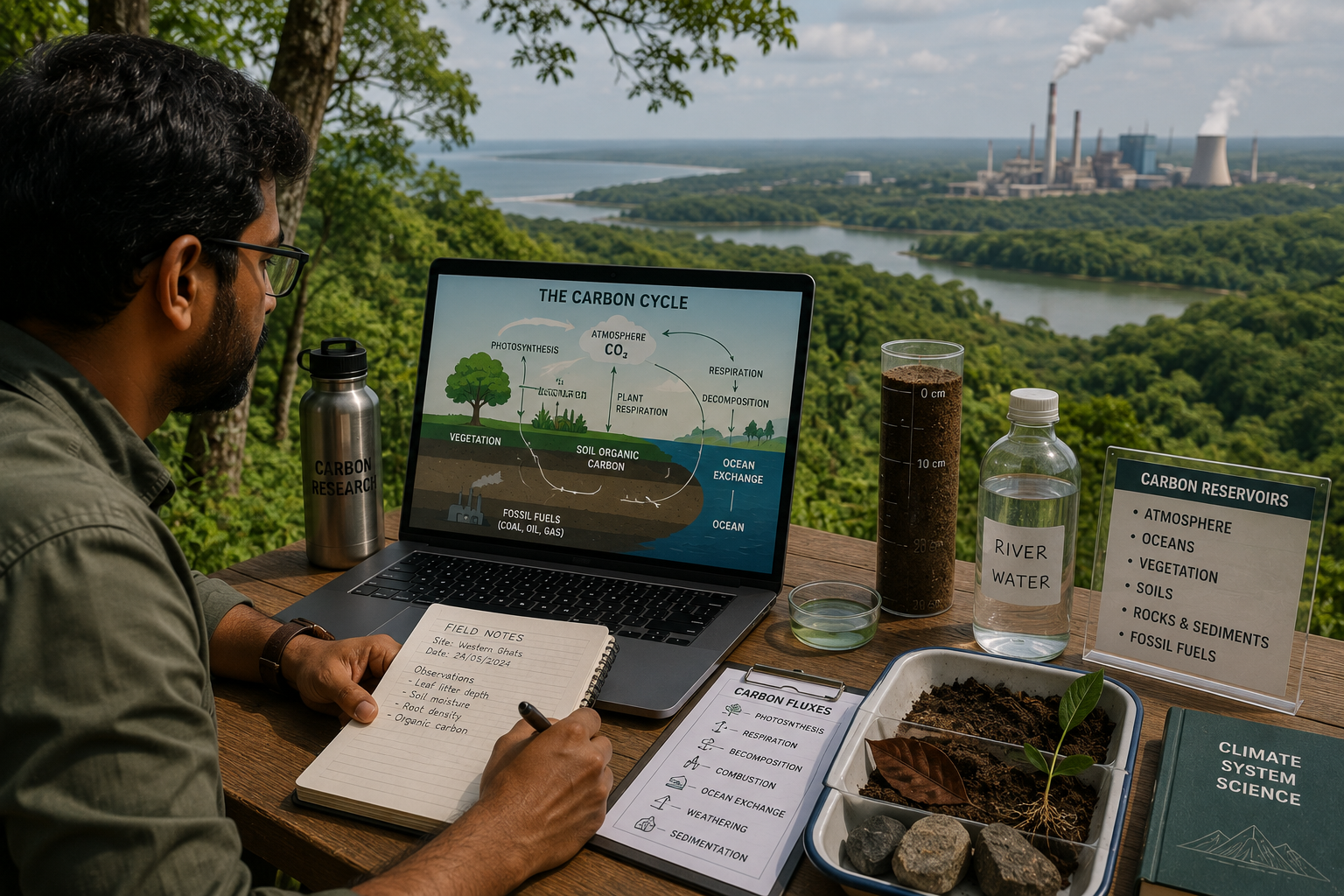
The carbon cycle is the planet’s long-running accounting system for one of the most important elements in life and climate. Carbon is in the air as carbon dioxide, in trees as wood and leaves, in soils as organic matter, in animals as tissue, in the ocean as dissolved carbon, in rocks as carbonate minerals, and underground as coal, oil and natural gas. It does not stay in one place. It moves, sometimes quickly through living organisms and sometimes slowly through rocks, oceans and geological processes. That movement is called the carbon cycle.
The idea sounds technical, but the logic is simple. Carbon atoms are constantly being transferred from one reservoir to another. A plant takes carbon dioxide from the air during photosynthesis and builds sugars, stems, roots and leaves. An animal eats the plant and incorporates some of that carbon into its body. Both plant and animal eventually respire, decay or burn, sending carbon back to the air, soil or water. At larger timescales, dead organic material may be buried, compressed and transformed into fossil fuels. Rocks weather, rivers carry carbon to the sea, marine organisms form shells, sediments become limestone, and volcanoes eventually return some carbon to the atmosphere.
The carbon cycle matters because it links life, climate, oceans, soils, energy and human development. It explains why forests can act as carbon sinks, why oceans absorb part of the carbon dioxide released by burning fossil fuels, why soils are not just dirt but major carbon stores, and why digging up ancient carbon and burning it in a few generations changes the atmosphere. Without the carbon cycle, climate change would appear as a vague pollution problem. With it, we can see the deeper mechanism: humans have accelerated the movement of carbon from long-term underground storage into the active atmosphere-ocean-land system.
Reservoirs, Flows and Timescales
A useful way to understand the cycle is to divide it into reservoirs and flows. A reservoir is a place where carbon is stored: the atmosphere, vegetation, soil, ocean, rocks or fossil fuels. A flow is the transfer between reservoirs: photosynthesis, respiration, decomposition, combustion, ocean exchange, weathering, sedimentation and volcanism. The size of a reservoir and the speed of a flow are not the same. Rocks store enormous amounts of carbon but usually exchange it slowly. The atmosphere stores less carbon than the ocean, but a small change in atmospheric carbon dioxide can strongly affect temperature because carbon dioxide is a greenhouse gas.
The fast carbon cycle operates mainly through life. Plants and phytoplankton take carbon dioxide from air or water and use sunlight to build organic molecules. This is photosynthesis. Animals, microbes and plants then release carbon dioxide through respiration. Dead leaves, roots and organisms decompose, transferring carbon to soil, water and the atmosphere. Fire can rapidly return plant carbon to the air. Seasonal changes in plant growth are visible in atmospheric carbon dioxide records: in the Northern Hemisphere spring and summer, growing vegetation draws down carbon dioxide; in autumn and winter, decay and reduced growth allow it to rise again.
The slow carbon cycle operates over thousands to millions of years. Rainfall reacts with carbon dioxide in the atmosphere to form weak carbonic acid, which weathers rocks. Rivers transport dissolved minerals and carbon to the ocean. Marine organisms use some of this material to build shells and skeletons. When they die, some shells and organic matter fall to the seafloor and become sediments. Over geological time, these sediments can turn into carbonate rocks or fossil fuels. Tectonic activity and volcanism can later return carbon to the atmosphere. This slow exchange acts like a planetary thermostat, but it works far too slowly to balance the rapid emissions created by modern industrial activity.
The Ocean, Forests and Soils
The ocean is central to the cycle because it is both a huge carbon reservoir and an active exchange surface. Carbon dioxide moves between the atmosphere and the ocean depending on temperature, winds, currents and chemistry. Cold water generally absorbs more carbon dioxide than warm water. Some carbon remains near the surface; some is carried into deeper waters through circulation. Marine plankton also take up carbon during photosynthesis, and some of that carbon sinks when organisms die. This biological pump helps move carbon from the surface to the deep ocean.
Ocean uptake is helpful because it slows the rate at which carbon dioxide accumulates in the atmosphere. But it is not free of consequences. When carbon dioxide dissolves in seawater, it changes ocean chemistry and contributes to ocean acidification. This can affect shell-building organisms, coral reefs and marine food webs. The ocean therefore protects the climate system from even faster warming while simultaneously absorbing stress. Calling the ocean a carbon sink should not make it sound like an unlimited dumping ground. It is a living, chemical and physical system with limits and consequences.
Forests and vegetation are another major part of the cycle. Through photosynthesis, trees remove carbon dioxide from the atmosphere and store carbon in trunks, branches, leaves and roots. Forest soils also store carbon through fallen leaves, decaying organic matter and root systems. When forests are cleared, burned or degraded, stored carbon is released and future carbon uptake is reduced. Reforestation, restoration and better land management can help, but they cannot simply cancel unlimited fossil-fuel emissions. A newly planted tree takes years to grow, while a barrel of oil releases ancient carbon almost immediately when burned.
Soils are often less visible than forests, but they are essential. Soil carbon comes from plant roots, dead organic matter, microbes and interactions between minerals and organic compounds. Healthy soils can hold significant carbon while supporting fertility, water retention and biodiversity. Bad land use, erosion, excessive disturbance and drainage of wetlands can release soil carbon. Peatlands are especially important because they store large amounts of carbon accumulated over long periods in waterlogged conditions. When peatlands are drained or burned, they can become major emission sources.
How Human Activity Disrupts the Cycle
Fossil fuels represent carbon that was removed from the active cycle over millions of years. Coal, oil and natural gas were formed from ancient organic matter buried under pressure and heat. In natural geological conditions, this carbon would return to the atmosphere only slowly. Industrial society changed that pace. By mining coal, drilling oil and extracting gas, humans moved stored geological carbon into the economic system. By burning those fuels for electricity, transport, industry and heating, we moved that carbon into the atmosphere in the form of carbon dioxide.
This is why human activity disrupts the carbon cycle. The problem is not that carbon dioxide exists or that carbon naturally moves. The problem is the speed and scale of the transfer. Modern emissions add extra carbon to the atmosphere much faster than natural sinks can absorb it. Land and oceans take up a portion, but not all. The rest accumulates in the atmosphere, strengthening the greenhouse effect and warming the planet. The carbon cycle is therefore out of balance not because nature stopped working, but because human systems are forcing carbon through the cycle at an unnatural rate.
A common misconception is that volcanoes emit more carbon dioxide than humans. This claim is not supported by mainstream Earth science. Volcanoes do release carbon dioxide as part of the slow carbon cycle, but modern human fossil-fuel combustion emits far more annually. The misconception survives because volcanoes look dramatic, while fossil-fuel emissions are dispersed through vehicles, power stations, factories, cement plants, homes and supply chains. The atmosphere responds to the total load, not to the drama of the source.
Another misconception is that because plants need carbon dioxide, more carbon dioxide must be purely beneficial. It is true that carbon dioxide supports photosynthesis. But plant growth also depends on water, nutrients, temperature, soil health, pests and extreme events. More carbon dioxide does not protect crops from heat stress, drought, flooding or ecosystem disruption. In some cases it may stimulate growth, but the wider climate impacts can reduce food security, damage forests and alter ecosystems. The carbon cycle is not a single fertilizer story. It is a whole-system balance story.
Solutions, Limits and Policy Relevance
The carbon cycle also explains why climate solutions need both emission reduction and carbon removal. Cutting emissions slows the addition of new carbon to the atmosphere. Protecting forests, restoring wetlands, improving soils and developing durable carbon removal methods can increase the amount removed or stored. But these two tasks are not interchangeable. Emission reduction prevents new damage. Removal deals with residual or historical carbon. A credible climate strategy prioritizes stopping the leak before celebrating the mop.
For policy, the carbon cycle clarifies the difference between temporary and permanent storage. Carbon stored in a forest can be released by fire, disease, illegal logging or land conversion. Carbon stored underground through geological storage may be more durable if properly monitored. Carbon in soil can rise or fall depending on management. Because storage types differ, climate accounting must consider permanence, leakage and measurement. A tonne of carbon temporarily held in trees is not automatically equivalent to a tonne of fossil carbon kept underground forever.
For businesses, the carbon cycle turns sustainability from marketing into material analysis. A company using fossil energy is drawing from geological carbon. A company buying agricultural products may influence soil and land carbon. A construction firm using cement is linked to process emissions and material choices. A food company affects emissions through land use, fertilizer, livestock, transport and waste. Understanding the cycle helps identify where carbon enters, moves and accumulates across a value chain.
For citizens, the carbon cycle gives everyday climate actions a larger logic. Saving electricity matters if electricity comes from fossil fuels. Public transport, efficient appliances and cleaner cooking reduce the flow of carbon from fossil reserves to air. Eating with less waste reduces pressure on land, energy and agricultural emissions. Supporting forest protection, wetland conservation and clean-energy policy strengthens the sinks and reduces the sources. The goal is not to memorize every carbon pathway. The goal is to see that daily systems are connected to planetary flows.
Final Takeaway
The carbon cycle also teaches humility. Earth has always had climate changes, carbon exchanges and natural feedbacks. But past natural change does not make present human-driven change harmless. In fact, Earth history shows the opposite: when carbon moves into the atmosphere rapidly, climate and ecosystems can change severely. The difference today is that the cause is not an asteroid, flood basalt or orbital shift. It is the combined effect of energy, land, industry and consumption choices made by human societies.
The final takeaway is simple: carbon is not the enemy. Carbon is life, food, soil, forests, oceans and energy. The problem is imbalance. Human beings have taken carbon stored underground for millions of years and released it rapidly into the air. The task of climate action is to restore a safer balance by reducing fossil carbon flows, protecting natural sinks, improving land and ocean stewardship, and using carbon removal only where it is scientifically credible. The carbon cycle is the map of that task.
A final editorial safeguard is to separate the concept from the claim. The concept may be scientifically valid, but a public claim still needs boundaries, data, assumptions, verification and proportionate language. Readers should not ask only whether a term sounds responsible. They should ask what the term includes, what it excludes, what evidence supports it, and whether the underlying emissions are actually falling over time. This habit turns sustainability language into accountability. It also protects the article from becoming a vocabulary lesson only. The strongest environmental writing connects definition, evidence, institutional responsibility and practical consequences. When these elements are kept together, readers can see why the concept matters for policy, business decisions, household choices and public debate rather than treating it as another technical phrase.
Key Takeaways
The carbon cycle describes how carbon moves through atmosphere, land, oceans, life, rocks and fossil fuels.
Fast carbon cycling happens through life; slow cycling happens through geology and oceans over much longer timescales.
Human activity disrupts the cycle by rapidly moving fossil carbon into the atmosphere.
Climate action requires reducing fossil-carbon flows while protecting and improving credible carbon sinks.