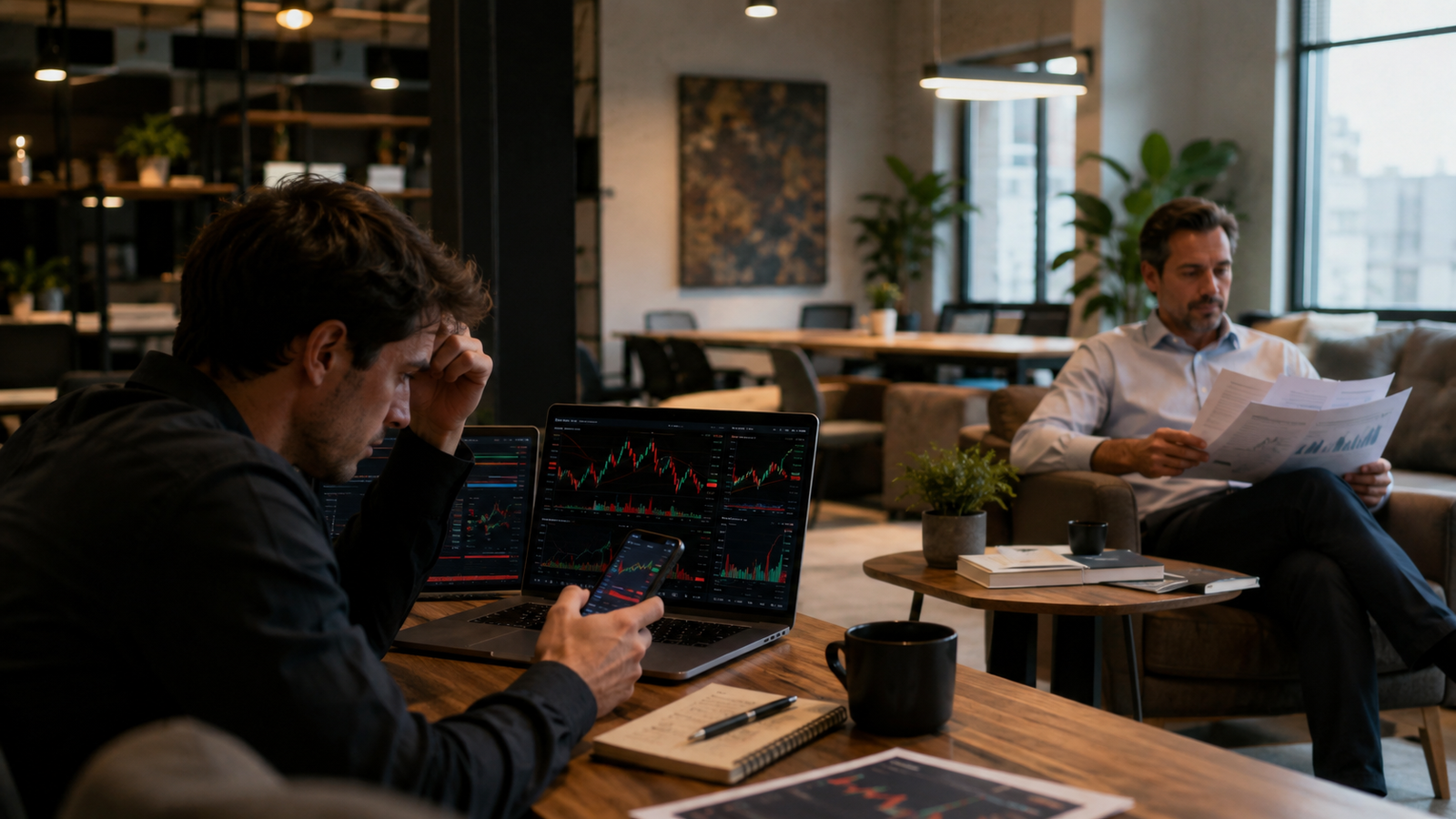
Two people can buy the same stock for completely different reasons
A trader and an investor may both buy the same share on the same day. Their actions look identical on the screen. Both place an order. Both own the stock for some time. Both hope to make money. But underneath the surface, they are doing very different things.
The trader is usually focused on price movement. They may hold the stock for minutes, hours, days or weeks. They care about momentum, chart patterns, news flow, volatility and timing. The investor is usually focused on business ownership. They may hold for years. They care about earnings, cash flows, competitive advantage, valuation, governance and long-term growth.
Confusing trading with investing is one of the most common beginner mistakes. People enter a stock for a quick trade, watch it fall, and then call themselves long-term investors. Others buy for long-term wealth creation but panic at every short-term price movement as if they were traders. The problem is not only terminology. It is mismatch of method, risk and behaviour.
What trading means
Trading is the act of buying and selling financial instruments with the aim of profiting from price movements over a relatively short period. The trader may use technical analysis, market news, order flow, price levels, indicators, derivatives, leverage or event-based strategies.
Trading can take many forms. Intraday traders close positions within the same day. Swing traders may hold for days or weeks. Positional traders may hold for longer but still focus mainly on price movement. Derivatives traders may use futures and options to take leveraged or hedged positions.
The common feature is that trading depends heavily on timing and execution. A trader must manage entry, exit, stop-loss, position size and risk. Being right about the broad direction is not enough. A trade can fail because timing, leverage or risk control is poor.
What investing means
Investing means committing money to an asset with the expectation that it will create value over time. In the stock market, investing usually means buying ownership in businesses directly through shares or indirectly through mutual funds, index funds or other vehicles.
Investors focus on long-term wealth creation. They may study the quality of the business, sector prospects, profitability, debt levels, management, cash flows, valuation and durability of growth. They are less concerned with daily price noise and more concerned with whether the asset can compound value over years.
Investing does not mean buying and forgetting blindly. Good investors review holdings, rebalance portfolios and respond when fundamentals change. But their decision framework is different from trading. They ask whether the asset deserves long-term capital, not merely whether the price may move tomorrow.
Time horizon: the first big difference
The clearest difference is time horizon. Trading is short term or medium term. Investing is long term. A trader may exit quickly if the price moves against them. An investor may tolerate volatility if the long-term thesis remains intact.
Time horizon changes everything. A trader needs liquidity, speed and discipline. An investor needs patience, valuation sense and emotional stability. A trader may care about a one-day breakout. An investor may care about a five-year earnings path.
The mistake begins when people enter without knowing their horizon. If you cannot answer how long you intend to hold and why, you are not following a strategy. You are reacting to price.
Risk: visible vs hidden
Trading risk is often visible and immediate. Prices move quickly. Losses can occur rapidly, especially with leverage. Costs such as brokerage, taxes, bid-ask spreads and slippage matter because trades are frequent. Emotional pressure is high because decisions are repeated often.
Investing risk is slower but still real. A company can decline structurally. A sector can become obsolete. A portfolio can remain overvalued for years. Poor diversification can create concentration risk. Inflation can reduce real returns.
Neither trading nor investing is automatically safe. Trading may be riskier for most beginners because it requires skill, emotional control and risk management. Investing can also be risky if done blindly, concentrated heavily or based on rumours.
Skill requirements are different
A trader needs to understand price behaviour, risk-reward ratios, position sizing, market microstructure, stop-loss discipline and psychological control. They need a process that can survive losing trades. They must accept that many trades may be wrong and still manage capital.
An investor needs to understand asset allocation, business quality, valuation, financial statements, industry structure, time horizon and behavioural biases. They need patience and the ability to avoid panic during volatility.
The skills overlap only partly. A good trader is not automatically a good investor. A good investor is not automatically a good trader. Each approach demands its own discipline.
Costs and taxation
Trading usually creates higher transaction costs because buying and selling happen frequently. Brokerage, securities transaction tax, exchange charges, GST, stamp duty and other costs can add up. Taxation may also differ depending on whether activity is treated as capital gains or business income, the holding period and the nature of instruments.
Investing generally involves fewer transactions, which can reduce costs. Long-term capital gains may receive different tax treatment from short-term gains depending on the asset class and current law. But investors must still track taxes, exit loads, dividend taxation and portfolio turnover.
The important point is that gross return is not the same as net return. A trader must earn enough to overcome costs and taxes repeatedly. An investor must plan for tax-efficient long-term outcomes.
Behavioural difference
Trading tests emotional speed. The trader must accept losses quickly, avoid revenge trading, control position size and not become addicted to action. Markets can create dopamine cycles: entry, movement, profit, loss, recovery attempt. Without discipline, trading becomes gambling with a financial interface.
Investing tests emotional patience. The investor must avoid panic, greed, herd mentality and overconfidence. They must hold through volatility but also avoid becoming stubborn when facts change.
Both approaches require self-knowledge. A person who cannot tolerate quick losses should not trade. A person who cannot hold through temporary decline may struggle to invest. Strategy must match temperament.
India angle: the rise of app-based market participation
In India, app-based investing and trading have expanded market participation. This is positive for financial inclusion, but it also creates risk. Easy account opening, colourful dashboards, instant charts and social media tips can make trading look simpler than it is.
Many beginners start with investing intentions but are pulled into short-term speculation. Others follow unregistered advice, options tips, Telegram channels or influencers without understanding risk. SEBI has repeatedly emphasised investor awareness, risk understanding and caution against unregistered or fraudulent market activity.
For Indian readers, the first discipline is to define identity: am I investing for goals, trading with a tested system, or merely reacting to market excitement? This distinction can prevent serious mistakes.
Which is better?
The better choice depends on skill, time, capital, temperament and goals. For most ordinary earners, disciplined long-term investing through diversified instruments is more suitable than active trading. It requires less screen time, reduces transaction frequency and aligns better with long-term goals.
Trading may be suitable for people who treat it as a serious skill, maintain risk rules, keep records, understand losses and avoid leverage misuse. It should not be approached as quick income or entertainment.
The worst approach is mixing both without clarity. A trade that fails should not automatically become an investment. An investment should not be judged by intraday noise. Each decision needs its own rulebook.
Final takeaway
Trading and investing are not the same activity. Trading seeks to profit from price movement. Investing seeks to build wealth through ownership and long-term value creation. Trading depends on timing and execution. Investing depends on patience, allocation and fundamentals.
Both can lose money. Both require discipline. But they demand different skills and mindsets. The beginner's first job is not to choose the most exciting strategy. It is to know what game they are playing.
Once that is clear, the rules become clearer too. A trader must manage risk like a professional. An investor must think like an owner. Confusion between the two is expensive. Clarity is the first protection.