Thomas Edison: Inventions, the Light Bulb Myth and the Birth of Industrial Research
Thomas Edison is one of the easiest inventors to recognise and one of the easiest to misunderstand.
For generations, schoolbooks reduced his career to a familiar story: Edison invented the light bulb after trying thousands of unsuccessful experiments, became one of history's greatest inventors and transformed the modern world through determination.
More recent popular accounts sometimes replace that heroic story with an equally simple reversal. In this version, Edison invented very little himself, stole ideas from people such as Nikola Tesla and used money, patents and publicity to take credit for the work of others.
Neither version is adequate.
Edison did not invent the first incandescent lamp. He did not personally perform every experiment associated with the technologies carrying his name, and some of his laboratory employees made major inventive contributions that older accounts understated. Yet he was also far more than a promoter attaching his name to other people's ideas.
His historical importance lies in understanding invention as a system.
Edison combined experimentation with skilled employees, machine shops, chemistry laboratories, patent strategy, manufacturing, investment, publicity and distribution. At Menlo Park and later West Orange, he helped establish a model in which technological innovation could become continuous, organised work rather than the occasional product of an isolated inventor.
The Thomas A. Edison Papers at Rutgers credits him with 1,093 successful U.S. patents across fields including telecommunications, electric power, sound recording, motion pictures, batteries, mining and cement. More importantly, the project argues that Edison broadened invention into something closer to what the twentieth century would call research, development and commercialization.
The most accurate description of Edison may therefore be neither “the man who invented everything” nor “the man who stole everything.”
He helped create a system for inventing.
Thomas Edison’s Early Life and the Telegraph
Thomas Alva Edison was born on February 11, 1847, in Milan, Ohio. His family later moved to Port Huron, Michigan, where much of his childhood was spent. He had relatively little conventional schooling and was educated partly by his mother and partly through extensive self-directed reading and experimentation.
As a teenager, Edison worked on the railroad selling newspapers, candy and other goods. The work exposed him to one of the most important technologies of the nineteenth century: the telegraph.
The telegraph was revolutionary because it separated communication from physical transportation. Before electrical telegraphy, a message generally could not move faster than a person, horse, ship or train carrying it. Telegraph systems allowed information to travel electrically through wires over long distances.
Edison learned telegraph operation and eventually worked professionally as a telegrapher. The occupation became his informal engineering education. Telegraph systems contained electrical circuits, switching mechanisms, relays, batteries, signalling equipment and demanding requirements for reliability. Problems in the system could therefore become opportunities for invention.
His first successful U.S. patent application was executed in 1868, when he was 21. Over the following years, his early inventive work concentrated heavily on telegraphy and related communications technologies.
This period established a pattern that would remain visible throughout his career. Edison was rarely interested in invention as an abstract intellectual exercise alone. He was attracted to technical problems embedded inside functioning commercial systems.
A better telegraph device was valuable because telegraph companies already existed. A better stock ticker mattered because financial markets were already using telegraphic information. The problem, the technology and the market were connected.
Edison Becomes a Professional Inventor
By the early 1870s Edison had established himself in Newark, New Jersey, as a professional inventor and entrepreneur. His work included improvements to stock tickers, automatic telegraphy and systems capable of transmitting multiple messages over the same telegraph line.
The Edison Papers notes that between 1870 and 1875 he developed important telegraph technologies including the quadruplex system, which could transmit four messages simultaneously over a single wire. He also worked on the electric pen, an early device intended to facilitate stencil copying.
These projects brought Edison money, contacts and credibility, but they also exposed a practical problem. Increasingly sophisticated invention required more than one talented person with a workbench.
Mechanical parts needed to be fabricated accurately. Different materials had to be tested. Experimental apparatus had to be built and rebuilt. Patent drawings needed preparation. Measurements had to be recorded. Business arrangements and manufacturing decisions had to occur while experiments continued.
Edison's response to this complexity became one of his most important contributions to technological history.
He built an organisation specifically designed to invent repeatedly.
Menlo Park and the Birth of the “Invention Factory”
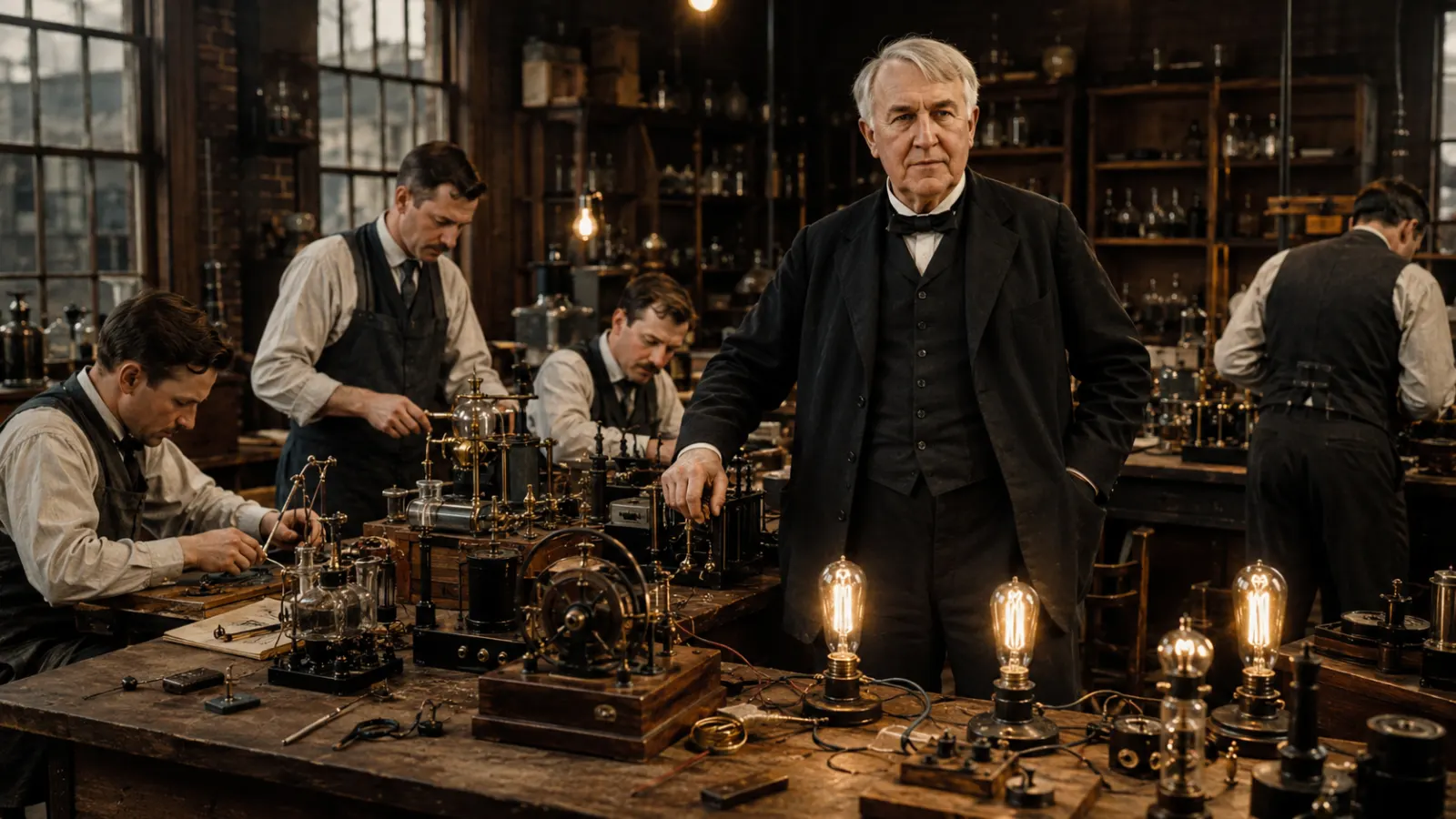
In 1876 Edison established a laboratory at Menlo Park, New Jersey. The site combined machine-shop capabilities, laboratory equipment, scientific instruments, chemicals, technical reference material and skilled workers in one research environment.
Rutgers describes Menlo Park as a freestanding industrial research facility incorporating both machine shops and laboratories. The National Park Service likewise treats it as a central part of Edison's transformation from individual inventor into the leader of an organised inventive enterprise.
The press eventually called Edison the “Wizard of Menlo Park.”
The nickname helped create the popular image of one extraordinary genius producing invention after invention almost magically.
The reality was more interesting.
The wizard had employees.
Machinists built experimental equipment. Assistants conducted tests. Chemists investigated materials. Draftsmen and technicians helped turn concepts into functioning devices. Edison remained intensely involved—proposing ideas, setting priorities, reviewing results, directing experiments and often working alongside his staff—but the laboratory's productivity depended on organised collaboration.
This distinction is essential to understanding Edison fairly.
Saying that employees made important contributions does not show that Edison was fraudulent. The laboratory was deliberately created so that many people could contribute to technological development.
At the same time, presenting everything produced inside the laboratory as the solitary work of Edison erases the people who made that organisational model successful.
Why Menlo Park Was Historically Important
Inventors had used workshops and assistants before Edison, so it would be inaccurate to claim that organised collaborative invention suddenly appeared in 1876.
What made Menlo Park notable was its scale, purpose and integration.
Edison created a permanent environment in which the development of new technology itself became an organised occupation. The laboratory could investigate several technical problems, fabricate experimental parts quickly, test alternative materials and connect successful prototypes with patents and commercial businesses.
Rutgers describes Edison as helping create the industrial research laboratory and broadening invention into a process involving research, development and commercialization.
That approach anticipated a fundamental feature of twentieth-century technology.
Companies would increasingly stop waiting for independent inventors to arrive with finished inventions. They would employ permanent teams whose job was to produce improvements, new products and new technical knowledge.
Later corporate laboratories became far larger and more scientifically sophisticated than Menlo Park, but the organisational principle became increasingly familiar.
Innovation could be managed.
The Phonograph Made Edison Famous
One of Menlo Park's most astonishing inventions emerged in 1877.
Edison developed a machine capable of recording sound and reproducing it: the phonograph.
The earliest version recorded vibrations onto tinfoil wrapped around a cylinder. By later standards it was crude, but the conceptual achievement was extraordinary.
Human speech had always disappeared almost immediately after being spoken unless another person remembered or transcribed it. The phonograph created the possibility that sound itself could persist.
A voice could be recorded and heard again after the speaker had stopped talking.
The Edison Papers notes that work connected to the telephone led Edison toward his method of recording sound, and the phonograph quickly brought him international fame as the “Wizard of Menlo Park.”
The cultural implications were much larger than the first machine.
Recorded speech could potentially be used for dictation. Music could be preserved and replayed. Performances could become reproducible commodities. Spoken material could travel through time in a way previously impossible.
Edison understood many of these possibilities, although turning the phonograph from an astonishing demonstration into a reliable mass-market technology required years of additional engineering.
Edison’s Phonograph Was Not a Finished Media Industry in 1877
Popular invention stories often stop at the breakthrough moment.
Real technologies rarely do.
The first phonograph proved that sound recording and reproduction were possible, but commercial success required improved recording materials, better mechanisms, repeatable manufacturing, distribution and content.
Edison repeatedly returned to the phonograph during his career. The National Park Service notes that it was his favourite invention and that he worked on phonograph technology for more than five decades.
Eventually, sound recording became an industry involving much more than machines. Consumers needed recordings to play on those machines. Performers, catalogues, dealers, recording formats and manufacturing systems became part of the business.
The economic model therefore shifted.
A company was not merely selling hardware. It could also sell the content consumed through that hardware.
That relationship between device, format and content would later become familiar in industries built around recorded music, film, video games, software and digital platforms.
Did Thomas Edison Invent the Light Bulb?
No.
This is the single most important correction to the traditional Edison story.
Inventors had experimented with electrical lighting long before Edison began his major work on incandescent illumination. The National Park Service explicitly states that Edison did not invent the first light bulb and notes that work on electric lighting had been underway for decades before his breakthrough.
But stopping there creates another misleading story.
If Edison did not invent the first bulb, what did he actually accomplish?
He and his laboratory developed a commercially practical incandescent-lighting system.
That distinction is much more historically important than the simplified schoolbook claim.
Edison’s Real Lighting Problem Was a System Problem
A light bulb is useful only if there is electricity available to power it.
Imagine inventing an excellent electric lamp in a city where customers have no electric wiring, no generating stations, no meters, no switches and no distribution network.
The lamp is technically impressive and commercially almost useless.
Edison understood this.
His goal was not merely to create a glowing filament. He wanted electric lighting to compete with established gas-lighting systems.
That required the development of a complete infrastructure involving lamps, generators, conductors, switches, safety devices, meters and central generating stations.
The National Park Service describes Edison's achievement as the development not only of a practical incandescent lamp but of an electric-lighting system containing the necessary elements to make incandescent lighting practical, safe and economical.
This is why the light-bulb myth both exaggerates and understates Edison.
It exaggerates his priority by implying that electric lighting began with him.
It understates his real contribution by reducing a complicated electrical infrastructure to one glass bulb.
The Menlo Park Lamp Experiments
Beginning in 1878, Edison and his laboratory devoted enormous effort to electric lighting.
Many variables had to be solved. The filament needed to reach a high temperature and emit useful light without burning out immediately. The electrical resistance needed to fit the proposed distribution system. The glass bulb required an adequate vacuum, while manufacturing had to become repeatable and economically viable.
The laboratory tested different materials and configurations.
In 1879, Edison demonstrated an incandescent lamp using a carbonised filament that operated long enough to become practically meaningful. The National Park Service records a lamp using carbonised sewing thread burning for approximately thirteen and a half hours and notes that Menlo Park publicly demonstrated the lighting system in December 1879.
Further development continued after the demonstration.
The important achievement was not that nobody had ever made material glow electrically before.
It was that Edison and his collaborators were moving toward a lamp compatible with a commercially workable electric-power system.
Pearl Street Turned the Lighting System Into Infrastructure
The next major step occurred in New York City.
In September 1882, Edison's Pearl Street station began supplying electricity to customers in lower Manhattan. The National Park Service identifies the station as the first commercial central power station in Edison's system and notes that it served a roughly one-square-mile area.
The significance was enormous.
Electric lighting was moving from laboratory demonstration and private installation toward utility service.
The system required more than dynamos and lamps. Underground conductors, junctions, meters, safety equipment and operating procedures had to work together.
This is systems engineering.
Edison's contribution to electrical history therefore becomes easier to understand when Pearl Street, rather than the isolated light bulb, is placed at the centre of the story.
The Weakness of Edison’s Direct-Current System
Edison's early power network distributed direct current, or DC.
The system could work effectively in dense areas located close to generating stations. Rutgers notes that Edison's DC arrangement was particularly suited to densely populated urban centres and isolated systems serving specific buildings.
The difficulty was distance.
Transmission becomes more efficient when electrical power can be moved at higher voltage and lower current. Alternating-current systems gained a major advantage because transformers could raise voltage for efficient long-distance transmission and lower it again nearer customers.
Edison's low-voltage DC networks therefore required generating stations relatively close to their consumers.
As electric service expanded beyond compact urban districts, the economics increasingly favoured alternating current.
That technological and commercial competition became famous as the War of Currents.
The War of Currents Was Not Simply Edison Versus Tesla
Popular culture often presents the conflict as a personal duel between Thomas Edison and Nikola Tesla.
That framing leaves out much of the real history.
The major commercial rivalry involved electrical businesses and their investors. Edison and companies associated with his direct-current system faced competition from George Westinghouse and the alternating-current system. Tesla's patents, particularly his work on polyphase AC motors and electrical systems, became extremely important after Westinghouse obtained rights to them.
The Edison Papers describes the conflict as a struggle between incompatible systems of electrical distribution involving the Edison Electric Light Company and its successors on one side and Westinghouse Electric and its allies on the other.
Tesla was crucial.
So was Westinghouse.
So were transformers, generating equipment, financing, utility companies, patent disputes and the economics of transmission.
Reducing the whole conflict to two rival geniuses makes excellent drama but weak history.
Edison’s Campaign Against Alternating Current
Edison believed high-voltage alternating-current distribution posed serious public-safety dangers. His financial and commercial interests also gave him a strong reason to defend the DC system in which he had invested years of work.
Those motivations became intertwined.
As the competition intensified, Edison and associates promoted the dangers of high-voltage AC. Animal electrocution experiments were conducted at Edison's West Orange laboratory, and the debate around electrocution became entangled with New York's search for an alternative to hanging as a method of execution.
The Edison Papers describes Edison's motives as mixed: his opposition contained plainly self-interested commercial elements, but he also genuinely believed that high-voltage systems presented unacceptable hazards in public streets.
That distinction matters because the historical record is more complicated than the claim that Edison invented the dangers of electricity purely to destroy Tesla.
High-voltage electrical accidents were real.
So was Edison's commercial conflict of interest.
Edison, Animal Electrocution and the Electric Chair
This part of the story deserves careful treatment because popular versions frequently collapse separate events into one dramatic narrative.
Edison and his associates did participate in animal electrocution experiments during the late 1880s. Rutgers records experiments involving dogs and other animals carried out with Arthur Kennelly and Harold P. Brown. Some of the work intersected with efforts to determine whether electricity could provide what authorities considered a more humane method of execution.
The resulting electric-chair debate became useful in the publicity campaign against alternating current because execution by high-voltage AC reinforced the association between AC and death.
Edison's involvement deserves criticism and should not be sanitised.
But popular claims need to distinguish documented participation from later myths.
Did Edison Electrocute Topsy the Elephant?
The famous Topsy story is a particularly useful example of how historical myths spread.
Topsy, an elephant at Luna Park on Coney Island, was killed in 1903 using a combination of methods that included electrocution. An Edison film crew recorded the event.
However, the Thomas Edison Papers states that the popular portrayal of Edison personally electrocuting Topsy as part of the War of Currents is erroneous. The major current war had ended years earlier, and the Edison Manufacturing Company filming the event does not establish that Edison personally organised the killing.
This does not erase Edison's documented participation in earlier animal-electrocution experiments.
It separates one real controversy from a later story inaccurately attached to it.
Historical criticism becomes stronger, not weaker, when it distinguishes what actually happened from what merely makes a memorable internet story.
Why Alternating Current Won the Main Distribution Battle
The competition was ultimately decided less by moral symbolism than by engineering and economics.
Alternating current could be transformed to very high voltages for efficient transmission and reduced to lower voltages nearer consumers. This allowed generating stations to serve much larger territories.
Westinghouse's system, strengthened by important Tesla technology, increasingly demonstrated advantages for large-scale distribution.
The National Park Service notes the importance of transformer technology and AC's ability to transmit power over long distances. The Edison Papers similarly concludes that AC became increasingly favoured by utilities because it was less expensive to build and operate over larger service areas.
Edison lost the dominant distribution-system battle.
That does not mean direct current disappeared.
Modern electronics, batteries, solar systems, data centres and specialised high-voltage transmission applications continue to use DC extensively.
AC and DC are engineering tools, not moral teams.
Edison and the Creation of General Electric
Edison's electrical businesses increasingly required financial resources beyond the control of a single inventor.
In 1889, several Edison interests were brought together as Edison General Electric. Investment bankers and corporate managers played increasingly important roles.
In 1892, Edison General Electric merged with Thomson-Houston to create General Electric. The National Park Service notes that Edison did not control the resulting organisation and that his name was removed when the merger produced GE.
This is an important turning point in his career.
Edison had helped build an electrical industry so capital-intensive and organisationally complex that it eventually moved beyond his direct control.
He increasingly turned his attention toward other technologies and to a much larger research operation in West Orange.
West Orange Expanded the Laboratory Model
In 1887 Edison opened his new laboratory complex in West Orange, New Jersey.
The site was substantially larger than Menlo Park and contained specialised laboratory spaces, machine shops, research rooms and facilities connected with manufacturing.
Rutgers describes the West Orange laboratory as an industrial research centre that remained exceptionally advanced into the twentieth century. The National Park Service preserves the complex today as Thomas Edison National Historical Park.
At West Orange, Edison's organisational role became even more obvious.
He was increasingly directing teams working across different technologies rather than personally fabricating every experimental component.
This makes the familiar language of “Edison invented X” increasingly inadequate.
Often, the more accurate formulation is that Edison and his laboratory developed X, with the precise allocation of credit varying from project to project.
Who Actually Invented Things in Edison’s Laboratories?
Edison's 1,093 successful U.S. patents remain an extraordinary record. Rutgers also notes that he filed an estimated 500–600 unsuccessful or abandoned U.S. patent applications.
Patent count, however, is not a perfect measure of individual creative labour.
Edison operated organisations containing machinists, experimental assistants, chemists and engineers. Employees built prototypes, tested materials and solved technical problems. Some projects reflected Edison's direct conceptual and experimental involvement. Others involved substantial co-invention by particular employees.
The most accurate interpretation depends on the technology.
Rutgers itself makes an especially important admission regarding early motion pictures: Edison's collaboration with William Kennedy Laurie Dickson was one of the clearest cases in which Edison received sole public credit despite substantial co-invention.
That does not erase Edison from motion-picture history.
It means Dickson belongs in the story too.
Edison, W. K. L. Dickson and the Birth of Motion Pictures
Edison became interested in creating a visual equivalent of the phonograph: a technology capable of recording and reproducing movement.
At West Orange, William Kennedy Laurie Dickson became central to the project.
The Library of Congress states that Edison's laboratory developed the Kinetograph motion-picture camera and the Kinetoscope viewing system, but notes that most of the development work was performed by Dickson, beginning in 1888.
That wording is historically valuable because it avoids both extremes.
Edison's laboratory and business organisation mattered.
Dickson's inventive work mattered.
Early cinema also developed through broader international experimentation involving figures such as Eadweard Muybridge, Étienne-Jules Marey, the Lumière brothers and many others.
There was no single magical moment in which one person “invented movies.”
The Kinetoscope Was Not Modern Cinema Yet
The Kinetoscope allowed an individual viewer to watch moving images through a peephole.
This differed from the projected cinema experience that later became dominant.
Edison companies nevertheless became important in early film technology, production and commercialization. The Library of Congress notes that the Edison Manufacturing Company produced films as well as equipment and that Edison's film operations remained active into the early twentieth century.
Again, the pattern resembles the phonograph.
The laboratory developed hardware.
The business then had to supply content for that hardware.
Technology and media production became connected.
The Black Maria and Early Film Production
At West Orange, Edison built an early motion-picture studio later known as the Black Maria.
The unusual structure was designed to facilitate filming in available sunlight and became associated with some of the earliest Edison motion pictures.
The Library of Congress timeline records the completion of the studio in 1893 and public demonstrations of Kinetoscope technology during the same period.
Some of the surviving films are extraordinarily simple by modern standards: performers, athletes, entertainers and brief scenes.
Their significance lies less in sophisticated storytelling than in demonstrating a new technological and commercial possibility.
Moving images could be recorded, reproduced and sold as entertainment.
Edison’s Career Included Major Failures
The myth of the unstoppable inventor can obscure another important part of Edison's life.
He failed repeatedly.
Some failures were inexpensive experiments that taught the laboratory what not to do.
Others consumed years and enormous amounts of money.
One of the most consequential was Edison's effort to process low-grade iron ore.
During the 1890s, he invested heavily in magnetic ore separation and built a large concentrating operation in Ogdensburg, New Jersey. The Edison Papers describes the project as consuming substantial amounts of his energy and wealth.
The technical concept faced a larger economic problem.
Changes in ore markets made the operation commercially unattractive.
The lesson is important because it complicates the famous idea that persistence inevitably produces success.
Persistence can solve a technical problem.
It cannot guarantee that the commercial environment will still reward the solution.
Edison’s Failures Reveal the Limits of Persistence
Edison became famous for an experimental culture in which large numbers of alternatives might be tested.
That persistence was extremely powerful when a solvable engineering problem stood between an idea and a viable product.
But persistence can turn into sunk-cost thinking when the underlying economic assumptions are wrong.
A researcher may improve a process repeatedly while the market shifts against it.
An entrepreneur may solve a manufacturing problem for a product customers no longer want.
Edison's career therefore provides a more useful lesson than the motivational slogan “never give up.”
A better lesson is: persist with the experiment, but keep testing the assumptions around the experiment too.
Storage Batteries Show a Different Kind of Persistence
Edison also spent years developing alkaline storage batteries.
The technology was initially connected to his interest in electric vehicles, but its eventual commercial uses expanded beyond automobiles.
Rutgers notes that the storage battery became one of the profitable foundations of Edison's later businesses even though its commercial trajectory differed from his original expectations.
This is another recurring feature of innovation.
Inventors can understand the technology correctly while predicting the wrong market.
A product may succeed for a use different from the one originally imagined.
Edison Was an Empirical Experimenter, Not an Anti-Science Caricature
Another popular contrast presents Nikola Tesla as the brilliant theoretical scientist and Edison as an ignorant mechanic randomly trying materials until something worked.
The distinction contains a fragment of truth but becomes misleading when exaggerated.
Edison strongly favoured empirical investigation. His laboratory culture relied heavily on building, measuring, testing and revising.
He was less mathematically oriented than some electrical contemporaries.
But systematic experimentation is not the absence of intelligence or scientific reasoning.
Engineering problems often contain properties that are difficult to model completely in advance. Material behaviour, manufacturing tolerances, durability and interactions between components may require empirical investigation even when theory is available.
Modern industrial R&D uses both approaches.
Models narrow the possibilities.
Experiments test the real world.
Edison's strength was particularly pronounced in the second.
Patents Were Part of Edison’s Business Model
Edison understood that invention and intellectual property were tightly connected.
Patents could help secure investment, establish negotiating power, protect markets and generate licensing income.
His organisations therefore treated patent activity as an integral component of technological development.
The Edison Papers contains extensive documentation of patent applications, disputes, business correspondence and litigation. Edison's 1,093 successful U.S. patents covered technologies ranging from telegraphy and electric power to sound recording, batteries and motion pictures.
This aggressive patent strategy contributed to his success and to his controversial reputation.
But it should be understood in context.
Nineteenth-century technology businesses were crowded with competing inventors and overlapping claims. Bell, Tesla, Westinghouse and many others also operated inside patent-driven commercial systems.
The history of invention was inseparable from the history of intellectual property.
A Patent Does Not Always Settle Who “Really Invented” Something
Modern readers often search patent records hoping for a simple answer to questions of priority.
Historical reality can be more complicated.
One person may first demonstrate a concept.
Another may improve it into a practical device.
A third may patent a particular implementation.
A company may assemble the full commercial system.
Several groups may develop similar technologies independently.
This is exactly what happened in areas such as electric lighting, telephony and motion pictures.
The question “Who invented it?” is therefore sometimes poorly framed.
More useful questions can include who established the principle, who developed the practical implementation, who created the surrounding system and who made the technology economically scalable.
Edison frequently excelled in those latter stages.
Edison Experimented With X-Rays—and Learned Their Dangers Tragically
After Wilhelm Röntgen's discovery of X-rays in 1895, Edison and his laboratory quickly began experimenting with the new phenomenon.
Edison investigated fluorescent materials and developed fluoroscopic technology intended to make X-ray images easier to observe.
The scientific opportunity was accompanied by a danger that researchers did not yet fully understand.
Edison's assistant Clarence Dally experienced extensive radiation exposure during the experiments, suffered severe injuries and later died. The Smithsonian notes that Dally's death and the difficulty of producing reliable X-ray equipment contributed to Edison's withdrawal from much of his X-ray research.
The episode is a powerful reminder that technological experimentation can advance faster than knowledge of occupational safety.
Researchers can discover what a technology does before they understand what repeated exposure does to researchers themselves.
Clarence Dally Complicates the Heroic Laboratory Story
Stories about Edison often celebrate extreme working hours and relentless experimentation.
Clarence Dally reveals the cost that heroic narratives can conceal.
Industrial research was not performed only by famous laboratory directors.
Assistants handled materials, operated experimental equipment and absorbed physical risks.
In Dally's case, those risks became catastrophic.
Modern laboratory safety, radiation protection and research ethics are partly responses to histories in which experimentation advanced without adequate protection for the people performing it.
Edison's laboratories therefore deserve attention not only because they anticipated modern R&D productivity.
They also anticipated questions about who carries the risks of research.
Edison as Employer and Research Director
The collaborative nature of Edison's laboratories creates another important historical question: how should credit be distributed?
Edison generated ideas, directed programmes, reviewed results, financed research, selected projects and frequently worked deeply in experiments himself.
Employees also made substantial technical contributions.
These roles are not mutually exclusive.
Modern science faces similar questions. A principal investigator may lead a major laboratory while graduate students, postdoctoral researchers, technicians and collaborators conduct much of the detailed work. A technology executive may direct a programme in which individual engineers solve critical problems.
The final product belongs to a team, but contributions within the team are unequal.
The Edison story is valuable partly because it forces us to abandon the assumption that every invention requires one identifiable heroic inventor.
Edison Was Also a Master of Publicity
Technical productivity alone does not explain why Edison became one of the world's most famous inventors.
He understood media.
Journalists visited his laboratories. Demonstrations were organised. Spectacular technologies such as the phonograph created powerful news stories. The nickname “Wizard of Menlo Park” transformed an industrial research organisation into a compelling personal brand.
That branding had practical value.
Public attention attracted investors.
Investors financed laboratories.
Laboratories produced technologies.
Technological demonstrations generated more publicity.
Edison was therefore creating not only inventions but an innovation narrative around himself.
The success of that narrative explains part of the historical distortion surrounding his career.
When a team-based organisation is branded around one individual, the public remembers the individual.
The “Muckers” Behind the Wizard
Workers associated with Edison were sometimes referred to as his “muckers.”
They included machinists, experimenters, technicians and specialists who turned ideas into working technology.
Some became historically visible, particularly figures such as W. K. L. Dickson.
Many others remained largely unknown outside specialist histories.
This imbalance is not unique to Edison.
Modern technology repeatedly produces similar narratives in which one founder, chief executive or laboratory leader becomes the public symbol for the work of hundreds or thousands of employees.
Edison is therefore useful for understanding not only nineteenth-century invention but the continuing politics of technological credit.
Did Edison Steal Nikola Tesla’s Inventions?
The simple claim that Edison “stole Tesla's inventions” is not an adequate description of their relationship.
Tesla briefly worked for an Edison organisation after arriving in the United States, but their engineering approaches and later commercial affiliations diverged. Tesla's most historically important AC patents became associated with George Westinghouse, whose company competed against Edison-linked electrical interests.
The later War of Currents involved real hostility and commercial competition, but it was not a story in which Tesla developed the electrical world and Edison simply appropriated his work.
Edison had already built major businesses and laboratories before Tesla became part of the American electrical industry. Tesla, meanwhile, made major contributions to alternating-current motors and polyphase systems that should not be diminished simply because Edison was more famous during much of their lives.
History becomes worse when correcting one exaggerated reputation requires creating another.
Both men mattered for different reasons.
Edison’s Greatest Invention May Have Been the Research Organisation
If the search for Edison's single greatest invention has any useful answer, the industrial research laboratory may be a stronger candidate than the light bulb.
Menlo Park demonstrated how skilled workers, workshops, scientific instruments, experimental records and patent strategy could be integrated into one ongoing innovation process.
West Orange expanded the model.
Rutgers explicitly argues that the industrial research laboratory might be considered Edison's greatest invention.
The idea spread far beyond Edison.
Twentieth-century companies created permanent research organisations working in telecommunications, chemistry, electronics, pharmaceuticals, aviation, computing and energy.
Bell Laboratories would later become an extraordinarily famous example, combining fundamental science with industrial technology.
Corporate R&D became an institution.
The modern technology company employing teams to develop products that may not reach market for years operates inside a world that Edison helped anticipate.
The Laboratory Changed the Meaning of Inventorship
The rise of organised research created a problem that still exists.
Who is the inventor when hundreds of people contribute?
Patent law may name particular inventors.
A company may own the resulting intellectual property.
A chief executive may receive public credit.
A research team may contain people who solved specific problems more directly than any famous leader.
These different kinds of credit do not always align.
Edison's laboratories therefore mark an important transition from the nineteenth-century cultural image of the individual mechanical inventor toward the modern reality of institutional innovation.
The public story remained individual.
The productive process became increasingly collective.
Edison’s Companies Helped Connect Invention With Markets
Another reason Edison mattered is that his inventive process rarely stopped at the prototype.
He organised or inspired hundreds of businesses connected with manufacturing and commercializing technology. Rutgers notes that more than 300 companies worldwide were formed to manufacture and market Edison inventions, including roughly 200 Edison illuminating companies.
This commercial infrastructure matters because technical inventions do not transform society simply by existing.
Factories must manufacture them.
Workers must install them.
Customers must be persuaded to adopt them.
Standards have to develop.
Distribution and service networks need to operate.
Capital has to finance expansion.
Edison repeatedly thought across these boundaries.
That made him not only an inventor but an innovation entrepreneur.
What Thomas Edison Actually Invented
It is therefore misleading to answer the question with one object.
Edison's career included major contributions to telegraph technology, the phonograph, carbon telephone transmitters, incandescent lighting systems, electric-power infrastructure, motion-picture technology, storage batteries and industrial processes.
But individual credit varies across these fields.
The phonograph is particularly closely associated with Edison's own inventive work. His electrical-lighting contribution was fundamentally system-oriented. Motion-picture development depended heavily on Dickson and other laboratory personnel. His later projects increasingly emerged from the large West Orange organisation.
The pattern is more interesting than a catalogue.
Edison repeatedly moved from problem to experiment, experiment to system and system to market.
That is the distinctive feature of his career.
Common Myths About Thomas Edison
Several myths become easier to correct once Edison is understood as the director of an invention system rather than as either an isolated genius or a fraudulent businessman.
The claim that Edison invented the first light bulb is false; electrical lighting preceded him, while his stronger contribution was making incandescent lighting part of a commercially workable power system. The claim that he personally invented everything credited to his laboratories is also false; employees made important contributions, and the Edison Papers explicitly recognises Dickson's major role in motion pictures.
The opposite claim that Edison invented nothing is equally untenable. His phonograph work alone would make him historically significant, while his 1,093 successful U.S. patents demonstrate a remarkably wide inventive career.
The idea that the War of Currents was simply Edison against Tesla is also misleading. It involved competing companies, investors, Westinghouse, Tesla's patents and the technical economics of distribution. Meanwhile, the claim that Edison personally electrocuted Topsy as a War of Currents publicity stunt is contradicted by the Edison Papers' historical account.
The truth is less cinematic.
It is also more revealing.
Why Edison Still Matters
Edison should not be remembered because every technology attributed to him sprang fully formed from his own hands.
That was never how his mature inventive organisation worked.
Nor should his importance be dismissed because employees contributed to his inventions, because earlier inventors had worked on similar problems or because his businesses aggressively protected patents.
Those facts are part of the history, not evidence that the history disappears.
Edison's lasting significance comes from connecting several activities that modern innovation often treats as one pipeline: research, experimentation, engineering, intellectual property, manufacturing, capital and commercial deployment.
His laboratories could investigate an idea.
The machine shop could build it.
The experimenters could test it.
The patent system could protect it.
Businesses could manufacture it.
Investors could finance expansion.
Marketing and publicity could create demand.
That integrated structure was unusually powerful.
Edison Also Shows Why Innovation History Needs More Than Heroes
The Edison story demonstrates why technological history becomes distorted when it is written only through famous names.
The light bulb had predecessors.
Electric-power systems depended on many engineers.
Motion pictures had multiple inventors and international roots.
AC power cannot be understood without Westinghouse, Tesla and others.
The phonograph itself evolved through contributions from later recording innovators and competing companies.
Yet eliminating the famous figure entirely creates another distortion.
Large technological systems usually contain individuals who play unusually influential organisational, conceptual or commercial roles.
Edison was one of them.
The challenge is to recognise leadership without turning leadership into solitary creation.
The Central Idea
Thomas Edison did not invent the modern world by himself.
He also was not merely a businessman who took credit for whatever happened inside his laboratories.
He was an inventor, experimenter, research director, entrepreneur, patent strategist and exceptionally effective publicist who helped transform the organisation of technological innovation.
He did not invent the first incandescent lamp. His achievement was helping develop a practical lamp together with the electrical infrastructure required to make incandescent lighting commercially useful. Pearl Street demonstrated that the real invention was partly the system surrounding the bulb.
He did not single-handedly invent motion pictures. William Kennedy Laurie Dickson performed much of the crucial developmental work inside Edison's laboratory, and cinema emerged through contributions from inventors in several countries.
He did participate in a harsh commercial campaign against alternating current, including involvement in animal-electrocution research connected with debates over electrical safety and execution. But the later claim that he personally electrocuted Topsy to defeat Tesla belongs to mythology rather than accurate chronology.
He made serious mistakes and spent enormous amounts on projects that failed. He could be commercially aggressive and stubborn. His laboratories concentrated public recognition in his own name even when employees contributed important technical work.
Those complications do not diminish the historical importance of the organisation he created.
They explain it.
Menlo Park and West Orange helped establish a new idea: invention could be pursued continuously by organised teams equipped with laboratories, machine shops, money, records and commercial objectives. Rutgers therefore argues that the industrial research laboratory itself may have been Edison's greatest invention.
That legacy survives everywhere modern organisations employ teams specifically to create technologies that do not yet exist.
The most useful description of Thomas Edison is consequently not “the inventor of the light bulb.”
It is more ambitious and more accurate:
Thomas Edison helped industrialise invention itself.