Raghu Rai: Photography, Memory and Six Decades of India
Raghu Rai spent more than six decades photographing India, but describing him simply as a photographer who “captured India” risks making both the country and his work sound more complete than either could ever be.
His archive is too varied for one subject to define it. Prime ministers, musicians, religious leaders, industrial disaster survivors, crowded streets, animals, landscapes, architecture, rituals and private moments all appear. What connects them is less subject matter than a way of looking. Rai repeatedly built photographs in which several things happen at once: a public figure may share the frame with aides, gestures and architecture; a street scene can hold multiple human stories without forcing one to dominate.
That visual density became one of his signatures. Where some documentary photography isolates a decisive subject from surrounding disorder, Rai often allowed the disorder to remain. Crowds mattered. Backgrounds mattered. Accidental relationships mattered.
His death in New Delhi on 26 April 2026 at the age of 83 turned a career long discussed in the present tense into a completed historical archive. Contemporary obituaries described a photographer whose work had chronicled more than six decades of Indian public and private life.
The challenge now is not simply to celebrate Raghu Rai. It is to understand why his photographs continue to matter—and how to prevent a vast body of work from being reduced to a handful of famous images.
Engineering gave way to the camera
Rai was born in 1942 in Jhang, then part of British India and now in Pakistan. He initially trained as a civil engineer before photography redirected his life. His elder brother, S. Paul, was already a photographer, and Rai's early encounters with the camera emerged partly through that relationship.
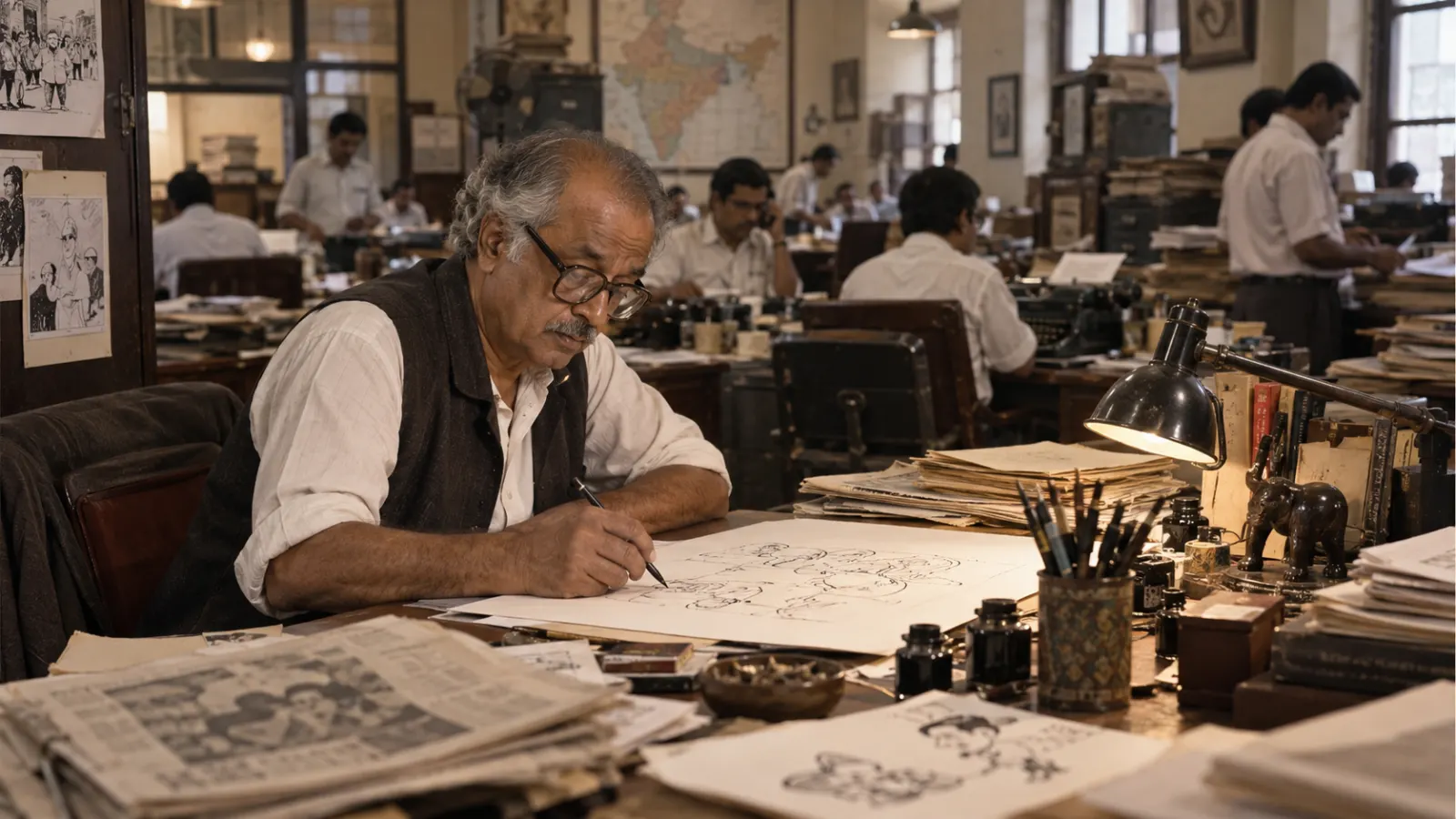
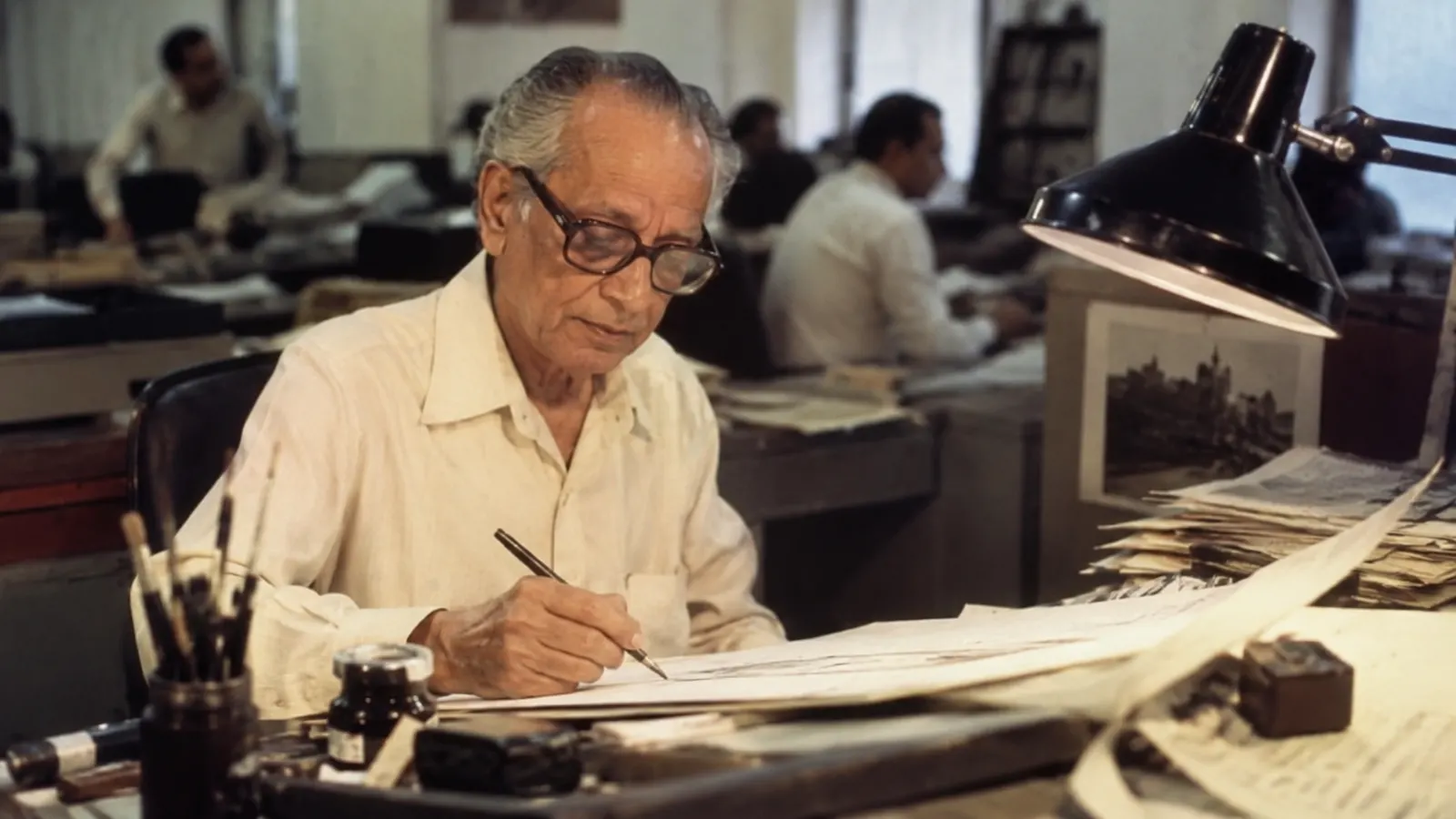
The transition was not the conventional route of an art-school-trained photographer entering the gallery world. Rai learned largely through practice, newspapers and the discipline of assignments.
He took up photography in 1965 and joined The Statesman the following year as a photographer. Magnum's own biographical material records that trajectory and says Henri Cartier-Bresson later nominated him to join Magnum Photos in 1977 after encountering his work.
Newspaper work was a particularly demanding education. A daily photographer has little control over events. Political leaders do not repeat gestures because the composition was weak. Crowds do not rearrange themselves. Light changes. The assignment has a deadline whether or not the photographer believes they have made a meaningful image.
That pressure trained speed and anticipation.
But Rai increasingly wanted photographs to survive beyond the immediate event. News photographs can become obsolete almost as quickly as the newspaper carrying them. His later work in magazines, books and long-form documentary projects gave him more room to ask whether an image contained something that remained meaningful after the headline disappeared.
That shift—from recording what happened to examining what continued to matter—became central to his career.
Magnum connected him to an international tradition without making him imitate it
Rai's association with Magnum Photos placed him within one of the most influential traditions in documentary photography. Henri Cartier-Bresson, one of Magnum's founders, played an important role in bringing him into the cooperative. Magnum records that Cartier-Bresson nominated Rai for membership in 1977.
The connection inevitably encouraged comparisons with Cartier-Bresson's idea of the “decisive moment”: the instant when movement, composition and meaning briefly align.
But Rai's photographs often operate differently.
Many of his frames are crowded rather than purified. Instead of waiting for every irrelevant element to disappear, he could build structure out of simultaneity. A foreground gesture might answer something happening deep in the background. Architecture might divide a crowd into layers. One person might occupy the obvious centre while another small action complicates the photograph from the edge.
This made his photography particularly suited to Indian public life, where several systems often occupy the same physical space at once: formal authority and informal labour, sacred practice and commerce, ancient architecture and modern traffic, private emotion and public spectacle.
The frame does not always tell the viewer where to stop looking.
That is part of its intelligence.
Rai often described photography in intuitive or spiritual language, but intuition should not be mistaken for absence of craft. Recognising a complex arrangement before it disappears requires intense attention to space, rhythm and human behaviour.
What looks spontaneous is often the result of learning how to remain alert inside visual disorder.
Photographing Indira Gandhi showed both the power and risk of access
Rai photographed Prime Minister Indira Gandhi repeatedly over many years, producing images that later became part of the visual memory of her political era. Magnum's archive describes him photographing Gandhi extensively from the late 1960s onward and includes portraits ranging from political rallies and elections to more private or transitional moments.
Long-term access creates possibilities that a one-day assignment cannot.
A photographer who repeatedly sees the same public figure can move beyond the formal podium image. Small gestures become legible. Relationships with aides and family members become visible. Confidence, isolation, vulnerability and political theatre can coexist across a sequence.
But proximity also creates an ethical challenge.
Repeated access can make a journalist sympathetic to the person being documented. Political power can begin to appear primarily through personality rather than through institutions and consequences. A familiar subject may become humanised while those affected by the subject's decisions remain distant.
Rai's strongest political work avoids a simple solution to this tension. Gandhi is neither flattened into villainy nor transformed into devotional portraiture. The photographs acquire meaning partly through ambiguity.
Their historical significance also changed after the photographs were made.
An image originally published as contemporary journalism later becomes archival evidence. Viewers who never experienced the events encounter the political period partly through the photographer's choices: where he stood, which instant he selected and which images survived into books and exhibitions.
Photography therefore does not merely record political memory.
It helps construct it.
Bhopal transformed disaster photography into long-term witness
The Bhopal gas disaster of December 1984 produced some of Raghu Rai's most widely recognised photographs.
The immediate catastrophe was visually overwhelming: bodies, hospitals, grieving families and the industrial site from which toxic gas had escaped. Rai photographed the aftermath, including the image often known as Burial of a Child, which became one of the defining visual records of the disaster. Contemporary accounts after his death continued to identify that photograph as among his most enduring images.
But concentrating only on the iconic photograph produces an incomplete account of Rai's Bhopal work.
He returned.
That decision matters.
Disaster journalism is structurally attracted to the moment of maximum visibility: explosion, flood, fire, bodies, rescue. Yet industrial and environmental harm often persists long after cameras leave. Survivors continue living with illness. Families pursue compensation. Contaminated environments remain. Legal and political arguments stretch over decades.
Rai's later Bhopal project, Exposure: Portrait of a Corporate Crime, documented both the immediate disaster and the continuing human and environmental consequences. Greenpeace described the project as covering not only the initial catastrophe but survivors' continuing struggle for health, security and accountability.
This makes Bhopal important beyond Rai's individual career.
It demonstrates the difference between photographing an event and photographing an aftermath.
The first asks: what happened?
The second asks: what is still happening?
That distinction remains relevant to contemporary environmental journalism, where climate change, pollution and toxic exposure often unfold as slow crises rather than single dramatic incidents.
Iconic photographs can reveal history—and shrink it
The success of an image creates its own danger.
When one photograph becomes globally recognisable, it can stand in for an event much larger than the frame. The viewer remembers the photograph and gradually forgets the institutional, legal and political history around it.
Bhopal involved industrial safety, corporate responsibility, public health, environmental contamination, legal claims, compensation and the lives of hundreds of thousands of people.
No single photograph can contain that history.
The famous image of a dead child is powerful precisely because it gives catastrophe a human scale. But if the image becomes the entire memory of Bhopal, photography begins to narrow the event it originally helped people understand.
This is why Rai's extended work matters.
Survivors, damaged neighbourhoods, medical consequences, protests and the continuing presence of the industrial site restore duration to an event easily compressed into one terrible night.
It also raises an editorial responsibility.
A publication analysing famous photography does not automatically have the right to reproduce it. Rai's photographs remain copyrighted. Wide circulation on social media does not place them in the public domain.
An article can discuss an image without reproducing it, or use properly licensed archival material where rights have been secured.
Respect for documentary photography includes respect for its authorship.
Faith, charisma and everyday surroundings
Rai's work also includes long-term engagement with figures such as Mother Teresa and the Dalai Lama.
These assignments presented a very different problem from industrial disaster or political conflict.
Religious subjects can tempt photographers toward two weak extremes. One is reverence so complete that documentary work becomes devotional imagery. The other is distance so determined to avoid reverence that lived faith is treated merely as spectacle.
Rai often approached influential religious figures by locating them within ordinary physical environments.
Rooms, crowds, gestures, clothing, waiting, fatigue and daily routines matter alongside public charisma.
That approach was consistent with his larger visual method: the subject is rarely independent of the world around the subject.
A religious leader is surrounded by followers and institutions. A politician is surrounded by aides and security. A musician exists inside the physical space of performance. A street worker belongs to the architecture and movement of the city.
Context prevents charisma from becoming the only story.
It also reminds viewers that documentary photographs are interpretations.
The photographer chooses where to stand.
Access is negotiated.
Moments are selected.
The camera does not provide transparent access to holiness, power or authenticity simply because the image appears intimate.
Cities became layered organisms rather than backgrounds
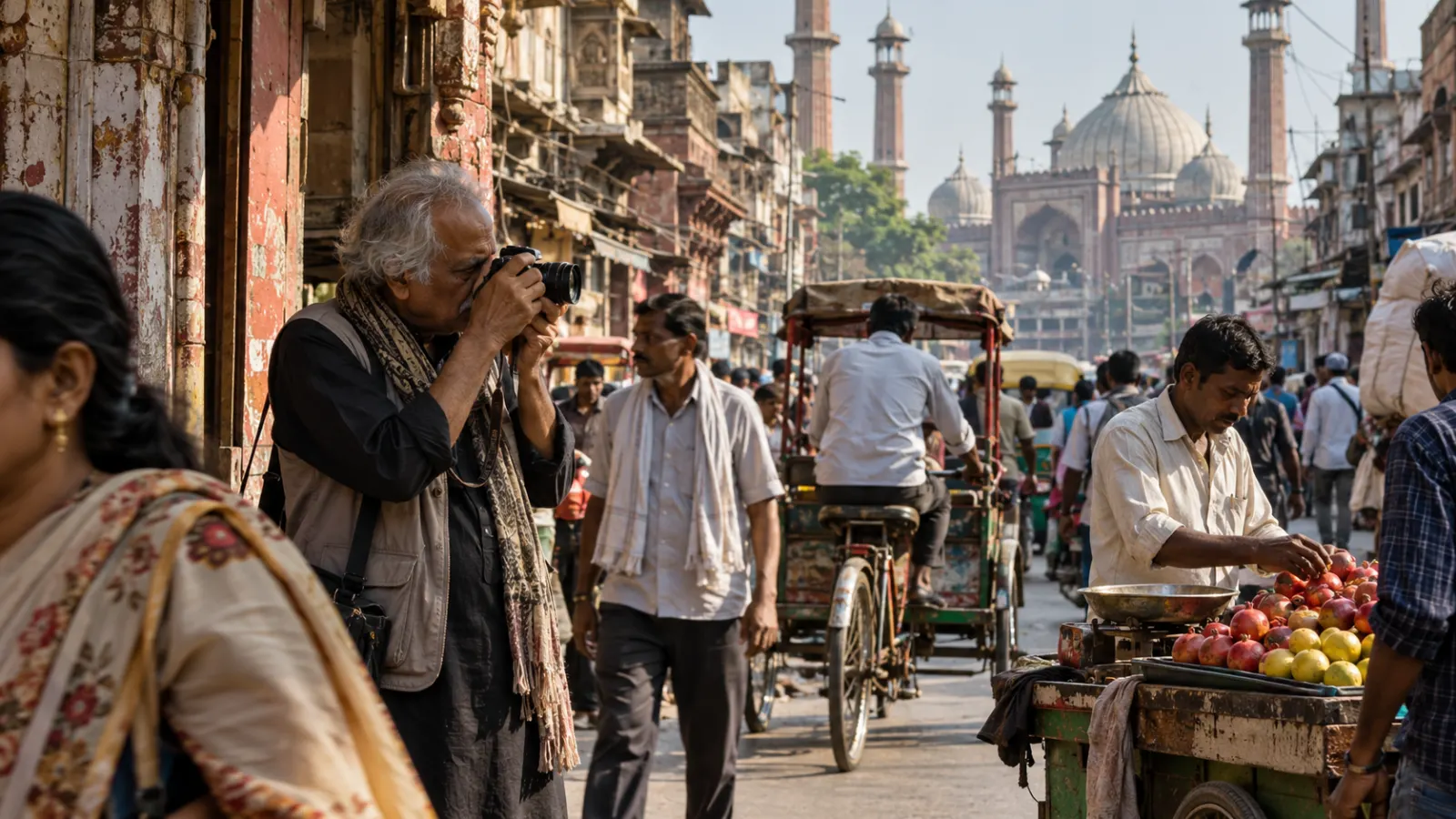
Rai's photographs of Delhi and other Indian cities reveal perhaps the clearest expression of his compositional method.
Cities are not treated primarily as skylines or architectural objects.
They are occupied systems.
People, animals, vehicles, monuments, advertising, ritual, informal labour and environmental disorder may share the same image. Foreground and background often carry different narratives while remaining compositionally connected.
This distinguishes Rai's urban photography from architectural images designed to remove human activity so that buildings can be seen clearly.
For Rai, human activity is not visual interference.
It is the city.
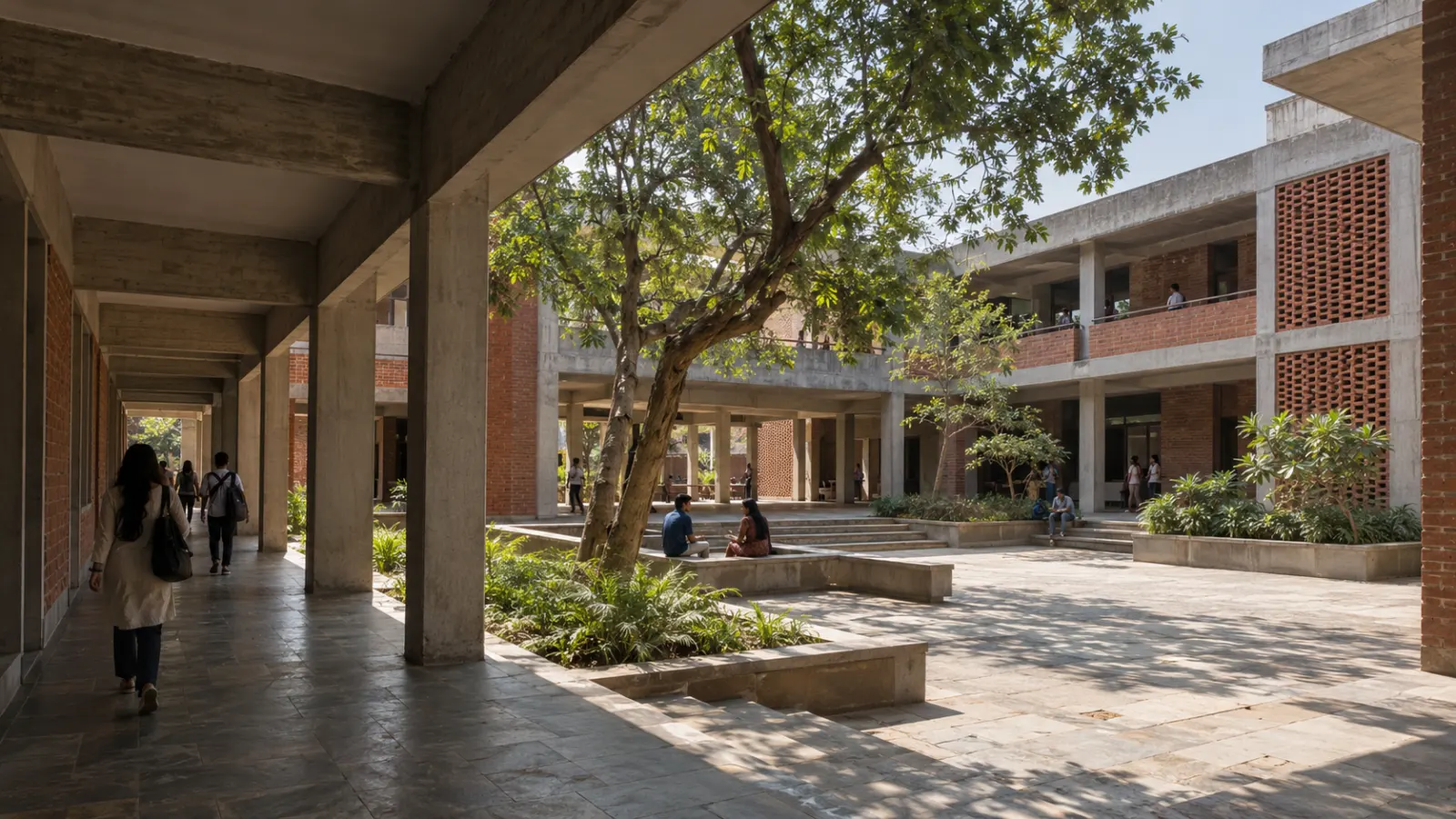
The contrast is especially useful when reading his work beside Indian modernist architects such as Charles Correa or B. V. Doshi. Architects organise spaces through plans, sections, materials and movement. Rai photographed what happens once those spaces enter social life.
People adapt architecture.
They wait in it, crowd it, ignore intended circulation, turn edges into workplaces and transform monumental spaces through repetition.
His photographs therefore become records not only of urban form but of urban occupation.
A city is what planners build and what residents subsequently do with it.
Black and white was important, but it was not the method itself
Rai became closely associated with black-and-white photography.
Monochrome can intensify geometry, expression and tonal contrast. Removing colour can make viewers notice spatial relationships they might otherwise overlook.
But black and white can also produce misleading ideas about authenticity.
Historical or contemporary poverty photographed in monochrome can appear timeless, as if it belongs to an eternal India rather than a specific year, political economy and location.
Rai's work is strongest when captions and context prevent this collapse.
Dates matter.
Locations matter.
The political moment matters.
His substantial use of colour also makes clear that his underlying visual intelligence did not depend on monochrome.
The deeper method was attention to relation—between people, objects, distance, architecture and gesture.
Colour or black and white were tools.
Neither was the meaning by itself.
Documentary photography depends on captions as much as photographs
A photograph can show extraordinary visual detail while leaving basic factual questions unanswered.
Where was it taken?
When?
Who are the people?
What happened immediately before or after?
Why was the crowd gathered?
Without reliable metadata, a dramatic photograph can become dangerously easy to misinterpret.
This is especially important now because images circulate separately from their original publications. Screenshots lose captions. Social-media accounts repost historical photographs with incorrect dates. Pictures from one conflict are falsely attached to another. Artificially generated imagery further complicates assumptions that photographic appearance automatically proves documentary origin.
Rai's archive therefore illustrates a principle extending far beyond his own career:
photographic truth is both visual and documentary.
The image provides evidence.
The caption establishes part of its meaning.
The publication context explains why it was shown.
Editors using archival photography should verify captions through the photographer's archive, agency records, books or reputable institutional catalogues rather than copying whatever text happens to accompany an online repost.
An iconic photographer's reputation does not eliminate the need for verification.
Editing is where a photographic archive becomes an argument
Rai was often described as intuitive, but the mythology of instinct can obscure another essential photographic skill: editing.
A photographer may make dozens or hundreds of exposures around one event.
Only a few survive into publication.
The intellectual work lies partly in determining which frames are merely striking and which remain meaningful.
In film photography, contact sheets made this process physically visible. Near-identical images could be compared side by side. A gesture might be stronger in one frame, but the background might undermine it. Another photograph might be less immediately dramatic yet carry more information.
Books require an additional level of editing.
A sequence of photographs creates rhythm.
Crowded scenes may be followed by quiet portraits. Public spectacle can give way to intimate detail. Architecture can provide pause between human events.
Rai's work in newspapers, magazines and later books exposed him to all of these forms.
This is one reason his career cannot be understood simply as an accumulation of famous single images.
A photographic body of work is partly created after the photographs are taken.
Selection determines which India future viewers see.
Omission determines what disappears.
Looking at suffering requires more than admiring composition
Documentary photography becomes ethically difficult when suffering is visually powerful.
A beautifully composed photograph of death or poverty can command attention.
It can also encourage viewers to admire form while forgetting the human condition being represented.
The problem is not solved by demanding that photographs of suffering look aesthetically poor.
Visual strength can make people stop and look.
The ethical question is what happens after attention has been captured.
Does the caption explain who is shown?
Does the larger story identify causes?
Are survivors treated as people with histories and agency rather than anonymous symbols?
Does the publication return to the issue after the spectacle disappears?
Rai's Bhopal work is valuable partly because the extended project keeps responsibility and aftermath connected to the images.
The photograph of suffering is not allowed to float free as generic tragedy.
This is a crucial distinction for environmental and humanitarian journalism.
Pain has a history.
Documentary dignity requires retaining it.
Recognition confirmed a career already established through journalism
Rai received major honours across several decades.
The Académie des beaux-arts selected him in 2019 as the first recipient of its William Klein Photography Award, created to recognise an outstanding career and commitment to photography. Its official account also records his earlier Padma Shri and other international recognition.
Awards help establish artistic reputation, but they are not the reason his work matters.
Rai had already demonstrated that an Indian photographer could move between daily journalism, international documentary practice and long-term authored projects without turning India into an exotic visual product for foreign consumption.
His photographs could certainly be dramatic.
But they were usually rooted in recognisable historical circumstances.
A refugee crisis was not merely picturesque movement.
Bhopal was not simply tragedy.
Indira Gandhi was not simply a charismatic face.
Delhi was not merely visual chaos.
The images belonged to histories.
That specificity helped Rai's work travel internationally without becoming entirely detached from the society in which it was made.
His influence was methodological rather than stylistic
Rai's career provided younger Indian photographers with an important professional example.
A photographer could work on assignments and still develop an authored body of work.
Journalism and artistic ambition did not necessarily have to exist in separate careers.
Books mattered.
Archives mattered.
Long-term return mattered.
Editing mattered.
International institutions such as Magnum could expand a photographer's reach without requiring abandonment of local subject matter.
But influence should not be confused with imitation.
Rai's layered compositions, crowded frames and language of intuition reflected his temperament and historical moment. Later Indian photographers have developed radically different approaches, including conceptual work, staged photography, intimate autobiographical projects, multimedia reporting and digital forms.
His strongest legacy is therefore not a photographic recipe.
It is permission to take documentary photography seriously as authorship.
The photographer is not simply the person assigned to illustrate someone else's words.
Photography itself can investigate.
Technology changed, but the problem of attention remained
Rai's career crossed extraordinary changes in photographic technology.
He worked through black-and-white film, colour film, improvements in camera portability, digital capture and online distribution.
Each shift altered professional practice.
Film imposed scarcity. Photographers had limited frames and could not instantly inspect the result. Processing created delay. Newspaper deadlines shaped how quickly an image could reach readers.
Digital cameras changed that relationship.
Thousands of frames can now be made cheaply and reviewed instantly. Images can reach global audiences within seconds.
Technological abundance solves real problems.
It does not automatically produce better observation.
If anything, Rai's emphasis on waiting and looking becomes more interesting in an era when the cost of making another photograph is almost zero.
A photographer can produce more images than ever while paying less attention to each one.
The creative problem remains selection.
Which relationship in this scene matters?
Why this instant rather than the one before it?
What does the background add?
What information is missing outside the frame?
Photography technology changed enormously during Rai's lifetime.
The discipline of seeing did not become obsolete.
Death turns a working archive into a curatorial responsibility
Raghu Rai died on 26 April 2026 after a career spanning roughly six decades. The Government of India marked his passing, while institutions and publications across India and abroad reviewed his contribution to photography.
Death changes the status of an artist's archive.
While the photographer is alive, new work can revise the interpretation of everything that came before. After death, estates, agencies, publishers, museums and curators increasingly determine which photographs continue circulating.
This can narrow a career.
For Rai, the obvious canon is easy to predict: Bhopal, Indira Gandhi, Mother Teresa, the Dalai Lama and several celebrated photographs of Indian public life.
All are important.
None is sufficient.
A retrospective consisting only of famous crises and famous people would miss the quieter work that explains why the crisis photographs are effective in the first place.
Children playing.
Musicians preparing.
People waiting.
Trees.
Animals.
Street corners.
Architecture occupied by ordinary life.
These photographs contain less headline drama but reveal the observational patience underlying the entire archive.
A country is not only what happens when history becomes news.
It is also repetition, routine and unnoticed relationships.
Raghu Rai leaves an unfinished portrait of India
No photographer can capture a country.
India changed too rapidly, contains too many social worlds and produces too many simultaneous histories for any archive to become definitive.
Raghu Rai's achievement was not overcoming that impossibility.
It was remaining inside it for decades.
His photographs repeatedly suggest that a frame can contain several truths without resolving them into one message. Power and vulnerability can occupy the same image. Sacred ritual can coexist with commerce. Monumental architecture can be interrupted by ordinary bodies. Beauty can appear inside damage without cancelling it.
That complexity explains why his strongest photographs often feel crowded.
The crowd is not something to remove in order to reveal the real subject.
The crowd frequently is the subject.
His archive now belongs increasingly to public memory. People who did not live through Bhopal, the political transformations he photographed or the cities of earlier decades will encounter those periods partly through images he selected.
That makes context more important, not less.
Photographs should lead viewers toward history rather than replace history.
Rai's career—from The Statesman to magazine journalism, Magnum, books, exhibitions and long-term documentary projects—demonstrated how photography could operate simultaneously as journalism, authorship and archive. Magnum records his professional trajectory from taking up photography in 1965 through joining the cooperative in 1977, while the Académie des beaux-arts later recognised the breadth of that lifetime commitment with its inaugural William Klein Photography Award in 2019.
His death closes the production of new photographs.
It does not complete their meaning.
Every future editor, curator and viewer will construct another sequence from the archive.
The most faithful way to approach Raghu Rai's work may therefore be the same way his best photographs ask to be viewed:
stay longer, look beyond the obvious subject, and remember that another story is usually unfolding somewhere near the edge of the frame.