Ramnath Goenka: Press Freedom, Power and the Indian Express
Ramnath Goenka occupies an unusual place in the history of Indian journalism because his public reputation rests less on bylined reporting than on what he chose to do as a newspaper proprietor. He built the Indian Express into a major media institution and became closely associated with resistance to censorship, most famously during the Emergency of 1975–77. Yet reducing him to a heroic defender of press freedom obscures an equally important part of the story: he was himself an unusually powerful owner who used newspapers actively in political and public life.
That tension makes Goenka historically significant. Private ownership can give a newspaper resources and institutional protection against government pressure. The same ownership structure can also concentrate decisions about editors, budgets, campaigns and political positioning in the hands of one proprietor. Goenka demonstrated both possibilities.
His career also spanned very different political systems. He entered newspaper ownership under British colonial rule, participated in India's nationalist political world, served in the Constituent Assembly and continued to run the Express after independence. By the time Prime Minister Indira Gandhi declared the Emergency on 25 June 1975, his ideas about censorship and the civic role of newspapers had already been shaped by decades of confrontation with political authority.
The most useful way to understand Ramnath Goenka is therefore not as a neutral proprietor standing outside politics. It is as a politically engaged media owner whose strongest historical reputation emerged when his own willingness to confront the government created room for journalists to resist censorship.
From Darbhanga to Madras and the Indian Express
Goenka was born in Darbhanga, Bihar, on 3 April 1904 and moved to Madras as a young man. According to the Constitution of India archive, he initially worked with his maternal uncle and later as a dispatch vendor for the Free Press Journal. During the 1930s he became involved with the Indian nationalist movement and acquired shares in the Indian Express, gaining complete control of the newspaper by 1936. (constitutionofindia.net)
The precise institutional story is slightly more complicated than a simple founding myth. The Indian Express Group commonly describes Goenka as its founder and dates the paper to 1932, while its own biographical material also notes his later consolidation of control. (indianexpress.com) (indianexpress.com) It is therefore safer historically to say that the newspaper emerged in Madras in the early 1930s and that Goenka acquired and consolidated control during that decade, building it into the institution later identified with his name.
That distinction matters because newspaper institutions rarely emerge from a single moment. They depend on capital, ownership changes, printing capacity, distribution networks, editors and readers. Goenka's achievement was not merely attaching his name to a publication; it was turning control of a newspaper into the basis of an expanding media organisation.
His political engagement was visible early. The Constitution of India archive records that he was associated with Gandhi and the freedom struggle, while institutional histories of the Express emphasise the paper's opposition to colonial restrictions on the press. (constitutionofindia.net)
The colonial period therefore supplied an important precedent for what would happen three decades later.
Colonial censorship helped shape the Express identity
British India maintained extensive powers to restrict publications through security laws, wartime regulation, seizures and censorship. Nationalist newspapers faced a difficult choice: comply, find ways around restrictions or stop publishing when permitted information became too limited to sustain genuine journalism.
Goenka chose confrontation in a particularly important episode during the Quit India period. The Constitution of India archive reproduces his argument that a newspaper unable to report national leaders, the Congress movement or important public facts except through approved government channels would no longer meaningfully function as a newspaper. (constitutionofindia.net)
Later accounts associated with the Express describe the paper as suspending publication rather than accepting those wartime restrictions. Former President Pranab Mukherjee, speaking at a Ramnath Goenka Memorial Lecture, also cited this episode as evidence that Goenka's conflicts over press freedom preceded independence. (indianexpress.com)
This history is useful because the Emergency confrontation was not a sudden transformation of an ordinary businessman into a civil-liberties figure.
The idea that a newspaper should sometimes absorb financial loss rather than allow the state to define what counted as legitimate news was already present in the institutional culture Goenka had helped develop.
That did not make the Express politically neutral.
Nationalist newspapers were political participants. They had causes, alliances and opponents. The relevant distinction is not between politically engaged and politically pure journalism. It is between journalism that retains enough institutional independence to investigate and criticise power and journalism whose permissible boundaries are determined by those exercising state authority.
Goenka entered the constitutional system he would later challenge
After independence, Goenka served in the Constituent Assembly as a representative from Madras on a Congress ticket. He was not one of the Assembly's most frequent speakers, but his recorded intervention on 9 September 1949 concerned a subject directly related to his profession: the taxation of newspapers. (constitutionofindia.net)
Goenka objected strongly to constitutional provisions allowing taxation relating to newspaper sales and advertising, arguing that excessive taxation could damage newspaper economics and therefore the ability of publications to serve the public. His intervention is revealing because it treated press freedom as more than protection against an explicit censorship order.
A government can affect newspapers through economic policy as well.
Taxation, newsprint, advertising, distribution, corporate regulation and property rules can all influence whether a media organisation remains financially capable of operating independently.
The Constitution ultimately did not create a separate fundamental right titled “freedom of the press.” Indian press freedom developed within the broader protection of freedom of speech and expression under Article 19(1)(a), together with subsequent judicial doctrine.
Goenka's presence in the Constituent Assembly therefore places him at an unusual intersection. He participated in the creation of the constitutional order within which he would later contest government attempts to control his newspaper.
Building a large newspaper group created both power and vulnerability
After independence, the Indian Express expanded into a major newspaper network with editions and publications across several regions and languages. Expansion required capital, printing facilities, distribution infrastructure and strong editorial organisations.
It also made Goenka far more powerful.
A proprietor controlling a large newspaper group could protect editors, sustain costly investigations, absorb temporary financial losses and give the organisation enough institutional weight to resist political pressure.
But scale created vulnerability too.
The larger the company, the more relationships it had with taxation authorities, corporate regulators, land agencies, public advertising systems, labour law and other arms of government.
Those relationships became particularly important during the Emergency.
Goenka also remained politically engaged. Accounts from colleagues and later institutional histories describe him as supporting particular leaders and causes at different points in his life rather than maintaining strict partisan detachment. The Indian Express's own later biographical material includes former editor Kuldip Nayar recalling political disagreements with Goenka while still praising his courage. (indianexpress.com)
This makes the concept of the “neutral proprietor” a poor fit for him.
His newspaper could be adversarial, campaign-oriented and influenced by his own political convictions.
The stronger question is whether those convictions enabled or restricted journalism—and whether the institutional protections available to journalists depended too heavily on the personality of the owner.
The Emergency made press freedom a direct institutional battle
Prime Minister Indira Gandhi's government proclaimed a national Emergency on 25 June 1975. During the 21 months that followed, civil liberties were curtailed, opposition leaders were detained and newspapers faced pre-censorship and other restrictions. More than 250 journalists were jailed, according to later historical reporting by The Indian Express. (indianexpress.com)
The Indian Express became one of the newspapers most closely associated with resistance.
The government's control of information was immediately visible. Electricity to major newspaper offices in Delhi's Bahadur Shah Zafar Marg was cut around the declaration of the Emergency, preventing publication. When the Express returned to print, it used blank space in its editorial area as a protest against censorship. Contemporary archive-based reporting by the newspaper dates the famous blank editorial to its first edition after the Emergency was imposed. (indianexpress.com)
Later retellings sometimes vary on whether the page appeared on 27 or 28 June, which makes surviving editions preferable to repeated anecdotes when establishing exact chronology. The important documented fact is that the paper deliberately displayed blank editorial space to make the existence of censorship visible. (indianexpress.com)
The visual tactic was powerful precisely because it exposed a paradox.
A censor could prevent readers from seeing a prohibited sentence.
A deliberately blank space could tell them that something had been prevented from appearing.
Absence became information.
The blank editorial was only one part of the resistance
The symbolic power of the blank space can overshadow the larger institutional struggle.
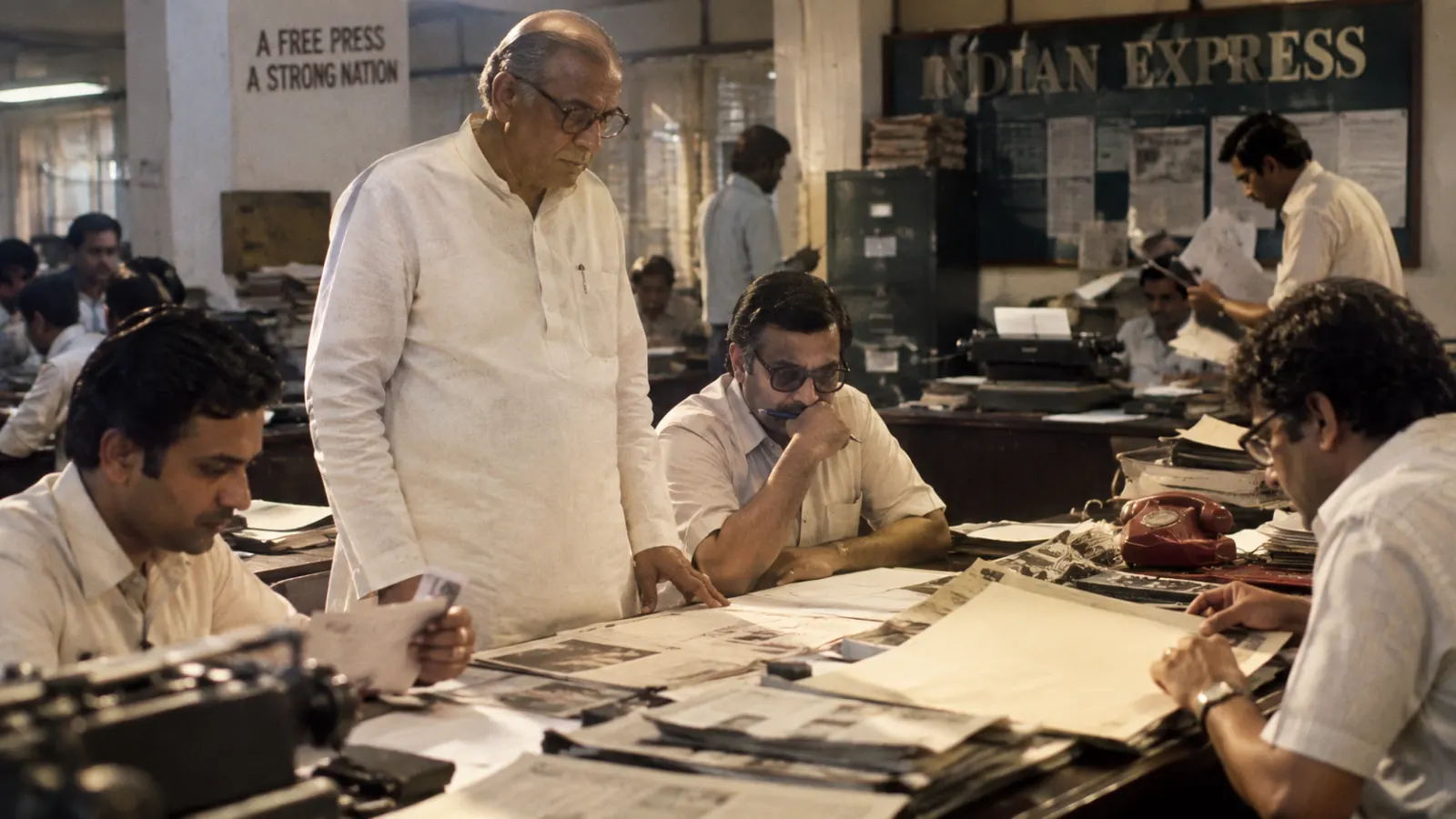
Censorship affected daily editorial decisions, news gathering, printing and legal strategy. Journalists were detained. Reporting was restricted. Government guidelines established what could and could not be published.
Former Express journalist Coomi Kapoor's detailed retrospective describes a newsroom in which reporters and editors attempted to work under censorship while Information and Broadcasting Minister V C Shukla sought greater control over the newspaper. She recounts pressure through company-law scrutiny, financial investigations and tax claims, as well as threats involving members of Goenka's family. (indianexpress.com)
Those recollections should be treated as documented testimony from a participant rather than as an exhaustive government archive. But they illustrate an important institutional point: governments do not need formally to close a newspaper to make independent publication costly.
A media organisation can face pressure through taxation, company regulation, property questions, access to state resources and other administrative mechanisms.
This is why the Emergency remains important to press-freedom history even beyond pre-censorship itself.
The absence of a permanent ban does not demonstrate the absence of coercion.
Goenka's ability to resist depended partly on personal willingness to accept those risks and partly on the scale and resilience of the organisation he had built.
The newsroom, not only the proprietor, resisted
Remembering the Emergency primarily through Goenka creates another distortion: it can make the journalists disappear.
A proprietor can refuse to surrender ownership, protect an editor or decide that the organisation will absorb financial pressure.
But proprietors do not report every story.
Reporters gather information. Editors decide how material should be presented. Sub-editors work under restrictions. Printers physically produce the paper. Lawyers challenge government actions. Correspondents find ways to continue supplying information.
The Indian Express's own 50th-anniversary retrospective on the Emergency records journalists using subtle methods to communicate information that could survive censorship and describes occasions when the newspaper had to rely heavily on its own correspondent network after access to news-agency wires was disrupted. (indianexpress.com)
Kuldip Nayar, who headed the Express News Service, was among the journalists detained during the Emergency. (indianexpress.com)
Goenka's importance therefore lay partly in what his ownership made possible.
He could provide institutional backing for people whose professional work carried direct personal risk.
That is different from saying that he personally produced the journalism for which the Express became known.
Press freedom is exercised collectively, even when ownership determines whether collective resistance remains financially possible.
Proprietorial power contains a democratic contradiction
The Emergency provides one of the strongest arguments for independent private media ownership.
A government seeking to control information encountered an owner unwilling to yield.
Yet Goenka's career also exposes the limitation of treating private ownership itself as a sufficient guarantee of press freedom.
An owner powerful enough to protect journalists from the government may also be powerful enough to influence journalists internally.
The proprietor decides which editor receives support, how long losses can be absorbed, which investigations receive resources, whether expansion is financed and ultimately who holds many of the senior positions through which editorial policy is implemented.
Goenka was particularly hands-on, and accounts by people who worked around him describe a forceful and often contradictory personality. The Express Group's description of B G Verghese's biography notes both Goenka's campaigns against prime ministers, political leaders and corporate figures and his involvement in “the making and unmaking of political leaders and governments.” (expressgroup.indianexpress.com)
This does not negate his resistance to censorship.
It sharpens the institutional lesson.
Freedom from government control is one dimension of media independence. Professional autonomy from owners, advertisers and other private interests is another.
A democratic media system is therefore stronger when press freedom does not depend entirely on whether one proprietor happens to possess the courage, resources and political convictions required at a particular historical moment.
Press freedom can be constrained economically as well as legally
Goenka's career repeatedly demonstrated that the economics of publishing and the politics of expression are connected.
His Constituent Assembly intervention on newspaper taxation already reflected this concern. During the Emergency, the vulnerability became much more concrete.
A government possesses tools that can affect a media company's survival without issuing an order saying “this newspaper is prohibited.”
Advertising policy can matter.
Tax enforcement can matter.
Newsprint allocation has historically mattered.
Company-law investigations can matter.
Property disputes can matter.
Regulatory approvals can matter.
None of those mechanisms is inherently illegitimate. Governments must enforce tax, corporate and property law against media companies just as they do against other businesses.
The press-freedom question arises when formally ordinary powers are applied selectively or coercively in order to influence editorial behaviour.
That distinction is more difficult to prove than explicit censorship, which is why documentary evidence matters.
Goenka's Emergency-era experience remains useful because it forces press-freedom analysis beyond the obvious question of whether a censor crossed out a sentence.
Institutions can become less independent because the financial cost of criticism becomes too high.
Resistance after the Emergency became part of the Express identity
The Emergency ended in 1977 after elections returned Indira Gandhi's government to opposition.
Goenka's resistance became a major source of institutional prestige for the Express. The newspaper increasingly identified itself with adversarial journalism and with a willingness to challenge those holding office.
That reputation created opportunity and obligation.
A newspaper remembered for confronting one government's abuses cannot treat that historical episode as permanent proof of independence. The meaningful standard is whether scrutiny continues when different parties, institutions or private interests become powerful.
This is where Goenka's politically engaged ownership remains instructive.
Adversarial journalism does not mean reflexively opposing every government decision. Nor does it mean supporting a rival political faction.
It means preserving the capacity to investigate claims, verify evidence and expose abuses regardless of who benefits politically from publication.
The distinction matters because a newspaper can be fiercely oppositional while still operating within partisan loyalties.
Goenka's record demonstrates both the value of politically motivated resistance to concentrated state power and the risks that accompany a proprietor who sees the newspaper as an active participant in political struggle.
His Constituent Assembly role complicates the outsider image
Goenka is often remembered as the proprietor standing outside political power and confronting it.
That image is incomplete.
He had been inside India's political institutions.
He was elected to the Constituent Assembly on a Congress ticket and participated in its debate over newspaper taxation. (constitutionofindia.net)
His wider life involved relationships with politicians, political causes and later opposition movements.
This makes his Emergency-era confrontation historically more interesting.
It was not a struggle between a politically innocent newspaper owner and politics.
It was a conflict involving a politically experienced proprietor who understood both the institutional importance of the press and the mechanisms through which political authority operated.
That background may have helped him recognise pressure that less experienced owners would have interpreted merely as administrative inconvenience.
But it also means that claims of absolute political detachment should be avoided.
Goenka's value to journalism did not arise because he lacked political beliefs.
It arose most clearly when his political engagement coincided with a defence of the institutional space required for newspapers to report without prior government approval.
The Emergency should be remembered as an institutional lesson, not a proprietor myth
The temptation with figures such as Ramnath Goenka is to turn history into a morality play.
One courageous owner confronts one powerful government and press freedom survives.
Reality is more complicated.
The Emergency affected many newspapers, journalists, lawyers and political actors. Some publications complied more readily than others. Several resisted in different ways. Journalists faced detention and censorship personally. Courts operated within an altered constitutional environment. Public access to information was restricted through a combination of law, administration and political pressure.
The Indian Express became particularly prominent because its proprietor gave the organisation room to resist and because the newspaper turned that resistance into visible acts such as the blank editorial.
Its role should be recognised without converting resistance into solitary heroism.
That distinction ultimately strengthens rather than weakens Goenka's significance.
A proprietor matters most when ownership creates enough institutional space for journalists to perform their work.
Commemoration transformed Goenka into a press-freedom symbol
Ramnath Goenka died in 1991.
His name later became attached to the Ramnath Goenka Excellence in Journalism Awards, created by the Indian Express Group to recognise journalistic work. The awards continue to invoke his association with press independence and Emergency-era resistance; at the 2025 ceremony, President Droupadi Murmu described the blank editorial as a symbol of a free press and the restoration of democratic rights. (indianexpress.com)
Commemoration inevitably simplifies.
The historical Goenka was simultaneously a businessman, nationalist, politician, Constituent Assembly member, newspaper proprietor and participant in political alliances.
The symbolic Goenka is primarily the man who refused to allow a government to silence his newspaper.
Both matter.
An award carrying his name is most faithful to that history when the principle extends beyond the particular political conflict that created the legend: journalism should retain enough independence to examine government, opposition parties, corporations, institutions and media organisations themselves.
Otherwise the Emergency risks becoming branding rather than a standard.
Ramnath Goenka's real legacy is institutional
An evidence-based assessment of Ramnath Goenka does not require choosing between admiration and dismissal.
He built one of India's major newspaper institutions. He participated directly in political life. He exercised substantial personal control over his media organisation. And during one of the most restrictive periods for the Indian press after independence, he chose confrontation rather than easy accommodation.
The Indian Express resisted pre-censorship, used blank space to make censorship visible and continued operating under significant government pressure. Goenka's ownership was an important reason that resistance could continue. Contemporary and later institutional accounts consistently place him at the centre of that struggle. (indianexpress.com) (indianexpress.com)
But the larger democratic lesson should not be that every newspaper needs a heroic proprietor.
It should be almost the opposite.
A healthy press system needs constitutional protection, independent courts, professional editorial norms, transparent ownership, consistent application of regulation and enough economic resilience that criticism does not depend on the personal bravery of one wealthy owner.
Goenka matters because he showed how ownership could be used as a shield for journalism.
His career also showed why that shield should not be the only one.
The durable question raised by his life is therefore larger than whether Ramnath Goenka himself was courageous. The better question is what institutions allow journalists to keep reporting when courage becomes expensive.
That is the standard by which his Emergency-era resistance remains relevant to the history of Indian journalism.