A Poet Who Became a Civilisation’s Voice
Rabindranath Tagore is often introduced through a few familiar labels: poet, Nobel laureate, composer of national anthems, founder of Santiniketan, voice of Bengal, critic of narrow nationalism. Each label is true, but none is sufficient. Tagore was not merely a literary figure who happened to influence politics, nor simply a patriot who wrote poems. He was one of those rare personalities whose life brought art, education, philosophy, nationalism, spirituality, and public conscience into a single conversation. His greatness lies not only in what he wrote, but in the way he expanded the moral imagination of modern India. He made beauty political without reducing it to propaganda, and he made patriotism ethical without allowing it to harden into hatred.
To call Tagore a poet patriot is therefore not to say that he was a simple nationalist poet. His patriotism was deeper and more difficult. He loved India intensely, but he refused to worship the nation as an idol. He wrote songs that became part of the emotional grammar of India and Bangladesh, yet he warned against nationalism when it became mechanical, aggressive, and spiritually empty. He criticised British imperialism, returned his knighthood after the Jallianwala Bagh massacre, and defended human dignity, but he also criticised Indian society when it trapped itself in caste, superstition, fear, or imitation. Tagore’s life matters because he shows that love for one’s country can be generous, self-critical, universal, and creative.
Early Life in Jorasanko: A Home Larger Than a House
Tagore was born on 7 May 1861 in the Jorasanko mansion of the Tagore family in Calcutta. The family stood at the centre of the Bengal Renaissance, a period when new ideas about religion, education, literature, social reform, science, and politics were reshaping Indian public life. His father, Debendranath Tagore, was a major figure of the Brahmo Samaj, and the household carried the atmosphere of spiritual inquiry, literary experiment, music, debate, and reform. Tagore was the youngest son, and he grew up not in a narrow domestic world but in an intellectual climate where old and new constantly met each other. This environment gave him an early sense that culture was not inherited passively; it had to be reimagined.
His formal schooling was irregular and often unhappy. Tagore disliked mechanical education, rigid classroom discipline, and the lifeless transfer of information. This dissatisfaction later became central to his educational philosophy. He learned at home, through tutors, music, literature, nature, conversation, and observation. The absence of conventional schooling did not make him anti-learning; it made him suspicious of education that crushed wonder. From childhood, he absorbed Sanskrit texts, Bengali literature, English poetry, devotional songs, and the living theatre of Calcutta’s social change. He also experienced loneliness, grief, and inwardness. The young Tagore was not simply a privileged child of a famous family; he was a sensitive mind learning to turn solitude into language.
Formative Influences: Bengal Renaissance, Brahmo Thought, and Nature
Tagore’s imagination was shaped by several forces. The Bengal Renaissance exposed him to reformist debates on religion, modernity, women’s education, social customs, and the role of reason. Brahmo thought gave him a spiritual vocabulary that emphasised the unity of the divine, the dignity of the human person, and the rejection of empty ritualism. The literature of Bengal gave him rhythm and emotional inheritance; Western literature gave him new forms of expression and philosophical contrast. But perhaps the most important influence was nature. His poetry repeatedly returns to rivers, skies, seasons, trees, light, boats, fields, and birds, not as decorative scenery but as living presences through which human life is enlarged.
This combination of influences prevented Tagore from becoming either a rigid traditionalist or a rootless imitator of Europe. He was deeply Indian, but never provincial. He read the Upanishads, wrote in Bengali, engaged with global literature, travelled widely, and conversed with thinkers across the world. His mind moved between the local and the universal. This movement became the signature of his life. He wanted India to awaken, but not by becoming a copy of Europe; he wanted India to rediscover its own creative and ethical strengths while learning from the world. In an age when colonial rule often made Indians feel either inferior or defensive, Tagore offered a third possibility: civilisational confidence without arrogance.
The Making of a Literary Revolutionary
Tagore’s literary output was astonishing in range. He wrote poetry, songs, novels, short stories, plays, essays, letters, travel writing, lectures, and later paintings. His work helped modernise Bengali literature by bringing it closer to everyday emotion, psychological subtlety, natural speech, and philosophical depth. He did not treat literature as a museum of inherited forms. He changed its tone. His poems could be devotional without being sectarian, romantic without being shallow, patriotic without being violent, and philosophical without becoming abstract. His songs, later known collectively as Rabindra Sangeet, entered Bengali life so deeply that they became part of everyday feeling: songs for love, seasons, sorrow, prayer, loss, awakening, and public memory.
His short stories are equally important because they helped shape the modern Indian short story. In them, Tagore examined women, children, widows, servants, peasants, families, and inner emotional conflicts with unusual sympathy. His fiction often exposes the quiet violence of social customs, the loneliness within households, and the moral failures hidden behind respectability. He was not merely celebrating culture; he was testing it. This is why Tagore cannot be reduced to a decorative national icon. The same writer who gave people songs of beauty also made readers face patriarchy, social hypocrisy, narrowness, and emotional imprisonment. His patriotism began with tenderness for life, not with slogans.
Gitanjali and the Nobel Moment
The global recognition of Tagore came through Gitanjali, a collection of poems that reached European readers in English translation and brought him the Nobel Prize in Literature in 1913. The Nobel moment made him the first Asian laureate in literature and brought unprecedented international attention to an Indian writer. For colonised India, this recognition carried symbolic power. It showed that Indian literary and spiritual expression could command respect on a world stage dominated by Europe. Yet the deeper significance of Gitanjali lies not in the prize but in the voice of the poems: intimate, devotional, open to the infinite, and rooted in a sense of surrender without passivity.
The international reception of Tagore was complex. Many Western admirers initially saw him through an Orientalist lens, treating him as a sage from the East rather than as a modern writer with a vast and diverse body of work. Tagore benefited from global admiration but also suffered from simplification. In India and Bengal, however, his range was never limited to mystical poetry. He was a novelist, composer, educator, dramatist, essayist, reformist thinker, and sharp critic of society. A serious reading must therefore separate the real Tagore from the image that global fame created. The Nobel Prize opened doors, but it also placed him inside expectations he repeatedly exceeded.
Patriotism Without Hatred
Tagore’s patriotism developed during a period of intense political change. The partition of Bengal in 1905 stirred anti-colonial emotion and strengthened the Swadeshi movement. Tagore participated in the emotional awakening of Bengal, wrote songs, encouraged unity, and spoke against division. Yet he became uneasy when nationalism turned coercive, exclusionary, or revengeful. His famous song Amar Sonar Bangla emerged from this atmosphere of love for Bengal and later became the national anthem of Bangladesh. Jana Gana Mana became India’s national anthem. These facts alone show the extraordinary depth of his public influence. Few poets have given voice to the emotional identity of two nations.
Yet Tagore never believed that the nation was the highest moral category. He feared that modern nationalism, especially in its European form, could become a machine that organised power but emptied the soul. His lectures on nationalism warned against blind imitation of aggressive state power. This position sometimes irritated political activists who wanted more direct alignment with nationalist mobilisation. But Tagore’s caution came from moral seriousness, not indifference. He opposed imperial domination because it violated human dignity. He also opposed any nationalism that required hatred of other peoples. His patriotism asked India to become free not only from foreign rule, but from fear, narrowness, cruelty, and imitation.
Jallianwala Bagh and the Return of Knighthood
The Jallianwala Bagh massacre of 1919 marked a decisive moral moment in Tagore’s public life. British forces under General Dyer fired on a peaceful gathering in Amritsar, killing and injuring hundreds. Tagore responded by renouncing the knighthood that had been conferred on him by the British Crown. His letter of renunciation was not an act of theatrical anger; it was a precise moral indictment. He argued that honours become meaningless when power humiliates the people. By returning the title, he converted personal prestige into public protest. It was one of the clearest examples of his patriotism in action.
This act also shows why Tagore should not be misunderstood as politically detached. He did not practise mass politics like Gandhi, nor did he lead a party or movement. But when the moral line was crossed, he acted with unmistakable courage. His response to Jallianwala Bagh was important because it came from a figure respected internationally. He used his global stature to make imperial violence visible. In doing so, he demonstrated a different form of political intervention: the intervention of conscience. Not every public act requires office, organisation, or electoral power. Sometimes a single refusal can become a historic statement.
Santiniketan and Visva-Bharati: Education as Liberation
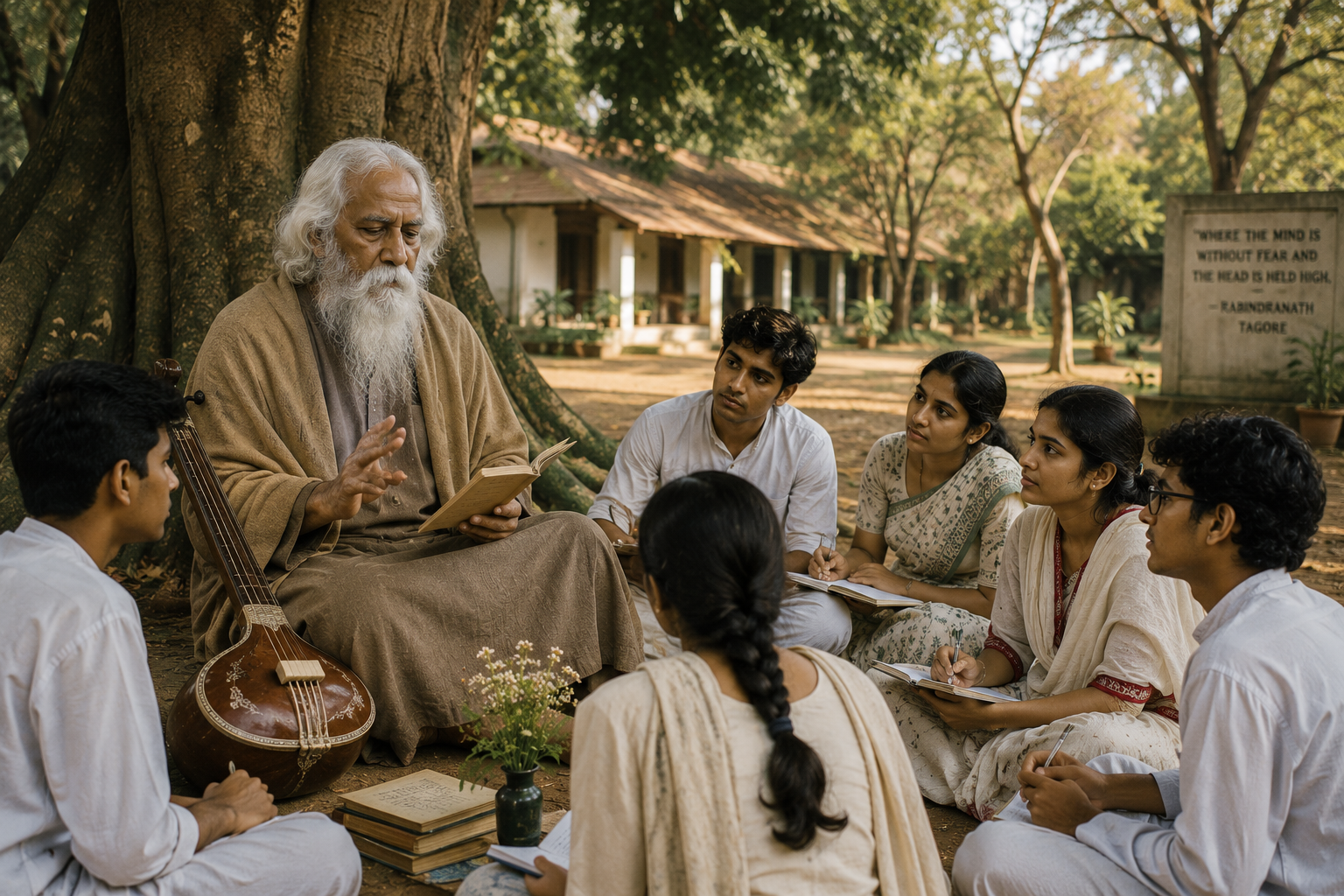
Tagore’s educational experiment at Santiniketan grew out of his dissatisfaction with colonial classroom discipline and his faith in learning through freedom, beauty, nature, and culture. He wanted education to awaken the whole human being, not simply produce clerks or examinees. Classes in open air, closeness to nature, music, art, language, crafts, and dialogue were not romantic accessories; they were part of a philosophy. Tagore believed that children learn deeply when curiosity is protected and when knowledge is connected to life. He saw education as liberation from fear, mechanical routine, and intellectual dependency.
Visva-Bharati, the institution he founded, expressed his larger vision of a meeting place between India and the world. Its motto and spirit imagined a space where cultures could encounter each other without domination. Tagore did not want India to close itself in defensive nationalism, nor did he want it to surrender to Western superiority. He wanted a university of the world rooted in India. The experiment faced financial challenges, administrative difficulties, and criticism, but its significance remains immense. It was an attempt to build an institution around the idea that education should cultivate humanity, creativity, and global fellowship. In an age of exam obsession, Tagore’s educational philosophy remains sharply relevant.
Critic of Society: Women, Rural Life, and Moral Stagnation
Tagore’s writings reveal a sustained concern with the condition of women. In novels and stories such as The Home and the World, Chokher Bali, and many shorter works, he explored women’s desire, intelligence, suffocation, and moral agency. He did not always escape the limits of his own time, but he gave women characters psychological depth and social seriousness. He understood that a nation cannot claim spiritual greatness while trapping half its population inside obedience. His critique was often subtle, literary, and emotional rather than programmatic, but it helped readers recognise the interior lives hidden beneath social rules.
He was also concerned with rural reconstruction. Tagore had direct experience managing family estates in rural Bengal, where he observed poverty, debt, hierarchy, and the distance between educated elites and village life. His rural initiatives tried to combine education, cooperation, agriculture, health, and self-help. He did not romanticise poverty. He knew that songs and slogans could not feed people or transform village conditions. This practical concern complicates the stereotype of Tagore as only a spiritual poet. He cared about beauty, but he also cared about institutions, livelihoods, education, and the dignity of ordinary people.
Criticism and Complexity
No serious profile of Tagore should turn him into an untouchable cultural monument. He was criticised by some nationalists for being too universalist and insufficiently militant. His critique of nationalism was sometimes read as softening anti-colonial struggle. Others have argued that his elite background distanced him from certain forms of mass politics. His educational experiments faced practical limitations, and his global reception sometimes depended on translations that could not fully carry the richness of his Bengali language. He was also a man of his age, shaped by the privileges and limits of a landed, reformist, intellectual family.
Yet these complexities do not diminish his greatness; they make it more meaningful. Tagore’s power lies precisely in the fact that he refused easy positions. He could oppose empire without worshipping the nation-state. He could love India without hating the world. He could honour tradition without defending injustice. He could seek modernity without becoming a mimic. Such balance is difficult, which is why his ideas often unsettled people who wanted simpler loyalties. Tagore’s life teaches that intellectual courage is not only the courage to resist enemies, but also the courage to criticise one’s own side when it loses moral proportion.
Legacy: A Living Argument, Not a Statue
Tagore died on 7 August 1941, before Indian independence, but his presence continued to shape the cultural life of the subcontinent. His songs remain alive in Bengal and beyond. His poetry, fiction, educational ideas, and essays continue to be studied across the world. He occupies a unique place in public memory because he belongs simultaneously to literature, music, nationalism, education, and moral philosophy. He is not merely quoted on anniversaries; he is sung, taught, debated, translated, and reinterpreted. His cultural afterlife is unusually intimate. People do not only admire Tagore; many live with him through song.
His relevance today is especially strong because the modern world still struggles with the questions he asked. Can patriotism avoid hatred? Can education produce freedom rather than anxiety? Can cultures meet without one dominating the other? Can art preserve tenderness in a political age? Can a country modernise without losing its moral centre? Tagore did not offer easy answers, but he gave India a vocabulary of openness, dignity, creativity, and self-criticism. His legacy is therefore not a finished inheritance. It is a living argument about what kind of human beings and what kind of society we wish to become.
Conclusion: The Nation Enlarged by the Human
Rabindranath Tagore’s life cannot be contained within a single role. He was a poet, composer, novelist, dramatist, painter, educator, reformer, critic, and public conscience. But the thread running through all these roles was the belief that human life must be enlarged by beauty, freedom, sympathy, and truth. He loved India not as a possession but as a civilisation capable of generosity. He criticised nationalism not because he lacked patriotism, but because he feared patriotism without humanity. He wrote songs for nations while warning against the worship of nations. That paradox is the key to his greatness.
To remember Tagore only as the author of an anthem is to reduce him. To remember him only as a Nobel laureate is also to reduce him. He should be remembered as a thinker who asked India to be free in the deepest sense: free from colonial domination, free from social cruelty, free from lifeless education, free from cultural inferiority, and free from hatred disguised as patriotism. His voice remains necessary because societies still confuse noise with strength and identity with wisdom. Tagore reminds us that a nation’s highest destiny is not power alone, but the flowering of the human spirit.
Global Traveller and Interpreter of India
Tagore’s travels across Europe, America, Japan, China, Southeast Asia, and other regions turned him into one of the first truly global Indian intellectuals of the modern age. He did not travel as a tourist collecting impressions, but as a thinker testing civilisations against one another. He admired creativity wherever he found it, but he also criticised the arrogance of industrial modernity and the emptiness of power without moral culture. His meetings with writers, educators, scientists, political leaders, and ordinary admirers gave him a world audience, but they also sharpened his dissatisfaction with both imperial domination and cultural self-enclosure. He wanted India to speak to the world, not as a defeated colony pleading for approval, but as a civilisation with something necessary to offer.
This global role made Tagore complicated at home. To some political activists, his universalism appeared too soft for an age of struggle. To some Western admirers, his Indianness appeared useful only when it confirmed their fantasy of the spiritual East. Tagore resisted both reductions. He insisted that India must learn from the world without becoming mentally colonised by it, and that the West must learn humility without romanticising Asia. His internationalism was therefore not rootlessness. It was rooted openness. He believed that cultures are most alive when they exchange, not when they imitate or isolate. This remains one of his most important lessons for a globalised century.
Language, Music, and Everyday Memory
Tagore’s influence also survives because he entered the everyday life of language and music. Many intellectuals are remembered through books; Tagore is remembered through breath, tune, and recitation. Rabindra Sangeet became a cultural home for generations of Bengali speakers, shaping how people expressed devotion, love, grief, seasonal change, political hope, and private reflection. This is not a minor artistic achievement. A society’s emotional vocabulary matters. When people turn to a poet in moments of marriage, mourning, protest, prayer, or memory, that poet has become more than an author. He has become part of collective consciousness.
His language made modern Bengali supple, intimate, and philosophical. He could write with simplicity without becoming simplistic, and with depth without becoming obscure. That balance allowed his work to travel across classes and generations. He gave educated readers complex ideas, but he also gave ordinary singers melodies that could carry feeling without explanation. The durability of Tagore’s memory therefore comes from both elite and popular routes. Universities study him, but families also sing him. Archives preserve him, but voices renew him. This living continuity is why his legacy has not hardened into a museum object.
Present Relevance: Freedom Beyond Political Independence
Tagore’s deepest relevance today lies in his expanded idea of freedom. Political independence was necessary, but he knew that a country could be politically free and still inwardly unfree. Fear, prejudice, mechanical education, communal hatred, gender injustice, cultural inferiority, and worship of power can all survive after the foreign ruler departs. Tagore’s writings repeatedly ask whether the mind is free, whether the heart is open, whether society allows creativity, and whether patriotism is large enough to include humanity. These questions remain uncomfortable because they expose the unfinished work of freedom.
For Editors Outlook readers, Tagore should be presented not as a safe icon but as a demanding thinker. He does not permit lazy nationalism, lazy cosmopolitanism, or lazy nostalgia. He asks the reader to love the country enough to improve it, love tradition enough to question it, and love humanity enough to resist hatred. That is why his biography belongs in a modern profiles section. He is not relevant because he is famous. He is relevant because the dilemmas he confronted - education, identity, nationhood, art, power, and moral freedom - are still the dilemmas of our age.
Body word count: 3116 words