What the Cornell method is trying to solve
The Cornell note-taking method is designed to solve a common student problem: notes are written during class but are not useful during revision. Many students take notes as if the goal is to record information. Later, when exams approach, they discover that the notes are long, unstructured and difficult to use for recall. The Cornell method changes the purpose of the page. It turns notes into a review system.
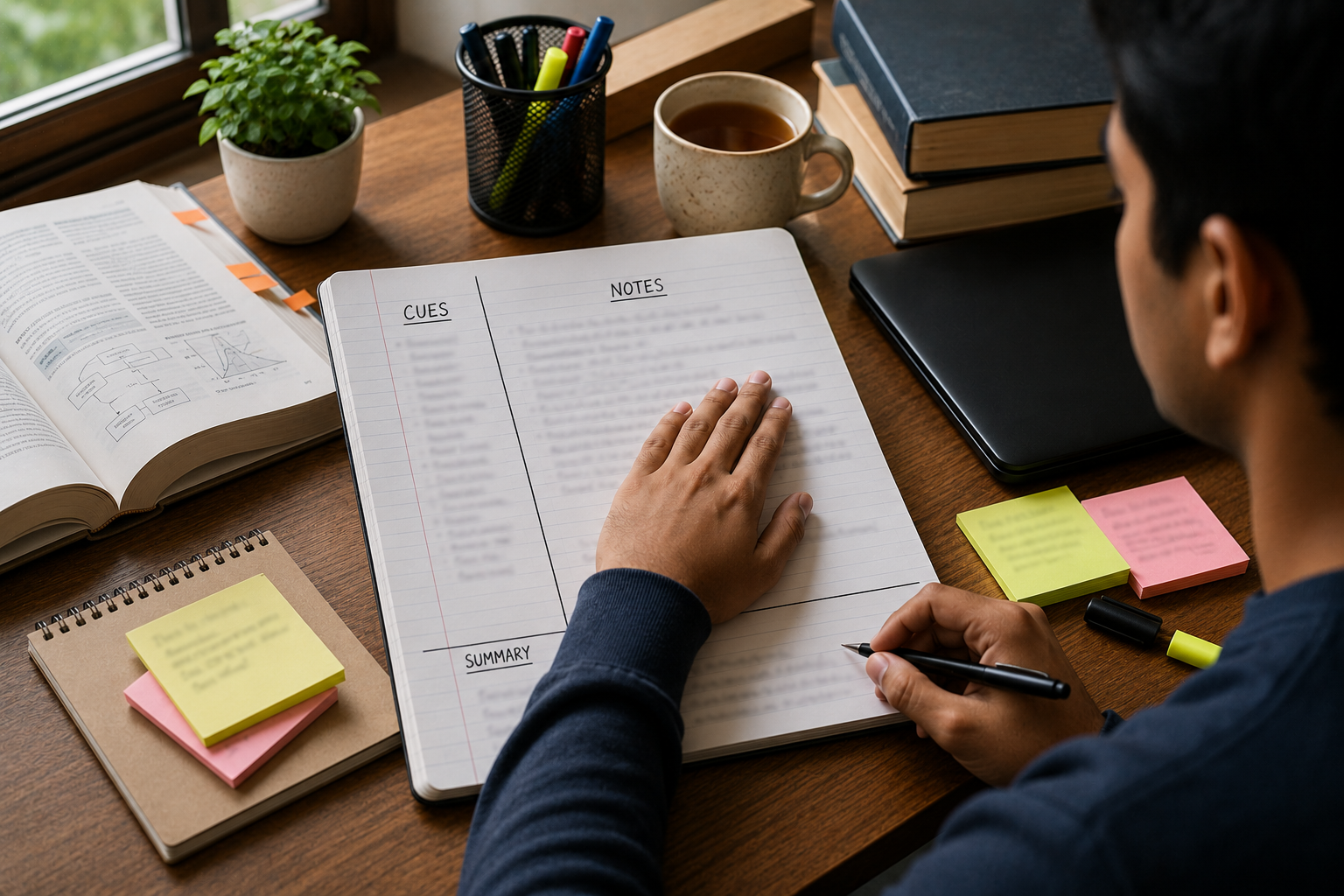
The method is simple. A page is divided into three functional areas: a main notes section, a cue column and a summary section. During the lecture or reading session, the student writes main notes in the large area. After the session, the student writes questions, keywords or cues in the left column. At the bottom, the student writes a short summary of the page. This structure makes the page useful not only for storage but also for active recall.
The page layout
A Cornell notes page usually has a title and date at the top. The page is then divided vertically. The right side, which is larger, is used for main notes. The left side, which is narrower, is used for cues, questions, keywords and prompts. The bottom section is kept for a short summary. The exact measurements do not matter as much as the function. The main idea is that each part of the page has a role.
The notes area captures the content. The cue column helps review the content. The summary area consolidates the content. This separation is powerful because it prevents notes from becoming one continuous block of information. It creates a built-in revision pathway. When the student returns to the page, the cue column can be used to test memory, and the summary can quickly restore the main idea.
The five-part process
The Cornell method is often explained through a sequence: record, reduce, recite, reflect and review. Record means taking notes during the lecture, reading or study session. Reduce means converting the notes into cues and questions after the session. Recite means covering the notes and answering the cues from memory. Reflect means thinking about meaning, connections, doubts and applications. Review means returning to the notes regularly.
This process matters more than the page design. A student can draw the Cornell layout perfectly and still gain little if the page is never used for recall. The power of the method comes from what happens after note-taking. The cue column and summary section push the student to process, question and revisit the material. The page is not the method. The review cycle is the method.
Step one: record the main ideas
During the session, use the main notes section to record important ideas. Do not try to write every sentence. Capture definitions, explanations, examples, formulas, arguments, steps, dates, case references, diagrams and doubts. Use abbreviations and symbols, but keep them understandable. Write in your own words where possible because paraphrasing helps processing.
In a lecture, listen for signals. Teachers often say phrases like “the main point is,” “this is important,” “remember,” “for example,” “in contrast,” or “this can be asked.” These signals indicate what should enter the notes. In a textbook, headings, bold words, summaries, examples and diagrams provide structure. The main notes section should reflect the skeleton of the topic, not every line of the source.
Step two: reduce the notes into cues
After the session, return to the page and fill the cue column. This is where many students gain the most benefit. The cue column should not simply repeat headings. It should contain questions and keywords that can trigger recall. For example, instead of writing “Federalism,” write “What features make a system federal?” Instead of writing “Photosynthesis,” write “What are the inputs, process and outputs of photosynthesis?”
Good cues turn notes into a self-test. When revising, cover the main notes area and look only at the cues. Try to answer from memory. Then uncover the notes and check accuracy. This is far stronger than simply rereading the page because it forces retrieval. It also reveals gaps. If you cannot answer a cue, you know exactly what to revisit.
Step three: write a summary
The summary section at the bottom should capture the page in a few sentences. A good summary answers: What is the central idea? What are the main supporting points? Why does this matter? What is still unclear? The summary should be written in your own words. It should not be copied from the textbook or teacher.
Writing the summary forces consolidation. It is easy to think you understand a page while looking at it. It is harder to compress it accurately without copying. That difficulty is useful. It reveals whether the information has become organised in your mind. The summary also becomes a quick revision tool. When you return after a few days, the summary helps you recover the main context before testing details.
Step four: recite from the cue column
The Cornell method becomes effective when the student uses the cue column for active recall. Cover the main notes and answer the questions aloud or in writing. If the cue says “Causes of inflation,” explain demand-pull, cost-push and monetary factors without looking. If the cue says “Steps of mitosis,” list and explain the stages. If the cue says “Features of effective communication,” reconstruct them from memory.
Recitation feels harder than rereading, but that is the point. The effort of retrieval strengthens learning and exposes weak areas. Students often avoid this step because it makes them feel less confident at first. Rereading feels smooth; recall feels uncomfortable. But performance improves when the brain practises producing the answer, not merely recognising it.
Step five: reflect on meaning and connection
Reflection is the part of Cornell notes that many students skip. After recalling, ask deeper questions. How does this topic connect with what I studied earlier? What example proves it? What is the exception? How could this appear in an exam? What mistake might I make? Why does this concept matter outside the textbook? Reflection turns notes from memory aids into understanding tools.
For example, in history, reflection may connect an event to long-term causes and consequences. In science, it may connect a formula to a real process. In economics, it may connect theory to market behaviour. In career learning, it may connect a skill to workplace performance. These connections make knowledge more flexible. Flexible knowledge is easier to apply to unfamiliar questions.
Step six: review regularly
A Cornell page should be reviewed more than once. The first review can happen soon after class. A second review may happen after a few days. Later reviews can happen before tests or at spaced intervals. The cue column makes this efficient because you can test yourself quickly. You do not need to reread every line each time.
Regular review prevents notes from becoming an archive. Many students take notes for months and open them seriously only before exams. By then, the material feels old and heavy. The Cornell method encourages smaller reviews earlier. This reduces last-minute pressure and supports long-term retention. The method works best when connected with a study schedule.
Example of the Cornell method in practice
Suppose a student is learning about the greenhouse effect. In the main notes area, the student writes: solar radiation enters the atmosphere, Earth’s surface absorbs energy, infrared radiation is emitted, greenhouse gases absorb and re-radiate heat, and increased greenhouse gas concentration strengthens warming. The student adds examples such as carbon dioxide, methane and water vapour. The student marks a doubt about the difference between weather and climate.
In the cue column, the student writes questions: What is the greenhouse effect? Which gases are involved? How does increased concentration change the process? What is the difference between natural and enhanced greenhouse effect? At the bottom, the student summarises: “The greenhouse effect is a natural heat-retention process, but human-driven increases in greenhouse gases intensify warming by trapping more outgoing infrared radiation.” Now the page can be used for recall, not just reading.
Where the Cornell method works best
The Cornell method works well for lectures, textbook chapters, conceptual subjects, exam preparation and professional learning sessions. It is especially useful when information needs to be reviewed repeatedly. The cue column creates ready-made questions, and the summary creates quick context. It is also useful for students who write too much because the layout forces selection.
It can work in many subjects, but it may need adjustment. For mathematics and physics, the main notes area should include worked examples and error patterns. For biology, diagrams may take more space. For law, the cue column may contain issues or case principles. For language learning, cues may include vocabulary prompts and sentence patterns. The Cornell method is a framework, not a rigid template.
Limitations of the Cornell method
The Cornell method is not magic. It does not guarantee learning if the student only copies notes. It may feel restrictive for highly visual topics, complex diagrams or creative brainstorming. Some students may spend too much time formatting the page and too little time reviewing. Others may fill the cue column with vague keywords that do not support recall. Like any method, it works only when used properly.
Another limitation is that Cornell notes are strongest for structured material. If a topic is exploratory, discussion-heavy or project-based, other methods such as mind maps, concept maps, annotated slides or action logs may work better. The smart approach is to use Cornell notes when they fit, and adapt them when they do not. The goal is effective learning, not loyalty to a format.
Cornell notes versus ordinary notes
Ordinary notes often contain information in the order it was received. Cornell notes reorganise the page around later use. Ordinary notes may be useful for storage. Cornell notes are designed for review. Ordinary notes often encourage rereading. Cornell notes encourage questioning. This difference is important because students usually fail not because they never wrote notes, but because their notes did not support recall.
The Cornell method also creates a feedback loop. If your cue questions are weak, your recall will be weak. If your summary is unclear, your understanding may be unclear. If your notes are too crowded, you may need better selection. The page itself shows where the learning process needs improvement.
How to create better cue questions
The quality of cue questions determines the quality of review. Avoid cues that are too broad, such as “Chapter 2” or “Important points.” Use questions that require explanation. Begin with what, why, how, compare, explain, list, evaluate or apply. For example: “Why did this policy fail?” “How does this formula work?” “Compare mitosis and meiosis.” “Apply this theory to a workplace example.”
You can also create exam-style cues. If preparing for competitive exams, write cues that mirror possible questions. If preparing for interviews, write cues that require explanation in simple language. If learning a professional skill, write cues that require action: “How would I use this in a client meeting?” Cues should pull knowledge out of memory and into use.
How to use Cornell notes digitally
Cornell notes can be created digitally using tables, note-taking apps or templates. The digital version has advantages: search, linking, editing and cloud storage. But it also carries distraction risk. If using a laptop or tablet, keep notifications off and avoid switching tabs. The method will fail if the tool becomes a distraction machine.
Digital Cornell notes should still preserve the three functions: notes, cues and summary. You can use a two-column table, collapsible toggles for questions, tags for topics and spaced review reminders. The format may change, but the logic remains the same. Capture, question, summarise and review.
A practical Cornell notes checklist
Before class, create the page title and write the topic. During class, record main ideas in the notes area. Soon after class, write cue questions in the left column. At the bottom, summarise the page in your own words. During revision, cover the notes and answer from the cue column. Mark weak answers. Review again later. Add examples, diagrams or corrections where needed.
This checklist is simple, but its power lies in repetition. One Cornell page may help a little. A semester of Cornell pages, reviewed properly, can transform revision. The method builds a habit of listening actively, processing quickly and testing regularly. It teaches students that notes are not finished when the lecture ends. Notes become valuable when the learner returns to them.
Final takeaway
The Cornell note-taking method is a structured way to turn notes into a learning system. Its strength is not the page design alone, but the cycle it creates: record the material, reduce it into cues, recite from memory, reflect on meaning and review over time. Students who use it properly do not merely collect information. They question it, summarise it and retrieve it.
For students who struggle with messy notes, passive revision or last-minute cramming, Cornell notes offer a practical solution. The method is clear enough for beginners and flexible enough for advanced learners. It should be adapted to the subject, but its central lesson remains constant: effective notes should help you think, remember and perform. If your notes can question you, guide you and reveal your gaps, they are no longer just notes. They are a study partner.