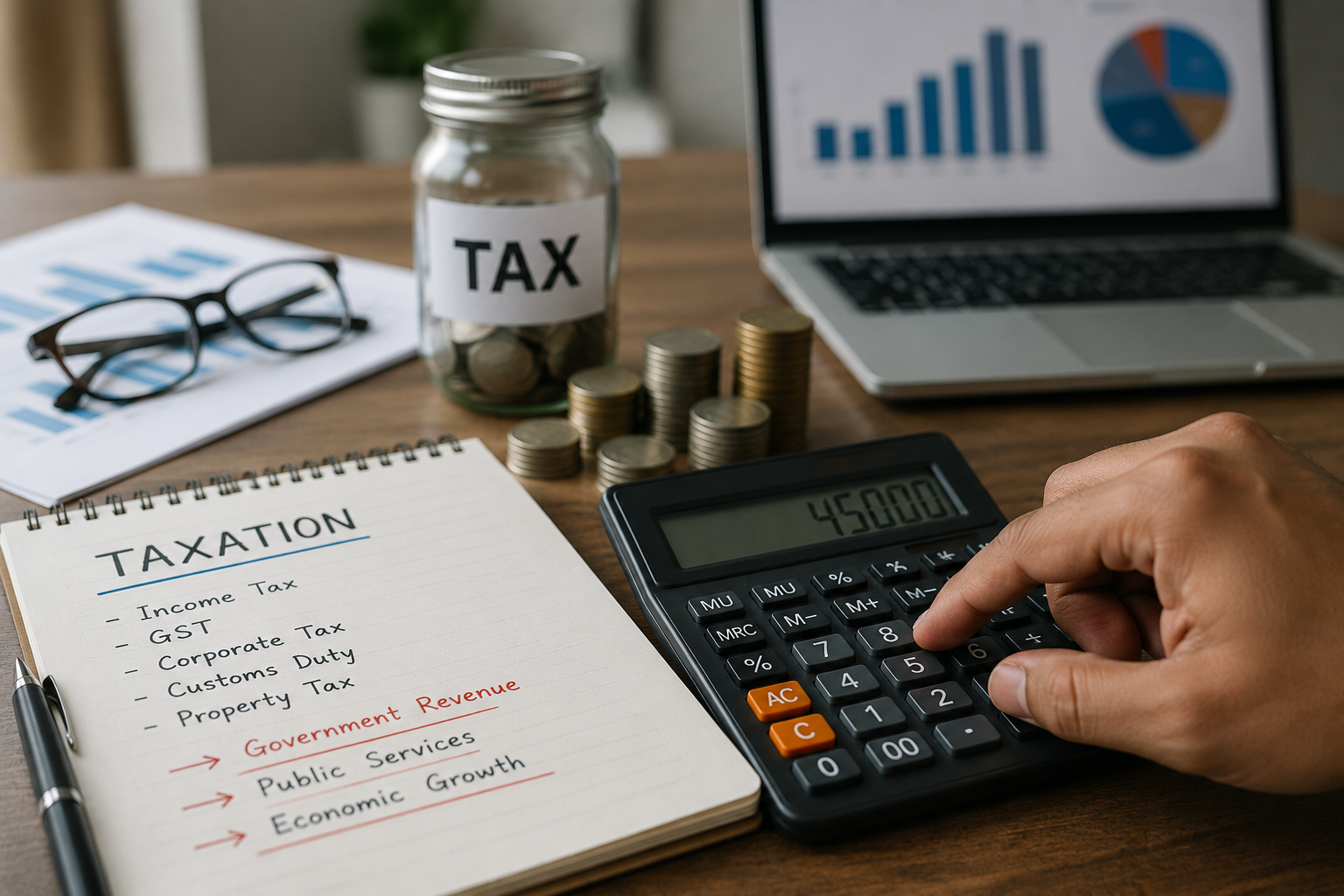
Taxation is usually discussed only when people have to pay it. Salaried workers notice tax when TDS reduces their monthly income. Businesses notice it when they file returns, collect GST, claim input tax credit or plan cash flows. Consumers notice it when prices include indirect taxes. Investors notice it when capital gains, dividends or interest income are taxed. Governments notice it every day because taxation is the financial foundation of public power.
But taxation is not merely a bill. It is one of the most important instruments through which a modern economy is organised.
At the simplest level, taxation is the compulsory payment collected by the government from individuals, businesses, transactions, property, imports, consumption or income. In return, taxpayers do not receive a one-to-one service for every rupee paid. Instead, taxes finance collective goods and public functions: roads, courts, police, defence, schools, hospitals, sanitation, digital infrastructure, welfare schemes, disaster response and public administration.
This is why taxation is different from a private purchase. If a person buys a phone, the person receives that phone. If a person pays tax, the benefit is indirect and collective. Some benefits are visible, such as highways, metro systems and public hospitals. Others are invisible, such as law enforcement, regulatory systems, national security, debt servicing, disease surveillance and the administrative machinery that allows society to function.
The first role of taxation is revenue. Governments need money to spend. Without taxes, a state either has to borrow excessively, print money, sell assets or cut essential services. Borrowing can be useful, but it cannot permanently replace revenue. A country with weak tax capacity often struggles to build strong institutions because it lacks predictable public finance.
The second role is redistribution. Markets do not distribute income equally. Some people earn high salaries, own profitable businesses or hold valuable assets. Others work in low-paid jobs, depend on informal labour or face social and regional disadvantages. Through progressive income taxes, welfare spending and public services, a government can reduce extreme inequality and provide a minimum floor of dignity.
Redistribution does not mean punishing success. It means recognising that a stable economy requires shared public foundations. A rich entrepreneur needs roads, courts, skilled workers, electricity, contract enforcement and social stability. These are not created by private talent alone. They are supported by public systems. Taxation is the contribution that sustains those systems.
The third role of taxation is incentive design. Taxes change behaviour. A high tax on tobacco can discourage consumption and reduce health costs. A carbon-related tax can push firms toward cleaner technology. A tax benefit for retirement savings can encourage long-term financial planning. A lower tax rate for certain sectors can support investment. Import duties can protect domestic producers, though they may also raise consumer prices.
This incentive role is powerful but risky. A tax incentive that encourages genuine investment may be useful. A poorly designed exemption may become a loophole. A high tax rate may raise revenue, but if it becomes too complex or unpredictable, it may encourage evasion, litigation or informal activity. Tax design must balance fairness, simplicity, compliance and growth.
The fourth role is macroeconomic management. Taxation is part of fiscal policy, along with government spending and borrowing. When the economy slows, governments may reduce taxes or increase spending to support demand. When inflation or overheating becomes a concern, governments may restrain spending or raise taxes. Tax policy therefore affects consumption, investment, savings and confidence.
For example, a reduction in personal income tax may leave households with more disposable income. Some may spend more, supporting demand. Some may save more, strengthening financial security. A corporate tax reduction may improve profitability and encourage investment, but only if firms believe demand and policy conditions justify expansion. Tax changes do not work mechanically; they operate through confidence, behaviour and expectations.
The fifth role of taxation is formalisation. A well-administered tax system brings more economic activity into recorded channels. GST invoices, income-tax returns, TDS records, digital payments and business registration create data trails. These records can improve credit access, reduce underreporting and expand the tax base. However, formalisation should not become harassment. Small businesses need simplicity, predictable rules and affordable compliance.
Good taxation depends not only on rates, but on trust. Citizens are more willing to comply when they believe the system is fair, services are visible, rules are stable and enforcement is not arbitrary. If taxpayers feel that honest compliance is punished while evasion is tolerated, morale weakens. Tax administration is therefore also a governance issue.
There are two broad questions in any tax system: who pays, and how much do they pay? A progressive tax asks higher-income groups to pay a larger share. A proportional tax applies the same rate. A regressive burden falls more heavily on lower-income groups relative to their income. Indirect taxes can become regressive if essential goods and services carry high rates, because poorer households spend a larger share of their income on consumption.
This is why the composition of taxation matters. A country that relies too heavily on indirect taxes may collect revenue efficiently but burden lower-income consumers. A country that relies too heavily on narrow direct taxes may overburden a small formal base and leave large informal income outside the system. A balanced system needs broad coverage, reasonable rates and effective administration.
India's tax structure reflects this balancing act. Income tax and corporation tax are major direct taxes collected by the Union government. GST is the central indirect tax system shared between the Centre and states through a constitutional framework. Customs and excise duties also matter, especially for imports and selected goods. States collect taxes such as stamp duty, excise on alcohol, motor vehicle tax and property-related levies, depending on constitutional powers.
Taxation also has a federal dimension. In India, revenue is not only collected; it is shared. The Finance Commission recommends the distribution of Union tax revenues between the Centre and states. This matters because states deliver many essential services, including health, education, policing, local roads and welfare implementation. A tax system that ignores federal finance can weaken service delivery.
The political debate around taxation usually moves between two extremes. One side says taxes are always a burden. The other side treats taxes as an unlimited source of government funding. Both views are incomplete.
Taxes are necessary, but they are not costless. Every tax affects behaviour, prices, savings, investment or compliance. Governments must therefore justify taxation through quality spending, administrative efficiency and fairness. Citizens should not demand Scandinavian-level public services while expecting tax effort to remain minimal. Governments should not demand higher tax compliance while delivering poor services and complex rules.
The real test is value for money. Are taxes financing productive expenditure? Are public services improving? Are leakages controlled? Are incentives aligned with growth? Are the poor protected? Are businesses given clarity? Is the tax base widening without excessive coercion?
A mature economy understands taxation as a contract. Citizens contribute resources; the state converts them into public goods, stability and opportunity. When that contract works, taxes become a foundation of development. When it fails, taxation feels like extraction.
Another important issue is tax buoyancy. A tax system is buoyant when revenue rises naturally as the economy grows, without constant rate increases. If incomes, profits and consumption expand but tax collections do not keep pace, the state must ask whether exemptions, evasion, informality or weak administration are limiting capacity. A buoyant tax system allows the government to finance development without repeatedly shocking taxpayers with sudden changes.
Tax certainty is equally important. Investors and households plan over years, not weeks. When tax rules are unclear or litigation-heavy, people delay decisions. A stable tax system does not mean rates can never change; it means changes are explained, predictable and administered fairly. Certainty reduces the cost of doing business and makes compliance feel less adversarial.
Technology can improve taxation, but it cannot replace trust. Data analytics, e-invoicing, pre-filled returns and digital payments can reduce evasion and paperwork. But if technology is used only for notices and penalties, it may create fear. The best tax administration combines digital capacity with taxpayer service, quick refunds, accessible grievance redressal and proportional enforcement.
Taxation is therefore not only an accounting subject. It is a moral, economic and political institution. It tells us what a society values, who carries the burden, who receives support and whether public power is being used responsibly. A country cannot become strong only by collecting more tax. It becomes strong when taxation funds a state that citizens can see, trust and use.
Disclaimer
This article is for general educational and editorial use. It is not tax, legal, accounting, investment or compliance advice. Tax rules change frequently and differ by taxpayer category, income source, transaction type and jurisdiction. Readers should consult qualified professionals and official government sources before acting on tax matters.