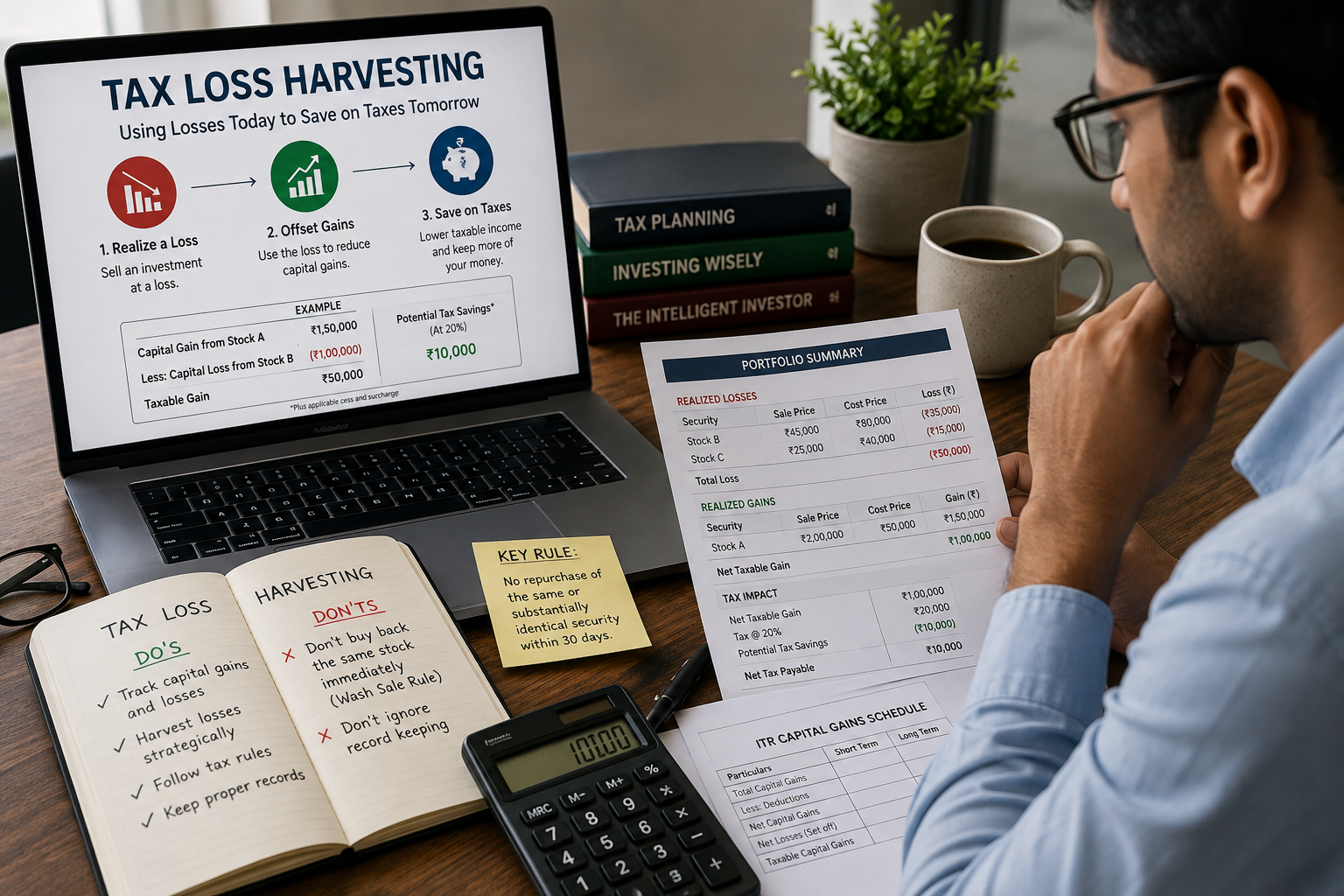
The loss that can still have value
Most investors hate seeing a loss in their portfolio. A falling stock, a declining mutual fund or a failed trade feels like proof of a wrong decision. But in tax planning, not every loss is only a loss. In some cases, a realised capital loss can reduce taxable capital gains. This is the principle behind tax loss harvesting.
Tax loss harvesting is the practice of deliberately selling an investment at a loss so that the loss can be used to offset capital gains, subject to tax rules. The investor may then reinvest in a suitable alternative, maintain the desired asset allocation and reduce tax liability in a lawful way. The idea is not to create losses for their own sake. The idea is to use losses that already exist in a portfolio efficiently.
This makes tax loss harvesting a useful but often misunderstood financial tool. Used properly, it is legal tax planning. Used carelessly, it can become short-term tinkering, poor portfolio management or even tax non-compliance. The difference lies in purpose, documentation and respect for the law.
What tax loss harvesting means
Tax loss harvesting means realising a capital loss by selling an investment whose market value has fallen below its purchase cost, and using that loss to reduce taxable capital gains as permitted by law. The harvested loss may be set off against eligible capital gains in the same year or carried forward if allowed under the tax framework.
The word harvesting is important. The investor is not celebrating the loss. The investor is collecting a tax benefit from a loss that has already occurred economically. If an asset has fallen and the investor has no strong reason to continue holding it, selling it may create a recognised loss for tax purposes. That recognised loss may reduce tax on gains elsewhere in the portfolio.
For example, suppose an investor has booked a capital gain from one mutual fund and is also holding another investment with an unrealised loss. If the weak investment no longer fits the portfolio, selling it may allow the loss to be used against the gain, subject to the rules for short-term and long-term capital losses. The tax bill may reduce, and the portfolio may become cleaner.
The difference between paper loss and realised loss
A paper loss is a decline in value that exists only on the portfolio statement. If an investor bought an asset for Rs 1,00,000 and it is now worth Rs 80,000, there is a paper loss of Rs 20,000. But tax systems generally recognise losses when they are realised through sale or transfer, not merely because the market price has fallen.
Tax loss harvesting therefore requires action. The investor must sell the asset and create a realised loss. Only then does the loss enter tax computation. This distinction matters because many investors think they can claim losses simply because their portfolio is down. That is not how tax recognition normally works.
Realising a loss should not be done casually. Selling an investment changes the portfolio. The investor must ask whether the asset should be sold on investment grounds, whether the tax benefit is meaningful, whether reinvestment is appropriate and whether transaction costs or exit loads reduce the benefit.
How capital losses are generally used
In India, capital losses have specific set-off restrictions. As an official Income Tax Department explanation states, long-term capital loss cannot be set off against any income other than long-term capital gain, while short-term capital loss can be set off against short-term or long-term capital gain. Capital losses are not generally available to reduce salary income, business income or interest income.
This rule is crucial. Tax loss harvesting is not a universal deduction. It works inside the capital gains framework. If an investor has no taxable capital gains, a harvested loss may not provide immediate tax relief, though carry-forward rules may apply if the return is filed properly and conditions are satisfied.
Section 74 of the Income Tax Act deals with losses under the head Capital gains and provides for carry-forward subject to time limits and conditions. Editors and readers should verify the current law before applying the rule because capital gains taxation changes frequently through Finance Acts, budget amendments and transition provisions.
A simple example
Assume an investor has sold one equity mutual fund and realised a taxable long-term capital gain. In the same financial year, another investment is showing a long-term capital loss and no longer suits the investor's portfolio. By selling the loss-making asset, the investor may be able to set the long-term capital loss against eligible long-term capital gain. The taxable capital gain reduces.
The benefit is not the loss itself. The benefit is the tax saved because the recognised loss reduces taxable gains. If the investor saved tax but destroyed a good long-term investment merely to chase a short-term tax benefit, the decision may be poor. If the investor sold a weak or unsuitable holding and improved portfolio structure while reducing tax, the decision may be sensible.
Tax loss harvesting should therefore begin with investment logic and then consider tax impact. Tax should improve a good decision, not justify a bad one.
Why investors use tax loss harvesting
Investors use tax loss harvesting for three main reasons. First, it can reduce current tax liability when gains and eligible losses exist in the same year. Second, it can clean a portfolio by removing poor or unsuitable investments. Third, it can make investors more disciplined about reviewing holdings instead of carrying weak assets indefinitely.
The practice is especially relevant in portfolios with multiple stocks, mutual funds or listed securities where some positions have gained and others have declined. Market volatility creates dispersion. Some holdings rise; others fall. Tax loss harvesting uses this dispersion intelligently.
However, the strategy is not meant for every investor every year. A person with a small portfolio, no capital gains or long-term high-conviction holdings may not need it. Excessive harvesting can create unnecessary churn. Good tax planning should simplify the financial life, not turn it into constant trading.
The danger of tax-first investing
The biggest mistake is allowing tax considerations to dominate investment strategy. An investor may sell a strong asset simply because it shows a temporary loss. Later, the asset may recover, and the investor may miss the upside. Alternatively, the investor may sell a loss-making investment and immediately buy another unsuitable product just to remain invested.
Tax loss harvesting also has costs: brokerage, securities transaction tax where applicable, exit loads, bid-ask spreads, time, record-keeping and advisory fees. These costs must be compared with potential tax savings. A small tax benefit may not justify a complex transaction.
Investors should also be careful about substance. If the sale and repurchase are structured only to manufacture a tax result without meaningful economic change, tax authorities may examine the transaction depending on facts and anti-abuse provisions. The safer approach is to ensure every transaction has a genuine investment purpose.
Tax loss harvesting and portfolio discipline
Used wisely, tax loss harvesting encourages portfolio discipline. It forces investors to ask: why do I still hold this asset? Does it fit my goal? Is there a better alternative? Am I holding it only because I do not want to admit a mistake?
Many investors suffer from the disposition effect: they sell winners too quickly and hold losers too long. Tax loss harvesting can challenge this behaviour. It converts a losing position into an opportunity to reassess. If the thesis is broken, the investor exits. If the thesis remains strong, the investor may hold despite the tax benefit.
The point is not to sell every loser. Some investments fall temporarily but remain fundamentally sound. The point is to stop treating all losses as emotional failures. Some losses are information. Some are tax assets. Some are warnings. A mature investor learns to distinguish them.
India angle: why documentation matters
In India, tax-loss harvesting must be supported by clean records. Investors should maintain contract notes, statements, purchase dates, sale dates, cost of acquisition, holding period, capital gains computation and return filing records. If losses are to be carried forward, timely and correct filing of the income tax return becomes essential.
Investors should also understand that equity, debt funds, property, gold, unlisted shares and other assets may have different tax rules, holding periods and rates. A strategy that works for one asset may not work the same way for another. Budget changes can also alter the treatment.
This is why generic social-media advice on tax loss harvesting can be risky. The method is conceptually simple, but execution depends on law, product type and individual tax position.
Final takeaway
Tax loss harvesting is a useful financial planning tool because it recognises a practical truth: a portfolio may contain both gains and losses, and the law may allow eligible losses to reduce taxable gains. It can lower tax, improve portfolio hygiene and reduce emotional attachment to weak holdings.
But it is not a shortcut to wealth. It cannot make a bad investment good. It cannot replace asset allocation. It cannot be applied without understanding capital-gains rules. It should never be used merely to create activity.
The best way to use tax loss harvesting is with three filters: investment merit, tax legality and documentation. If all three are satisfied, a loss can still serve a purpose. If any one is missing, the tax benefit may not be worth the risk.