The Spiritual Teacher Swami Vivekananda
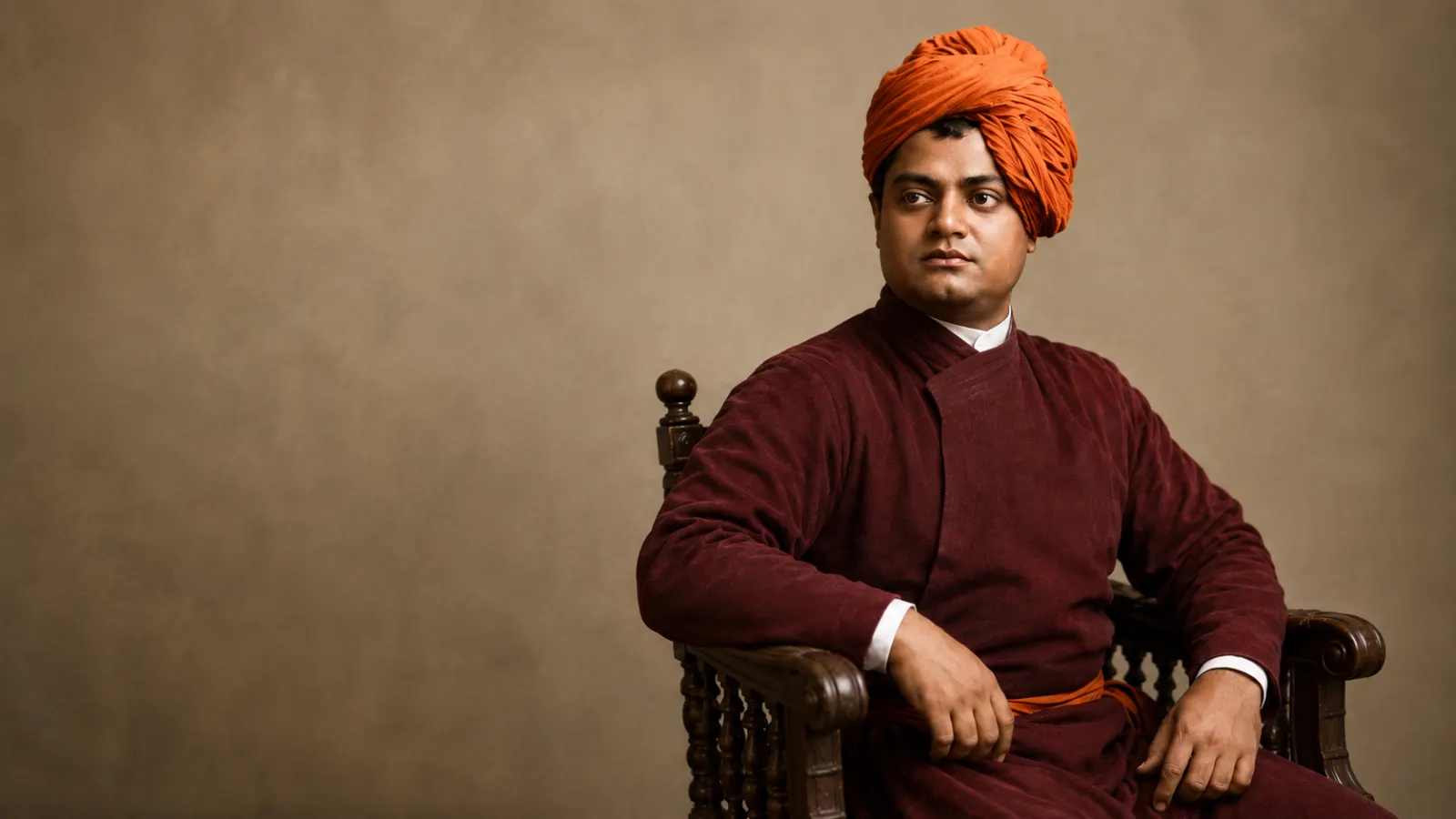
On 11 September 1893, a relatively unknown Hindu monk from India rose to address the World's Parliament of Religions in Chicago.
The event took place as part of the World's Columbian Exposition. The Art Institute of Chicago, on whose present site the Parliament was held, preserves Vivekananda's association with the gathering and describes his address as an important call for religious tolerance.
The speech made Swami Vivekananda an international figure.
But the famous Chicago moment can distort his biography if it is treated as the beginning and end of his importance.
Vivekananda was simultaneously a monk, interpreter of Vedanta, critic of social stagnation, organiser, transnational lecturer and institution-builder.
He became influential partly because he could speak in several intellectual languages at once.
To religious Indians, he could invoke Vedanta.
To Western audiences, he could present Hindu philosophy in categories intelligible to modern religious and philosophical debate.
To educated Indians living under colonial rule, he could speak of cultural confidence.
To his followers, spirituality could be transformed into organised service.
Narendranath before Vivekananda
Swami Vivekananda was born Narendranath Datta in Calcutta on 12 January 1863.
Ramakrishna Math and Ramakrishna Mission's official biography describes his father, Vishwanath Datta, as an attorney with wide intellectual interests and his mother, Bhuvaneshwari Devi, as a formative religious influence. Narendra received a modern education and developed interests extending across philosophy, music, physical culture and religion.
Calcutta in the late nineteenth century was one of the major centres of colonial education and religious reform.
Christian missionary criticism, Western philosophy, Brahmo reform, Hindu revival and new forms of print culture created an environment in which inherited religious ideas were being questioned and reconstructed.
Narendra's religious search unfolded within this setting.
Meeting Ramakrishna
The decisive relationship of his early life was with Ramakrishna, the mystic associated with the Kali temple at Dakshineswar.
Narendra approached spiritual questions with scepticism as well as longing.
The relationship between the intellectually restless student and the devotional mystic became foundational to later Ramakrishna-Vivekananda tradition.
After Ramakrishna's death in 1886, a group of disciples developed a monastic community.
Narendra eventually emerged as its most internationally influential figure.
Devotional biographies interpret this period through spiritual destiny.
Historical analysis has to use a different method.
It can document relationships, writings, institutions and recollections without claiming to verify supernatural experiences themselves.
The wandering monk
Vivekananda travelled extensively across India as a wandering monk.
These journeys became central to his later understanding of the country.
Institutional accounts emphasise that witnessing poverty and social hardship strengthened his concern for the condition of India's masses.
Modern historical research adds an important complication: his mobility also helped him form networks with patrons, intellectuals and regional supporters who later made his international work possible.
The wandering monk was therefore not outside politics and society.
Travel was itself a process of intellectual and organisational formation.
Chicago and the making of a global figure
The Parliament of the World's Religions opened in Chicago in September 1893.
Vivekananda's first address became famous partly for its warm salutation to the audience and its presentation of Hinduism as a tradition capable of religious tolerance and universal acceptance.
Later retellings sometimes exaggerate details about the length of applause or reproduce newspaper praise without reliable citation.
Those embellishments are unnecessary.
The well-supported fact is that the Parliament made Vivekananda highly visible and created opportunities for an extended lecture career in the West.
He did not merely deliver one memorable speech and return home.
He spent years lecturing, teaching and building circles of followers.
What exactly was Vivekananda teaching?
Vivekananda presented Vedanta as a philosophical framework with universal relevance.
Central to his message was the idea of an underlying unity of existence and the divine potential of the human being.
He drew heavily on Advaita Vedanta but did not simply repeat classical Advaita in unchanged form.
He adapted ideas to new audiences and linked spiritual realisation with action in the world.
This modern reinterpretation is often called Neo-Vedanta.
The label can be useful, but scholars debate how strongly Vivekananda departed from earlier traditions.
What is clear is that he translated Vedantic concepts into a global modern vocabulary.
Religion became something he could discuss alongside science, philosophy, psychology and social service.
Raja Yoga and the Western reception of yoga
Vivekananda's Western work also influenced the modern reception of yoga.
His Raja Yoga, published during the 1890s, presented yogic philosophy to English-speaking readers in a systematic form.
This was long before yoga became globally associated primarily with physical postures and wellness culture.
For Vivekananda, yoga concerned mental discipline and spiritual realisation.
His presentation helped establish an intellectual route through which Indian philosophical traditions entered Western religious and psychological discussion.
That legacy would later develop in directions he could not have anticipated.
Practical Vedanta
Perhaps the most consequential aspect of Vivekananda's teaching in India was his insistence that spirituality should have practical social consequences.
Ramakrishna Mission describes his post-1897 programme as an attempt to combine spiritual principles with attention to the conditions of the poor and disadvantaged.
The organisation uses the term Practical Vedanta to describe this emphasis.
This was an important shift in the social role of monasticism.
The ideal monk did not have to withdraw completely from organised public service.
Education, health care, famine relief and other forms of assistance could become religious action.
Founding the Ramakrishna Mission
Vivekananda returned to India in 1897.
On 1 May that year, he founded the Ramakrishna Mission.
The organisation joined monks and lay supporters in educational, medical, humanitarian and religious work.
The establishment of the Mission turned Vivekananda's ideas into institutional practice.
This may be one of the most important distinctions between a charismatic speaker and a durable historical figure.
Speeches disappear unless organisations reproduce their influence.
The Mission survived him.
Belur Math and organised monastic life
By the late 1890s, the monastic movement acquired a permanent base at Belur.
Vivekananda sought to create a form of monastic organisation that combined spiritual discipline and service.
Belur Math later became the headquarters of the Ramakrishna Math and Ramakrishna Mission.
This institutional legacy explains why Vivekananda remained influential after his early death.
He created structures through which followers could train, publish, teach and serve.
Vivekananda and social hierarchy
Vivekananda spoke forcefully about poverty, weakness and the condition of India's masses.
He criticised forms of caste arrogance and argued for social uplift.
Yet his relation to caste, Hindu tradition and social reform is more complicated than quotations selected for modern political purposes suggest.
Like many nineteenth-century thinkers, his statements vary according to context and audience.
Some are sharply egalitarian.
Others retain assumptions rooted in his historical environment.
A serious treatment therefore has to resist the search for a single quotation that proves he perfectly anticipated one modern ideology.
Historical thinkers are rarely so convenient.
Women in Vivekananda's thought
Vivekananda frequently linked national regeneration to the education and status of women.
His Western networks also included influential women such as Margaret Noble, later Sister Nivedita, who travelled to India and became involved in education.
Here again, however, interpretation matters.
Vivekananda's rhetoric about women sometimes drew on idealised images of motherhood, spirituality and cultural strength.
It could be empowering while also operating within nineteenth-century gender assumptions.
Religion and nationalism
Few aspects of Vivekananda's legacy are more contested than his relationship with Indian nationalism.
Later nationalist thinkers across different ideological traditions claimed inspiration from him.
His celebration of India's spiritual heritage provided a language of cultural confidence under colonial rule.
But was he a Hindu nationalist in the modern political sense?
Scholars disagree about how the label should be applied.
A balanced conclusion is that Vivekananda influenced Indian nationalism without being reducible to any one later political organisation.
Was his Hinduism “traditional”?
Vivekananda frequently presented Hinduism as possessing an underlying philosophical unity.
That presentation helped make Hindu traditions intelligible as a “world religion” in the emerging comparative-religion environment of the nineteenth century.
But Hinduism had never been a single institution with one church, creed or founder.
To present it globally required selection and synthesis.
Vivekananda elevated Vedanta—especially Advaita—as a framework capable of representing Hindu spirituality broadly.
This was intellectually powerful.
It was also interpretive.
He was not simply exporting an unchanged ancient package.
He was helping create a modern understanding of Hinduism.
Universalism and its limits
Vivekananda's Chicago rhetoric is remembered for its opposition to sectarian intolerance.
This universalist aspect of his thought remains one of the reasons he is admired internationally.
Yet universalism itself can take different forms.
One form says all religions are equal because none possesses unique truth.
Another says different religions are paths toward a deeper truth that one philosophical system explains most completely.
Vivekananda's position often moved closer to the second.
He could celebrate religious diversity while still arguing for the philosophical depth or superiority of Vedanta.
This distinction matters when modern readers use him as a symbol either of pure pluralism or of Hindu supremacy.
His own thought was more layered.
The shortness of his life
Vivekananda's public career was remarkably compressed.
He was born in 1863 and died at Belur Math on 4 July 1902, aged only 39.
The movement associated with him therefore had to develop largely after his death.
His collected lectures, letters and books became important to this process.
The Complete Works tradition preserved a very large textual corpus that later followers and scholars interpreted in different ways.
How Vivekananda became many different Vivekanandas
Historical memory rarely preserves a figure intact.
Different generations select what they need.
Religious followers emphasise the monk and disciple of Ramakrishna.
Indian nationalists emphasise cultural confidence.
Educationists emphasise character formation.
Interfaith movements emphasise Chicago.
Yoga communities emphasise Raja Yoga.
Social-service institutions emphasise Practical Vedanta.
Political movements select statements useful to their own understanding of nation and civilisation.
All of these Vivekanandas have some basis in the historical record.
None alone is the whole person.
A global religious entrepreneur?
Modern historians sometimes use concepts such as networks, mobility and religious entrepreneurship to analyse Vivekananda.
Such language can initially sound disrespectful when applied to a monk.
It need not be.
It simply recognises that global religious influence requires organisation.
Vivekananda cultivated patrons.
He travelled strategically.
He lectured publicly.
He published.
He established institutions.
He trained followers.
He moved ideas between cultural environments.
Understanding those mechanisms does not deny spiritual conviction.
It explains how conviction became historically effective.
Why Swami Vivekananda still matters
Vivekananda's continuing importance comes from the number of debates he sits inside.
What is Hinduism?
How should ancient philosophical traditions respond to modernity?
Can monastic spirituality justify organised social service?
How should religious diversity be understood?
What relationship exists between cultural pride and nationalism?
Can an intellectual tradition become global without changing in the process?
Vivekananda offered answers to all of these questions.
Some remain persuasive to millions.
Others have been challenged by historians, philosophers and political critics.
That continuing disagreement is itself evidence of his importance.
The least useful way to remember him is as a collection of motivational quotations.
The more interesting Vivekananda is the historical thinker moving between Calcutta, princely India, Chicago, London and New York; between Ramakrishna's mysticism and modern print culture; between monastic renunciation and organised service; between universal religion and cultural nationalism.
His career shows how religious traditions survive modernity not simply by resisting change, but by being reinterpreted.
Vivekananda was one of the most influential interpreters in that process.