A country’s reputation becomes a borrowing cost
A sovereign rating is one of the clearest examples of how reputation becomes money. When a government borrows, investors do not look only at speeches, flags or political confidence. They ask a hard question: will this country repay its debt on time? The answer shapes interest rates, foreign investment, currency pressure, banking stability and even the everyday cost of running the state. A sovereign rating is not just a financial label. It is a judgement on national credibility.
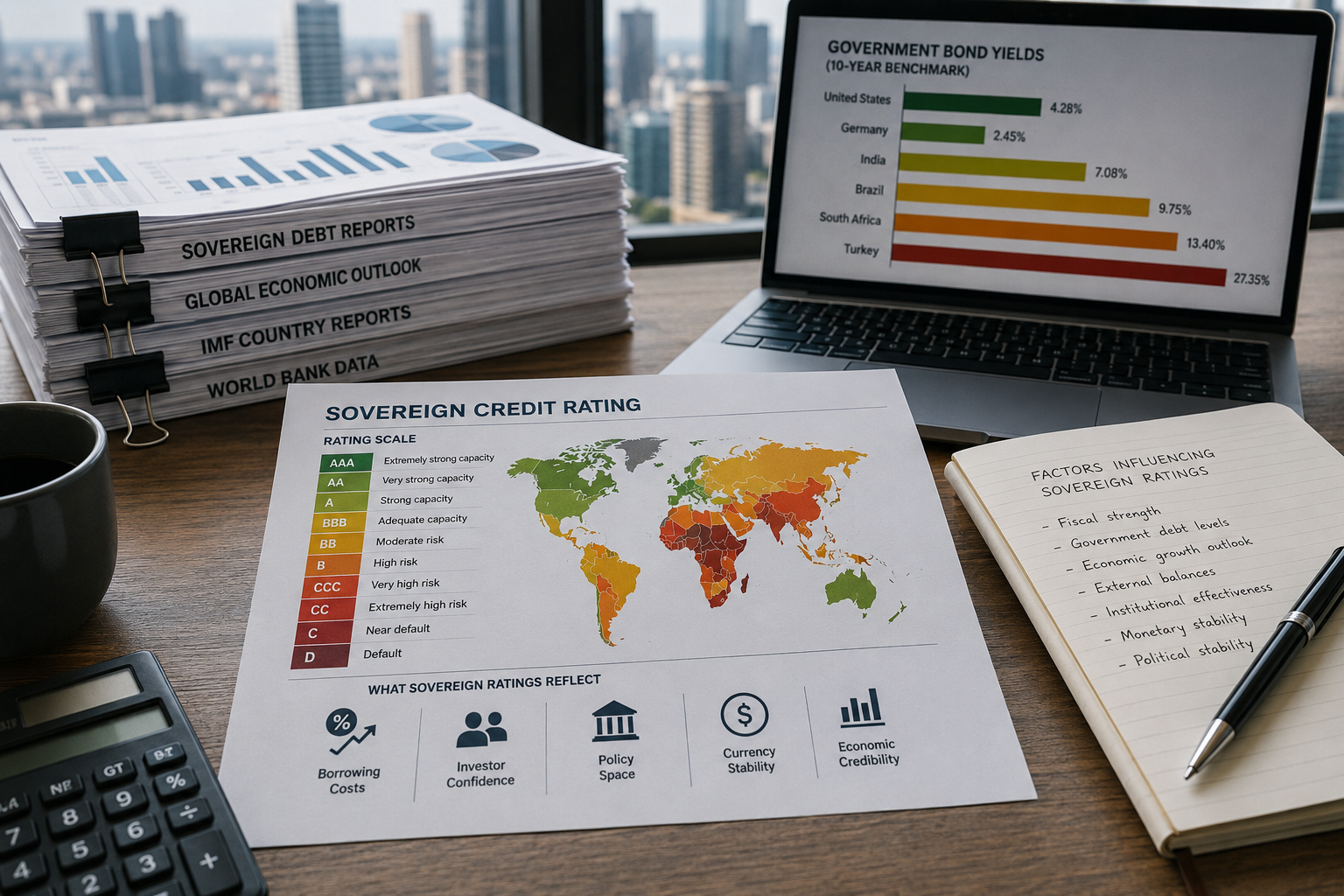
Sovereign credit ratings are assessments of a government’s ability and willingness to meet its debt obligations. They are issued by credit rating agencies and applied to countries, their bonds and sometimes specific currency obligations. A higher rating suggests that a country is seen as more likely to repay. A lower rating suggests greater default risk, weaker fiscal capacity, political uncertainty or external vulnerability.
The rating itself may look like a small set of letters, but the consequences are wide. When a country is upgraded, investors may become more willing to buy its bonds. When it is downgraded, borrowing can become costlier. When the outlook turns negative, markets may begin pricing future stress before an actual downgrade. For emerging economies especially, ratings can influence how the outside world interprets their economic story.
What rating agencies look at
A sovereign rating is built from several pillars. The first is fiscal strength. Agencies examine government debt, fiscal deficit, interest burden, revenue capacity and the credibility of budget management. A country with high debt is not automatically unsafe if it has strong institutions, deep domestic markets and stable revenue. But high debt combined with weak growth, poor tax collection and political instability creates concern.
The second pillar is economic strength. A large, diversified and growing economy can usually absorb shocks better than a small and narrow economy dependent on one commodity or one external lender. Agencies look at growth potential, productivity, per capita income, inflation, investment climate and structural reform capacity. The third pillar is external strength. Countries that depend heavily on foreign borrowing, imported energy or volatile capital flows are more exposed to sudden stops. Foreign exchange reserves, current account balance and exchange-rate flexibility matter.
The fourth pillar is institutional and political strength. Investors care not only about numbers but about decision-making. Does the government honour contracts? Are budgets credible? Is the central bank trusted? Can political conflict paralyse reform? Is policy predictable? A country may have resources, but weak institutions can turn resources into risk. Sovereign ratings therefore mix economics with governance.
How ratings affect borrowing costs
The most direct effect of a sovereign rating is on the interest rate a government pays. Investors demand compensation for risk. A country with strong ratings can borrow at lower yields because investors see lower probability of default. A country with weak ratings must pay more to attract buyers. This additional interest cost can become a fiscal burden. Money that could have gone to infrastructure, education, healthcare or defence may instead go to debt servicing.
The effect is not limited to new borrowing. When ratings fall, the price of existing bonds can decline and yields can rise. If a government must refinance maturing debt during a period of rating pressure, it may face much higher costs. For countries that borrow in foreign currency, the pressure can be even sharper. A weaker rating may reduce foreign investor appetite, weaken the currency and make external debt more expensive in local terms.
The ceiling effect on companies and banks
Sovereign ratings also affect private companies. In many cases, a country’s rating acts as a ceiling or reference point for corporate borrowing abroad. If the sovereign is considered risky, even strong domestic companies may find it harder or costlier to raise international capital. Investors ask: if the government itself faces fiscal stress, how safe are companies operating within that economy?
Banks are especially connected to sovereign ratings. Banks hold government bonds, depend on domestic liquidity and operate under national macroeconomic conditions. A sovereign downgrade can reduce confidence in banks, raise their funding costs and affect the broader financial system. This creates a feedback loop: a stressed sovereign can weaken banks, and weak banks can increase pressure on the sovereign if the government must provide support.
The psychological effect
Ratings are powerful because they simplify complex realities into a symbol. This makes them useful, but also dangerous. Investors, journalists and policymakers can overreact to a rating action. A downgrade may become a headline that travels faster than the underlying report. Political debates may reduce ratings to national pride, even though the real issue is not prestige but risk pricing.
The psychological effect can become self-reinforcing. If a downgrade causes investors to sell bonds, yields rise. Higher yields increase debt-servicing costs. Higher costs worsen fiscal pressure. This can validate the original concern. That does not mean agencies create crises out of nothing, but it shows how ratings can amplify market movements.
The Global South problem
Developing countries often argue that sovereign ratings understate their resilience and overstate their risks. They say agencies can be harsher on poorer countries, quicker to punish political uncertainty and slower to recognise structural improvement. There is a serious debate here. Ratings must reflect risk honestly, but risk assessment should not become a mechanism that permanently raises the cost of development for countries that already face capital scarcity.
For low- and middle-income countries, a lower rating does not merely affect investors. It affects development space. Higher borrowing costs mean fewer roads, schools, hospitals and energy projects. A country facing climate shocks or commodity volatility may need more financing precisely when markets become more expensive. This is why sovereign ratings are not a narrow Wall Street issue. They are part of the development architecture.
The India angle
India’s sovereign rating debate is often politically charged because the country combines strong growth potential with persistent concerns around fiscal deficit, debt burden, per capita income and institutional capacity. India’s large domestic market, deepening financial system, foreign exchange reserves and growth trajectory support confidence. At the same time, rating agencies watch government finances, external vulnerability, banking stability, inflation credibility and reform execution.
The deeper lesson for India is that ratings are not won by public relations alone. They improve when economic fundamentals, fiscal discipline, institutional credibility and policy predictability improve. A country that wants cheaper capital must make itself easier to trust. That requires transparent data, credible budgets, stable regulation, productive public investment and disciplined debt management.
Why ratings are not the whole truth
Sovereign ratings matter, but they are not perfect. Agencies have made mistakes before. They may lag markets, underestimate political shocks, or fail to anticipate crisis dynamics. Ratings also compress complex national realities into broad grades. Two countries with the same rating may have very different risks. One may face fiscal stress; another may face external vulnerability. One may have political risk; another may have commodity dependence.
Investors therefore look beyond the rating. They examine bond yields, credit default swap spreads, fiscal data, central bank credibility, current account trends, political developments and reform direction. Policymakers should do the same. A rating is useful feedback, but it should not become the only measure of national economic health.
Final takeaway
Sovereign ratings affect nations because they influence the price of trust. They shape how investors view government debt, how companies access capital, how currencies behave and how much policy space a state enjoys. But a rating is not destiny. Countries can improve credibility through prudent debt management, strong institutions, transparent data, productive investment and stable policy. The real goal is not to impress rating agencies. The real goal is to build an economy that deserves confidence even when the world is uncertain.