The Educator Savitribai Phule
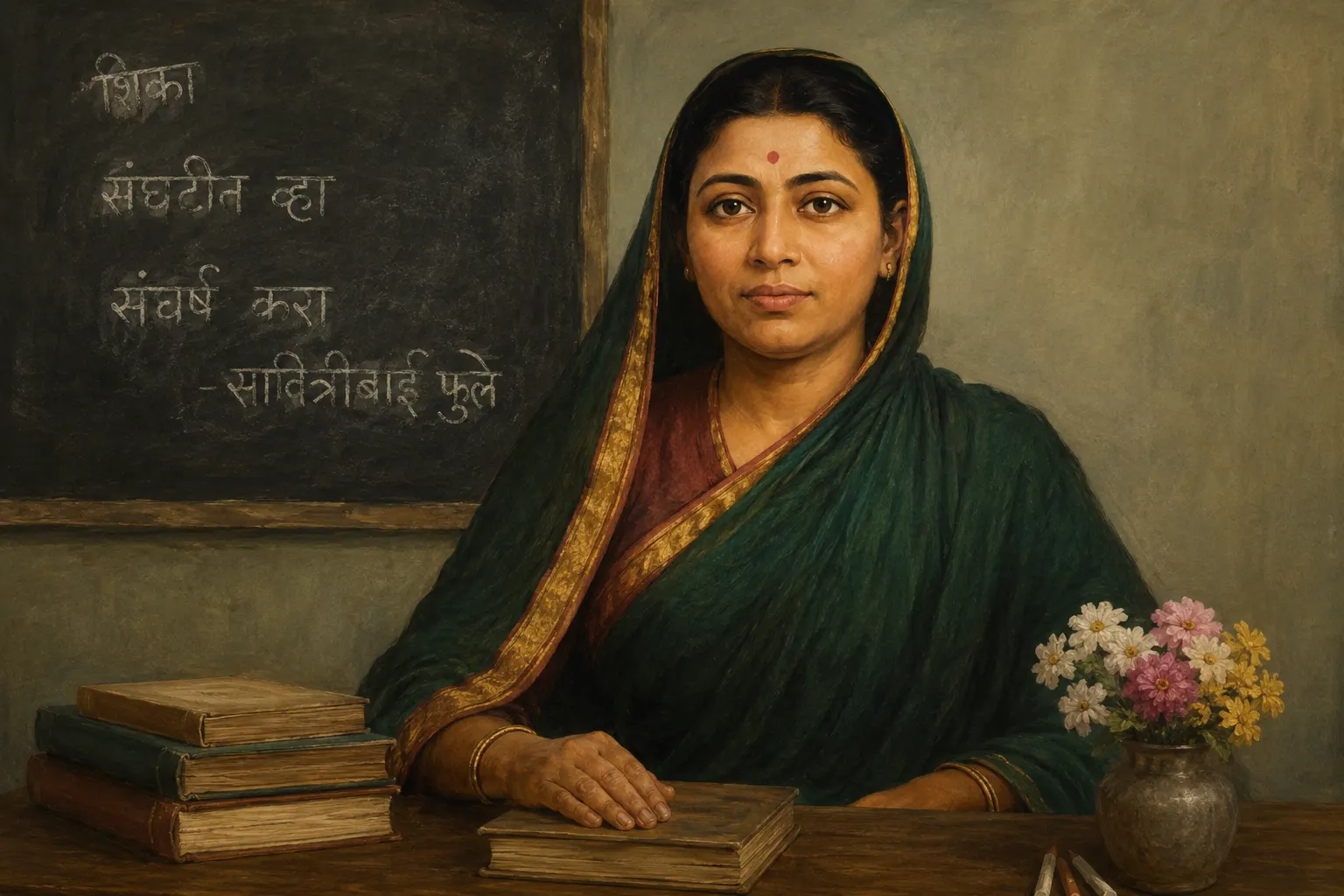
Savitribai Phule is often introduced with a superlative: India’s first woman teacher.
The phrase has enormous symbolic power.
It also needs historical qualification.
Female education existed in missionary and other institutional settings before the Phules began their work in Pune. Jyotirao Phule himself told the Education Commission in 1882 that missionaries had already established a female school in Pune before his own initiative, although he emphasised that an indigenous girls’ school was lacking.
Savitribai's importance therefore does not depend on proving that no woman anywhere in India taught before her.
Her achievement is more substantial than a slogan.
She became one of the earliest prominent Indian women to teach in a modern school, helped organise education for girls and marginalised communities, wrote poetry and letters, participated in anti-caste reform, confronted entrenched social opposition and continued public work across much of her adult life.
She was not simply present at the beginning of an educational movement.
She helped define what that movement meant.
Born into a society that restricted women's learning
Savitribai was born on 3 January 1831 in Maharashtra.
She married Jyotirao Phule while still young, in accordance with the child-marriage practices of the time.
Most girls in her social environment had extremely limited access to formal education.
Her own transformation from an initially uneducated girl into a teacher therefore embodied the social change she later advocated.
Accounts of her life describe Jyotirao's role in encouraging her education and her subsequent teacher training.
But framing this as a husband “giving” education to his wife misses what happened next.
Savitribai converted learning into public action.
That distinction is crucial.
The school as a political institution
In the late 1840s, the Phules and their associates began establishing schools in Pune.
The best known operated at Bhide Wada.
The schools sought to educate girls, including students from communities excluded from elite educational structures.
By the early 1850s, the movement was operating several schools for girls.
Jyotirao's later testimony to the Education Commission explicitly credited both himself and his wife with years of work in female education and also described schools for Mahar and Mang children.
For Savitribai, the classroom was politically disruptive.
Teaching a girl to read did more than increase literacy.
It challenged assumptions about who was entitled to knowledge, who could interpret texts, who could earn authority and what role women should occupy outside the household.
When caste was added to gender, the challenge became even larger.
Education and caste could not be separated
Modern accounts sometimes remember Savitribai principally as a women's-rights pioneer.
That is correct but incomplete.
The educational project of the Phules also targeted caste exclusion.
Their work among Mahar, Mang and other marginalised communities challenged a social order in which learning had historically been unequally distributed.
This meant Savitribai's educational politics operated along two axes simultaneously:
gender and caste.
The significance of that intersection becomes clearer when compared with reform movements that supported women's education primarily within privileged social groups.
Savitribai's work belonged to a broader attempt to democratise knowledge.
Fatima Sheikh and the danger of the lone-hero story
Savitribai's story is frequently told as though she and Jyotirao worked alone.
They did not.
Among the figures associated with their educational activity was Fatima Sheikh, a Muslim educator whose role has received increasing historical attention.
Sources differ on details of Sheikh's biography, and some modern commemorative claims about her require careful verification.
But the larger lesson is clear: reform was collaborative.
Savitribai belonged to a network.
Friends provided shelter.
Teachers worked together.
Students and families accepted social risk.
Supporters financed institutions.
The history of education becomes distorted when all of that collective work is compressed into a single heroic individual.
Savitribai deserves recognition without erasing the people around her.
Opposition and the problem of famous anecdotes
A familiar story says that orthodox opponents threw mud, stones or dung at Savitribai while she walked to school, forcing her to carry an extra sari.
The anecdote has become one of the most repeated scenes in modern accounts of her life.
Social opposition to girls' education and the Phules' anti-caste work is well documented.
But specific dramatic details are not always supported by contemporary evidence of equal quality.
A rigorous biography should therefore distinguish between the documented fact of opposition and individual anecdotes that may have been strengthened through later retelling.
The broader historical reality does not require embellishment.
A woman publicly teaching girls and marginalised children in conservative nineteenth-century Pune was already challenging powerful conventions.
Savitribai's own voice
One of the most important corrections to older biographies is to read Savitribai herself.
She was not merely the subject of other people's writing.
She wrote.
Her collection Kavya Phule appeared in 1854, and later writings continued to connect knowledge, dignity and liberation.
Modern scholarship has increasingly treated her poetry and letters as evidence of an independent intellectual voice rather than as supplementary material to Jyotirao's career.
Her poems repeatedly valorised education.
This matters because education in Savitribai's work was not abstract self-improvement.
It was a route out of imposed inferiority.
Learning created the possibility that subordinated people could reinterpret the world in which they lived.
Letters as historical evidence
Several surviving letters from Savitribai to Jyotirao are especially valuable.
English translations reproduced from collections of her Marathi writings show her discussing education, caste conflict, family disagreement and social intervention.
A letter from 1856, for example, describes conflict with her brother over the couple's reform activities and reflects the extent to which education had become tied to their challenge to social hierarchy.
The letters are important precisely because they make Savitribai a participant rather than an icon.
Commemorative statues cannot argue.
Letters can.
They reveal someone thinking about events, responding to opposition and participating in strategy.
Beyond the classroom
The Phules' activism expanded into other areas affecting women.
They opposed oppressive treatment of widows and supported initiatives intended to provide refuge to women facing pregnancy under socially dangerous circumstances.
These interventions must be understood within a society in which widowhood could bring severe restrictions and sexual relations outside sanctioned marriage could expose women to social violence.
Education was therefore part of a larger challenge to patriarchy.
A literate woman with social support and institutional alternatives possessed possibilities unavailable to someone entirely dependent on family or caste authority.
Savitribai's teaching work and social reform activity were thus closely connected.
Satyashodhak politics
When Jyotirao founded the Satyashodhak Samaj in 1873, Savitribai remained associated with the movement's broader campaign against caste domination and ritual hierarchy.
The organisation attempted to create a social sphere in which inherited priestly authority was not necessary for every important life event.
For women, this had particular significance.
Marriage, widowhood, sexuality and family honour were major sites through which caste order reproduced itself.
A movement challenging hereditary religious authority inevitably touched gender relations as well.
Savitribai's place in that movement should therefore be understood politically, not merely charitably.
After Jyotirao
Jyotirao Phule died in 1890.
Savitribai continued public activity after his death rather than disappearing from political life.
This period is important because it makes clear that her reform identity was not dependent on his physical presence.
She had already spent decades as educator, organiser and writer.
Her later public work continued that trajectory.
Plague and her death
Savitribai died on 10 March 1897 during a plague epidemic.
Later biographical accounts describe her involvement in caring for plague patients and state that she contracted the disease while assisting the sick.
Some accounts provide dramatic details about her personally carrying an infected child to medical care.
Those details are widely repeated, but as with other popular anecdotes, historians should distinguish well-established facts from later narrative embellishment where contemporary documentation is limited.
What can be stated securely is that her death became associated with service during the plague crisis.
It gave the final chapter of her life a symbolic continuity with the rest: public responsibility expressed through practical action.
Why “first” is not the most important word
Savitribai's modern reputation is often built around a competition for historical priority.
Was she the first Indian woman teacher?
Was Bhide Wada the first girls' school?
Was Fatima Sheikh the first Muslim woman teacher?
Such questions can be historically useful, but they can also narrow public understanding.
Education rarely begins at one single point.
Missionaries, indigenous reformers, community organisations, private tutors and institutions often develop simultaneously.
The deeper question is not who crossed an imaginary finish line first.
It is what kind of education they were creating and whom it sought to include.
Savitribai's importance lies in linking girls' education to the emancipation of communities marginalised by both caste and gender.
The intellectual meaning of education
For Savitribai, education was power because ignorance was politically useful to hierarchy.
A person unable to read had to depend more heavily on intermediaries.
A girl denied education had fewer routes toward public independence.
A caste excluded from knowledge could more easily be told that its social position was natural.
Education disrupted those dependencies.
This helps explain why opposition to schooling could be intense.
The issue was not merely whether girls should learn arithmetic.
It was whether the structure of authority itself might change.
Savitribai as a writer
Her literary work deserves more attention than it usually receives.
When schoolchildren encounter Savitribai only through a paragraph about bravery, they miss the fact that she used language deliberately as an instrument of reform.
Her poetry framed knowledge as a means of awakening.
She wrote within a Marathi literary environment in which caste, religious tradition and social authority were actively contested.
Her writing therefore belongs in intellectual history as well as educational history.
How modern India remembers her
Savitribai is now commemorated through universities, government programmes, public institutions, statues and educational observances.
This recognition is historically significant because figures from marginalised communities—and particularly women—were often underrepresented in older national narratives.
Yet commemoration creates its own danger.
A historical person can turn into a flawless symbol.
Savitribai should instead be remembered as a political actor working within constraints, partnerships and incomplete institutions.
That version is more human and more instructive.
What her life reveals about reform
Savitribai's career demonstrates that social reform requires infrastructure.
An idea such as “girls should be educated” becomes meaningful only when someone finds a building, trains teachers, persuades families, develops lessons, pays expenses, withstands opposition and keeps the school functioning.
This operational dimension is often missing from intellectual history.
Savitribai did not merely believe in education.
She practised it.
That difference separates aspiration from institution.
Why Savitribai Phule still matters
India now has constitutional equality and a mass education system unimaginable in Savitribai's lifetime.
Yet educational opportunity remains unequal.
Gender, caste, income, geography and family background still influence the quality and duration of schooling available to millions.
The modern relevance of Savitribai is therefore not that India remains exactly as it was in 1848.
It clearly does not.
Her relevance is that she understood education as a mechanism through which social power is distributed.
That insight remains true.
Schools do more than teach subjects.
They influence who gains confidence, credentials, employment, public voice and access to institutions.
Savitribai Phule's lasting contribution was to insist—through teaching, organising and writing—that people historically denied that power should not have to wait for permission to claim it.