Vijaya Lakshmi Pandit: From Freedom Struggle to Global Diplomacy
Vijaya Lakshmi Pandit belonged to a generation that had to make two very different political transitions: first from colonial subject to nationalist activist, and then from anti-colonial protest to governing an independent state. Her own career moved through almost every institution created by that transformation. She was imprisoned under British rule, served in a provincial government, represented India in Moscow and Washington, became the first woman elected president of the United Nations General Assembly, served as high commissioner in London, governed Maharashtra and later returned to parliamentary politics.
The sequence is impressive, but reducing her biography to a list of “firsts” misses the more important story. Pandit helped translate the moral language of India's freedom struggle—racial equality, national sovereignty and opposition to colonial domination—into the diplomacy of the new republic. At the same time, her career embodied some of the contradictions of elite Indian nationalism. She came from the Nehru family and benefited from access available to very few women, yet she also endured imprisonment, won elected office and spent decades performing difficult political and diplomatic work. Her significance lies precisely in holding those realities together rather than choosing between family privilege and individual agency.
From Anand Bhavan to Independent Political Life
Born Swarup Kumari Nehru in Allahabad in 1900, Pandit grew up in the political environment created by her father Motilal Nehru and elder brother Jawaharlal Nehru. Anand Bhavan was not an ordinary elite household. It became deeply connected with the Indian National Congress and eventually one of the symbolic homes of nationalist politics. That environment provided political education through conversation, visitors, travel and reading at a time when formal educational opportunities for Indian women remained highly unequal.
Privilege opened doors, but it did not make her life free from the legal and social restrictions affecting women. In 1921 she married lawyer and scholar Ranjit Sitaram Pandit. His death in 1944 later brought questions of inheritance and women's legal position directly into her personal life, reinforcing the larger political reality that national independence and women's civil equality were not the same project. Her biography therefore complicates any simple assumption that elite status automatically insulated women from patriarchal law and family structures.
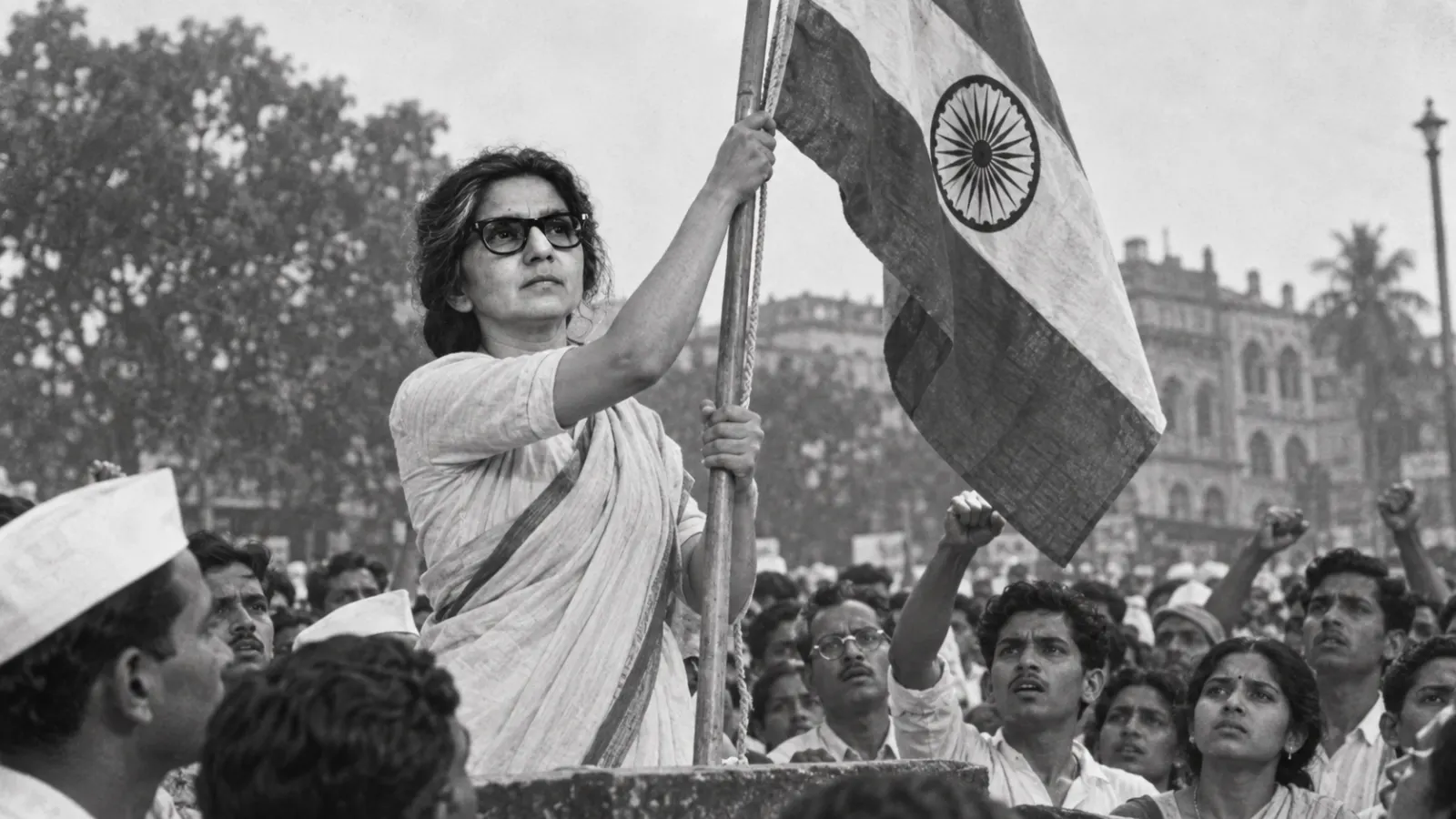
Pandit's transition from a politically connected daughter and sister into a political actor developed through the Congress movements against British rule. The Nehru Archive records that she was imprisoned several times during the nationalist struggle before moving into provincial government. (nehruarchive.in) Imprisonment had political significance beyond personal sacrifice. Women in nationalist families were often expected to host meetings, raise money and symbolically support male political actors; prison placed Pandit among those women who had crossed into direct confrontation with colonial authority.
That experience was followed by an equally important transition. Under the provincial autonomy introduced by the Government of India Act of 1935, the Congress formed ministries after the 1937 elections. Pandit entered the United Provinces government and held portfolios associated with local self-government and public health. The United Nations' own biographical material describes her as the first Indian woman to hold a cabinet position in pre-independent India. (un.org)
The symbolic breakthrough mattered, but the administrative substance mattered more. Local government and public health involved municipalities, sanitation, civic administration and the everyday machinery through which political promises become public services. Pandit was therefore exposed to executive responsibility before she became internationally famous. She was not moving directly from nationalist speeches into diplomatic receptions; she had already encountered budgets, bureaucracy and the constraints of government.
Nationalism Becomes International Diplomacy
The Second World War and final phase of colonial rule increasingly pushed Pandit into international politics. She travelled abroad to explain India's demand for self-government and challenged British portrayals of colonial rule before foreign audiences. This was effectively a form of unofficial diplomacy before India possessed fully sovereign embassies of its own. She had to present Indian nationalism not simply as an internal British constitutional disagreement but as part of a wider question about democracy, colonialism and racial hierarchy.
The founding of the United Nations gave India an especially important arena. India was not yet independent when the UN began operating, but it was already able to participate as a founding member. Pandit became one of the most visible Indian representatives in those early debates. A UN record from October 1946 identifies her speaking for India during the first session of the General Assembly, while India also brought the discriminatory treatment of people of Indian origin in South Africa before the Assembly that year. (digitallibrary.un.org) (southafrica.un.org)
This issue was central to India's early international identity. The South African government argued that racial discrimination against Indians was an internal matter, while India insisted that such treatment violated the principles of the UN Charter and therefore belonged in international discussion. In December 1946, the General Assembly adopted Resolution 44(I), affirming that the treatment of Indians in South Africa should conform to international obligations under the Charter. (digitallibrary.un.org)
Pandit continued pressing racial questions after independence. In 1952 she introduced discussion of apartheid in the General Assembly's Ad Hoc Political Committee on behalf of India and other sponsoring states, arguing that institutional racial discrimination threatened fundamental rights and international peace. (digitallibrary.un.org)
These interventions show why her UN career should not be treated as ceremonial. India was trying to establish a foreign-policy identity based partly on the claim that sovereign equality and racial equality had to apply beyond Europe. Colonialism, apartheid and political independence were presented as connected questions rather than separate regional problems. That position would later contribute to the broader Afro-Asian diplomacy associated with decolonisation and non-alignment.
Moscow, Washington and the Problem of Cold War Autonomy
After independence, Pandit became India's ambassador to the Soviet Union from 1947 to 1949, one of the new republic's most strategically important early appointments. She entered Moscow while India was still constructing its diplomatic institutions and while the Cold War was rapidly hardening into rival American and Soviet blocs. The basic foreign-policy problem was already visible: India wanted cooperative relations with major powers without accepting the assumption that independence required attachment to one geopolitical camp. The Nehru Archive records her Moscow posting as one of her first major diplomatic assignments after independence. (nehruarchive.in)
Pandit next served in Washington, representing India in the United States while also holding responsibility for Mexico. Oxford's Rothermere American Institute summarises her major postings as the Soviet Union from 1947–49, the United States and Mexico from 1949–51, Ireland from 1955–61, Spain from 1958–61 and the United Kingdom as high commissioner from 1955–61. (rai.ox.ac.uk)
Washington required a very different style of diplomacy. India wanted economic assistance and political cooperation with the United States, but Nehru's government rejected the premise that anti-communism should determine its position on every international question. The Chinese Revolution, Korean War, Kashmir dispute and emerging military alliances created repeated disagreements. Pandit's job was therefore not simply to cultivate goodwill but to explain why friendship with the United States did not imply strategic alignment.
This distinction became one of the defining principles of early Indian foreign policy. A capable ambassador could make Indian positions more intelligible to American officials and the public, but no amount of personal charm could remove the underlying structural difference between an American alliance system and an Indian preference for strategic autonomy. Pandit's significance lay partly in becoming one of the public faces through which that unfamiliar Indian position was presented internationally.
Her appointments inevitably raise the question of dynastic advantage. Jawaharlal Nehru, as prime minister and foreign-policy leader, had enormous influence over India's diplomatic appointments, and Pandit was his sister. Ignoring that connection would be historically unserious. But treating the connection as the complete explanation is equally inadequate. Before independence she had already been imprisoned, elected and appointed to ministerial responsibility, and by the time she became ambassador she had substantial public experience of her own. The more accurate interpretation is that privilege and competence were both present.
The First Woman to Lead the UN General Assembly
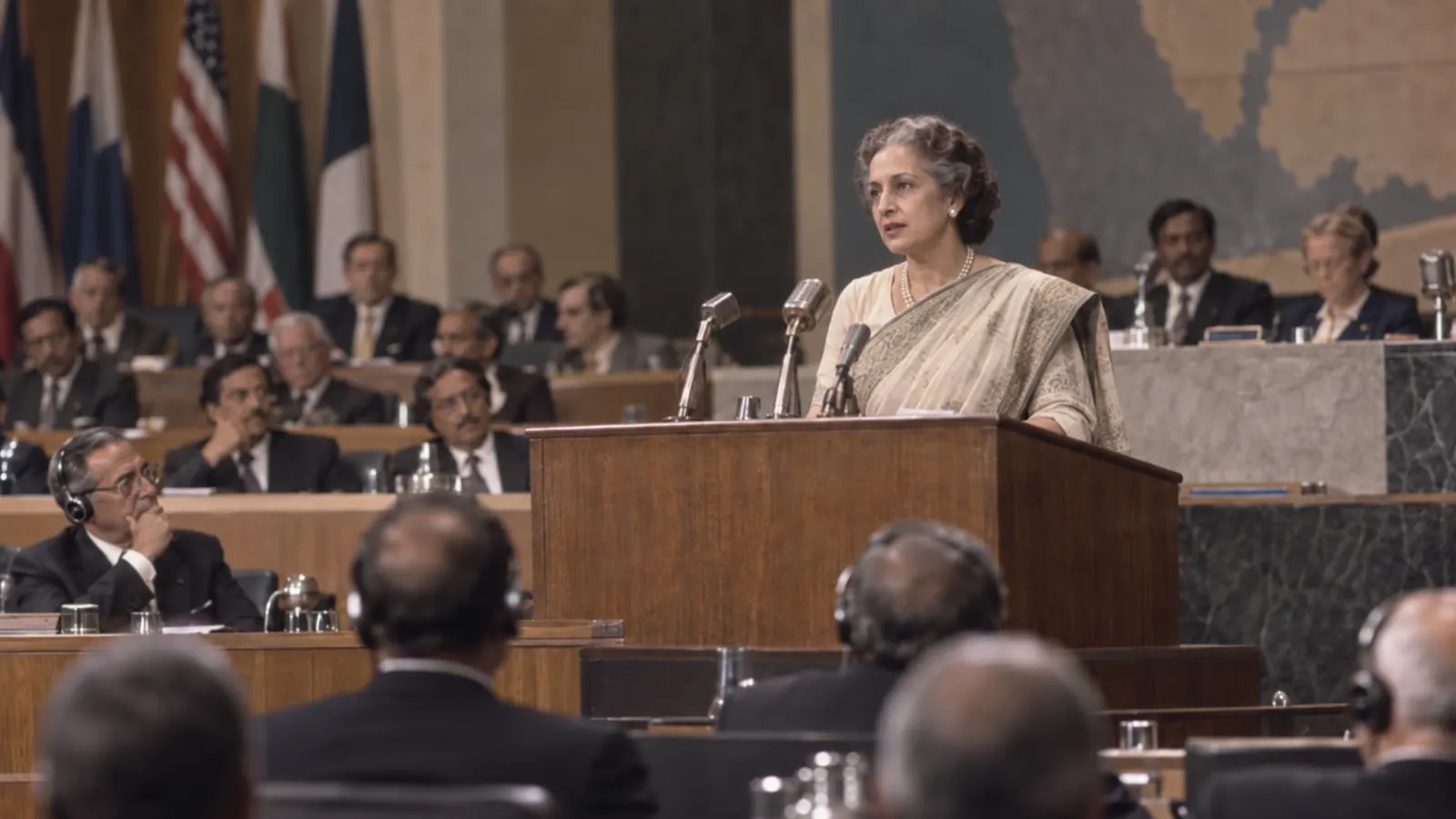
Pandit's most internationally recognised achievement came in 1953, when she was elected president of the eighth session of the United Nations General Assembly. United Nations records confirm both the date and the distinction: she was the first woman ever elected to the presidency of the General Assembly. (un.org) (un.org)
The milestone had obvious gender significance. International diplomacy in the early 1950s was overwhelmingly controlled by men, and many societies represented at the UN still sharply limited women's access to senior public office. A woman from a recently independent Asian country presiding over the General Assembly therefore carried symbolism beyond India's national history.
Yet symbolism alone understates the position. The president of the General Assembly has to manage procedure, competing blocs and the politics of a highly visible international institution. Pandit assumed the presidency during an intense Cold War period in which decolonisation, racial politics, Korea, disarmament and relations between rival power blocs continually tested the UN's universal language.
Her election also reflected years of prior diplomatic work. She had already represented India at the UN, argued questions of racial discrimination and served in two of the world's most strategically important capitals. The presidency was therefore not simply an honorary reward for being a pioneering woman; it recognised an established international political figure.
Pandit's UN work also reveals an important feature of India's early diplomacy. India frequently invoked the universal principles contained in the UN Charter while arguing that the international system did not apply those principles consistently. Colonial rule, racial discrimination and unequal political power sat uneasily beside claims of sovereign equality. Pandit's speeches repeatedly occupied that gap between principle and practice.
London and the Diplomacy of Decolonisation
Pandit's long posting as high commissioner to the United Kingdom from the mid-1950s until 1961 placed her inside perhaps the most psychologically complicated bilateral relationship of early independent India. Britain was no longer India's colonial ruler, but trade, Commonwealth institutions, political networks and habits of hierarchy continued to connect the two countries.
London diplomacy therefore required something different from either Moscow or Washington. Britain was simultaneously a former imperial power, a continuing economic partner and a state with which India disagreed sharply over aspects of decolonisation, South Africa and international crises. Personal familiarity between political elites could coexist with deep political disagreement.
This was also the period in which Britain's old imperial relationships were being renegotiated across Asia and Africa. Pandit's diplomatic experience gave her a front-row position in that process. She could move comfortably through elite British political and social circles while representing a government prepared to challenge Britain publicly on colonial and racial issues.
That combination helps explain why contemporary descriptions of her personality could be sharply divided. Supporters emphasised confidence, intelligence and social command; critics sometimes described her as forceful or moralising. Senior women were also judged within diplomatic cultures whose behavioural expectations had been constructed largely around men. Descriptions of temperament therefore have to be read critically, because they can reveal the assumptions of the observer as much as the character of the diplomat.
From International Office Back to Indian Politics
Pandit's diplomatic career did not end her domestic political life. She served as Governor of Maharashtra from 28 November 1962 to 18 October 1964, according to the state's official record. (rajbhavan-maharashtra.gov.in) She later returned to Parliament, representing Phulpur, the constituency closely associated with Jawaharlal Nehru. Parliamentary records show her participating in Lok Sabha debates from Phulpur in the later 1960s. (eparlib.sansad.in)
This domestic phase matters because it prevents her biography from ending with a diplomatic milestone. The transition from ambassadorial work to governorship and Parliament required a different political relationship with the Indian state. She was no longer mainly explaining India to foreign governments; she was again operating inside India's constitutional system.
Her later career also confronted her with an uncomfortable question shared by many members of the independence generation: what should loyalty to the freedom movement mean once its principal party had been in power for decades? The issue became unavoidable during the Emergency imposed by Prime Minister Indira Gandhi in 1975.
Pandit opposed the Emergency and emerged publicly from relative retirement during the 1977 election campaign. Contemporary reporting records her arguing that the Emergency had undermined democratic institutions, the rule of law, judicial independence and freedom of the press. She offered support to the opposition while making clear that she was not seeking office herself. (indianexpress.com)
The dissent was particularly significant because Indira Gandhi was her niece and because Pandit's own political identity had been inseparable from the Congress and Nehru family. She was hardly an outsider challenging an establishment from which she had always been excluded. She had spent much of her life inside that establishment. Her break therefore carried a different meaning: she was arguing that commitment to a political inheritance did not require unconditional loyalty to whoever currently controlled it.
Women, Family Privilege and the Limits of Symbolic Breakthroughs
Pandit's career is sometimes used as evidence that independent India opened political opportunity to women unusually early. There is truth in that claim, but it needs qualification. Serving as a provincial minister, ambassador, UN General Assembly president and governor represented extraordinary breakthroughs in institutions that remained overwhelmingly male. Her success made female authority internationally visible at a time when women were still absent from much senior political life.
But an exceptional woman does not establish structural equality.
Pandit came from one of the most politically powerful and socially privileged families in India. She had international exposure, political contacts and social capital unavailable to most women. Her path into power was therefore not easily reproducible. Women's representation in legislatures, diplomacy and senior administration remained limited despite individual pioneers.
This does not make her achievements less real. It changes the question we ask about them.
The useful historical question is not simply, “Was she the first woman to hold this office?” It is also, “What did her appointment change, and what barriers remained after she left?”
The same analytical balance applies to the Nehru family itself. Family connection unquestionably increased her access. Yet family connection alone cannot explain decades of political endurance across provincial government, prison, multilateral diplomacy, Moscow, Washington, London, the UN General Assembly, a governorship and Parliament. Privilege helps explain entry; it does not automatically explain sustained performance.
Why Vijaya Lakshmi Pandit Still Matters
The strongest assessment of Vijaya Lakshmi Pandit does not require turning her into either a flawless pioneer or a beneficiary of dynasty.
She was a bridge figure between anti-colonial mobilisation and postcolonial statecraft. She entered politics through the nationalist movement, experienced imprisonment under colonial rule and then had to operate the institutions created by independence. She brought ministerial experience into diplomacy and carried India's arguments about racial equality and colonial freedom into the United Nations. She represented India in both Moscow and Washington without treating diplomatic friendship as political alignment, and later negotiated the difficult psychological terrain of relations with the former colonial power in London.
Her 1953 election as the first woman president of the UN General Assembly remains an extraordinary landmark, but it should sit inside that larger history rather than replace it. (un.org)
Her later opposition to the Emergency gives the biography an equally important conclusion. Pandit's political life began in resistance to a colonial government that restricted Indian political freedom. Decades later, she publicly opposed restrictions imposed by an Indian government led by a member of her own family. The circumstances were radically different, but the episode reveals the democratic standard by which she wanted political power judged.
Vijaya Lakshmi Pandit's historical importance therefore lies in more than being Jawaharlal Nehru's sister, more than representing India abroad and more than accumulating pioneering offices. Her life connected the freedom movement, women's political participation, anti-racial diplomacy, the early Cold War, decolonisation and the defence of constitutional democracy.
Few political careers crossed so many boundaries.
She moved from prison to cabinet office, from nationalist campaigning to the United Nations, from representing a new republic abroad to criticising that republic when she believed it had abandoned democratic restraint.
The list of firsts is memorable.
The political journey behind them is what makes Vijaya Lakshmi Pandit significant.