Khan Abdul Ghaffar Khan: Nonviolence on the Frontier
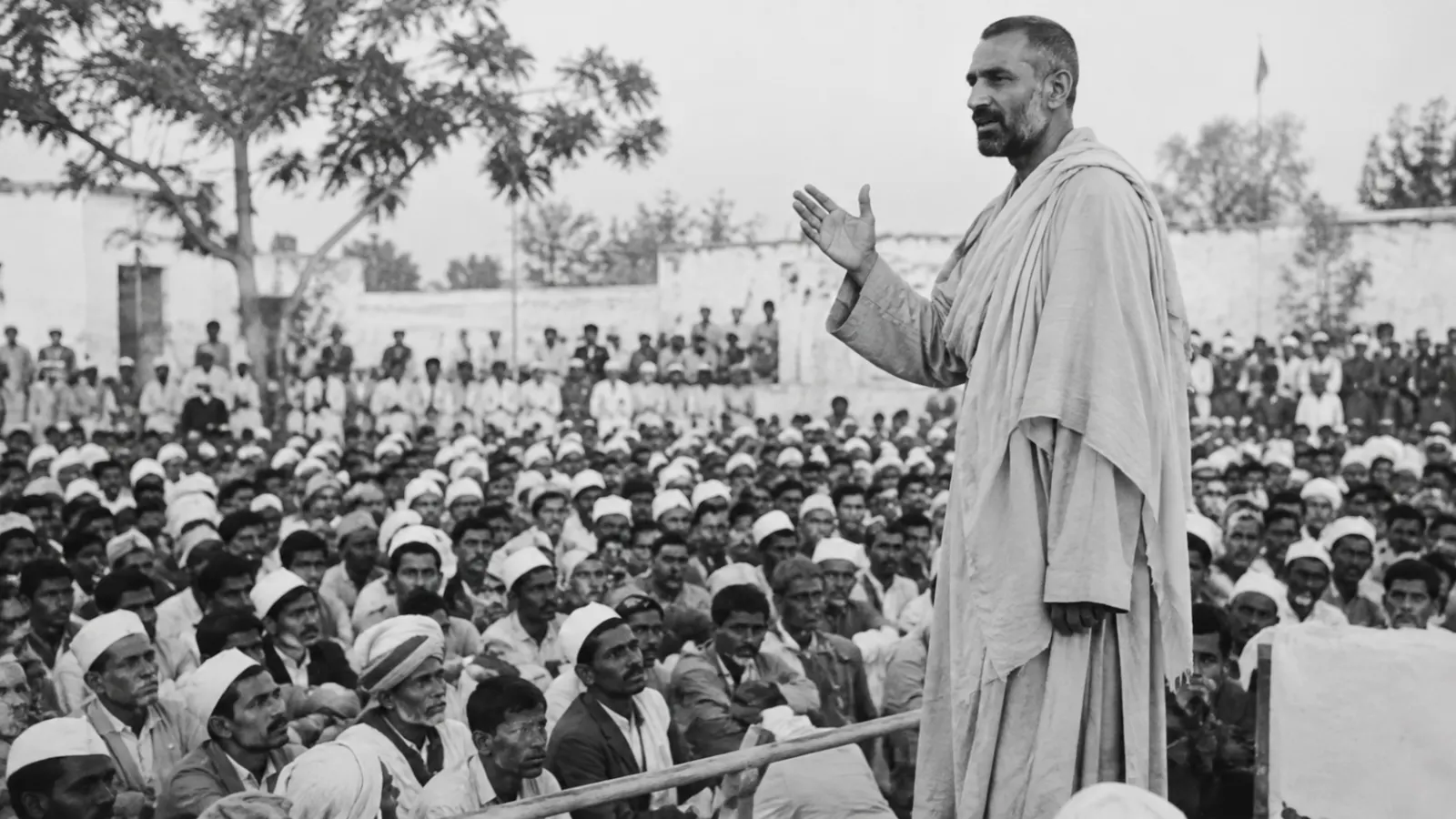
Khan Abdul Ghaffar Khan, widely known as Bacha Khan or Badshah Khan, occupies an unusual place in the political history of South Asia. A Pashtun Muslim leader from the North-West Frontier Province, he organised a mass movement that publicly committed itself to nonviolent resistance while operating in a region that British colonial administration frequently represented through the language of tribal violence and exceptional security. His Khudai Khidmatgar—“Servants of God”—combined anti-colonial politics with education, social reform, village service and strict organisational discipline. Scholarly accounts describe it as an unarmed Pashtun resistance movement rooted partly in an Islamic interpretation of nonviolence and in earlier programmes of social reform.
His career is often compressed into the nickname “Frontier Gandhi.” The name reflects his close relationship with Mohandas Gandhi and his alliance with the Indian National Congress, but it can also obscure what was distinctive about his political development. Ghaffar Khan’s work among Pashtuns began with education and social reform before his movement became closely integrated with Congress politics. His language of service, patience, discipline and nonviolence drew on his own religious and regional environment rather than simply reproducing Gandhi’s politics in another province.
That distinction matters because Ghaffar Khan’s significance lies not merely in being an ally of more famous nationalist leaders. He attempted to build an autonomous political tradition within Pashtun society: one in which honour could be connected to disciplined restraint rather than retaliation, public service could become political organisation, and opposition to colonial rule could coexist with a strong regional identity. His later opposition to Partition and advocacy of Pashtun political rights made him difficult to fit neatly into either Indian or Pakistani national narratives.
Education, Social Reform and the Khudai Khidmatgar
Ghaffar Khan was born in 1890 in Utmanzai in the Peshawar Valley, then part of British India’s North-West Frontier region. He came from a landowning Pashtun family and received schooling that exposed him to formal education at a time when educational access remained limited in many rural communities. His early political activity centred less on national constitutional questions than on education and social reform. He established schools and worked with local reformers who saw illiteracy, factional conflict and restrictive social practices as obstacles to both dignity and political autonomy.
This early phase is important because it challenges a simple chronology in which Ghaffar Khan first encountered Gandhi and then adopted nonviolence. His reform networks preceded the mature Congress alliance. Education was itself political because independent schools, local associations and reform organisations created institutions beyond direct colonial control and attempted to reshape how Pashtun communities understood collective responsibility.
By 1929, these efforts had developed into the Khudai Khidmatgar, an organisation committed to both social reform and resistance to British rule. Members became widely known as the Red Shirts and adopted an oath stressing service, discipline and nonviolence. The organisation developed branches, uniforms, drills and a structure that could appear almost military, yet its declared methods were unarmed. Academic accounts describe it as the interventionist wing of a wider Pashtun reform movement and emphasise its combination of Islamic ethical language, social service and organised nonviolent resistance.
That combination was politically significant. The movement did not ask members merely to refrain from carrying weapons during demonstrations. Its discipline included attempts to reduce feuding, encourage public service and build habits of collective organisation. The source material also records work involving sanitation, education and mediation of local disputes.
It would be misleading to imply that every member interpreted nonviolence identically or that Pashtun society suddenly became uniformly pacifist. Historians have debated the depth, consistency and motives of individual adherence. The more defensible claim is institutional: Ghaffar Khan and his colleagues created an organisation capable of sustaining significant episodes of disciplined nonviolent mobilisation under severe pressure.
His relationship with Gandhi and Congress strengthened around 1929–30. The alliance gave the frontier movement access to an all-India anti-colonial network, while Congress gained a significant organisational partner in a Muslim-majority province. Yet the relationship was not one of simple ideological absorption. The Khudai Khidmatgar retained a regional base and Ghaffar Khan consistently connected nonviolence with Islamic moral ideas, service and Pashtun social reform.
This distinction became increasingly important as political competition between Congress and the Muslim League intensified. Ghaffar Khan was a devout Muslim who rejected the proposition that Muslim political interests necessarily required support for the League or the creation of Pakistan. His movement therefore became evidence of the diversity of Muslim political positions in late colonial India rather than a straightforward extension of either Congress majoritarianism or Muslim League nationalism.
Qissa Khwani, Repression and the Test of Nonviolent Discipline
The Khudai Khidmatgar’s most famous confrontation with colonial power came in Peshawar on 23 April 1930. After arrests of movement leaders, including Ghaffar Khan, crowds gathered in the Qissa Khwani Bazaar during the Civil Disobedience movement. British-led forces opened fire on demonstrators. Government and later historical accounts agree that many people were killed, although casualty estimates vary considerably and should not be presented as a single uncontested number. India’s Ministry of Home Affairs describes the episode as a major confrontation between colonial forces and nonviolent demonstrators, while historical scholarship similarly treats it as a defining moment in the frontier movement.
The political importance of Qissa Khwani goes beyond casualty figures. Colonial administration had long governed the frontier through exceptional legal and security arrangements partly justified by portrayals of the region as unusually violent. An organised movement of unarmed Pashtuns complicated that framework. When protesters maintained resistance despite lethal force, the conflict raised an uncomfortable question for imperial authority: whether coercion was maintaining order or suppressing an increasingly organised political movement.
Repression continued beyond one episode. Khudai Khidmatgar members faced detention, restrictions and violent enforcement during subsequent campaigns, while Ghaffar Khan spent substantial periods in prison. Scholarship on the movement records severe colonial responses, including arrests, beatings and restrictions on political activity.
These conditions help explain why Ghaffar Khan placed so much emphasis on discipline. A movement confronting an armed state could be destabilised quickly if local grievances triggered retaliatory violence. Nonviolence therefore functioned not only as an ethical principle but also as a demanding form of political organisation. The source draft captures this point well: education, oaths, village leadership, routines and social reform created a structure capable of restraining revenge when repression might otherwise have fragmented the movement.
The movement’s relationship with formal governmental power also became more complicated during the late 1930s. Congress performed strongly in the North-West Frontier Province, and Ghaffar Khan’s elder brother, Dr Khan Sahib, headed a provincial ministry. That brought the Khudai Khidmatgar into a political environment in which close allies were no longer only resisting government but participating in it.
Opponents, particularly the Muslim League, criticised the provincial administration and accused Congress-aligned forces of partisan domination. Supporters argued that the ministry represented an expansion of representative politics in a province previously governed through unusually restrictive arrangements. The important point is that Pashtun politics was never politically homogeneous. Congress supporters, League activists, religious leaders, landlords, tribal authorities and other groups competed for influence, and Ghaffar Khan’s popularity did not eliminate those divisions.
The Second World War and the constitutional crises of the 1940s sharpened them. Congress ministries resigned in 1939, colonial repression increased again during later phases of the independence struggle, and the Muslim League expanded its organisational strength. By the mid-1940s, the frontier had become part of the larger contest over whether British India would remain united or be divided into successor states.
Partition, the 1947 Referendum and a Political Break With Congress
Ghaffar Khan opposed the Partition of India and resisted the constitutional settlement that would place the North-West Frontier Province inside a binary choice between India and Pakistan. The issue became acute in 1947 when British plans provided for a referendum on the province’s constitutional future.
Contemporary records in the Nehru Archive show that the question divided even Congress leaders and their frontier allies over strategy. Jawaharlal Nehru wrote in June 1947 that the referendum was expected to offer a choice connected with India or Pakistan and explicitly acknowledged Ghaffar Khan’s concern that the available options did not reflect what many of his supporters wanted. Nehru also recognised that a boycott would effectively make Pakistan’s victory more likely.
Ghaffar Khan and the frontier Congress eventually supported a boycott. Nehru Archive material records that Ghaffar Khan appealed to Pashtuns favouring a free Pathan state not to participate and that he explored proposals for a separate or autonomous Pathan political unit.
This episode is often presented retrospectively as proof that Ghaffar Khan wanted either straightforward secession from Pakistan or accession to India, but the documentary record is more complicated. His central objection was that the referendum excluded a Pashtun autonomy or independence option. His political position during this period combined opposition to Partition, attachment to a broader Indian anti-colonial coalition and a demand that Pashtuns be able to determine their political status on terms wider than the India-versus-Pakistan binary.
The referendum nevertheless proceeded, and Pakistan won overwhelmingly among those who voted after the Khudai Khidmatgar and provincial Congress boycotted the process. Ghaffar Khan subsequently operated within the political reality of Pakistan rather than organising an armed war against the new state.
His sense of political abandonment by Congress became an enduring part of later accounts of Partition. The source draft notes the famous claim that the Pashtuns had been “thrown to the wolves,” but such quotations should be used only when their textual provenance is securely established. More securely documented is the disagreement itself: Congress leadership accepted a transfer-of-power framework that Ghaffar Khan believed left insufficient space for his movement’s preferred constitutional future.
This does not make the relationship reducible to betrayal on one side and loyalty on the other. Congress leaders were operating within rapidly collapsing negotiations over Partition, communal violence and transfer of power; Ghaffar Khan was defending a regional movement that faced a constitutional settlement it considered deeply unfavourable. The conflict is better understood as a collision between national partition negotiations and a regional political project than as a simple personal dispute.
Pakistan, Pashtun Rights and Continued Imprisonment
Independence in 1947 did not end Ghaffar Khan’s conflict with state authority. Pakistani officials regarded the Khudai Khidmatgar, its Congress history and its demands for Pashtun autonomy with deep suspicion. Contemporary and later accounts record that Ghaffar Khan declared allegiance to the new state while pressing for greater autonomy, but relations with the government deteriorated rapidly.
The Khudai Khidmatgar was banned in 1948 and many of its leaders were imprisoned. Academic reference works confirm the organisation’s prohibition following Partition, while scholarship on Pashtun nationalism records the incarceration of its leadership.
The confrontation became especially violent at Babrra in August 1948, where police fired on Khudai Khidmatgar supporters protesting the detention of political leaders and new security measures. Casualty figures remain contested: official and movement accounts differ substantially. The event nevertheless became a major point of memory in Pashtun political history and illustrates how quickly anti-colonial political divisions were carried into the institutions of the new state.
Ghaffar Khan spent further periods in prison and continued to argue for federalism, democratic politics and Pashtun political rights. These positions were interpreted differently within Pakistan. Critics viewed his Congress association, opposition to Partition and regional demands as evidence of questionable loyalty; supporters regarded federal autonomy as compatible with a democratic Pakistani state. A neutral account should distinguish demands for Pashtun rights and federal restructuring from claims that every such demand amounted automatically to secessionism.
This post-1947 history complicates national narratives in both India and Pakistan. In India, Ghaffar Khan could be remembered as a symbol of religious pluralism and a close associate of Gandhi and Nehru, but that memory can understate his own regional political programme. In Pakistan, interpretations of his opposition to Partition sometimes overshadow the fact that his political activity after independence remained largely organised around nonviolent federal and Pashtun-rights politics rather than armed opposition.
The complexity is precisely what makes his biography historically useful. He cannot be understood exclusively as an Indian nationalist, Pakistani dissident or Pashtun nationalist. Those identities intersected differently across his life.
Religion, Social Reform and the Meaning of His Nonviolence
One of the most important features of Ghaffar Khan’s movement was the way it placed nonviolence inside Islamic and Pashtun ethical language. Academic treatments of the Khudai Khidmatgar emphasise its Islamic interpretation of nonviolent resistance as well as its reformist programme.
This matters because political ideas rarely become mass practices simply because an intellectual leader announces them. They need to be translated into concepts that communities recognise. Ghaffar Khan associated endurance, service and refusal of revenge with moral strength rather than submission. The Khudai Khidmatgar’s organisational discipline attempted to redirect aspects of Pashtun honour away from retaliatory violence and toward public service and collective resistance.
The movement’s social programme included education and community reform as well as political mobilisation. Ghaffar Khan supported wider educational access and criticised social practices he believed weakened Pashtun society. His reform agenda also addressed women’s education and participation, although the movement operated in a strongly patriarchal rural environment and leadership remained overwhelmingly male. It would therefore be inaccurate either to present the Khudai Khidmatgar as a fully developed feminist movement or to omit the fact that gender reform formed part of its broader vision of social change.
The same caution applies to religious interpretation. Ghaffar Khan’s example demonstrates that an influential Muslim political movement could make principled nonviolence central to its identity. It does not prove that all Islamic or Pashtun political traditions shared his interpretation, nor that his movement permanently transformed the political culture of the frontier.
His historical significance lies in demonstrating that another political language was organisationally possible.
A Legacy Across India, Pakistan and Afghanistan
Ghaffar Khan remained connected to India after Partition and was publicly honoured there. In August 1987, the President of India awarded him the Bharat Ratna, India’s highest civilian honour, according to the official Gazette notification.
He died in January 1988 after a long period of illness and was buried in Jalalabad, Afghanistan, in accordance with his wishes. Contemporary reporting described enormous funeral gatherings in Peshawar before his body was taken across the frontier for burial. Reports also recorded a temporary ceasefire in the Afghan conflict to facilitate the funeral, reflecting his symbolic standing across national borders.
His reputation remains contested because each national tradition has reasons to emphasise different parts of his life. Indian memory often foregrounds his relationship with Gandhi, commitment to Hindu-Muslim cooperation and opposition to Partition. Pashtun political memory frequently emphasises the Khudai Khidmatgar, regional autonomy and repression before and after 1947. Pakistani historical debates have often focused on his opposition to the creation of Pakistan and his subsequent demands for Pashtun rights.
None of these perspectives alone is sufficient.
A reliable account has to hold several facts together: Ghaffar Khan was an anti-colonial leader allied with Congress; a Muslim reformer whose nonviolence drew on his religious convictions; a Pashtun organiser with regional political objectives; an opponent of Partition; and, after 1947, a Pakistani political figure who repeatedly challenged centralising governments through demands for federalism and Pashtun rights.
His political importance also cannot be measured solely by whether he achieved every objective. Partition occurred despite his opposition. The Khudai Khidmatgar suffered intense repression and lost much of its organisational power after Pakistan’s creation. Ghaffar Khan spent long periods imprisoned by both colonial and postcolonial governments.
Yet political defeat does not erase historical significance.
The Khudai Khidmatgar demonstrated that nonviolent mass organisation could emerge in a frontier region governed through heavily militarised colonial assumptions. It created schools, village networks, oaths, routines and forms of collective discipline capable of sustaining political action beyond the personal presence of its founder.
That may be the most useful way to understand Khan Abdul Ghaffar Khan.
His historical importance does not depend on treating him as a saintly copy of Gandhi or as proof that nonviolence always succeeds. It lies in the institutions he helped build and the political alternatives they made visible.
He showed that a political identity commonly portrayed by colonial officials as inherently martial could also be mobilised around service and disciplined restraint.
He showed that Muslim politics in late colonial India contained important positions outside the eventual Congress-versus-Muslim-League binary.
And his life after 1947 showed that independence from empire did not automatically resolve conflicts over federalism, regional identity, democracy and state power.
Ghaffar Khan’s biography therefore crosses the boundaries between Indian, Pakistani and Pashtun history.
That is precisely why reducing him to the nickname “Frontier Gandhi” misses the most important part of the story.
He was not merely Gandhi’s follower on the frontier.
He was the organiser of one of South Asia’s most distinctive experiments in Pashtun social reform, mass nonviolent resistance and regional democratic politics.