Aruna Asaf Ali: Courage, Quit India and a Life Beyond 1942
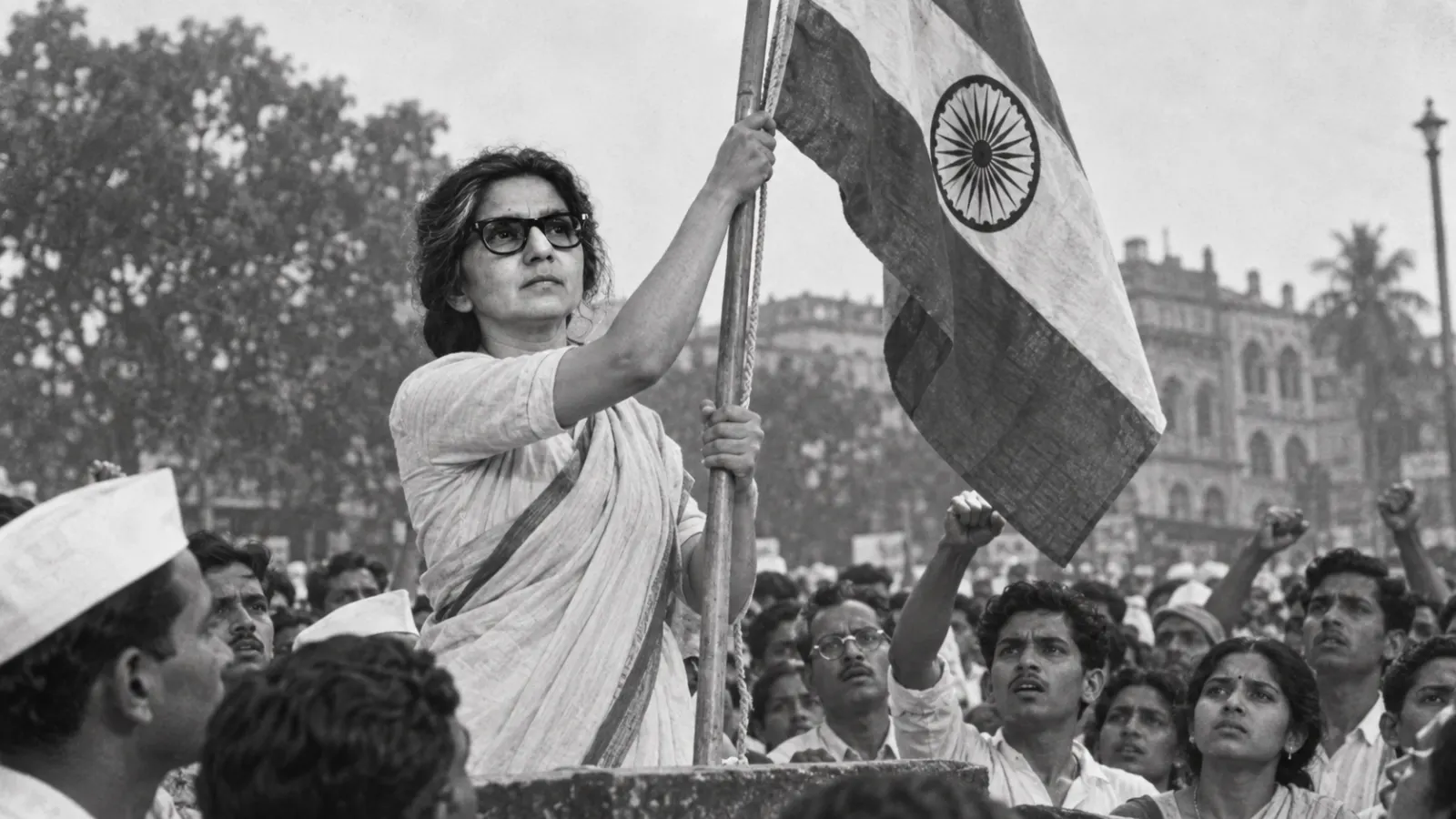
Aruna Asaf Ali is remembered above all for one morning in Bombay. On 9 August 1942, after the British colonial government had arrested Mahatma Gandhi, Jawaharlal Nehru, Vallabhbhai Patel and much of the senior Congress leadership, she appeared at Gowalia Tank Maidan and hoisted the Congress tricolour. The gesture became one of the enduring images of the Quit India Movement because it delivered precisely the message the arrests had been intended to prevent: removing nationally recognised leaders would not automatically end resistance. Government commemorative material continues to identify the flag-hoisting at what is now August Kranti Maidan as the act that brought her to national prominence.
But the image can distort as much as it illuminates if it becomes the entire biography. Aruna had already participated in civil disobedience, been imprisoned and challenged prison conditions before 1942. After the flag-hoisting she did not simply disappear from the story; she went underground and remained involved in clandestine resistance while the colonial state attempted to dismantle Congress networks. Independence did not turn her into a ceremonial freedom fighter either. She moved through socialist and communist politics, women's organisations, international solidarity campaigns, journalism and municipal government, eventually becoming the first mayor of the newly created Delhi Municipal Corporation in 1958. The Nehru Archive describes her not only as an underground Quit India worker but also as a Delhi political leader, mayor and founder-chairman of Patriot.
Her significance therefore lies in a political life much larger than one heroic scene. Aruna repeatedly entered spaces in which obedience was expected—from family and marriage conventions to colonial prisons, underground politics and later party structures—and treated political independence as something requiring active judgment rather than passive loyalty.
From Aruna Ganguly to a Political Prisoner
Born Aruna Ganguly in 1909, she grew up in a Bengali family and worked as a teacher before marrying Asaf Ali, a prominent Muslim lawyer and Congress politician, in 1928. Their marriage crossed religious boundaries and a substantial age difference, attracting opposition from her family. It later became easy to present the relationship as a perfect symbol of secular nationalism, but that interpretation risks turning a private decision into retrospective political symbolism. What can be said more securely is that the marriage defied social expectations and brought Aruna into closer proximity with nationalist politics without preventing her from developing an identity independent of her husband's.
Her first major involvement in the freedom struggle came during the Civil Disobedience Movement and Salt Satyagraha. Government commemorative accounts record that she participated in public processions, was arrested and was not initially released with many other political prisoners after the Gandhi–Irwin Pact. Fellow women prisoners protested her continued detention, and public pressure eventually contributed to her release.
A second imprisonment in 1932 revealed something more distinctive about her politics. While detained in Delhi's Tihar Jail, Aruna protested conditions imposed on political prisoners through a hunger strike. Institutional accounts from Jamia Millia Islamia and later historical summaries record that the protest concerned treatment inside the prison and was followed by her transfer to Ambala and solitary confinement.
The episode matters because it shows that her courage was not created suddenly in August 1942. Prison transformed the body itself into a political instrument. A prisoner deprived of ordinary public speech could still refuse food, expose unequal treatment and force administrators to respond to the possibility of deterioration or death. Aruna's willingness to challenge prison authority also separated her from the safer roles sometimes allocated to elite nationalist women as hosts, fundraisers or symbolic supporters.
At the same time, the early prison story should not be converted into a solitary-hero narrative. Women's participation in the nationalist movement was collective. Other prisoners protested, public campaigns mattered and political organisations created the context in which her detention became consequential. Aruna's individuality emerged within those networks rather than outside them.
Why the Flag at Gowalia Tank Mattered
The All India Congress Committee adopted the Quit India resolution in Bombay on 8 August 1942. The colonial government responded before the movement could develop through ordinary central leadership, arresting Gandhi and much of the senior Congress leadership during the night and early morning. The intention was straightforward: remove the organisers before they could organise.
That strategy helped produce the opposite problem. With established command structures disrupted, Quit India became unusually decentralised. Students, workers, peasants, local Congress activists, socialists and underground organisers improvised according to local circumstances. Protest included strikes, demonstrations and clandestine communication, but also sabotage, attacks on infrastructure and the formation of parallel authorities in some regions. Colonial repression was severe. A useful history of Quit India therefore cannot reduce the movement either to Gandhi's call or to Aruna's flag-hoisting.
Her role matters precisely inside this decentralised context.
On 9 August, she appeared at Gowalia Tank Maidan and participated in the planned flag ceremony despite the mass arrests. Official Indian commemorative material identifies her act of hoisting the flag there as one of the defining images of the movement. The ground later became known as August Kranti Maidan, permanently attaching the location to the uprising.
The political force of the scene came from timing. A government had tried to demonstrate that Congress leadership had been neutralised. A visible act of defiance the following day demonstrated that political initiative could reappear from below. Aruna did not single-handedly “launch” Quit India, and describing her that way would erase thousands of participants whose actions gave the movement its national scale. Her importance was symbolic and organisational: she represented continuity at exactly the moment when colonial repression was designed to produce interruption.
Symbols are politically useful because they compress complexity into something memorable. A photograph or story of one woman raising a flag is easier to remember than thousands of dispersed acts of resistance. But the reason the image deserves historical weight is what came afterward. Aruna accepted the consequences of becoming publicly associated with defiance rather than treating the ceremony as a one-day performance.
Underground Resistance Was a Network, Not an Adventure Story
After the events of August 1942, Aruna avoided arrest and went underground. Government accounts record that colonial authorities pursued her while she continued political activity rather than surrendering. Later accounts describe seizure of property and a monetary reward for information leading to her arrest, although the precise details of those measures should always be tied to documentary sources rather than repeated simply because they have entered nationalist folklore.
Underground politics is often remembered romantically through secret meetings and dramatic escapes. Its reality was far more logistical. People needed safe houses, money, couriers, printing facilities and trusted intermediaries. Messages had to move despite censorship and police surveillance. A single arrest could expose an entire network. Participants could not easily verify rumours or defend themselves publicly against accusations because visibility itself created danger.
Women occupied an especially complicated position in such networks. Colonial police and wider society could underestimate their political involvement because of gendered assumptions, sometimes creating opportunities for communication or movement. Those same conventions also restricted women's mobility and exposed them to family pressure and other vulnerabilities. Aruna's prominence should therefore open the story toward the many less-recorded women involved in safe houses, courier networks and clandestine organisation rather than allowing one famous name to stand in for them.
She also worked within the socialist current of the nationalist movement and was associated with figures including Ram Manohar Lohia. Contemporary and later records connect her with underground publication and political communication, including Inquilab. The underground struggle brought activists into difficult arguments about violence, nonviolence and the limits of ordinary constitutional activity when the national leadership was imprisoned and wartime emergency powers were being used to suppress dissent.
Aruna's independent relationship with Gandhi became particularly revealing. Government commemorations note that Gandhi urged her to surrender, but she did not immediately follow his advice and remained underground until the arrest warrant was withdrawn in 1946. This was not necessarily a repudiation of Gandhi's historical importance. It showed that the nationalist movement was not organised through unquestioning personal obedience. Activists influenced by Gandhi could still reach different tactical conclusions.
Her emergence from underground in 1946 therefore closed a distinctive political period. By then the imperial state was negotiating the transfer of power, the Second World War had ended and India's politics had moved rapidly toward constitutional negotiations, communal conflict and Partition. Aruna returned to public life not as the same Congress activist she had been before 1942 but as someone whose politics had moved substantially toward the left.
Independence Did Not End Her Political Dissent
One of the weaknesses of conventional freedom-fighter biographies is that they often become vague after 15 August 1947. Independence is treated as the conclusion of the subject's purpose, after which awards and honorary positions replace politics.
Aruna Asaf Ali does not fit that pattern.
The Prime Ministers Museum & Library's catalogue of her papers traces a complicated post-independence political journey: she was president of the Delhi Pradesh Congress Committee in 1947–48, joined the Socialist Party in 1948, formed the Left Socialist Group in 1950, was associated with the Communist Party of India from 1955 to 1958 and later returned to the Congress in the 1960s. It also records her involvement with the Indo-Soviet Cultural Society, Afro-Asian solidarity, peace organisations and women's movements.
The sequence matters more than any simple ideological label. Independence had removed British sovereignty, but Aruna did not believe political and economic emancipation had therefore been completed. Her movement toward socialism and communism reflected wider debates within the nationalist generation about inequality, capitalism, labour and what freedom should mean after the colonial state had disappeared.
Recent scholarship has begun to take this period of her life more seriously. A 2026 study of Aruna's postcolonial left politics argues that her trajectory from Congress socialism toward the CPI and later forms of left unity cannot be understood simply as party-switching. It was connected with a wider international outlook in which Indian development, anti-imperial politics and Third World solidarity were treated as related questions.
This internationalism was visible in her later public interventions. Nehru Archive correspondence from February 1961 records her concern over the murder of Congolese leader Patrice Lumumba and efforts to organise a public response in India. Nehru agreed that Lumumba's death was a matter of major significance and discussed how a meeting might be convened.
The episode helps place Aruna within a generation for whom Indian independence was not an isolated national event. Colonialism in Africa, racial hierarchy and Cold War power remained connected to the anti-imperial politics through which many Indian activists had been formed.
From Underground Resistance to Governing Delhi
In April 1958, Aruna was elected the first mayor of the newly created Delhi Municipal Corporation. A contemporary chronology records her election on 14 April, while Nehru Archive documents from the same year identify her directly as Mayor of Delhi.
The office creates one of the most revealing contrasts in her biography. Sixteen years earlier, she had been evading colonial police while helping sustain an underground movement. Now she was responsible for a democratic municipal institution confronting housing, sanitation, urban development and social welfare.
Her own correspondence shows that she treated the office seriously. In a July 1959 letter to Jawaharlal Nehru, Aruna described plans to develop urban community programmes, reorganise social education and confront slum clearance after authority had been delegated to the municipal corporation. She criticised fragmented welfare efforts and argued that assistance to people living in desperately poor urban conditions required greater coordination.
This evidence is valuable because it rescues the mayoralty from becoming another line in a list of “firsts.” Municipal government forced a former revolutionary to confront the morally ambiguous work of administration. Slum clearance, for example, can improve sanitation and housing conditions while simultaneously displacing vulnerable residents if badly designed. Urban government requires budgets, land decisions, bureaucracy and compromise—the opposite of the clean moral clarity later memory often assigns to anticolonial resistance.
That does not make municipal politics less courageous. It represents a different kind of political responsibility. Resistance asks whether an authority is legitimate. Democratic administration asks what a legitimate authority should actually do with the power it possesses.
Aruna's political career crossed both questions.
Journalism, Women's Politics and International Solidarity
Municipal office was only one part of her postcolonial public life. Aruna became deeply involved in publishing, particularly Link and Patriot. The Nehru Archive describes her as founder-chairman of the daily Patriot, while the publication's own institutional account associates her with its launch and progressive political identity.
Publishing provided a different kind of political platform. Newspapers and magazines allowed activists who were outside high government office to influence debates about economic policy, non-alignment, socialism, foreign affairs and the character of the republic. In Aruna's case, journalism was closely intertwined with her left and internationalist politics rather than functioning as an apolitical commercial venture.
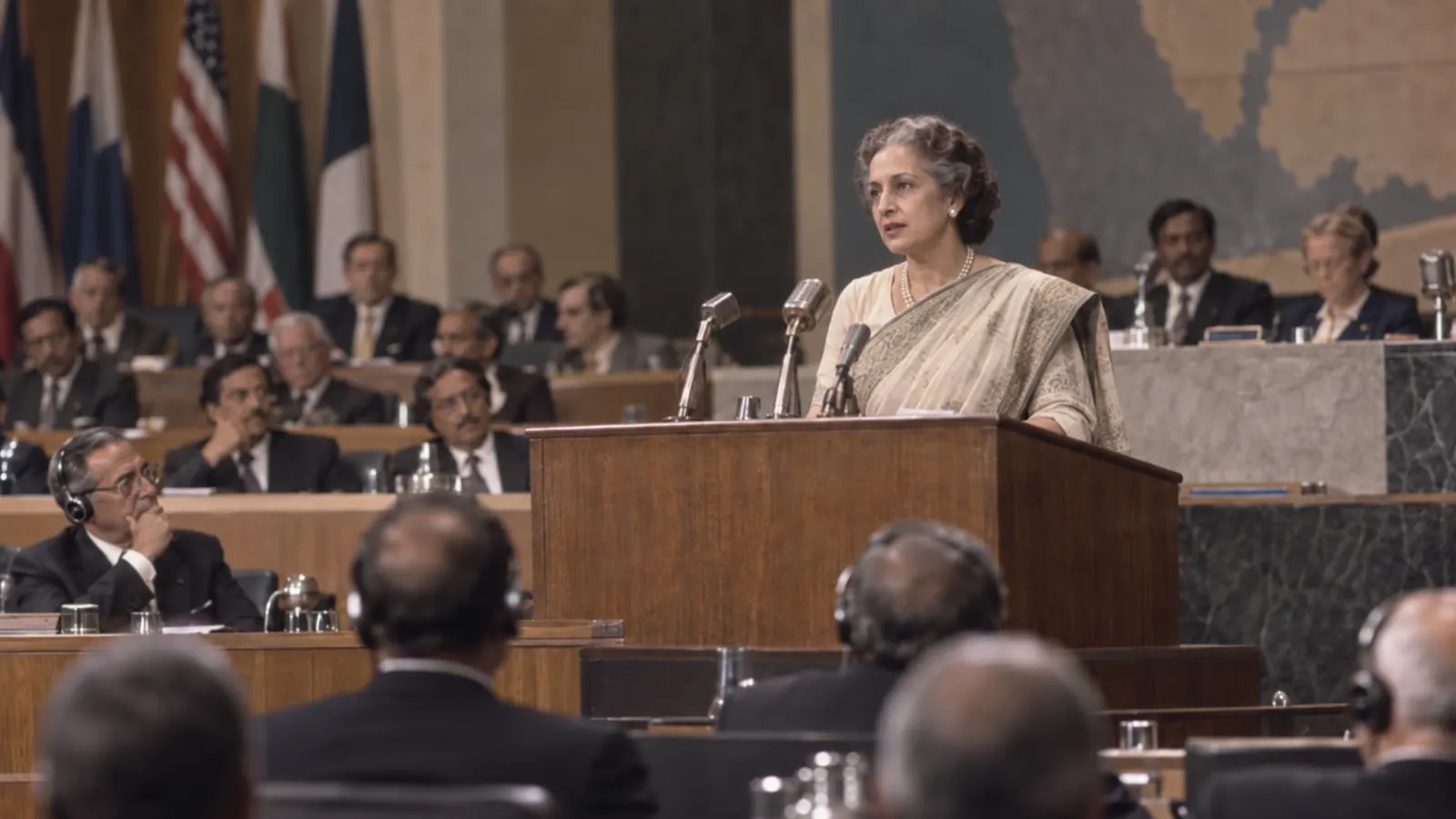
She was also associated with women's organisations and peace movements. PMML records her leadership or participation in organisations including the National Federation of Indian Women and the All India Women's Conference, alongside Afro-Asian and Indo-Soviet bodies. These affiliations show how far her politics had expanded beyond the nationalist objective of expelling British rule.
This later activism complicates the familiar label “Grand Old Lady of the Independence Movement.” The phrase honours longevity and courage, but it can also domesticate her politics. It turns an underground socialist, party dissenter and left publisher into a safe elderly national icon.
National commemoration tends to do this to radicals. Once a political conflict is safely in the past, institutions can celebrate courage while removing the arguments that made the person controversial.
Aruna's later honours demonstrate the extent of that transformation in public memory. She received major national and international recognition, and India ultimately honoured her posthumously with the Bharat Ratna. Government sources commonly list the honour for 1997; the formal Presidential Gazette notification naming her among the posthumous recipients was issued on 1 March 1998. India Post also issued a commemorative stamp carrying her image in 1998.
These honours establish national recognition. They should not replace analysis.
Aruna Asaf Ali's Courage Was Political Continuity
The strongest way to understand Aruna Asaf Ali is not to ask whether she was the bravest woman of Quit India or to repeat superlatives that cannot meaningfully be measured.
Her importance lies in continuity across changing forms of political action.
During civil disobedience, she accepted imprisonment. Inside prison, she challenged the treatment of political prisoners. When the Congress leadership was arrested in August 1942, she participated in a public act that demonstrated resistance had not been decapitated. When the state sought to arrest her, she chose clandestine political work rather than immediate surrender. When independence arrived, she refused to behave as though national sovereignty had resolved disagreements over economic and social power.
Later, she entered municipal government, publishing, women's organisations and international solidarity movements. These activities required very different skills from underground resistance. The mayor could not simply defy the state because she had become part of one of its democratic institutions. The publisher had to build an organisation capable of surviving beyond a demonstration. The political activist had to choose between competing left parties rather than a simple colonial division between ruler and ruled.
Her life therefore challenges the tendency to freeze freedom fighters at the moment that made them famous.
The Aruna of 1942 matters.
But so does the prisoner of 1932, the socialist of the late 1940s, the left internationalist of the 1950s, the mayor confronting Delhi's urban poverty and the publisher trying to influence the ideological direction of the republic.
The Gowalia Tank flag remains powerful because it condensed a historical crisis into one visible act. The British government had arrested established leaders in an effort to prevent organised resistance; a young woman publicly demonstrated that political initiative could survive them.
But the underground years give the image its depth.
She did not raise a flag and retreat into safety. She accepted years of uncertainty, surveillance and clandestine work that followed from the choice.
And the decades after independence give the story its meaning.
Aruna Asaf Ali did not treat courage as something required only against a foreign ruler. She continued asking what freedom should become after Indians acquired the power to govern themselves.
That is why her life is larger than 9 August 1942.
The flag made her a national symbol.
The political independence of mind behind it made her historically important.