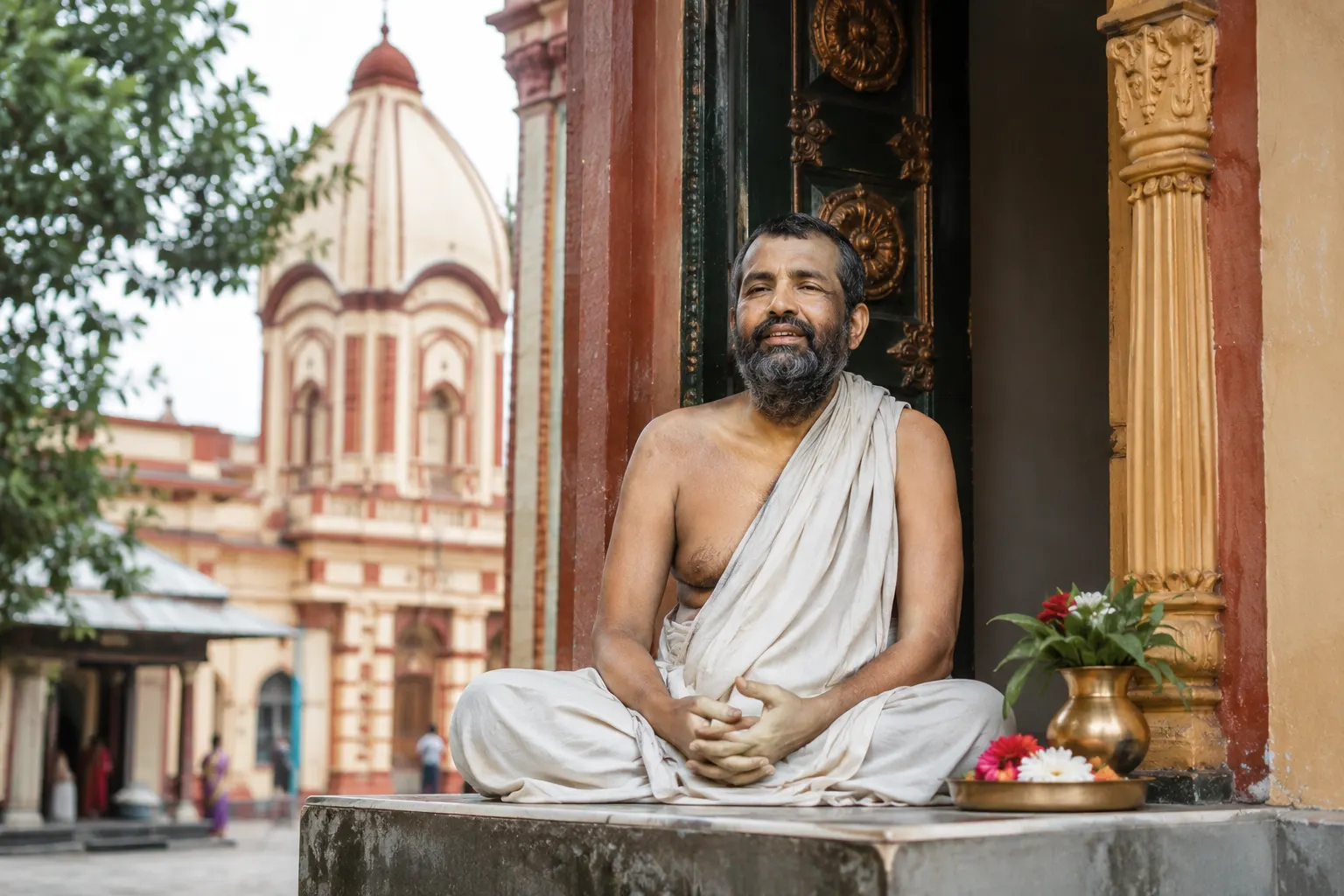
Ramakrishna Paramahansa left behind no political party, no treatise of systematic theology and no organisation carrying out a programme designed by him. He spent most of his mature life in and around a temple complex near Calcutta, spoke in the idiom of village Bengal, entered states that followers understood as spiritual ecstasy, and attracted a relatively small circle of householders and young disciples.
Yet within a generation of his death in 1886, his name had become inseparable from one of the most influential modern Hindu movements. Swami Vivekananda carried an interpretation of his teacher’s message across India and into Europe and the United States. The Ramakrishna Math and Ramakrishna Mission gave institutional form to a tradition that combined Vedantic spirituality, religious pluralism, monastic discipline and social service. Ramakrishna’s recorded conversations became a widely read religious text.
That transformation raises the central historical question of his life: how did a Bengali temple mystic become a figure of global religious significance?
The answer begins with Ramakrishna’s unusual religious practice, but it also depends on the people who remembered, recorded, interpreted and organised around him.
From Kamarpukur to Dakshineswar
Ramakrishna was born Gadadhar Chattopadhyay on 18 February 1836 in Kamarpukur, a village in present-day West Bengal. Institutional biographies maintained by the Ramakrishna Order describe his family as materially modest and religiously observant. He received limited conventional schooling and showed little enthusiasm for the kind of formal education that could lead to a professional career in colonial Calcutta.
That fact later became central to his image. Admirers contrasted his lack of academic training with the apparent sophistication of the religious questions he addressed. But it would be misleading to describe him as intellectually empty before his spiritual life began. Rural Bengal possessed rich oral traditions: devotional songs, epics, folk theatre, temple rituals, Vaishnava traditions, Shakta worship and popular storytelling. Ramakrishna’s religious vocabulary emerged from that environment rather than from an English-language college.
His elder brother Ramkumar was a priest and teacher in Calcutta. Through him, Gadadhar became connected with the newly established Kali temple at Dakshineswar, built under the patronage of Rani Rashmoni. He eventually became a priest associated with the image of Bhavatarini Kali.
The location mattered. Dakshineswar was not an isolated cave or forest hermitage. It was close enough to Calcutta to bring Ramakrishna into contact with educated visitors, reformers, professionals and members of the emerging Bengali middle class. His spirituality grew in a temple environment, but his later audience increasingly came from a city experiencing rapid intellectual change.
The problem of describing mystical experience
Accounts of Ramakrishna repeatedly describe intense devotional states: absorption in worship, altered awareness, visions and episodes interpreted by followers as samadhi.
A historical article cannot verify the supernatural meaning of those experiences. It can, however, establish that such states were central to how contemporaries understood him and how he understood himself.
The distinction is important. Saying that Ramakrishna reported a vision of the goddess Kali is a historical statement about testimony. Saying that a deity objectively appeared is a theological claim.
Ramakrishna’s religious authority grew partly because people around him believed his experiences to be authentic rather than theatrical. His behaviour did not resemble the polished public style of many reformers of colonial Bengal. He often used parables, everyday comparisons, humour and highly physical devotional language. To educated visitors accustomed to debating religion through texts and abstract propositions, that immediacy could be startling.
Shakta devotion and the figure of Kali
Ramakrishna’s early mature spirituality was deeply shaped by devotion to Kali, the goddess worshipped at Dakshineswar.
To modern readers unfamiliar with Bengali Shaktism, the imagery can be difficult. Kali is sometimes reduced in popular representations to a frightening goddess of destruction. In devotional traditions, however, she may also be approached as the Divine Mother: intimate, protective, terrifying, creative and beyond ordinary moral categories.
Ramakrishna’s relationship with Kali was intensely personal. Devotional accounts present his longing for direct experience of the Divine Mother as so overwhelming that ordinary ritual observance became secondary to emotional absorption.
This was one reason his later religious universalism did not amount to detached comparative religion. He did not stand outside traditions and classify them academically. His religious experimentation began from profound commitment to a particular devotional world.
Tantra, Vaishnavism and Advaita
Later accounts describe Ramakrishna undertaking disciplines associated with several streams of Hindu practice.
Under the guidance of a woman ascetic usually known as Bhairavi Brahmani, he is said to have followed forms of Tantric and Vaishnava discipline. The precise interpretation of these practices varies sharply between devotional biographies and modern scholarship, partly because Tantra itself is a broad category and partly because later communities sometimes sanitised practices considered socially uncomfortable.
Ramakrishna also encountered the non-dual Vedantic tradition through the monk Totapuri. Advaita Vedanta teaches, in its classical formulation, that ultimate reality is non-dual and that the apparent separateness of individual self and Brahman is rooted in ignorance. Ramakrishna’s followers describe him as entering a form of non-dual absorption under Totapuri’s instruction.
This encounter is central to later interpretations of Ramakrishna because it helped place ecstatic goddess devotion and non-dual Vedanta within one life rather than as mutually exclusive systems.
His later interpreters—especially Vivekananda—would make that capacity for synthesis one of the foundations of a modern presentation of Hinduism.
Religious practices beyond Hindu traditions
The most discussed feature of Ramakrishna’s spiritual biography is his reported practice of disciplines associated with Islam and Christianity.
Ramakrishna Order accounts state that he temporarily adopted Islamic devotional practices and later experienced Christianity in a similarly concentrated manner. His followers took these episodes as experiential confirmation that different religions could lead toward the same ultimate reality.
This claim became one of the defining themes of the Ramakrishna-Vivekananda tradition.
A critical historian must introduce several qualifications.
First, Ramakrishna’s engagement with other religions was not equivalent to years of formal training within Islamic jurisprudence, Christian theology or the full institutional life of either tradition. His practice was selective and mystical rather than comprehensive.
Second, the evidence comes mainly through disciple records and later biographies. The episodes are historically important because Ramakrishna’s community believed them and organised a theology around them, even where their precise details cannot be independently reconstructed.
Third, his universalism should not be flattened into the modern slogan that “all religions are the same.” His teaching was better understood as affirming multiple spiritual paths while retaining his own metaphysical assumptions about divine reality.
That is a more interesting position than generic tolerance. It attempts to explain religious diversity rather than merely accept it.
Sarada Devi: marriage transformed into spiritual partnership
Ramakrishna was married to Sarada Devi, who was born in 1853 in Jayrambati.
The marriage took place when Sarada was young, in accordance with social practices of the period. She later joined Ramakrishna at Dakshineswar. Their relationship became one of the most unusual features of the tradition that developed around them.
Ramakrishna’s followers represented the marriage as celibate and spiritual. Sarada Devi subsequently became a religious authority in her own right and, after Ramakrishna’s death, an important stabilising figure for the emerging monastic community.
Calling her merely “Ramakrishna’s wife” therefore understates her later historical significance.
The Ramakrishna movement came to recognise her as the “Holy Mother.” She counselled disciples, accepted spiritual seekers and embodied a form of authority distinct from Vivekananda’s public, intellectual and organisational leadership.
This three-part legacy—Ramakrishna, Sarada Devi and Vivekananda—became more important to the movement than Ramakrishna’s biography alone.
Calcutta’s reforming world comes to Dakshineswar
Nineteenth-century Bengal was full of religious argument.
The Brahmo Samaj questioned image worship and inherited ritual, promoted forms of monotheism and engaged deeply with modern education and Christian critique. Figures associated with the Bengal Renaissance debated scripture, caste, widowhood, education, rationalism and the relationship between Indian traditions and European modernity.
Ramakrishna occupied an unusual position in this landscape.
He was neither a Western-educated reformer nor a defender of religion through scholastic polemic. Visitors could encounter in him a person who seemed to claim religious certainty on the basis of experience rather than textual argument.
His interactions with prominent Brahmo figures helped widen his audience. He did not simply reject reformers; he conversed with them while retaining devotional practices many Brahmos considered problematic.
That tension helped make him attractive to younger educated Bengalis who were dissatisfied with both inherited orthodoxy and purely rationalised religion.
Mahendranath Gupta and the making of a textual Ramakrishna
One of the most consequential people in Ramakrishna’s afterlife was Mahendranath Gupta, usually identified in the literature simply as “M.”
Gupta began visiting Ramakrishna in the early 1880s and kept detailed notes of conversations. These eventually became the Bengali Sri Sri Ramakrishna Kathamrita. An English translation by Swami Nikhilananda, The Gospel of Sri Ramakrishna, appeared in the twentieth century and became one of the principal ways English-speaking readers encountered Ramakrishna.
This textual history matters because Ramakrishna himself did not write a systematic book of teachings.
What later generations call “Ramakrishna’s teachings” are mediated through remembered conversations, diaries, editorial choices, translations and institutional transmission.
That does not make them worthless. It means they must be read as historical texts with a chain of transmission.
The Kathamrita is especially valuable because it preserves the conversational character of Ramakrishna’s teaching: stories, jokes, metaphors, questions, songs and exchanges with identifiable visitors. But it is still not a stenographic recording.
The difference between a remembered conversation and an authored philosophical treatise should remain visible.
Narendra Datta enters the story
Among the young men drawn to Ramakrishna was Narendranath Datta, later Swami Vivekananda.
Narendra was educated in the intellectual world of colonial Calcutta and brought sceptical questions to his encounters with Ramakrishna. Their relationship is often presented in devotional narratives as the meeting of master and destined disciple.
Historically, its importance is easier to demonstrate in another way: Narendra became the person most responsible for converting Ramakrishna’s local spiritual reputation into an international religious legacy.
Ramakrishna did not attend the 1893 World’s Parliament of Religions. He did not found the Ramakrishna Mission. He did not deliver English lectures on Vedanta in New York or London.
Vivekananda did those things.
Yet he repeatedly presented Ramakrishna as the experiential source of the religious synthesis he taught.
This means that understanding Ramakrishna requires separating two layers that later merged: the historical teacher at Dakshineswar and the modern universal religious figure interpreted by his disciples.
Illness, Cossipore and death
In the mid-1880s Ramakrishna developed a serious throat illness, commonly described in biographies as cancer.
He was eventually moved to a garden house at Cossipore, where disciples cared for him. The period became important for the formation of the group of young men who later developed into the Ramakrishna monastic order.
Ramakrishna died on 16 August 1886.
His death did not dissolve the community. It forced it to answer a new question: what did loyalty to the teacher require when the teacher was no longer physically present?
The household disciples maintained devotional networks. Sarada Devi became a continuing spiritual centre. Narendra and other young followers moved toward formal monastic life.
From that point onward, Ramakrishna’s historical influence depended increasingly on institutions he never personally administered.
What did Ramakrishna actually teach?
Because he did not produce a systematic doctrine, attempts to reduce his teaching to a few propositions are risky. Still, several recurring themes appear strongly in the recorded tradition.
One is the possibility of direct religious experience. Religion, in this framework, is not primarily assent to propositions but transformation of consciousness.
A second is intense devotion combined with flexibility of spiritual path. People differed in temperament, and religious practice could differ accordingly.
A third is the conviction that different traditions could lead toward the same ultimate reality, although Ramakrishna expressed that idea from within his own Hindu metaphysical horizon.
A fourth is the distinction between ordinary attachment and spiritual life. His language about lust and greed could be uncompromising, particularly in a monastic context.
Finally, his teaching frequently relied on concrete analogies rather than abstraction. A single reality could be approached through different names; water might be called by different words; paths might differ while reaching a destination. Such images were memorable because they translated metaphysical claims into everyday speech.
The problem of modern interpretation
Ramakrishna has generated unusually divergent scholarly interpretations.
Devotional biographies understand his experiences in spiritual terms and often treat his religious practices as evidence of realised religious harmony.
Academic scholars have approached him through history of religions, psychology, sexuality, colonial modernity, Bengali culture and textual analysis. Some interpretations have been sharply contested by monks and scholars associated with the Ramakrishna tradition, especially where psychoanalytic readings were seen as imposing categories unsupported by Bengali sources.
A responsible profile does not need to decide every dispute. It should make the existence of the dispute clear.
Religious biography is especially vulnerable to two opposite errors. One is to repeat devotional testimony as objective fact. The other is to assume that sceptical reduction is automatically more historical.
The strongest approach distinguishes evidence, testimony and interpretation.
From mystic to modern Hindu symbol
After Ramakrishna’s death, Vivekananda and the institutions founded by his followers increasingly presented him as a figure whose life reconciled apparently competing religious demands: devotion and non-dualism, tradition and modernity, Hindu diversity and inter-religious openness.
That interpretation proved powerful because colonial modernity had created pressure for religious traditions to present themselves as coherent systems comparable to Christianity or Islam.
Ramakrishna’s life offered a different kind of coherence. Instead of arguing that one doctrine alone unified Hinduism, his followers could argue that diverse paths were validated through spiritual experience.
This became particularly significant in the global presentation of Vedanta.
Yet it is worth remembering that the polished universal teacher of later institutional literature emerged from a far more local world: Bengali speech, Kali worship, temple ritual, songs, household devotees and intense embodied mysticism.
The global Ramakrishna never completely replaced the village-and-temple Ramakrishna. The tension between them is part of his historical fascination.
Why Ramakrishna still matters
Ramakrishna matters today for at least three reasons.
First, his life sits at the heart of debates about religious pluralism. He is frequently invoked as evidence that deep commitment to one tradition need not require denying the spiritual value of others.
Second, his legacy demonstrates how religious authority is constructed after a charismatic teacher’s death. Disciples, recorders, translators and institutions can turn oral encounters into durable traditions.
Third, his biography shows why modern Hinduism cannot be understood solely through texts, reform organisations or political movements. Mysticism, temple devotion, vernacular culture and personal charisma were equally capable of shaping modern religious history.
Ramakrishna did not become globally important because he designed a global movement.
He became important because others believed that his life contained something worth translating—across language, class, nation and religion.
That translation continues. It is the reason a nineteenth-century priest at Dakshineswar remains part of twenty-first-century arguments about spirituality, pluralism and the meaning of religious experience.