Plastic Pollution: Causes, Effects, Solutions and Why the Crisis Keeps Growing
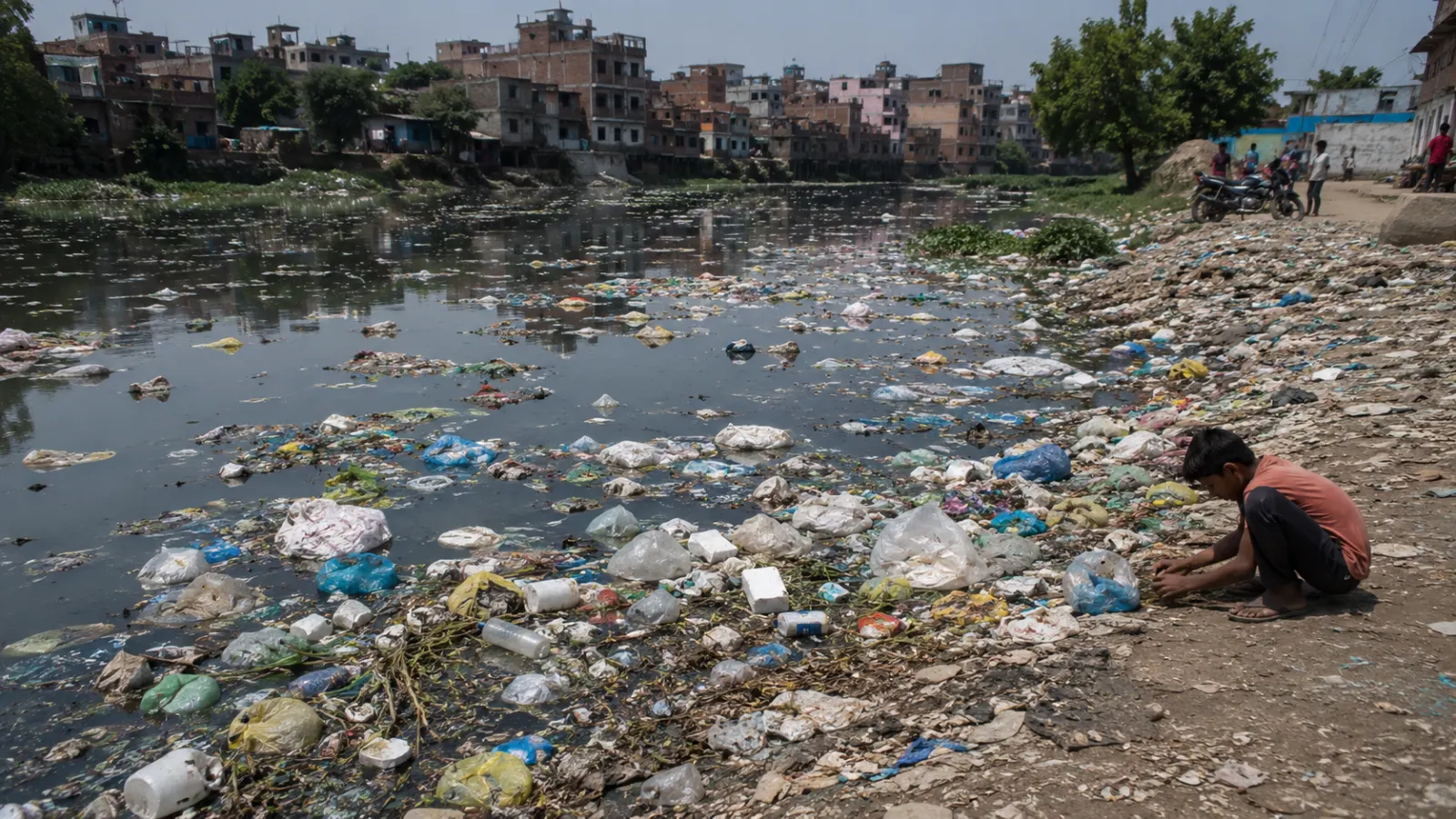
Plastic pollution is easy to recognise when bottles, bags and food wrappers collect along a beach or roadside. The harder part is seeing the industrial and economic system that produced them.
A discarded package is the visible end of a much longer lifecycle. Raw materials are extracted, polymers are produced, chemicals are added, products and packaging are designed, goods are distributed and used, and the resulting material must eventually be reused, recycled, burned, buried, exported or otherwise managed. Plastic can enter the environment at several points along that chain, not only when an individual drops litter.
That broader definition matters because plastic itself is not simply a useless or inherently “bad” material. Its durability, low weight, chemical resistance and ability to be shaped into thousands of forms explain why it became indispensable in healthcare, electronics, transport, construction, food protection, agriculture and countless other sectors.
The crisis comes from something more specific: enormous quantities of durable material are being produced, much of it for short-lived uses, while collection, reuse and recycling systems cannot keep pace with the resulting waste.
The scale is already enormous. UNEP says humanity was expected to consume more than 500 million tonnes of plastic in 2024, with around 400 million tonnes quickly becoming plastic waste. Under a business-as-usual trajectory, UNEP warns that global plastic waste could approach 1.2 billion tonnes annually by 2060.
Plastic pollution therefore cannot be solved only by cleaning beaches or asking households to recycle more carefully. Those actions can help, but they intervene near the end of the problem.
A durable solution has to reach much further upstream.
Plastic Pollution at a Glance
| Question | Short answer |
|---|---|
| What is plastic pollution? | The release, accumulation or harmful presence of plastics and associated substances across land, freshwater, oceans, air and other environments |
| Where does it come from? | Production losses, short-lived products, litter, mismanaged waste, industrial pellets, tyres, synthetic textiles, paints, agriculture and other sources |
| How much plastic is produced? | More than 460 million tonnes annually according to IUCN; UNEP estimated consumption above 500 million tonnes in 2024 |
| How much enters the environment? | IUCN estimates around 20 million tonnes of plastic litter enters the environment each year |
| Does plastic disappear? | Many plastics persist and fragment into progressively smaller pieces rather than rapidly biodegrading |
| Is the problem only in oceans? | No. Plastic pollution affects terrestrial, freshwater, marine and built environments |
| Are microplastics part of the crisis? | Yes. They can originate from fragmentation or sources such as tyres, textiles, paints and industrial pellets |
| Can recycling solve plastic pollution? | Recycling is necessary but insufficient by itself |
| What works best? | Reducing unnecessary use, reuse, better product design, collection, recycling, producer responsibility and leakage prevention across the full lifecycle |
| Is there a global plastics treaty? | Negotiations are continuing; no final treaty has yet been agreed |
Why Plastic Became So Successful
Plastic dominates modern material systems because it solves genuine engineering and economic problems.
It can be made rigid enough for pipes, flexible enough for film, transparent enough for medical packaging, durable enough for building components and lightweight enough to reduce transport mass. Plastic insulation helps make electrical systems safer. Sterile disposable medical products can reduce infection risks. Packaging can protect food from moisture, contamination and damage.
These advantages matter because simplistic substitution can create other environmental costs. Replacing lightweight plastic with much heavier materials may increase transport requirements. Replacing durable components too frequently can increase overall resource use. Some medical and safety applications depend on properties that are not easily reproduced by other materials.
A serious plastic-pollution strategy therefore does not begin with the slogan “eliminate all plastic.”
It begins by distinguishing between applications that deliver substantial functional value and those in which durable material is used unnecessarily or for only a few minutes.
Packaging makes that mismatch especially visible. UNEP notes that plastic packaging accounts for around half of plastic waste. A disposable wrapper may perform its function for minutes yet remain physically present in some form for decades or much longer.
That is the central design contradiction: long-lived material is frequently being placed into short-lived systems.
Where Plastic Pollution Actually Comes From
Visible litter is only one source.
Plastic can escape during production when resin pellets, powders or fragments are lost from industrial facilities or transport systems. Products can release particles during normal use. Synthetic textiles shed fibres. Tyres release polymer-containing wear particles as vehicles travel. Paints and coatings can weather or abrade. Agricultural films can fragment when retrieval is incomplete.
After use, the waste-management system becomes critical. In places with reliable collection, most material enters formal waste streams even if only part of it is eventually recycled. Where collection is incomplete, waste can be dumped, burned or carried by wind and rain into the wider environment.
Stormwater is particularly important in cities. Lightweight packaging dropped on streets can enter drains during rainfall and travel into waterways. Rivers then become transport routes carrying plastic from inland settlements toward lakes, estuaries and oceans.
IUCN estimates that approximately 20 million metric tonnes of plastic litter enter the environment each year and emphasises that plastic pollution affects land, freshwater and marine ecosystems rather than oceans alone.
This lifecycle perspective changes where responsibility is located. The consumer holding the final product is only one actor. Manufacturers determine material combinations and repairability. Retailers influence packaging. Governments determine collection infrastructure and regulation. Waste operators determine what happens after disposal. Supply chains determine whether materials can return for reuse.
Plastic pollution is therefore produced by a system of decisions, not one careless moment.
Why Plastic Persists for So Long
Durability is one of plastic's most useful properties while a product is in service.
Once plastic escapes into the environment, that same durability becomes a liability.
Many common plastics resist rapid biological decomposition. Exposure to sunlight, heat, waves and physical abrasion can weaken larger products and break them into smaller fragments, but fragmentation is not the same as disappearance.
EPA notes that plastics can persist in the environment for very long periods, depending on material and conditions, and progressively fragment into microplastics and nanoplastics.
This produces an important asymmetry.
A large bottle or fishing net is visible enough to collect.
Once that material breaks into thousands or millions of tiny pieces distributed through soil, sediment or water, recovery becomes vastly more difficult.
Plastic pollution therefore becomes harder and more expensive to reverse as time passes.
Preventing leakage is generally much easier than collecting highly dispersed fragments later.
Microplastics Are Not Just Broken Bottles
Microplastics are often described as the tiny fragments created when larger plastic waste breaks down.
That is only part of the picture.
Some microplastic pollution is generated directly during ordinary product use. OECD identifies tyre wear, synthetic textiles, paints and industrial pellet losses among important sources. Under business-as-usual conditions, these sources are expected to continue increasing as plastic use grows.
This matters because traditional anti-litter campaigns cannot address such emissions effectively.
A driver can dispose of every plastic bottle correctly while still participating in tyre-wear emissions. Someone may never litter but release fibres through synthetic clothing. A building can shed particles from coatings without any obvious discarded object.
Microplastic policy therefore requires product engineering, industrial controls and infrastructure alongside consumer behaviour.
It also demonstrates why plastic pollution cannot be understood solely by counting visible rubbish.
The Environmental Effects Extend From Cities to Oceans
Plastic pollution affects ecosystems through several mechanisms.
Animals can become entangled in fishing line, nets, straps or packaging. Wildlife can ingest plastic accidentally or because fragments resemble food. Large debris can damage habitats physically, while small particles can move through food webs and environmental compartments.
EPA reports that more than 1,500 species in marine and terrestrial environments are known to ingest plastics.
Plastic waste can also interfere with human infrastructure. Packaging and other debris can block drainage systems, worsening flooding during intense rainfall. Agricultural plastics can remain in soils. Improperly managed dumpsites can allow waste to escape into neighbouring communities and waterways.
The effects vary greatly according to material, size, location and exposure.
A lost fishing net creates a different ecological problem from microscopic tyre particles. Agricultural film produces different pathways from disposable beverage containers.
Calling all plastic pollution identical would therefore be scientifically unhelpful.
The common problem is persistence combined with enormous scale.
Plastic Pollution Is Not Only an Ocean Problem
The ocean has become the dominant visual symbol of plastic pollution, partly because floating bottles, entangled animals and littered beaches are easy to photograph.
But most plastic begins its environmental journey on land.
Cities generate waste. Roads generate tyre particles. Clothing produces fibres. Farms use plastic films and equipment. Industrial facilities manufacture and move polymers. Rivers then connect land-based sources to marine environments.
OECD estimated that 6.1 million tonnes of plastic waste entered aquatic environments in 2019, with accumulated stocks already reaching approximately 139 million tonnes in aquatic environments that year.
This means marine pollution cannot be solved only at the coastline.
The intervention often needs to occur hundreds or thousands of kilometres upstream through collection, product design, urban drainage, industrial control and waste prevention.
Plastic Pollution Has a Climate Footprint Too
Plastic policy and climate policy overlap because most conventional plastic is still produced from fossil-fuel feedstocks and because polymer production and conversion require substantial energy.
OECD estimated that the plastics lifecycle generated approximately 1.8 billion tonnes of greenhouse-gas emissions in 2019, equivalent to about 3.4% of global emissions. Around 90% came from the production and conversion of fossil fuels into plastic products.
That does not justify assuming that every alternative material has a lower climate impact.
Material substitution can involve trade-offs. Glass may be reusable and recyclable but is heavy. Aluminium can circulate efficiently when recovered but is energy-intensive to produce initially. Paper can use renewable feedstocks while still requiring land, water, energy and processing.
The strongest climate intervention is often not merely changing the material.
It is reducing unnecessary throughput.
A packaging system that eliminates ten unnecessary containers avoids more production than one that simply changes all ten containers from one disposable material to another.
Chemicals Make the Plastic Problem More Complicated
Plastic products are not usually made from polymers alone.
Manufacturers use additives and processing chemicals to alter colour, flexibility, durability, flame resistance, ultraviolet stability and many other properties.
UNEP's 2023 technical assessment identified more than 13,000 chemicals associated with plastics and plastic production. Scientific information on thousands of these substances indicates that more than 3,200 have one or more hazardous properties of concern. UNEP highlights groups including certain flame retardants, phthalates, bisphenols, PFAS, UV stabilisers and other substances.
This has two important implications.
First, chemical safety needs to be considered across the plastics lifecycle rather than only after products become waste.
Second, chemical complexity can make circularity more difficult. Recycling material containing problematic additives can potentially move those chemicals into another product stream instead of eliminating them.
A circular economy for plastics therefore needs to consider what is being circulated, not merely how many tonnes are recovered.
Human-health claims need particular care. Exposure pathways, dose, chemical identity and individual circumstances matter, and scientific certainty differs across substances and outcomes. The strongest conclusion is not that every plastic product is toxic. It is that chemical composition deserves much more attention in plastic policy and product design.
What Do We Actually Know About Microplastics and Human Health?
Microplastics have now been detected in human tissues and biological samples, as well as throughout the environment.
That discovery has understandably created concern.
However, detection and demonstrated clinical harm are not the same thing.
EPA currently notes that research is still developing and that more evidence is needed to understand the potential human-health impacts of microplastics.
This distinction is essential for responsible reporting.
It would be inaccurate to claim that microplastics have been proved harmless.
It would also be inaccurate to treat every detected particle as proof of a specific disease.
Researchers need to understand exposure, particle size, chemistry, dose, biological mechanisms and long-term outcomes.
Plastic pollution is already justified as an environmental problem without exaggerating unresolved human-health claims.
Why Recycling Cannot Solve Plastic Pollution Alone
Recycling is an important part of plastic management.
It can keep some material in circulation, reduce demand for virgin feedstock and divert waste from disposal.
But recycling faces technological and economic constraints.
Different polymers behave differently. Food contamination can reduce material quality. Labels, pigments and additives complicate processing. Multilayer packaging may combine materials that are difficult or expensive to separate. Collection systems vary widely. Recycled polymers can also lose quality or move into applications that are harder to recycle again.
Most importantly, recycling systems have to process whatever volume the economy sends toward them.
If plastic consumption grows rapidly, recycling infrastructure has to expand just to prevent the situation from worsening.
OECD's 2024 modelling makes this limitation unusually clear. Without stronger policy, global plastics production and use are projected to rise from about 435 million tonnes in 2020 to 736 million tonnes in 2040—an increase of roughly 70%. Under that baseline, recycled plastics would still represent only a small fraction of total production, while mismanaged waste and environmental leakage would continue rising.
A downstream-only strategy therefore becomes an endless race against growing waste.
Why “Recyclable” Does Not Mean “Recycled”
A product can be technically recyclable and still have almost no chance of being recycled in the place where it is sold.
Actual recycling requires several things to happen successfully.
The material must be collected. It must reach a sorting facility. The facility has to identify and separate it. A recycler needs technology capable of processing it. The resulting material has to meet usable quality standards. And somebody must be willing to buy that recycled material.
If one link fails, the recyclable object may still be burned, buried or discarded.
This distinction between theoretical recyclability and real recovery is crucial.
Designing packaging that no local facility accepts does not create a circular economy.
UNEP's lifecycle framework therefore emphasises designing products for the recycling systems in the markets where they are actually sold.
Why Reuse Usually Comes Before Recycling
Recycling preserves material.
Reuse can preserve the entire product.
A returnable bottle that is washed and refilled remains a bottle. If it is crushed and melted, only its material value remains.
The same logic applies to crates, containers, furniture, electronics and many other products.
Reuse is particularly powerful when standardised items can circulate repeatedly through efficient return systems. Business-to-business transport packaging can work well because the same suppliers, warehouses and manufacturers exchange materials continuously.
Consumer reuse requires convenient return infrastructure. A container designed for one hundred uses achieves little if most customers throw it away after the first trip.
The goal should therefore be reuse systems, not merely reusable products.
The Plastic Waste Hierarchy
A practical hierarchy looks like this:
avoid unnecessary use → reduce material → design for durability → reuse and refill → repair where relevant → recycle what can genuinely circulate → safely manage the residual waste
The order matters.
If packaging is unnecessary, avoiding it prevents manufacturing and waste entirely.
If the packaging is necessary, reducing its material content lowers resource use.
If it can circulate repeatedly, reuse preserves more value.
Recycling becomes particularly important once the product can no longer remain useful in its existing form.
Disposal is the final stage, not the strategy around which the entire economy should be designed.
What UNEP Means by “Turning Off the Tap”
UNEP's influential Turning off the Tap report uses a systems approach rather than concentrating only on waste collection.
Its framework combines reducing problematic and unnecessary plastic use with three major market shifts: reuse, recycle, and reorient and diversify toward appropriate alternatives, alongside management of existing pollution.
UNEP estimated that these systemic changes using available approaches could reduce global plastic pollution by around 80% by 2040.
The metaphor is useful.
Imagine water pouring continuously into an overflowing bath.
Cleaning the floor matters.
But if the tap remains fully open, cleanup never catches up.
Plastic policy faces the same problem.
Better recycling and waste management are essential.
But the amount entering the system also matters.
OECD Modelling Shows Why Lifecycle Policy Matters
The OECD's 2024 modelling provides one of the clearest quantitative demonstrations of the difference between upstream and downstream policy.
Under business as usual, plastics use and environmental leakage continue growing.
A strategy focused primarily on improving waste management without reducing waste generation performs substantially worse than comprehensive action across the entire lifecycle.
In OECD's most ambitious global scenario, policies combine controls on production and demand, circular product design, stronger recycling and measures to close leakage pathways. The model estimates that this could reduce plastic leakage to the environment by approximately 96% relative to business as usual by 2040, while raising the global average recycling rate from 9.5% in 2020 to around 42% in 2040.
The result should be interpreted correctly.
It is a modelled policy scenario, not a forecast that the world is automatically on course to achieve a 96% reduction.
Its importance lies in showing the relative effectiveness of different strategies.
The model suggests that waste management works much better when it does not have to absorb continuously expanding plastic demand.
Product Design Determines What Becomes Waste
Many end-of-life problems are created before the product leaves the factory.
Designers choose whether a package contains one polymer or several bonded layers. They determine whether a label separates easily, whether a reusable component can be cleaned, whether additives complicate recovery and whether spare parts exist.
A consumer cannot recycle around those decisions.
This is why design for circularity has become central to serious plastic policy.
Manufacturers can eliminate unnecessary components, reduce material, avoid problematic combinations, increase recycled content and make packaging compatible with real collection systems.
Products should also be evaluated by function.
A redesigned system that eliminates packaging altogether may outperform a package made from a supposedly greener material.
The circular-economy question is not simply “What should this package be made from?”
It is “Does this package need to exist in this form at all?”
Extended Producer Responsibility Changes Who Pays
Waste management has traditionally placed much of the cost on households and local governments after products have already been designed and sold.
Extended Producer Responsibility, or EPR, attempts to shift part of that responsibility back toward producers.
Depending on the system, companies may be required to finance or organise collection, recycling and end-of-life management for packaging they place on the market.
The principle can do more than raise money.
If fees differ according to recyclability, material choice or product design, EPR can create an upstream incentive to make packaging easier and cheaper to manage.
Poorly designed EPR can become merely another fee.
Well-designed EPR can connect design decisions with downstream consequences.
UNEP reported in its 2024 annual work that it was supporting countries in developing EPR approaches, while dozens of countries already had such schemes operating in some form.
Deposit-Return and Refill Systems
Deposit-return programmes attach financial value to an otherwise disposable container.
A customer pays a deposit when purchasing the product and receives it back when the container is returned.
Returned containers can then enter high-quality recycling systems or, where designed appropriately, be washed and reused.
The strength of the approach is behavioural and logistical.
A bottle is less likely to become worthless litter when the system continues treating it as an asset.
Refill systems go further by avoiding repeated packaging production.
They can work through consumer-owned containers, standardised returnable packaging or centralised refill infrastructure.
The best model depends on the product, transport network, washing requirements and number of realistic reuse cycles.
Alternatives Need Lifecycle Evidence Too
Plastic alternatives are often marketed as obvious environmental improvements.
Some are.
Others involve trade-offs.
Paper, aluminium, glass, compostable polymers and bio-based materials all have production impacts. Their performance depends on weight, transport, land use, energy, reuse rates and what happens after use.
A compostable package provides little advantage if the local waste system has no way to identify and process it.
A heavy reusable container performs poorly if it circulates only twice.
A bio-based plastic does not necessarily biodegrade.
The correct objective is therefore not replacing plastic at any cost.
UNEP uses the phrase reorient and diversify precisely because alternatives should be selected according to environmental and economic performance rather than symbolism.
Waste Collection Remains Essential
Upstream reform does not eliminate the need for conventional waste management.
Billions of products are already being used, and some residual plastic will remain even in a substantially more circular economy.
Reliable collection prevents waste from entering streets, drains, rivers and informal dumps.
Collection is especially important in rapidly growing cities where consumption can increase faster than municipal infrastructure.
Waste-management workers also need safe working conditions. Circular-economy rhetoric should not conceal the fact that sorting and recycling can expose informal workers to physical and chemical hazards.
A genuinely circular system has to be environmentally and socially credible.
Open Burning Is Not a Solution
Where collection systems fail, plastic waste may be burned in the open.
Burning makes the visible pile disappear, but it does not make the pollution disappear.
Poorly controlled burning can release particulate matter and hazardous pollutants and creates direct exposure risks for nearby communities.
This is another reason individual behaviour cannot be separated from infrastructure.
Telling households not to burn waste is of limited value if no reliable collection service exists.
Preventing plastic pollution therefore requires basic public services as well as sophisticated circular design.
Cleanups Matter—but They Come Late
Beach, river and neighbourhood cleanups are useful.
They remove material before it fragments further. They can protect wildlife, improve public spaces and raise awareness.
Cleanup data can also reveal recurring sources. If the same packaging category appears repeatedly at one river mouth, policymakers can investigate where it is entering the system.
But cleanup is fundamentally downstream.
A beach cleaned today can be polluted again next month if the upstream material flow remains unchanged.
The best cleanup therefore asks two questions:
What can we remove now?
and
Why did this material arrive here in the first place?
The second question has far greater long-term leverage.
Individual Behaviour Still Matters
Systems thinking should not become an excuse to dismiss personal choices.
Individuals influence demand and determine what happens to products inside the part of the system they control.
Useful actions include avoiding unnecessary single-use items, carrying durable reusable products, choosing less heavily packaged goods, using refill systems, maintaining products longer and following local recycling rules.
But individual responsibility should be proportional to actual control.
A customer cannot make a multilayer package recyclable.
A low-income household may have few alternatives to small packaging formats.
A resident cannot create municipal collection infrastructure independently.
Consumers matter.
They are not the only actors.
Business Responsibility Is Larger Than Consumer Responsibility
Businesses decide which products exist and how they are designed.
They control material choice, packaging volume, labels, additives, repairability, refill options and much of the supply chain.
This gives companies leverage that individual consumers do not possess.
A manufacturer eliminating unnecessary packaging across one product line can prevent millions of items from entering the waste stream.
A retailer introducing refill infrastructure can change behaviour for thousands of customers without requiring each person to invent their own solution.
A logistics company switching from disposable transport packaging to returnable crates can reduce material flow behind the scenes where consumers never see it.
Plastic reduction therefore needs corporate measurement.
Businesses should know what plastic they purchase, what functions it performs, how much becomes waste and where higher-value alternatives exist.
The Global Plastics Treaty: Where Negotiations Stand in September 2026
The international treaty process is one of the most important current developments in plastic policy.
In March 2022, UN Member States adopted a resolution directing UNEP to convene negotiations for a legally binding international instrument addressing plastic pollution through a comprehensive lifecycle approach, including production, design and disposal.
Negotiations subsequently took place through INC-1 in Uruguay, INC-2 in Paris, INC-3 in Nairobi, INC-4 in Ottawa, INC-5.1 in Busan and INC-5.2 in Geneva.
The August 2025 Geneva session ended without agreement on a final treaty text.
A resumed INC-5.3 session was held in Geneva on 7 February 2026, but UNEP confirms that it dealt with organisational and administrative matters, including the election of new leadership, and no substantive treaty negotiations were held.
As of 3 September 2026, the process remains unfinished.
UNEP has scheduled further informal work before the next formal negotiating session. A virtual heads-of-delegation meeting is scheduled for 8–9 September 2026, followed by an in-person meeting in Bangkok from 27–30 September 2026. A further informal meeting is planned within 25 January–2 February 2027.
The fourth part of the fifth negotiating session, INC-5.4, is scheduled within 13–24 March 2027.
There is therefore no completed global plastics treaty yet.
Why the Global Treaty Is So Difficult
The scientific proposition that plastic pollution should be reduced is relatively easy to accept.
The political questions are much harder.
Should an international agreement regulate only waste or also plastic production?
Should certain products be phased out globally?
How should chemicals of concern be addressed?
Should design requirements be mandatory?
Who should finance waste-management infrastructure in lower-income countries?
How much flexibility should individual governments retain?
How should producer responsibility work across international supply chains?
These questions distribute economic costs differently.
Countries with major petrochemical industries have different interests from small island states facing marine pollution. Rapidly developing economies may need major investment in collection infrastructure. Companies may support harmonised recycling rules while opposing production limits.
The unfinished treaty process demonstrates that plastic pollution is not merely an engineering problem.
It is also a dispute over who changes, who pays and where responsibility begins.
What Would a Serious Plastic-Pollution Strategy Include?
No single intervention is sufficient.
A comprehensive strategy needs several layers working together.
The first is prevention: remove unnecessary products and packaging before they become waste.
The second is reduction and redesign: use less material, simplify products and eliminate combinations or chemicals that make recovery difficult.
The third is reuse: create durable refill and return systems where lifecycle evidence supports them.
The fourth is recycling: expand collection, sorting and markets for secondary materials while designing products that real facilities can process.
The fifth is universal waste management: prevent uncontrolled dumping, burning and leakage.
The sixth is producer responsibility: connect upstream design choices with downstream costs.
The seventh is targeted control of microplastic sources, including tyres, textiles, paints and industrial pellet losses.
And the final layer is legacy pollution: remove accumulated debris where cleanup is feasible and environmentally useful.
UNEP and OECD differ in modelling details but converge on the same broad conclusion: the plastic crisis requires intervention across the entire lifecycle, not just better bins.
Common Myths About Plastic Pollution
One common myth is that plastic pollution is mostly caused by people littering. Litter matters, but pollution also arises from production, product wear, inadequate collection, industrial losses and poorly designed systems.
Another is that all plastic is unnecessary. Plastic provides significant benefits in medicine, infrastructure, transport, food protection and many other fields. The priority is eliminating unnecessary and problematic uses rather than ignoring function.
A third myth is that recycling can solve the crisis by itself. Recycling is necessary, but rapidly expanding plastic demand can overwhelm even improved waste-management systems.
Another misconception is that biodegradable or compostable means safe to litter. Breakdown depends on material and environmental conditions, and some products require controlled industrial processes.
It is also misleading to assume that every alternative material is automatically greener. Lifecycle impacts depend on production, weight, transport, number of uses and end-of-life management.
Finally, microplastics should not be framed either as proven harmless or as proven causes of every disease with which they are associated online. Human-health research is developing, and claims should match the strength of available evidence.
Frequently Asked Questions About Plastic Pollution
What is plastic pollution?
Plastic pollution is the accumulation or release of plastic materials and associated substances into natural and built environments in ways that create environmental, social or economic harm.
What causes plastic pollution?
Major causes include high plastic production, short-lived products, inadequate waste collection, littering, dumping, industrial losses, poorly recyclable packaging and particle emissions from products such as tyres, textiles and paints.
How much plastic waste does the world produce?
UNEP says humanity generated an estimated 400 million tonnes of plastic waste in 2024.
How much plastic enters the environment?
IUCN estimates that around 20 million metric tonnes of plastic litter enter the environment each year.
Why is plastic pollution harmful?
Plastic can persist and accumulate, entangle or be ingested by wildlife, damage habitats, obstruct drainage and fragment into microplastics that disperse widely through ecosystems.
Is plastic pollution only an ocean problem?
No. It affects land, rivers, lakes, soil, urban environments and the atmosphere as well as marine ecosystems.
What are microplastics?
Microplastics are very small plastic particles. They can result from the fragmentation of larger items or be released from sources such as tyres, textiles, paints and industrial materials.
Are microplastics harmful to humans?
Potential health effects are an active area of research. Microplastics have been detected in human tissues, but the clinical significance of different exposures is not yet completely understood.
Does plastic contribute to climate change?
Yes. OECD estimated that the plastics lifecycle accounted for approximately 3.4% of global greenhouse-gas emissions in 2019.
Can plastic be recycled forever?
Generally not. Recycling quality and technical feasibility differ by polymer, contamination and product design, and some materials degrade or move into lower-value applications.
Why is so little plastic recycled?
Challenges include collection gaps, mixed materials, contamination, difficult product design, low economic value and insufficient demand for recycled feedstock.
Is reusable packaging always better?
Not automatically. Its impact depends on product weight, number of reuse cycles, washing, transportation and what disposable system it actually replaces.
Are paper and glass always better than plastic?
No. All materials have lifecycle impacts. The strongest intervention is frequently reducing unnecessary material use rather than automatically substituting one disposable material for another.
What is Extended Producer Responsibility?
EPR is a policy approach that makes producers financially or operationally responsible for some of the collection and end-of-life management of products or packaging they place on the market.
What is the best way to reduce plastic pollution?
The strongest strategies combine prevention, reduction, reuse, circular product design, effective recycling, universal waste collection, producer responsibility and controls on environmental leakage.
Can beach cleanups solve plastic pollution?
No. They can remove existing pollution and provide useful data, but they do not prevent more material from entering the environment.
What does UNEP's “Turning off the Tap” mean?
It refers to reducing the flow of plastic pollution at its source through systemic changes rather than relying mainly on downstream cleanup.
Can plastic pollution be almost eliminated?
OECD modelling suggests that highly ambitious global policies across the entire lifecycle could reduce plastic leakage by approximately 96% relative to business as usual by 2040. This is a modelled scenario, not a forecast of what current policies will automatically achieve.
Is there a global plastics treaty?
Not yet. Negotiations are continuing under the UN Intergovernmental Negotiating Committee process.
What happened at INC-5.3?
INC-5.3 took place on 7 February 2026 in Geneva for organisational and administrative purposes. UNEP states that no substantive treaty negotiations took place.
When is the next formal plastics treaty meeting?
UNEP has scheduled INC-5.4 within 13–24 March 2027, with additional informal negotiations taking place beforehand.
Plastic Pollution Is Ultimately a Design Problem
The most important lesson about plastic pollution is that the bottle floating in a river is not where the story began.
Long before it became waste, somebody chose the material.
Somebody determined its thickness, additives, colour and packaging format.
A company decided whether the product would be refillable or disposable.
A retailer placed it into a market.
A government determined whether producers carried responsibility for its end of life.
A municipality either provided reliable collection or did not.
A recycling system either had the capacity to recover the material or did not.
Only then did the object reach the person who eventually discarded it.
That sequence explains why plastic pollution cannot be solved through moral appeals to consumers alone.
Individual behaviour matters, but many of the most consequential choices occur before the customer sees the product.
The same principle explains why recycling, while necessary, cannot carry the whole system. OECD modelling shows that downstream waste management becomes increasingly difficult and expensive when plastic production and demand continue expanding. Comprehensive policies perform much better because they reduce the volume that waste systems have to manage in the first place.
UNEP reaches a similar conclusion through its systems-change approach: reduce unnecessary plastic, redesign products and markets, expand reuse and recycling, move toward appropriate alternatives and address the pollution already accumulated in the environment.
The strongest plastic strategy therefore works backwards from waste.
Do not begin with the recycling bin.
Begin with whether the product needs to exist.
If it does, ask whether it needs so much material.
Then ask whether it can remain in service longer.
Can the package be refilled?
Can the product be reused?
Can components be recovered?
Can the remaining material actually be recycled where it is sold?
Can unavoidable waste be collected safely?
And can environmental leakage be prevented before cleanup becomes necessary?
That is the systems problem hidden behind every piece of visible plastic litter.
Plastic became one of the defining materials of modern life because it is extraordinarily good at performing useful functions.
The challenge now is to become equally good at deciding where plastic is genuinely valuable, where it is unnecessary, how long it should remain in use and what happens after that useful life ends.
Only then does plastic pollution become a problem that can realistically shrink rather than merely a waste stream society continually tries to clean up.