Lending without the bank in the middle
The oldest form of finance is not banking. It is trust between people. One person has surplus money, another needs money, and a promise connects them. Modern banking formalised that relationship. Banks collected deposits, assessed borrowers, gave loans, absorbed some risk and earned the spread between deposit rates and lending rates. Peer to peer lending tries to return finance to a more direct structure, but with digital technology between the two sides.
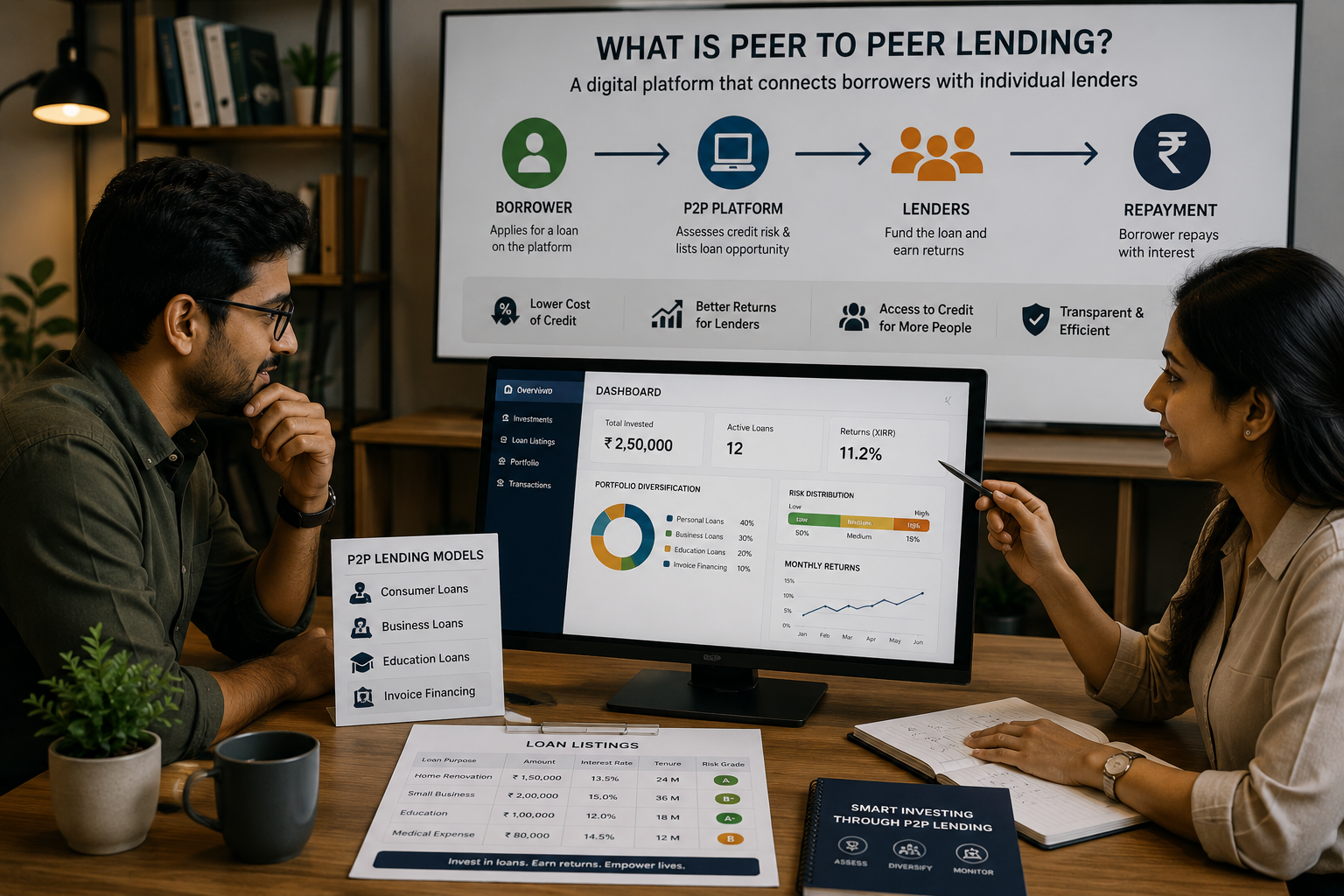
Peer to peer lending, or P2P lending, connects individual lenders and borrowers through an online platform. A borrower seeks a loan. A lender agrees to fund part or all of that loan. The platform facilitates matching, documentation, risk assessment, repayment tracking and sometimes recovery processes. In theory, borrowers may get access to credit outside traditional banks, while lenders may earn higher returns than ordinary savings products.
That is the attraction. But it is also the danger. P2P lending is often marketed as simple, direct and high-yielding. In reality, it involves credit risk, operational risk, liquidity risk, platform risk and regulatory risk. The lender is not placing money in a bank deposit. The lender is taking exposure to borrowers who may default. The platform may facilitate the transaction, but it does not magically remove the risk.
What peer to peer lending means
Peer to peer lending is a digital lending arrangement where a platform connects lenders and borrowers without becoming the traditional lender itself. The platform is not supposed to act like a bank that takes deposits and lends from its own balance sheet. Instead, it provides loan facilitation services: onboarding users, assessing credit profiles, displaying loan opportunities, routing payments, maintaining records and supporting collections within regulatory boundaries.
The borrower may be an individual seeking personal credit or a small business needing working capital. The lender may be an individual seeking return by lending to multiple borrowers. The platform may split one borrower's loan across many lenders so that no single lender bears the full exposure. Similarly, one lender may spread money across multiple borrowers to reduce concentration risk.
The model appears efficient because it uses technology to lower matching costs. But lower matching costs do not mean lower credit risk. If a borrower lacks repayment capacity, no app interface can convert that borrower into a safe exposure. The foundation of P2P lending is credit underwriting, not software design.
How the process works
A borrower applies on a P2P platform, providing identity, income, bank account and credit-related information. The platform performs checks and assigns a risk category or credit score based on its model. Lenders registered on the platform review available lending opportunities. They decide how much to lend and to whom, often based on expected return, tenure and risk grade.
Once funding is completed, disbursal and repayment are routed through banking channels and escrow mechanisms as prescribed by regulation. The borrower repays principal and interest over time. The platform may deduct fees for facilitation. If the borrower delays payment, collection processes begin. If the borrower defaults, the lender bears loss according to the terms and regulatory framework.
This structure is crucial. In genuine P2P lending, the platform should not promise that the lender will definitely get principal and interest back. It can facilitate credit, but it should not convert risky lending into a guaranteed investment product. When platforms blur that distinction, the model becomes misleading.
Why borrowers use P2P lending
Borrowers may turn to P2P lending for several reasons. Some may not qualify easily for bank loans. Some may need faster processing. Some may seek smaller ticket loans that traditional lenders find uneconomical. Some may have temporary cash-flow needs. Small entrepreneurs, freelancers and individuals with non-standard income patterns may find digital credit channels more accessible than traditional branch-based banking.
For borrowers, the benefit is access. P2P platforms can use alternative data, faster digital processes and flexible matching. They may serve borrowers who are not completely excluded from finance but are underserved by conventional credit systems.
However, access is not automatically empowerment. If borrowers pay very high interest, borrow repeatedly or use loans to cover consumption gaps without repayment capacity, P2P lending can deepen financial stress. Responsible lending requires clear disclosure of interest, fees, tenure, penalties and repayment burden. Borrowers need credit that improves stability, not credit that postpones crisis.
Why lenders participate
Lenders participate because P2P lending can offer returns higher than traditional deposits or low-risk fixed-income products. The logic is straightforward: if a lender bears borrower default risk directly, the expected return must be higher. The platform may allow diversification across multiple borrowers, giving the lender a portfolio rather than one large exposure.
But the word expected is important. Higher expected return is compensation for higher risk. It is not a guarantee. A lender may lose money if borrowers default, recoveries fail, the platform's risk model is weak, or economic conditions deteriorate. Unlike a bank deposit, P2P lending is not protected by deposit insurance. It is closer to private credit exposure than to savings.
The problem begins when lenders treat P2P lending like a fixed-return investment. Any product that depends on borrower repayment should be judged as credit risk, not as passive assured income.
The role of regulation
P2P lending needs regulation because it sits at the intersection of technology, lending and consumer protection. Without rules, platforms may mis-sell risk, pool funds improperly, promise returns, provide hidden guarantees, or expose unsophisticated users to credit products they do not understand.
In India, P2P platforms are regulated as NBFC-P2P entities under the Reserve Bank of India framework. The regulatory idea is to ensure that platforms act as intermediaries and do not behave like unregulated banks, deposit schemes or investment managers. The RBI framework covers registration, operations, fund routing, participant disclosure, grievance redressal, reporting and restrictions on assuming credit risk.
Regulation also matters because of systemic trust. Digital lending can expand quickly. If users suffer losses because products were marketed as safe when they were not, trust in the wider financial ecosystem weakens. Good regulation protects both users and legitimate platforms.
The biggest risk: confusing lending with investing
The most dangerous misunderstanding in P2P lending is the belief that it is an investment product with assured return. It is not. It is lending exposure. The lender's return depends on whether borrowers repay. If borrowers default, the lender can lose principal, interest or both.
This is why regulatory authorities have become stricter about platforms presenting P2P lending as guaranteed or deposit-like. A platform may assess borrower risk, provide information and facilitate recovery, but it cannot remove default risk unless it is legally permitted to assume that risk. In the Indian regulatory framework, the lender must understand that loss can occur.
For readers, the safest mental model is this: P2P lending is not a fixed deposit with better yield. It is a portfolio of small loans to real borrowers. Some borrowers may repay. Some may delay. Some may default. The yield shown before default is not the same as the return actually earned after default, delay, fees and taxes.
Credit risk and diversification
Diversification can reduce concentration risk but cannot eliminate credit risk. If a lender puts all money into one borrower and that borrower defaults, the damage is obvious. If the lender spreads money across many borrowers, one default hurts less. But if the platform's underwriting is weak or a broad economic downturn affects many borrowers, several loans can fail together.
This is where platform quality matters. How does the platform assess borrowers? Does it rely only on self-declared data? Does it check credit bureau records? Does it report defaults? How transparent are its historical loss rates? Does it disclose portfolio performance by risk grade? Are recovery practices legal and ethical? Does it explain how fees affect returns?
A lender who looks only at headline yield is not doing credit analysis. In lending, return is visible early; risk becomes visible later.
Platform risk and operational risk
P2P lending also creates platform risk. Even if borrowers are genuine, the platform must handle onboarding, compliance, escrow routing, data security, repayment tracking, grievance redressal and reporting. A weak platform can create confusion, delays, poor documentation or inadequate recovery support.
Operational failures matter because lenders and borrowers usually do not have a direct offline relationship. The platform is the infrastructure of trust. If that infrastructure fails, users may struggle to understand their rights and obligations. Data privacy is another concern. Lending platforms handle sensitive financial and identity information. Misuse or leakage of that data can create long-term harm.
This is why regulation cannot focus only on borrower default. It must also examine platform governance, cyber security, disclosures, outsourcing, grievance systems and business conduct.
India angle: digital credit with guardrails
India has a large credit access gap, a fast-growing digital payments ecosystem and a population increasingly comfortable with app-based finance. These conditions make P2P lending potentially useful. It can help some borrowers access credit outside traditional channels. It can give some lenders a way to participate in direct lending with small ticket sizes.
But India also has uneven financial literacy and a history of informal lending exploitation. A digital interface does not automatically make credit fair. If borrowers do not understand the cost of borrowing, or lenders do not understand default risk, the model can create harm at both ends. The challenge is not simply to make credit available. It is to make credit responsible.
For policymakers, the task is balance. Excessive restriction can kill useful innovation. Excessive freedom can produce mis-selling. The right approach is regulated experimentation, clear disclosures, strict prohibition of guaranteed-return language, responsible collection practices and platform accountability.
How borrowers should evaluate P2P loans
Borrowers should compare the annualised interest rate, processing fee, late fee, repayment schedule and total repayment amount. They should not borrow simply because approval is fast. Speed can be useful in emergencies, but fast debt is still debt.
A borrower should ask whether the loan solves a productive need or merely covers an ongoing deficit. Borrowing for a temporary cash-flow gap may be reasonable if repayment is visible. Borrowing repeatedly to pay earlier loans is a warning sign. Borrowing for consumption without income stability can lead to a debt trap.
The best loan is not always the easiest loan. It is the loan whose cost, tenure and repayment burden match the borrower's capacity.
How lenders should evaluate P2P exposure
Lenders should begin by accepting that loss is possible. They should review the platform's regulatory status, risk disclosures, historical default data, fee structure, grievance mechanism, borrower information standards and recovery process. They should avoid platforms or agents that promise guaranteed returns, fixed monthly income without risk, or deposit-like safety.
Lenders should also consider tax treatment, liquidity and concentration. P2P loans may not be easy to exit before maturity. Returns may be taxable. High-risk borrowers may offer higher rates, but the higher rate exists because default probability is higher. A portfolio that looks attractive in normal times can behave differently under stress.
The serious lender thinks like a credit analyst, not like someone chasing yield.
Final takeaway
Peer to peer lending is a powerful idea because it uses digital infrastructure to connect surplus capital with credit demand. It can widen access, reduce dependence on traditional institutions and make lending more granular. But it also transfers risk from institutions to individuals. That transfer must be understood clearly.
For borrowers, P2P lending can be helpful when it provides transparent, affordable and manageable credit. For lenders, it can be a higher-risk credit exposure that may generate return but can also produce losses. For regulators, it is a sector that requires constant vigilance because mis-selling can grow quickly in digital markets.
The most important lesson is simple: removing the bank from the middle does not remove risk from the loan. It merely changes who bears it. In peer to peer lending, technology connects people, but repayment still depends on income, discipline and trust.