Organic Farming: Benefits, Limits and Environmental Trade-Offs
Organic farming is often described with words such as natural, chemical-free, traditional, local, healthy or environmentally friendly. None of those descriptions is precise enough to explain what organic agriculture actually is. In regulatory terms, organic is primarily a production system governed by standards: rules determine how crops and livestock are managed, which substances and practices are permitted or prohibited, how records are kept and, where certification applies, when a product may legally be sold as organic.
The details differ between countries, but organic systems generally place greater emphasis on crop rotations, biological processes, soil fertility, biodiversity and restricted use of many synthetic inputs. In the United States, for example, USDA standards require organic crop producers to manage fertility through practices such as rotations and cover crops, supplemented with crop and animal materials and certain permitted substances. Pest management begins with physical, mechanical and biological measures, but substances approved under the organic rules can be used when those approaches are insufficient. (ams.usda.gov)
This immediately corrects two common misconceptions. Organic does not mean that crops receive no fertiliser, and it does not mean that pesticides are never used. Plants still require nitrogen, phosphorus, potassium and other nutrients, while farmers still need to control weeds, insects and diseases. What changes is the set of tools available and the management philosophy through which those problems are addressed.
Organic farming is therefore useful to study precisely because it is neither an environmental miracle nor an empty marketing label. It represents a distinctive way of organising agricultural production, with genuine strengths, measurable limitations and trade-offs that depend heavily on crop, climate, landscape and management.
Organic Is a Production Standard, Not a Guarantee of Sustainability
A certified organic product receives that status because its production complied with the relevant organic rules, not because every possible environmental indicator has been optimised.
USDA describes organic explicitly as a labelling term indicating that an agricultural product has been produced according to approved methods and verified through certification. For crops, the standards include restrictions on prohibited substances, requirements around soil fertility and crop nutrients, pest-management hierarchies and rules governing seeds and planting stock. Certification then provides a system through which compliance can be documented and audited. (ams.usda.gov)
That is much more meaningful than allowing anyone to use “organic” simply because a product appears natural. But certification still answers a specific question: Was this product produced under the organic standard?
It does not automatically answer: Did this farm use less water? Did it protect nearby wildlife? Did it emit fewer greenhouse gases per kilogram of food? Did it minimise erosion? Was labour treated fairly? Did the crop produce enough food from the available land? Those outcomes can be influenced by organic practices, but they must still be evaluated rather than assumed.
A poorly managed organic farm can experience erosion, nutrient loss, inefficient irrigation or low productivity. A conventional farm can use crop rotation, cover crops, integrated pest management, precision nutrient application and habitat protection even though it is not certified organic. Sustainable agriculture is therefore a broader objective than organic certification.
This distinction also explains why organic agriculture overlaps with—but is not identical to—agroecology, conservation agriculture, regenerative farming or integrated pest management. FAO describes organic agriculture as a production-management system intended to promote agroecosystem health, including biodiversity, biological cycles and soil biological activity. Conservation agriculture, by contrast, is organised around minimum soil disturbance, permanent soil cover and plant-species diversification. These approaches can share practices without becoming the same system. (fao.org) (fao.org)
The meaningful comparison is therefore not “organic equals sustainable” and “conventional equals unsustainable.” It is which combination of practices produces food while protecting soil, water, biodiversity, climate and farm viability under particular conditions.
Soil Fertility Changes From Buying Nutrients to Managing Nutrient Cycles
One of the defining challenges in organic farming is supplying crops with enough nutrients without relying on the same range of highly soluble synthetic fertilisers available in conventional agriculture.
Plants do not recognise ideological categories. A maize plant requires nitrogen whether that nitrogen ultimately came from manufactured fertiliser, manure, compost or biological fixation. Phosphorus remains phosphorus, and potassium remains potassium. Organic farming therefore changes the source and management of nutrients, not the fundamental nutritional requirements of the crop.
Crop rotation is central to this system. Leguminous crops can work with nitrogen-fixing bacteria to introduce biologically fixed nitrogen into the farming system. Cover crops can capture nutrients that might otherwise be lost between commercial crops, provide organic matter and protect bare soil. Manures, composts and crop residues can recycle nutrients and contribute carbon to the soil.
These practices also interact with the biological life of soil. FAO notes that soil organisms perform functions including organic-matter decomposition, soil aggregation, nutrient transformations and biological nitrogen fixation. Diverse plants, organic inputs and continuous biological activity can therefore influence soil structure and nutrient cycling in ways that matter directly to crop production. (fao.org)
But biological nutrient cycling is not automatically efficient. Nutrients in manure or compost may become available at a different time from crop demand. Their nitrogen, phosphorus and potassium ratios may not match what a particular crop needs. Manure can lose ammonia during storage or application, nitrate can leach into water and organic nitrogen can contribute to nitrous oxide emissions when conditions favour its production.
Bulky organic materials can also be expensive to transport. A farm that imports large amounts of manure may improve the nutrient status of its own soil while effectively transferring nutrients from somewhere else. Where livestock densities are high, excess manure can itself become an environmental problem.
The strength of well-designed organic fertility management lies in treating soil as an active biological system rather than simply as a medium into which soluble nutrients are added. Its weakness appears when nutrient supply fails to match crop demand closely enough to sustain yields or prevent losses.
This is why debates framed as “natural fertiliser versus chemical fertiliser” are scientifically weak. The more useful questions are: How much nutrient enters the farm? Where did it come from? When does it become available? How much does the crop remove? How much is retained in soil, and how much escapes into air or water?
Good nutrient management matters regardless of certification.
Organic Farming Reduces Some Pesticide Uses, but It Is Not Pesticide-Free
Perhaps no misconception about organic food is more persistent than the belief that organic farmers do not use pesticides.
Organic standards generally restrict many synthetic pesticides and require farmers to begin with preventive, cultural, physical and biological controls. Crop rotation can interrupt pest cycles. Resistant varieties can reduce disease pressure. Habitat management may support natural enemies. Mechanical cultivation can control weeds. Where those measures are insufficient, however, organic systems can permit particular biological, botanical and even some synthetic substances that meet the relevant standard. USDA states this explicitly in its crop rules. (ams.usda.gov)
The scientifically important distinction is therefore not simply pesticide versus no pesticide.
Pesticides differ enormously in toxicity, persistence, dose, mode of action and environmental behaviour. A naturally derived substance is not automatically harmless because nature produced it. Conversely, describing a substance as synthetic does not tell us its risk without information about hazard and exposure.
Environmental consequences depend on which substance is used, at what dose, how frequently, how it is applied, whether it reaches water or neighbouring habitat and which organisms are exposed. Worker protection, application timing and resistance management matter as well.
Organic agriculture can nevertheless create important changes in pest-management behaviour because the restricted toolbox gives farmers stronger incentives to prevent problems rather than relying routinely on broad chemical control. Diverse rotations, physical weed management and biological controls can become structurally more important to the farm system.
Those restrictions may also create difficulties. Weed pressure can increase when effective herbicides are unavailable. Mechanical cultivation can require more labour, fuel or soil disturbance. A serious pest or disease outbreak can become harder to manage when the most effective control is prohibited under the standard. Farmers therefore need greater attention to rotation, timing, genetics, monitoring and prevention.
The appropriate conclusion is neither that organic farming is pesticide-free nor that restrictions on pesticide use have no value. Organic systems deliberately reduce access to many conventional chemical tools and encourage non-chemical management, but their actual environmental performance depends on the alternatives used.
Biodiversity Is One of Organic Farming's Strongest Environmental Arguments
Agricultural land is not biologically empty. Crops exist alongside weeds, pollinators, birds, soil organisms, predators, parasites, microbes and the organisms living in neighbouring habitats. Farming decisions determine which of these species can survive within and around agricultural landscapes.
Organic agriculture often changes several pressures simultaneously. Herbicide and insecticide use is restricted, rotations may be more diverse, non-crop habitat may receive more attention and soil management may rely more strongly on biological processes. These differences create plausible mechanisms through which organic farms could support more biodiversity.
A large hierarchical meta-analysis comparing organic and conventional farming across 94 studies found species richness to be roughly one-third higher on organic farms on average. The magnitude varied considerably among crops and organism groups, and the research base was heavily concentrated in Europe and North America, which limits how confidently the exact effect can be transferred to every agricultural region. (pubmed.ncbi.nlm.nih.gov)
The variation is important. “Organic increases biodiversity” is a useful average finding, not a guarantee that every organic field is ecologically rich.
A vast certified monoculture with little non-crop habitat remains structurally different from a smaller farm surrounded by hedgerows, wetlands, woodland fragments and flowering margins. Pollinators and other mobile organisms experience entire landscapes, not certification boundaries. What neighbouring farmers do can therefore influence biodiversity on an organic farm, and vice versa.
Landscape context can even change the value of organic management. The biodiversity meta-analysis found that differences between organic and conventional systems tended to become larger in landscapes dominated by intensive arable agriculture. In a very simplified landscape, a differently managed farm may provide disproportionately important habitat. (besjournals.onlinelibrary.wiley.com)
Diversity within farming systems can also be functional rather than decorative. Rotating cereals with legumes, forage crops or other species changes rooting patterns, nutrient demands and pest hosts. Cover crops maintain living roots and physical protection between main crops. FAO notes that diversity through rotations, plant mixtures and soil cover can support nutrient cycling, soil fertility and other ecosystem services. (fao.org)
The strongest environmental case for organic farming therefore often comes not from the word organic itself but from the management practices that accompany it: diversified rotations, reduced use of certain pesticides, biological nutrient cycling and deliberate attention to habitats.
The Yield Question Changes the Environmental Calculation
Any comparison of farming systems eventually encounters a difficult question: How much food is produced from the land being used?
Environmental impacts are frequently measured per hectare. That makes sense when the concern is what happens to a particular landscape. But food systems must also be evaluated per tonne, litre or calorie of food produced. A farming method that creates less pollution on one hectare may not necessarily create less pollution per kilogram of product if it produces substantially less food from that hectare.
Meta-analyses generally find that organic crop yields are lower than conventional yields on average, although the size of the difference varies widely by crop and management. A major analysis covering 115 studies and more than 1,000 comparisons estimated organic yields to be about 19% lower overall. Importantly, the gap became much smaller where practices such as crop rotations and multi-cropping were used effectively, suggesting that system design can substantially influence the result. (pubmed.ncbi.nlm.nih.gov)
An average yield gap should not be interpreted as a fixed biological law. Some crops and regions show much smaller differences, while poorly matched organic nutrient or pest management can create much larger ones. Farm skill, irrigation, soil fertility, weather and the conventional system used for comparison all matter.
Yield also has consequences beyond the farm boundary.
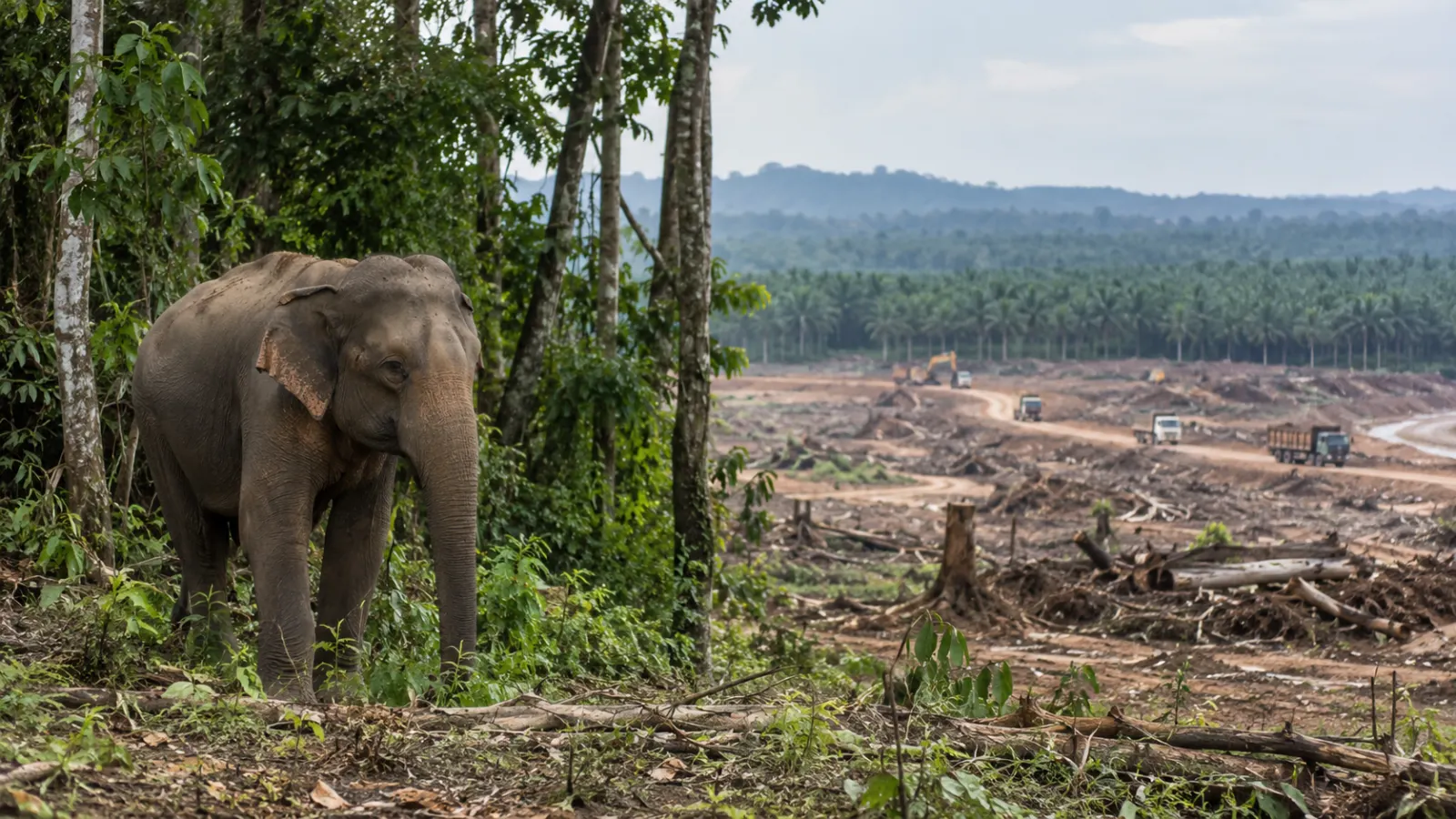
Suppose one system produces 20% less food per hectare. Producing the same total amount of food may then require more agricultural land unless consumption, waste, crop allocation or yields elsewhere change. Where additional farmland replaces forest, grassland or other high-biodiversity habitat, land-use change can dominate the environmental calculation.
This is why a farming system that performs better per hectare can sometimes perform less favourably per unit of food produced. A European meta-analysis found organic farming generally had lower environmental impacts for several measures when evaluated by land area, but those advantages were often reduced or reversed when impacts were calculated per unit of product because organic systems generally used more land and produced lower yields. (pubmed.ncbi.nlm.nih.gov)
Yield stability matters too. Farming is not judged only by its average harvest but by whether production remains dependable from year to year. A global meta-analysis found organic systems to have lower temporal yield stability per unit yield than conventional systems on average, while also finding that management improvements such as green manure and better fertilisation could reduce part of the gap. (pubmed.ncbi.nlm.nih.gov)
None of this proves that organic farming cannot contribute to food security. It shows why the debate cannot be resolved by examining one indicator. A system may support more biodiversity and build soil organic matter while producing less crop. Whether that trade-off is worthwhile depends partly on what resource is scarce, what environmental damage conventional production creates and whether management can narrow the productivity gap.
The strongest agricultural systems will ultimately need both high environmental performance and sufficient productivity.
Climate Claims Depend on Whether We Measure the Field or the Food
Organic agriculture is sometimes presented as an obvious climate solution because it avoids manufactured nitrogen fertiliser and can encourage practices that increase soil organic matter. The reality is more conditional.
Producing synthetic nitrogen fertiliser requires energy and generates greenhouse-gas emissions. Organic systems can reduce dependence on this input by relying more heavily on legumes, manure and other nutrient sources. Practices that increase soil organic matter may also store additional carbon, at least until a new equilibrium is reached.
But biological nitrogen is not climate-neutral. Nitrous oxide can be produced from nitrogen in manure, crop residues and biologically fixed sources just as it can from manufactured fertiliser. Manure storage can generate methane and ammonia, while livestock continue to produce methane irrespective of whether the farm is certified organic.
Again, the unit of comparison changes the result.
A global meta-analysis of soil greenhouse-gas measurements found lower nitrous oxide emissions from organically managed soils when calculated per hectare, but higher yield-scaled nitrous oxide emissions because organic yields were generally lower. (pubmed.ncbi.nlm.nih.gov)
Earlier European evidence showed a similar pattern across several environmental indicators: organic systems often performed favourably per unit of land but did not necessarily retain that advantage per unit of output. (pubmed.ncbi.nlm.nih.gov)
This is why claims such as “organic farming has a lower carbon footprint” need a second question: lower per what?
A hectare of land, a tonne of wheat, a litre of milk and a calorie of food are different denominators. Agricultural climate accounting also needs to consider land-use change, energy use, soil carbon, fertiliser production, methane and nitrous oxide across the whole system rather than selecting whichever measure produces the preferred conclusion.
Organic practices can make important contributions to climate-smart farming, particularly where they improve soil management, diversify rotations and reduce inefficient nitrogen use. But climate performance should be measured rather than inferred from certification.
Certification Creates Trust, but It Also Creates Costs
Without standards and certification, the term organic would be extraordinarily difficult to police. Producers could make essentially any environmental claim and ask consumers to trust it.
Certification converts the claim into something that can be checked. Farmers must follow defined rules, maintain records and undergo verification before using protected organic labels in systems such as USDA Organic. (ams.usda.gov)
That system has economic value. Consumers willing to pay a premium for organic products can create a market reward for farmers who accept restrictions on their production methods. In principle, the price difference helps compensate for certification expenses, additional labour, transition risk or potentially lower yields.
The same system can create barriers.
Conversion periods may prevent a farmer from immediately receiving an organic premium after changing practices. Record keeping and inspection require time and administrative capability. Farmers must understand which inputs are permitted and ensure that organic production remains adequately separated from non-organic production where both occur.
For a large operation supplying a valuable organic market, these costs may be manageable. For a small farmer serving a local market where consumers will not pay much more for certification, formal organic status may not be economically attractive even if many of the farming practices already resemble organic management.
This is another reason not to confuse certified organic agriculture with the total universe of environmentally responsible farming. Certification verifies a particular standard. It does not have a monopoly on good agronomy.
Farmers outside organic systems can use long crop rotations, integrated pest management, biological controls, cover crops and careful nutrient budgeting. Organic farmers can in turn adopt techniques developed in precision agriculture, improved plant breeding, irrigation science and modern monitoring as long as those techniques are compatible with the applicable standard.
Agriculture improves when useful practices move across labels.
Organic Food Should Not Be Given Benefits the Farming Standard Does Not Prove
Consumers often encounter organic farming primarily through food labels, so agricultural arguments quickly become health claims.
The production standard itself cannot establish that every organic food is nutritionally superior. Nutrient content is influenced by variety, soil, maturity, weather, storage, processing and many other factors. Two tomatoes produced under different certification systems can vary for reasons that have little to do with the label.
Similarly, organic does not mean risk-free. Foodborne pathogens can contaminate organic or conventional food. Natural toxins remain natural toxins. Allergens do not disappear because a crop is organic.
The label does provide meaningful information about how the product was produced, including restrictions on many pesticides and fertiliser practices. Those differences may affect exposure patterns and environmental outcomes. But the evidence should be evaluated for the specific health question rather than assuming that every desirable characteristic follows automatically from the word organic.
The same principle applies to terms such as local, natural and regenerative. Agricultural labels and farming systems describe particular characteristics. None should be used as a substitute for measuring every outcome that matters.
Where Organic Farming Makes the Strongest Case
The strongest argument for organic farming emerges when the production system achieves several objectives together.
A well-managed organic farm may use diverse rotations to suppress pests and support fertility, maintain cover crops that protect soil, recycle nutrients carefully, reduce reliance on many synthetic pesticides, provide habitat for wildlife and earn a market premium that keeps the farm economically viable. In such circumstances, certification aligns commercial incentives with practices that provide environmental benefits.
Organic farming may also be especially valuable where the alternative system relies excessively on hazardous pesticide use, simplified rotations or poorly managed nutrient inputs. Changing the production rules can force attention toward preventive and biological approaches that might otherwise receive less investment.
But the weakest version of organic farming is one that merely substitutes permitted inputs for prohibited ones while leaving the rest of the production system unchanged. Replacing one pesticide with another without improving pest ecology, importing large quantities of organic fertiliser without balancing nutrients or maintaining large simplified monocultures does not capture the deeper systems logic behind organic agriculture.
The most interesting question is therefore not whether organic farming is categorically better than conventional farming.
It is which practices produce which outcomes under which conditions.
Research supports some broad patterns. Organic farms often support more farmland biodiversity. They can have favourable soil characteristics and lower environmental pressures per hectare for some indicators. They restrict many synthetic pesticides and encourage rotations and biological processes. At the same time, average yields tend to be lower, environmental advantages can shrink when impacts are measured per unit of food, nutrient management remains difficult and organic production still uses pesticides, land, water and energy. (pubmed.ncbi.nlm.nih.gov) (pubmed.ncbi.nlm.nih.gov)
Both sets of findings can be true because agriculture has multiple objectives.
A field must produce food, but it also occupies land, interacts with wildlife, moves nutrients through water and air, consumes resources and supports someone's livelihood. Improving one dimension does not automatically optimise the others.
That is why the future of sustainable agriculture is unlikely to be found in treating “organic” and “conventional” as two perfectly opposed packages. Conventional systems can adopt rotations, biological controls, cover crops and better soil management. Organic systems can improve nutrient precision, plant genetics, monitoring and productivity. The most useful innovation often comes from understanding which practices work rather than defending a label as an ideology.
Organic farming remains important because it demonstrates that agricultural production can be organised around biological processes and restricted inputs at commercial scale. Certification has also created a market in which consumers can support those production choices directly.
Its limits are equally important.
Organic certification cannot guarantee sustainability, climate superiority, high biodiversity or better nutrition in every case. Those outcomes depend on the farm, crop, landscape and metric being examined.
The responsible conclusion is therefore neither that organic farming is the answer to agriculture's environmental problems nor that its benefits are merely marketing.
It is a defined production system with real environmental strengths and real agronomic trade-offs.
The best organic farms show what becomes possible when soil, rotations, biodiversity and biological processes are treated as productive assets rather than external concerns. The challenge is to preserve those strengths while improving yields, nutrient efficiency and climate performance—and to transfer the practices that work into agriculture more broadly.
That is a more useful ambition than deciding which label should win.