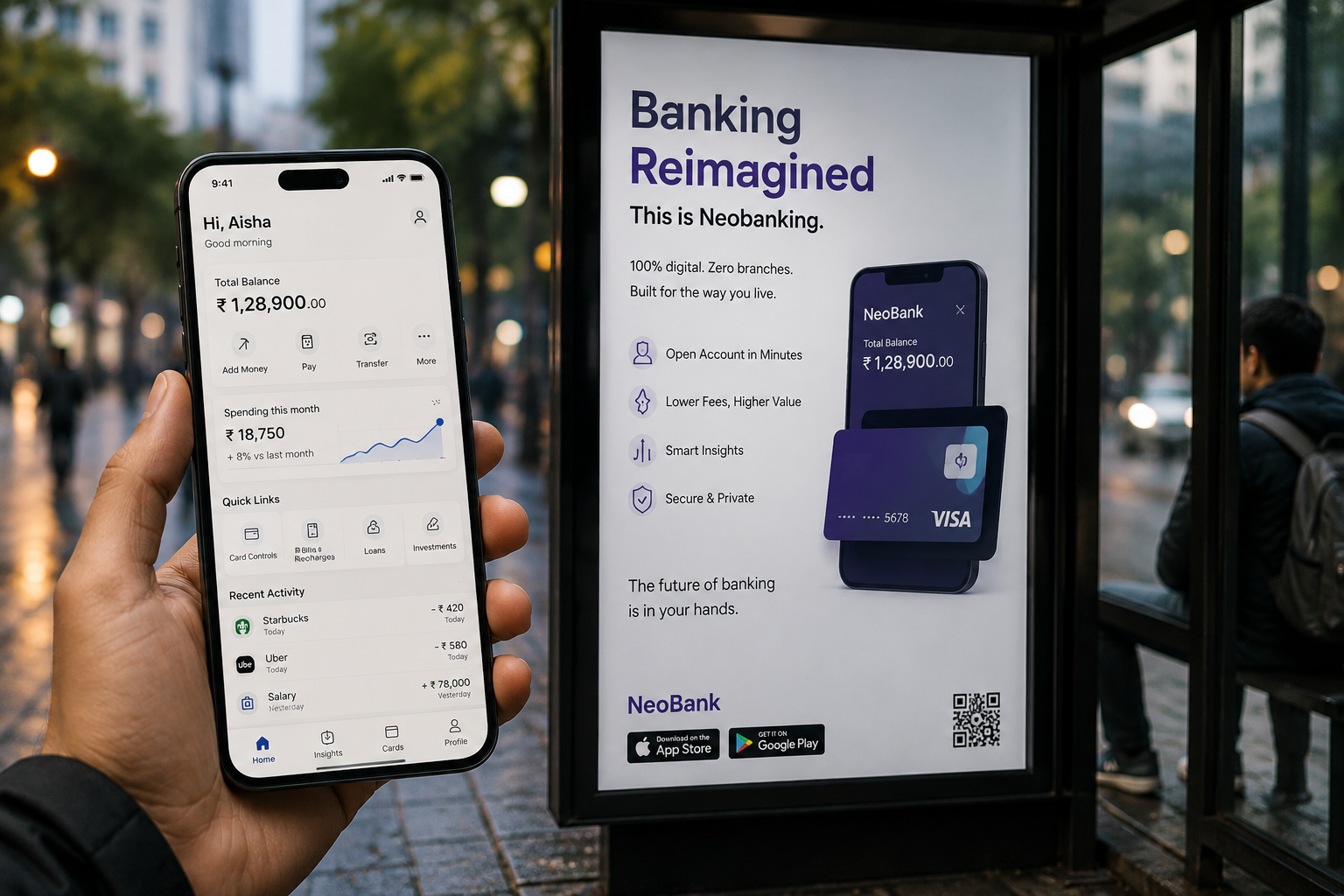
When banking looks like an app
A generation ago, the bank was a place. It had a branch, counters, forms, passbooks, waiting lines and managers who knew regular customers. Today, for many users, the bank is an app icon. Salary arrives digitally. Bills are paid digitally. Investments are started digitally. Loans are applied for digitally. Customer service may happen through chat instead of a branch visit.
Neobanks emerge from this shift. They are digital-first or digital-only financial platforms that provide banking-like services through mobile apps and online interfaces. They may offer accounts, cards, payments, expense tracking, budgeting tools, business banking dashboards, credit products or savings-related features. Their appeal is simple: banking without the visible burden of traditional banking.
But the term neobank can mislead. In some countries, neobanks may have banking licences. In others, including India, many neobank-style platforms operate in partnership with licensed banks or regulated financial institutions. They may own the user experience but not the banking licence. This distinction is critical. The customer sees one brand on the screen, but the legal and financial responsibility may sit behind the scenes.
What a neobank is
A neobank is a technology-led financial platform that delivers banking or banking-adjacent services through digital channels, usually without a conventional branch network. It focuses on user experience, speed, low friction, data-driven insights and specialised financial workflows.
Some neobanks target individuals with app-based accounts, cards, savings features and spending insights. Others target small businesses with invoicing, payroll, current-account dashboards, tax-support tools, vendor payments and cash-flow tracking. Some focus on freelancers, students, migrants or niche communities that traditional banks serve poorly.
The key feature is not merely online banking. Traditional banks also offer apps. A neobank is built around the digital interface as the primary experience. It often designs finance from the user's daily workflow backward rather than from branch operations forward.
How neobanks differ from traditional banks
Traditional banks are balance-sheet institutions. They take deposits, give loans, manage risk, comply with prudential regulation and operate under banking licences. Their technology sits on top of a regulated banking foundation. A neobank may be different. It may provide the customer interface while relying on partner banks for regulated account services.
This creates a layered model. The user interacts with the neobank app. The deposit account may legally belong to a partner bank. The card may be issued through a licensed institution. The lending product may be offered by a regulated bank or NBFC. The neobank may provide technology, distribution, design, analytics and customer engagement.
The distinction matters because customer protection depends on legal structure. If something goes wrong, the user must know who holds the money, who provides the loan, who resolves complaints and which regulator governs the product. A neobank's brand is not the same thing as a banking licence.
Why users like neobanks
Neobanks appeal to users because they remove visible friction. Account opening may be faster. Dashboards may be cleaner. Notifications may be real-time. Expense categorisation may be automatic. Small businesses may get cash-flow tools that traditional banks do not provide elegantly. Users may feel that the neobank understands their behaviour better than a branch-led institution.
For young professionals, freelancers and digital entrepreneurs, neobanks can feel more natural than legacy banking. They speak the language of apps, not forms. They integrate with payments, subscriptions, invoices and analytics. They make financial data easier to read.
This user-experience advantage is real. Traditional banking often became difficult not because finance is inherently complex, but because institutions made simple tasks unnecessarily slow. Neobanks forced the market to ask why routine banking could not be simpler.
The business model behind neobanks
Neobanks may earn money through interchange income, subscription fees, premium features, lending partnerships, software services, float-related arrangements where permitted, distribution commissions, business banking tools or embedded financial products. Some target consumer scale, while others target profitable niches such as SMEs.
The economics are challenging. A beautiful app is not enough. Customer acquisition can be expensive. Compliance is costly. Margins on basic payment and account services may be thin. If the neobank relies heavily on partner banks, it may not capture the full economics of banking. If it pushes into lending or cross-selling too aggressively, it may create consumer-risk problems.
This is why many neobanks around the world struggle to move from user growth to profitability. Convenience attracts users, but sustainable financial services require revenue quality, risk control and trust.
Neobanks for individuals
For individuals, neobanks may offer spending analysis, savings pockets, card controls, instant alerts, subscription tracking, remittance tools and easy account access. These features can improve financial behaviour if used well. A person who sees monthly spending categories clearly may make better choices. A person who receives instant payment alerts may detect fraud faster.
However, users should not assume that every app-based feature is advice. A spending insight is not financial planning. A suggested product may be a commercial recommendation. A convenient credit offer may still be expensive debt. The same app that helps a user budget may also nudge the user toward loans, cards or investments.
The customer must separate utility from persuasion. Neobanks are designed to be easy to use, but financial decisions should not be made only because the interface is smooth.
Neobanks for businesses
Business-focused neobanks may be more transformative than consumer neobanks because small enterprises often face messy financial workflows. A small business may need invoicing, payment collection, GST support, payroll, vendor management, cash-flow tracking, reconciliation and credit access. Traditional banks often provide the account but not the full operating layer.
A neobank-style platform can become a financial operating system for small businesses. It can show receivables, payables, balances, taxes and collections in one dashboard. This can improve decision-making and reduce administrative burden. It can also help lenders assess business cash flows more accurately.
But business users should verify data security, integration reliability, account ownership, service continuity and export options. A business should not become trapped in a platform without understanding how to retrieve records, shift providers or resolve disputes.
Regulation and the India context
In India, the term neobank must be used carefully because a company cannot simply call itself a bank unless it has the required banking licence. Many neobank-style companies operate through partnerships with licensed banks, NBFCs or other regulated entities. This partnership model can be useful, but it requires clear disclosure.
The regulatory concern is not innovation itself. The concern is consumer confusion. If a customer thinks a fintech app is itself a bank, the customer may misunderstand risk, grievance channels and legal responsibility. Regulators therefore focus on outsourcing, digital lending, data protection, payment-system rules and regulated-entity accountability.
A healthy neobank ecosystem needs clarity. The app should tell users which entity holds deposits, which entity provides credit, what fees apply, how complaints are handled and which terms govern the relationship. Transparency is not optional; it is the price of trust.
Risks users should understand
Neobanks carry several risks. The first is regulatory confusion. Users may not know whether they are dealing with a licensed bank, fintech interface, NBFC partner or payment intermediary. The second is data risk. Neobank apps may collect extensive financial data. The third is service continuity. If a partnership breaks down, features may change. The fourth is cross-selling risk. A platform that knows spending behaviour may push loans, cards or investments.
There is also cyber risk. App-based finance depends on device security, authentication, encryption and user behaviour. A compromised phone, weak password or phishing attack can expose financial accounts. The convenience of mobile banking also increases the need for security discipline.
Users should enable strong authentication, avoid sharing credentials, review permissions, read terms and maintain access to official bank channels. The neobank interface may be helpful, but it should not be the user's only understanding of where money is held.
How traditional banks are responding
Traditional banks are responding in three ways. Some build better apps and digital banking units. Some partner with fintech and neobank platforms. Some acquire or invest in technology capabilities. The pressure is clear: if banks do not improve user experience, fintechs will own customer attention even when banks own the regulated infrastructure.
This competition is useful for consumers when it improves service quality. Banks that once treated digital as an add-on now treat it as core distribution. Customer onboarding, payments, loan journeys, investment access and business tools are becoming more digital. Neobanks have forced banks to modernise.
But banks also bring caution. They understand risk, compliance, capital and systemic responsibility. The best future may combine neobank design with bank-grade governance.
What to check before using a neobank
Before using a neobank, a customer should ask a few practical questions. Is the entity licensed as a bank, or is it partnering with a licensed bank? Who holds the account? Who issues the card? Who provides any loan? What happens if the app shuts down? How are complaints resolved? What data is collected and shared? Are fees transparent? Is customer support reliable?
For businesses, additional checks matter. Can transaction data be exported? Does the platform integrate with accounting systems? What are downtime risks? Are user roles and approvals available? Does it support compliance needs? Is there a backup channel with the partner bank?
Good digital finance should make these answers easy to find. If the answers are hidden, that is itself a warning sign.
Final takeaway
Neobanks represent a shift in banking from place to interface. They make financial services more usable, especially for customers frustrated by slow and fragmented traditional banking. They can help individuals track money and help businesses manage cash flows. Their design advantage is real.
But neobanks also require careful understanding. A banking-like app is not always a bank. A smooth interface is not the same as regulatory protection. A convenient offer is not automatically a wise financial decision. Users must understand who is behind the product and what legal structure supports it.
The future of neobanking will be shaped by trust. If neobanks combine transparency, responsible partnerships, data protection and practical value, they can improve finance. If they rely only on branding and convenience, they risk becoming another layer of confusion in an already complex financial world.