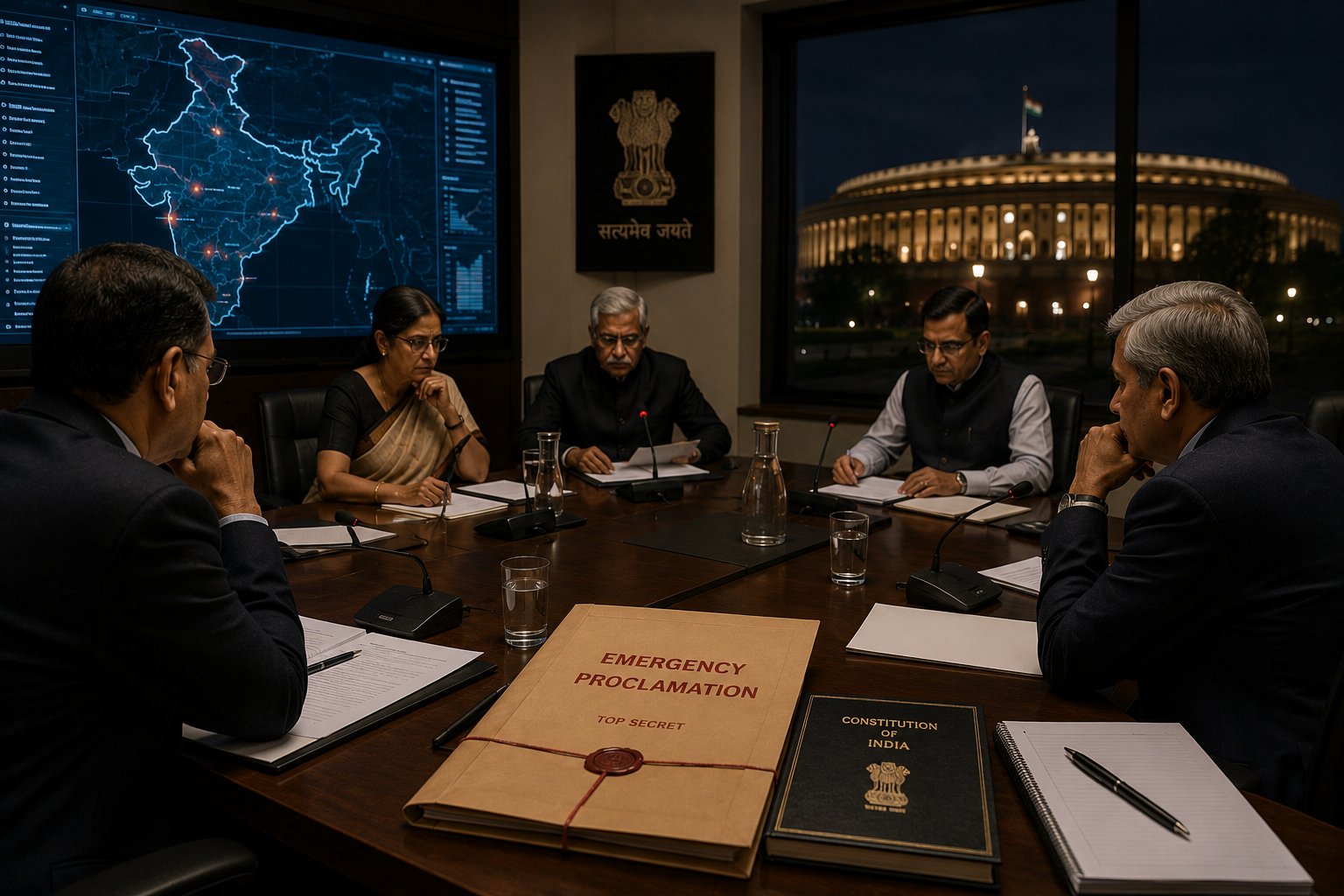
The Most Serious Emergency Power in the Constitution
A National Emergency is one of the most powerful constitutional mechanisms in India. It allows the Union government to respond to grave threats to the security of India or any part of India. But because it expands central power and can affect rights and federal balance, it is also one of the most sensitive provisions in the Constitution.
Article 352 provides for proclamation of Emergency when the security of India or any part of its territory is threatened by war, external aggression or armed rebellion.
A National Emergency is not an ordinary law-and-order response. It is a constitutional response to an exceptional threat.
Meaning of National Emergency
A National Emergency is a formal proclamation issued under Article 352. It declares that India, or part of India, faces a security threat of the kind recognised by the Constitution.
The grounds are specific: war, external aggression or armed rebellion.
War refers to an actual state of war. External aggression refers to hostile action or attack from outside. Armed rebellion refers to serious internal armed uprising against the State.
These grounds show that National Emergency is meant for extraordinary situations, not normal political unrest or administrative difficulty.
Grounds Under Article 352
Article 352 allows National Emergency on three grounds.
The first is war. This involves an actual war situation affecting the security of India.
The second is external aggression. This may include aggression by another country even before a formally declared war.
The third is armed rebellion. This replaced the earlier phrase “internal disturbance” through the 44th Constitutional Amendment. The change was important because “internal disturbance” was considered too broad and vague.
By requiring armed rebellion, the Constitution now sets a higher threshold for internal emergency.
Cabinet Advice Requirement
A major safeguard is the requirement of written Cabinet advice.
The President cannot issue a National Emergency proclamation unless the decision of the Union Cabinet is communicated in writing. This safeguard was inserted to ensure that the decision is taken collectively by the Cabinet and not casually or individually.
This matters because emergency power affects the entire constitutional system. Such power should not rest on informal advice or personal satisfaction alone.
Parliamentary Approval
A proclamation of National Emergency must be approved by Parliament within the time required by the Constitution. After the 44th Amendment, approval requires a special majority: a majority of the total membership of each House and a majority of not less than two-thirds of members present and voting.
This makes approval more difficult than ordinary legislation.
The purpose is to ensure that emergency power has broad parliamentary support and is not imposed merely through a simple majority.
Duration and Continuation
Once approved, a National Emergency can continue subject to periodic parliamentary approval. It does not become permanent automatically.
The Constitution requires renewal after specified intervals. This ensures that Parliament repeatedly examines whether the emergency should continue.
Periodic approval is important because emergency conditions may change. A crisis may reduce, end or transform. Emergency power should not continue only because it was once justified.
Revocation
A National Emergency can be revoked. The President may revoke the proclamation. The Lok Sabha also has a special role in disapproval. If a required number of Lok Sabha members give notice for a special sitting to consider disapproval, the mechanism allows the House of the People to test whether the emergency should continue.
This safeguard strengthens democratic control. Since the Lok Sabha is directly elected, its ability to question continuation of emergency is important.
Effect on Federalism
A National Emergency changes the federal balance.
During such an emergency, Parliament may gain power to legislate on matters in the State List under Article 250. Union executive power may also extend to giving directions to States regarding how their executive power should be exercised.
This does not abolish States, but it centralises authority during the emergency. The logic is national security. The risk is over-centralisation.
Effect on Fundamental Rights
National Emergency may affect Fundamental Rights through Articles 358 and 359. Article 358 concerns suspension of freedoms under Article 19 during emergency based on war or external aggression, subject to the current constitutional framework. Article 359 allows the President to suspend the right to move courts for enforcement of specified Fundamental Rights during emergency, but important safeguards exist after the 44th Amendment.
Notably, rights under Articles 20 and 21 cannot be suspended even during Emergency. This is one of the most important post-Emergency safeguards for life, liberty and criminal justice.
Historical Importance
India has experienced National Emergencies in the past, including during wars and the 1975-1977 internal Emergency. The 1975 Emergency had a deep constitutional impact because it revealed how emergency power could affect liberty, press freedom, political opposition and institutional independence.
The experience led to major constitutional safeguards through the 44th Amendment.
This history is why Article 352 must be understood not only as a legal provision but also as a warning about concentration of power.
Citizen Impact
For citizens, National Emergency can affect rights, political debate, federal governance and ordinary legal remedies.
Even if daily life appears normal, the legal relationship between citizen and State may change. Parliament’s powers may expand. The Union may direct States more strongly. Rights enforcement may be affected depending on the emergency and presidential orders.
Therefore, citizens must treat National Emergency as a grave constitutional event, not a routine government announcement.
Common Misunderstandings
One misunderstanding is that National Emergency can be declared for any serious problem. It cannot. Article 352 grounds are specific: war, external aggression or armed rebellion.
Another misunderstanding is that all rights disappear during Emergency. That is incorrect. The Constitution contains important limits, and Articles 20 and 21 have special protection.
A third misunderstanding is that Emergency is outside the Constitution. It is not. It is an extraordinary power inside the Constitution, controlled by constitutional procedure.
Final Takeaway
National Emergency under Article 352 is the Constitution’s response to the gravest security threats. It allows extraordinary central action during war, external aggression or armed rebellion, but it also carries serious risks for rights and federalism.
The lesson is clear: emergency power may be necessary in crisis, but it must remain limited, justified, reviewed and constitutionally controlled.
Disclaimer: This article is for general information and educational understanding only. It is not personal legal advice. For specific legal problems, consult a qualified legal professional.