Sarvepalli Gopal: The Historian Who Brought Archives Into Diplomacy
Sarvepalli Gopal was not a conventional diplomat. He did not build his reputation through ambassadorial postings, ceremonial representation or the public theatre of negotiation. His importance to Indian diplomacy came from a quieter source: documentary research. From 1954 to 1966, Gopal worked in the Historical Division of India's Ministry of External Affairs, first as deputy director and later as director, examining maps, treaties, administrative records and diplomatic correspondence at a moment when the newly independent Indian state was confronting unresolved questions inherited from empire.
His expertise became particularly important during the India–China boundary dispute, when historical evidence itself became part of diplomacy. Gopal later returned to academic life and became one of the most influential historians of modern India. He helped establish Jawaharlal Nehru University's Centre for Historical Studies, wrote the major three-volume biography of Jawaharlal Nehru, edited Nehru's documentary record for decades and produced an unusually candid biography of his own father, philosopher and former president Sarvepalli Radhakrishnan.
His career therefore raises a larger question about the relationship between history and power. What happens when a historian works inside the state whose history he is reconstructing? For Gopal, history did not merely explain diplomacy after events had finished. Archives became part of state capacity, shaping what officials believed could be demonstrated about treaties, boundaries and earlier political commitments. At the same time, proximity to the state later became both an advantage and a methodological challenge when he began writing the history of people and institutions he had known from inside.
From Radhakrishnan's Son to an Archival Historian
Gopal was born in Madras in 1923, the son of Sarvepalli Radhakrishnan, the philosopher who would become independent India's first vice-president and later its second president. Growing up within such a family gave him unusual access to intellectual and political worlds, but it also created an obvious problem of identity. Any scholarly career he built would inevitably be compared with that of a father already recognised internationally as philosopher, academic and statesman.
Gopal chose a markedly different intellectual discipline. Where Radhakrishnan worked principally through philosophy, religion and comparative thought, Gopal became a historian concerned with political institutions, decisions and documentary evidence. His early scholarship focused heavily on British rule in India. Works on Lord Ripon, Lord Irwin and later British Policy in India, 1858–1905 required him to reconstruct imperial policy through correspondence, administrative papers and official records. That training became unusually useful because diplomatic disputes over boundaries often turn on precisely these kinds of historical questions: what a map represented, whether a proposed frontier was formally accepted, which administration exercised authority and whether an old document described actual practice or merely asserted a claim.
After teaching at Andhra University between 1948 and 1952, Gopal joined the National Archives of India as assistant director. The move was important because archives are not merely warehouses in which old papers wait for historians. They are institutions through which states preserve and organise memory. Decisions about classification, description, access and preservation influence what later officials and scholars are able to reconstruct. Gopal's years in the National Archives placed him directly inside that documentary infrastructure before he moved in 1954 to the Historical Division of the Ministry of External Affairs.
For a newly independent country, such a division had obvious practical value. India inherited not only territory and government institutions from British rule but also treaties, maps, diplomatic correspondence, administrative precedents and unresolved frontiers. Independence did not make those records irrelevant; in some cases it made their interpretation more politically important. A historical division could help officials determine what earlier governments had actually claimed, agreed to or administered before those records were used in contemporary diplomatic arguments.
When History Became Part of the India–China Boundary Dispute
The India–China boundary dispute forced independent India to confront the complicated geographical inheritance of British rule. The Himalayan frontier had not emerged from one uniform process. Different sectors had different histories of mapping, administration, diplomatic negotiation and strategic interest, while Tibet's political position had been central to earlier British frontier policy. When the People's Republic of China consolidated control over Tibet after 1950, questions that had once belonged partly to the frontier politics of the British Empire became direct questions between two postcolonial Asian states.
Relations between India and China initially contained substantial political optimism, but border disagreements became increasingly difficult to contain. Differences over maps, patrols and territorial claims could no longer be dismissed as minor cartographic anomalies. The dispute concerned strategic geography, sovereignty and historical interpretation simultaneously. Both governments needed to explain not only where they believed the boundary lay but why their interpretation should be regarded as legitimate.
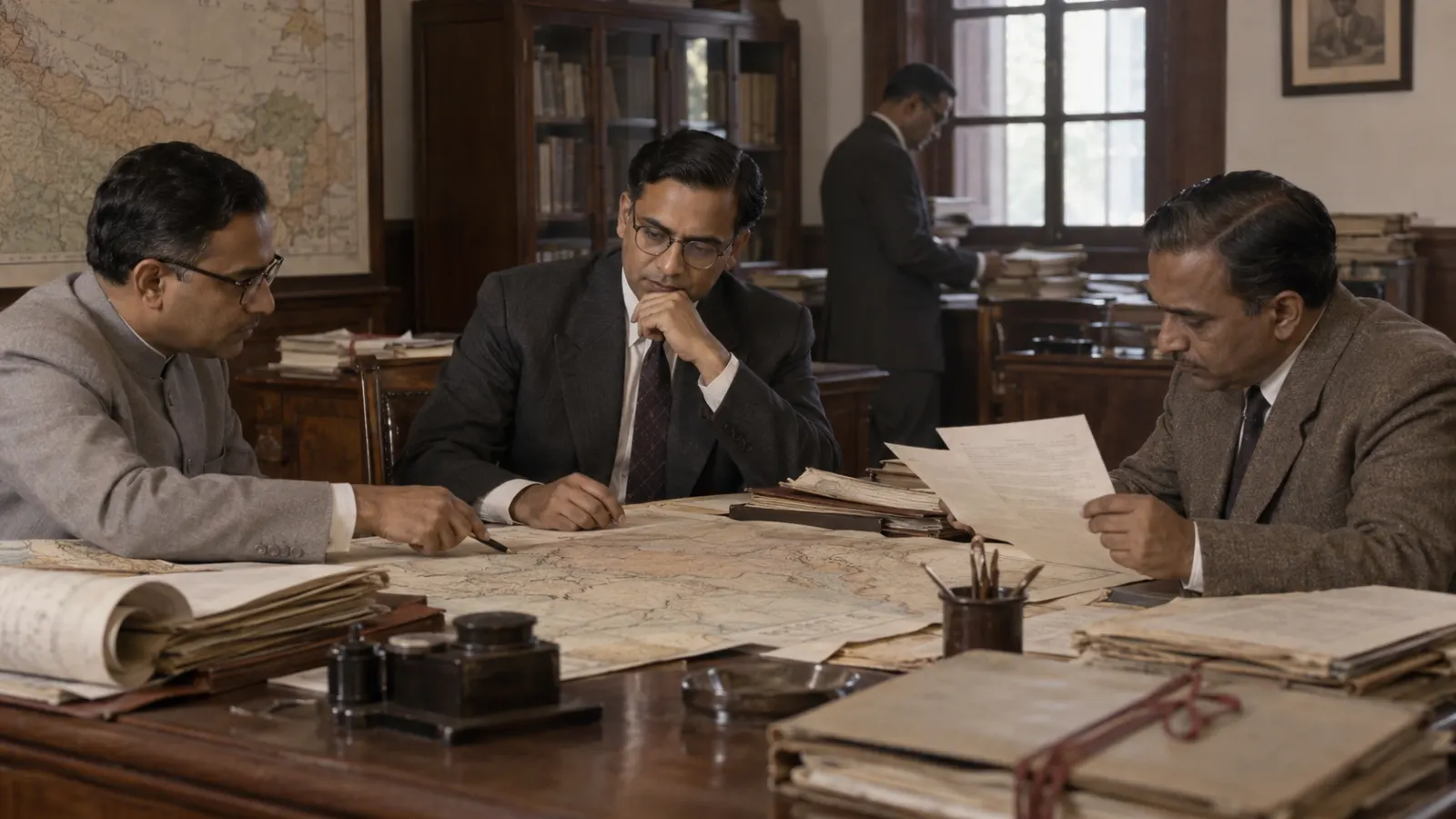
This was the environment in which Gopal's Historical Division became important. Historical documents moved from archive boxes into active foreign policy. A line on an old map could become evidence in a territorial argument. Administrative reports, treaties, correspondence and records of earlier expeditions could be examined to determine whether they demonstrated sovereignty, practical jurisdiction or merely an unimplemented proposal.
The tension within such work was unavoidable. A historian inside government does not work in an institution without interests; the state has claims and policies it wants to defend. A historical unit can therefore face pressure to assemble evidence supporting a position already chosen. The professional challenge is to distinguish research that informs policy from research designed merely to justify it. Gopal's career became especially significant because this tension moved from the abstract to one of India's most consequential foreign-policy disputes.
The 1960 Officials' Talks: Diplomacy Through Documents
Gopal's clearest direct contribution to diplomacy came in 1960. After meetings between Prime Minister Jawaharlal Nehru and Chinese Premier Zhou Enlai failed to resolve the boundary dispute, the two governments agreed that officials would examine the historical and documentary evidence supporting their respective positions. The official report identifies J. S. Mehta, director of the China Division, as leader of the Indian team and lists Dr S. Gopal as director of the Historical Division. Other specialist advisers participated on both sides.
This detail gives precise meaning to Gopal's diplomatic role. He was not negotiating as an ambassador. He participated as a historian and government specialist whose expertise concerned the evidentiary foundations of India's boundary case. The officials examined maps, treaties, administrative practice, diplomatic correspondence and other records. The resulting exercise produced an enormous documentary report presenting the factual material and competing interpretations advanced by the two governments.
The talks did not resolve the dispute. In important respects, the final report placed two historical cases beside one another. India and China could agree that particular documents existed while disagreeing profoundly about what those documents established. Administrative activity could be interpreted as evidence of sovereignty by one side and treated as temporary or illegitimate by the other. A historical map could be presented as recognition of a boundary or dismissed as merely illustrative. An agreement could be accepted as significant while its legal force or geographical implications remained contested.
The report records that Gopal and J. S. Mehta signed for India alongside Chang Wen-chin and Yang Kung-su for China in Rangoon on 12 December 1960. This was documentary diplomacy in an unusually literal sense: two states argued through historical evidence. It also demonstrated the limits of archives. Documents can constrain political claims and expose contradictions, but they cannot force competing governments to assign the same meaning to the past.
The 1962 War and the Limits of Historical Expertise
The India–China War of 1962 made those limits unmistakable. Historical research could help India understand the documentary basis of its territorial claims, but it could not determine whether military deployments were sustainable, whether political assumptions about Chinese intentions were accurate or whether the broader diplomatic strategy could prevent armed conflict. Documentary research, intelligence assessment, political decision-making and military planning were different functions, even when they interacted.
This distinction matters when assessing Gopal. Because he worked on India's historical case, it would be inaccurate to make him responsible for operational border policy. At the same time, it would be equally misleading to treat historical research as irrelevant. Governments make strategic decisions partly on the basis of what they believe they are entitled to defend, and historical interpretations help construct those beliefs. The 1962 conflict therefore demonstrates an important principle of statecraft: a state can believe that the historical or legal basis of its claim is strong and still mishandle the political or strategic problem surrounding it.
For Gopal, the war created an additional intellectual complication. He later became Nehru's principal biographer and had to interpret a major foreign-policy disaster whose documentary background he had himself helped investigate. Few historians occupy such a position. He was close to the event as an official and later responsible for explaining the political leadership under which it occurred. That dual perspective made his later work unusually informed, but it also made critical distance especially important.
From the Foreign Ministry to Oxford and JNU
Gopal left the Ministry of External Affairs in 1966 and returned fully to academic life. He taught at Oxford University from 1966 to 1971 and was associated with St Antony's College before returning to India to join Jawaharlal Nehru University's newly developing Centre for Historical Studies. JNU's institutional history places S. Gopal alongside historians such as Romila Thapar, Bipan Chandra and Satish Chandra among the scholars who helped guide the centre during its formative period.
The transition illustrates how porous the boundary between scholarship and public service could be in the first decades after independence. Historians moved into archives, ministries, commissions and cultural institutions, while officials returned to universities carrying knowledge of how government actually operated. This circulation created real advantages. A historian who had worked inside government could understand administrative processes that appeared opaque from outside, while a ministry employing professional historians could obtain a more disciplined understanding of treaties, frontiers and precedents.
The arrangement also raised an unavoidable question about independence of judgment. Could someone who had participated in policy later write its history with enough distance? There is no automatic answer. Insider knowledge can illuminate government decision-making, but insiders can also inherit assumptions that become difficult to see precisely because they once appeared normal. Gopal's authority came partly from having inhabited both worlds and understanding their different standards of evidence.
At JNU, he also helped shape an institution whose historical scholarship increasingly moved beyond elite political and administrative history. The Centre for Historical Studies became associated with debates over colonialism, nationalism, class, social movements, secularism and historical method. Gopal's own intellectual formation remained strongly archival and political, but the institution he helped build became part of a wider transformation in Indian historiography.
Nehru, Radhakrishnan and the Problem of Historical Proximity
Gopal's three-volume biography of Jawaharlal Nehru became the work with which he was most closely identified. The scale of the subject made biography almost indistinguishable from national political history. Nehru had led the interim government before independence, served as prime minister from 1947 until 1964, shaped foreign policy, influenced economic planning and helped define many of the institutions through which the new republic understood itself. Writing his life therefore meant interpreting a large part of twentieth-century Indian politics.
Gopal possessed an enormous advantage: documentary access. He understood government processes from inside, had worked within Nehru's Ministry of External Affairs and was deeply familiar with official and private records. Yet the same advantage created the central methodological question surrounding his biography: can proximity deepen historical understanding without narrowing historical perspective?
It would be simplistic to dismiss Gopal as merely a court historian. His biography did not present Nehru as infallible and examined failures as well as achievements. But any major biography inevitably organises history around its subject. If Nehru is the central character, political developments are naturally interpreted through Nehru's ideas, decisions and constraints. Later historians could broaden that frame by focusing more heavily on regional politics, opposition parties, bureaucratic institutions, social movements and actors outside Delhi. Gopal's Nehru biography is therefore best understood as foundational rather than final: a major archival interpretation that subsequent historians can challenge, extend or reorganise.
His work on the Selected Works of Jawaharlal Nehru may have had an equally enduring influence. Gopal served as general editor for decades. Documentary editing is less visible than writing narrative history, but it creates the infrastructure on which historical argument depends. Editors establish chronology, identify correspondents, annotate references and select documents from enormous collections. These choices inevitably shape historical access, but without disciplined documentary editions much of an archive remains practically inaccessible except to specialists.
Gopal later faced an even more intimate challenge when he wrote Radhakrishnan: A Biography. Writing the life of one's own father creates methodological problems no archival training can completely remove. Family intimacy can provide knowledge inaccessible to outsiders, but it also makes emotional distance difficult. Gopal had access to Radhakrishnan's private papers as well as official collections, giving him unusual material while making the relationship between access and bias impossible to ignore. The broader historical lesson is simple: closeness can provide evidence and create bias at the same time.
That tension runs through nearly every major stage of Gopal's career. He was close to Nehru, close to the Indian state, close to the diplomatic dispute he later helped interpret and personally close to Radhakrishnan. His authority often came from that proximity, but so did the need to read his conclusions critically.
Public History, Institutions and the Politics of Evidence
Gopal did not remain confined to diplomatic history and biography. He became involved in wider debates about secularism, nationalism and the political uses of history, including through work related to the Babri Masjid–Ramjanmabhoomi controversy. By the late twentieth century, historical claims about temples, mosques, conquest and national identity had become instruments of mass politics. The context was radically different from the India–China boundary dispute, but the underlying methodological problem was familiar: the past was being mobilised to legitimise present claims.
Professional historians could not make politics disappear from these disputes, but they could insist that political importance did not exempt historical claims from evidentiary scrutiny. Gopal's instinct remained archival. What did the available records establish? Which conclusions were inference rather than fact? Which narratives emerged later? Which sources were being privileged or ignored?
His institutional career was equally substantial. He chaired the National Book Trust, served on UNESCO's Executive Board, became general president of the Indian History Congress and later chaired the Indian Institute of Advanced Study in Shimla. He received major recognition, including the Padma Vibhushan in 1999. These roles confirm how deeply he was embedded in the intellectual establishment of post-independence India.
That status can be interpreted positively as institution-building. A new republic needed universities, archives, publishing organisations, research centres and scholarly associations capable of sustaining intellectual life beyond colonial structures. Gopal spent much of his career helping create or run those institutions. But establishment status can also produce blind spots. Historians positioned near elite institutions have greater access to official archives and political networks, while the experiences of groups whose lives generate fewer formal records can remain less visible.
Neither conclusion should be turned into a verdict. Institutional authority does not prove intellectual compromise, just as public service does not guarantee neutrality. It is part of the context within which historical scholarship is produced.
Why Gopal's Diplomatic Role Matters
Calling Sarvepalli Gopal a diplomat without explanation would be misleading. His verified career in the Ministry of External Affairs was centred on the Historical Division rather than a conventional sequence of diplomatic postings. He did not become historically important because he represented India as ambassador in foreign capitals.
Yet removing diplomacy from his story would be equally inaccurate. He participated directly in the 1960 India–China officials' talks, signed the resulting report and helped research the historical foundation of India's position in one of its most consequential international disputes. His diplomatic significance came from a specialised function: he helped translate archives into state argument.
That role may be less dramatic than summit diplomacy, but it reveals something important about how foreign policy actually works. States need negotiators, military planners, intelligence officers, lawyers and political leaders, but they can also need historians. A government that does not understand what its own documents contain may enter negotiations with claims it cannot substantiate. A state that knows only the version of history most convenient to present policy can become equally vulnerable.
Historical competence is therefore a form of institutional capacity. It cannot determine strategy, and documents cannot automatically settle political disputes, but accurate knowledge of the record establishes boundaries around what a government can plausibly claim.
This is what makes Gopal's career more interesting than a conventional diplomatic biography.
Sarvepalli Gopal's Legacy Was the Politics of Evidence
Sarvepalli Gopal's lasting importance lies in the connection he forged between archive, diplomacy and historical argument. Inside the Ministry of External Affairs, he helped a young republic reconstruct the documentary inheritance underlying foreign-policy claims. During the 1960 India–China officials' talks, that research entered diplomacy directly. At Oxford and JNU, he returned to history as an academic discipline. Through his Nehru biography, he converted enormous documentary resources into political narrative, while through the Selected Works he helped create a documentary foundation on which future historians could build different interpretations.
His career also provides a warning about historical evidence. Documents do not speak for themselves. Maps require interpretation. Diplomatic letters have institutional contexts. Official archives preserve some voices far more completely than others. A documentary record can constrain mythology, but evidence can also be selectively mobilised to support present claims.
Gopal spent much of his professional life in that difficult space between record and argument. He should therefore neither be reduced to an official historian of the Nehruvian establishment nor romanticised as a neutral custodian of documentary truth. His position was more complicated and more revealing than either description.
At one of the most consequential moments in India's early foreign-policy history, a historian sat inside the machinery of diplomacy because the past itself had become part of the dispute. For the rest of his career, Sarvepalli Gopal continued working on essentially the same problem from different institutional positions: how to make political claims answerable to evidence.
That was his distinctive contribution—not diplomacy through embassies, but diplomacy through documents.