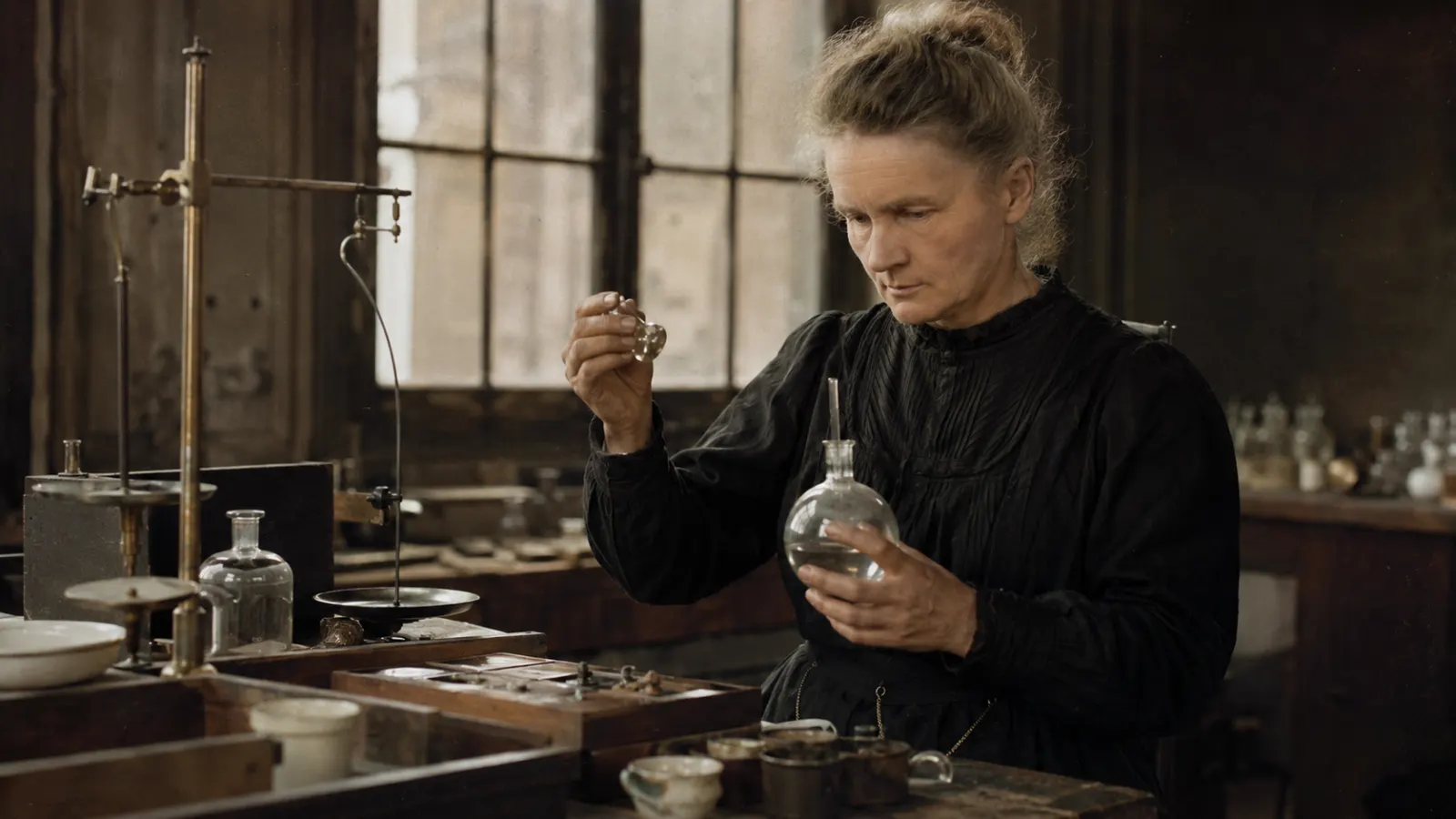
Marie Curie: Discoveries, Radioactivity and Scientific Legacy
Marie Curie’s scientific papers still carry traces of the phenomenon she spent her life studying.
Some notebooks and papers from her laboratory work remain sufficiently radioactive that special precautions are required for their preservation and handling. The fact has become an almost perfect symbol of Curie’s career: the physical evidence of her research continues to bear the effects of radioactivity more than a century later.
But the symbolism can also distort the history.
Marie Curie did not discover radiation by herself. Wilhelm Röntgen had discovered X-rays in 1895, and Henri Becquerel discovered spontaneous radiation from uranium compounds in 1896. Pierre Curie became an essential collaborator in Marie’s research. Chemists, physicians, laboratory assistants and later industrial workers also helped transform radioactivity from a mysterious laboratory phenomenon into a major field of physics, chemistry and medicine.
Curie’s achievement was more precise and, in some ways, more important than the simplified story.
She developed a systematic way to measure the phenomenon, showed that its intensity was linked to the amount of radioactive element present rather than the chemical form of the compound, recognised that unusually active uranium ores implied the presence of unknown substances and, with Pierre Curie and collaborators, announced the discovery of polonium and radium in 1898. She then spent years separating radium compounds and establishing their chemical properties.
The work changed ideas about matter itself.
It also made Curie the first woman to receive a Nobel Prize, the first person to receive two Nobel Prizes, and the only individual still to have received Nobel Prizes in two different scientific categories, Physics and Chemistry.
Those records are remarkable.
Yet the deeper story is not the prizes.
It is how one apparently anomalous measurement became evidence for an entirely new understanding of matter.
Maria Skłodowska Before Marie Curie
Marie Curie was born Maria Skłodowska on 7 November 1867 in Warsaw, which was then part of the Russian Empire. Her parents were teachers, and education occupied an important place in the family even as they experienced financial and political difficulties.
Her early life also unfolded in a Poland that did not exist as an independent state. Warsaw was under Russian rule, and education could become inseparable from national identity.
Women faced an additional barrier: the conventional university system did not offer them the same opportunities available to men.
Curie therefore did not follow the simple path that later biographies can make her career appear to have taken. Scientific ability did not automatically produce access to a university laboratory.
She participated in informal educational activity and eventually developed a practical arrangement with her older sister Bronisława. Maria would work and help finance her sister’s medical education in Paris; later, Bronisława would help Maria pursue her own studies.
For years, Maria worked as a governess.
This period matters because Curie’s later career is sometimes narrated as though extraordinary talent simply overcame every obstacle placed in front of it.
The reality was more structural.
Talent required money, migration, family cooperation, education and access to institutions capable of turning curiosity into scientific work.
Curie Moves to Paris
In 1891, Maria moved to Paris and enrolled at the Sorbonne. In France she increasingly used the name Marie.
Her life as a student was financially difficult. She lived frugally and devoted herself intensely to physics and mathematics.
Institut Curie records that she completed a physics degree with first-class results in 1893 and continued her mathematical studies the following year.
Paris placed her inside one of Europe’s leading scientific environments.
It did not remove the gender barriers surrounding science.
Women were still unusual in advanced physics, and scientific institutions were overwhelmingly controlled by men.
Curie nevertheless gained access to the laboratories, instrumentation and intellectual community she had been unable to find in Warsaw.
In 1894 she met Pierre Curie, already an accomplished physicist known for work including piezoelectricity and magnetism. They married in 1895.
Their relationship became one of the most celebrated scientific partnerships in history.
But it is important not to describe Marie simply as Pierre Curie’s assistant.
The research problem that led to their most famous discoveries emerged from Marie Curie’s doctoral work.
Henri Becquerel Opens the Door
The story of radioactivity did not begin with the Curies.
In 1896, French physicist Henri Becquerel discovered that uranium compounds emitted penetrating radiation spontaneously.
The finding emerged while scientists were intensely interested in newly discovered X-rays.
Becquerel established that uranium could produce radiation without the external energy source he had initially expected.
Marie Curie chose this unfamiliar phenomenon as the subject of her doctoral research.
Her decision would transform the problem.
Rather than treating Becquerel’s rays mainly as something mysterious that blackened photographic plates, Curie approached them quantitatively.
She wanted to measure the phenomenon.
Measurement Was Curie’s Critical Move
Pierre Curie and his brother Jacques had previously developed highly sensitive electrical instruments through their research on piezoelectricity.
Marie used sensitive electrometric techniques to measure the electrical effects created when radiation ionised the surrounding air.
This gave her something enormously valuable:
a number.
Instead of simply observing that one substance seemed radioactive, Curie could compare levels of activity systematically.
She discovered that the intensity of the radiation produced by uranium compounds was related mainly to the quantity of uranium present rather than to the precise chemical form in which the uranium appeared.
That observation pointed toward a radical conclusion.
The radiation did not seem to depend primarily on the arrangement of molecules.
It appeared to be associated with the uranium atom itself.
This was a major conceptual step at a time when atoms were commonly treated as stable fundamental constituents of matter.
Curie also found that thorium compounds displayed similar behaviour.
The phenomenon was becoming larger than uranium.
She gave it a name that would define an entire field:
radioactivity.
The Pitchblende Anomaly
The next breakthrough began with something that did not fit.
Curie measured minerals containing uranium, including pitchblende, and found that some were considerably more radioactive than the amount of uranium they contained should have allowed.
This discrepancy mattered.
Either the measurement was wrong, or the ore contained another material whose radioactivity was substantially greater than uranium’s.
Curie pursued the second possibility.
Pierre Curie joined the investigation.
That decision illustrates an important feature of scientific discovery.
The breakthrough did not begin because Curie saw a new element sitting visibly in front of her.
It began because the data were inconsistent with the existing explanation.
The ore was too radioactive.
Instead of dismissing the anomaly as experimental noise, the Curies treated it as evidence that something unknown might be present.
The Discovery of Polonium
In July 1898, Marie and Pierre Curie announced evidence for a previously unknown element.
They named it polonium.
The name was deeply personal and political.
Marie chose it in reference to Poland, her homeland, which at the time remained partitioned and absent as an independent country from the political map of Europe.
Polonium therefore entered chemistry carrying a geopolitical message.
The element had not been isolated as a large visible sample. Its presence was inferred through chemical separation and extraordinary radioactivity.
That distinction is important for understanding how elemental discovery actually worked.
The new substance existed in extremely small concentrations inside a complicated mineral mixture.
Measurement allowed its presence to become visible scientifically before it became visible physically.
The Discovery of Radium
Only months later, in December 1898, Marie and Pierre Curie, working with chemist Gustave Bémont, announced evidence for another highly radioactive element.
They named it radium.
Nobel records now describe Curie’s work in terms of the discovery of both polonium and radium, followed by her later isolation and study of radium.
But announcing that radium existed was only the beginning.
The element was present in extremely small quantities.
To establish its properties convincingly, Curie had to separate enough radium-containing material from enormous quantities of ore residues.
This became one of the most physically demanding stages of her scientific career.
Isolating Radium Was an Industrial-Scale Chemical Problem
The romantic image of Curie working inside a primitive shed has become part of scientific folklore.
There is truth behind it.
The laboratory conditions were poor, and the chemical separation process was arduous.
But concentrating only on hardship can obscure the chemistry.
Curie processed large quantities of pitchblende residues through repeated separation procedures. She exploited small differences in chemical behaviour and repeatedly used fractional crystallisation to increase the concentration of radium compounds.
Each cycle produced only incremental improvement.
The process had to be repeated again and again.
This was not one brilliant moment.
It was years of disciplined separation, measurement and verification.
By the early twentieth century Curie had obtained increasingly pure radium compounds and had established an atomic weight for radium. In 1910, working with André Debierne, she succeeded in producing radium in metallic form, further demonstrating that radium was indeed a distinct element.
The episode is an important corrective to romantic ideas about discovery.
A scientific breakthrough can begin with a conceptual insight.
Establishing that insight may require years of repetitive technical labour.
Marie Curie’s 1903 Doctoral Thesis
Curie’s research became the basis of her doctoral thesis on radioactive substances.
The work brought together measurement, chemistry and the developing theory of radioactivity.
By this point, what had begun as an obscure property of uranium had become a major research programme.
Radioactivity was no longer simply Becquerel’s unusual observation.
It had become a general phenomenon requiring explanation.
Curie’s role in that transformation is one of the strongest reasons her contribution cannot be reduced to the discovery of two elements.
Polonium and radium mattered.
The new way of thinking about matter mattered even more.
The 1903 Nobel Prize in Physics
In 1903 the Nobel Prize in Physics was divided between Henri Becquerel and Pierre and Marie Curie.
Becquerel received half the prize for his discovery of spontaneous radioactivity. Pierre and Marie Curie jointly received the other half for their research on the radiation phenomena Becquerel had discovered.
Marie Curie thereby became the first woman to receive a Nobel Prize.
The award also illustrates the politics of scientific recognition.
Nobel historical material records that French academics initially proposed recognition that risked excluding Marie, and Pierre Curie insisted that her role be acknowledged.
This episode should not be simplified into the claim that Pierre somehow “gave” Marie a Nobel Prize.
The scientific work justified her recognition.
The episode instead reveals something about institutions: contribution and recognition do not always align automatically.
Researchers can perform central work and still depend on institutional systems capable of recognising it fairly.
Radioactivity Changed the Meaning of the Atom
Curie’s discoveries arrived at a moment when the physical meaning of the atom was being radically reconsidered.
Radioactivity created a serious problem for the idea of atoms as permanently stable and indivisible units.
Radioactive substances emitted enormous amounts of energy relative to ordinary chemical processes. Some radioactive materials also transformed into different substances.
Scientists including Ernest Rutherford and Frederick Soddy later developed increasingly sophisticated theories of radioactive decay and transmutation.
Curie did not build nuclear physics single-handedly.
No individual did.
Her contribution was to provide measurements, materials and discoveries that became central to a larger revolution in atomic science.
The atom was becoming something dynamic.
It had internal structure and could change.
That transformation eventually helped lead toward nuclear physics, nuclear medicine and modern understanding of atomic nuclei.
Pierre Curie’s Death Changed Marie Curie’s Life
On 19 April 1906, Pierre Curie died suddenly after being struck by a horse-drawn vehicle in Paris.
Marie was left with two young daughters and a scientific programme that had developed through intense collaboration with her husband.
The University of Paris asked her to continue Pierre’s teaching responsibilities.
Her first lecture later that year drew enormous attention.
In 1908, she became the first woman appointed as a professor at the Sorbonne.
The milestone is often presented as a straightforward triumph for women in science.
The reality was more complicated.
It followed profound personal loss.
Curie was required simultaneously to rebuild her laboratory life, continue raising her family and occupy a professional position that few women had previously been permitted to hold.
She did not simply inherit Pierre’s work.
She continued expanding her own.
The 1911 Nobel Prize in Chemistry
Eight years after the Physics Nobel, Marie Curie received the 1911 Nobel Prize in Chemistry.
The official Nobel citation recognised her work on the discovery of radium and polonium, the isolation of radium and the study of the nature and compounds of radium.
The award made her the first person to receive two Nobel Prizes.
More than a century later, she remains the only individual to have received Nobel Prizes in two separate scientific categories.
This achievement is sometimes presented simply as evidence of extraordinary individual genius.
It also reflects the unusual interdisciplinary character of Curie’s work.
Her research crossed the boundary between physics and chemistry.
Measurement revealed the phenomenon.
Chemistry isolated and characterised the elements.
The scientific problem did not respect academic departmental boundaries.
The Nobel Prize Came During a Public Scandal
Curie’s second Nobel Prize arrived during one of the most difficult periods of her public life.
Her relationship with physicist Paul Langevin, who was separated from his wife, became the subject of intense newspaper coverage in France.
The resulting campaign against Curie contained misogyny, xenophobia and political hostility. Her Polish origin became part of the attack, and some press commentary attempted to cast her as a dangerous foreign outsider.
This episode reveals how scientific celebrity changed the circumstances of her career.
Curie could no longer exist publicly only as a laboratory scientist.
Her identity as a woman, immigrant and famous intellectual became material for the mass press.
She nevertheless travelled to Stockholm and accepted the Nobel Prize.
Scientific achievement had become inseparable from public life.
Radium Became More Than a Scientific Element
By the early twentieth century, radium had become a cultural sensation.
Its mysterious radiation created extraordinary public fascination.
The word “radium” began appearing in advertising, medical claims and consumer culture. Some products contained genuinely radioactive materials; others merely borrowed the name because it sounded modern and powerful.
This period is important because it demonstrates how quickly scientific discovery can move beyond the control of the people who made it.
Curie and her contemporaries were studying real physical phenomena.
Commercial culture transformed those phenomena into symbols of health, modernity and technological progress.
The problem was that the biological dangers of sustained ionising-radiation exposure were still poorly understood.
Early Researchers Did Not Understand Radiation Risk as We Do Today
Marie and Pierre Curie handled radioactive materials under conditions that would be unacceptable in a modern laboratory.
Pierre deliberately exposed his skin to radium while investigating biological effects.
Researchers carried radioactive sources without the shielding and monitoring procedures used today.
Marie also accumulated exposure through years of laboratory work and later through extensive X-ray activity.
The early scientific community gradually learned that radiation could burn tissue and produce deeper injuries, but systematic radiation-protection standards emerged only over time.
This context matters because Curie is sometimes portrayed as knowingly sacrificing her health in the face of dangers fully understood today.
That is historically inaccurate.
The researchers were discovering both the possibilities and the hazards of radiation simultaneously.
Did Radiation Kill Marie Curie?
Marie Curie died on 4 July 1934, aged 66.
Her cause of death was aplastic anaemia, and long-term radiation exposure is widely considered to have contributed to the illness. NobelPrize.org notes the connection between aplastic anaemia and large radiation exposures in discussing her death.
Her death later became part of the mythology surrounding her work.
But the more useful historical lesson is about occupational safety.
New technologies often become useful before all their risks are understood.
Scientific progress therefore eventually requires not only discovery but measurement of exposure, safety standards, protective equipment, professional training and regulation.
Curie’s career belongs to that history too.
Why Marie Curie’s Papers Are Still Radioactive
The often-repeated statement that Curie’s notebooks remain radioactive is substantially true, although it is better expressed carefully.
NobelPrize.org notes that some of Curie’s books and papers remain sufficiently radioactive to require special storage, and identifies an experimental notebook from 1899–1902 that still contains radioactive contamination.
The reason is not mystical.
Long-lived radioactive contamination can persist because certain isotopes decay extremely slowly.
Curie’s papers therefore provide an unusually tangible connection between historical research and physical materials.
The laboratory did not merely record radioactivity.
Radioactivity became part of the laboratory archive.
Radioactivity Quickly Entered Medicine
Researchers soon realised that radiation could damage biological tissue.
That property was dangerous.
It was also potentially useful.
If radiation damaged living cells, physicians began asking whether controlled exposure could destroy diseased tissue, particularly tumours.
Pierre Curie conducted early experiments on biological effects, while physicians began exploring therapeutic applications of radium.
Institut Curie traces early “curietherapy” to experiments in which radium sources were applied near or within diseased tissue.
This eventually contributed to the history of modern radiotherapy.
But it would be inaccurate to say that Marie Curie personally invented contemporary cancer radiotherapy.
Modern radiotherapy emerged from the combined development of physics, radiation biology, medicine, engineering, imaging and dosimetry over many decades.
Curie helped create the scientific foundation on which much of that development became possible.
Curie’s Importance to Medicine Was Larger Than One Treatment
Her medical legacy was partly institutional.
Curie understood that scientific discovery had to connect with physicians if radioactivity was to become medically useful.
This philosophy helped shape what became the Institut du Radium, created through cooperation between the University of Paris and Institut Pasteur.
The institution brought together a physics and chemistry laboratory under Curie and a biological-medical laboratory directed by physician Claudius Regaud. Construction was completed in 1914.
The arrangement anticipated an idea now fundamental to biomedical science:
laboratory research and clinical medicine should interact.
Modern institutions call this translational research.
Curie was helping build an early organisational version of the same principle.
World War I Turned Curie Into a Medical Organiser
When the First World War began in 1914, Curie redirected considerable energy toward medical radiology.
X-rays could reveal bullets, shrapnel and fractures inside wounded soldiers.
The problem was accessibility.
Large numbers of casualties were being treated far from well-equipped radiology departments.
Curie helped organise mobile radiological units equipped with X-ray machines. These vehicles later became popularly known as the “petites Curies,” or little Curies.
Institut Curie records that she helped equip 18 mobile X-ray cars and supported radiological services in Red Cross hospitals.
Her daughter Irène also participated in wartime radiological work.
This episode broadens the meaning of Curie’s scientific career.
She was not merely discovering phenomena.
She was organising technology so that doctors could use physical science in an emergency medical system.
X-Rays Were Not Curie’s Discovery
This distinction is important because popular biographies occasionally blur different radiation technologies together.
Marie Curie did not discover X-rays.
Wilhelm Röntgen discovered them in 1895.
Nor were X-rays produced by radium in the ordinary medical equipment Curie used during the war.
X-ray machines generated electromagnetic radiation electrically.
Curie’s expertise in radiation physics and her organisational capabilities allowed her to help deploy the technology effectively.
This is a good example of how scientific influence works.
Someone does not need to invent a technology to transform how it is used.
The Radium Institute Became Curie’s Institutional Legacy
Curie spent much of the later part of her career developing the scientific infrastructure surrounding radioactivity.
The Institut du Radium combined fundamental research with medical investigation and later became part of the institutional foundation of today’s Institut Curie.
Institut Curie continues to combine research, cancer care and teaching, explicitly tracing this multidisciplinary model to Curie’s work.
This matters because Curie’s legacy is sometimes reduced to two elements and two Nobel Prizes.
Institutions can outlive discoveries.
A laboratory culture, scientific standard or organisational model can influence thousands of researchers who never met the founder.
Curie became not only a discoverer but an institution-builder.
Scientific Discovery Eventually Requires Standards
As radioactivity research expanded, laboratories needed a way to compare measurements.
If one scientist said they possessed a certain amount of radium, other laboratories needed confidence that the quantity meant the same thing.
Medicine created an even stronger need for standardisation.
Radiation used therapeutically had to become measurable.
Curie therefore became involved in the development of radium standards and the broader metrological infrastructure surrounding radioactivity.
This work sounds less dramatic than discovering a new element.
In mature science, however, standards are indispensable.
A phenomenon cannot become reliably technological or medical if every laboratory measures it differently.
Discovery produces a phenomenon.
Measurement and standardisation turn the phenomenon into infrastructure.
The Gram of Radium and the Economics of Science
Radium was extraordinarily expensive.
After the First World War, Curie’s research programme needed financial support and radioactive material.
American journalist Marie Meloney organised a campaign in the United States to raise enough money to purchase a gram of radium for Curie’s laboratory.
Curie travelled to the United States in 1921 and received the material during a highly publicised visit.
Institut Curie describes the campaign as an important episode in financing the institute’s research.
The story reveals something often excluded from heroic biographies of science.
Research needs money.
Brilliant ideas do not purify radium, construct laboratories, employ researchers or purchase equipment on their own.
Curie became skilled at using her international reputation to support scientific institutions.
Fame, although personally uncomfortable for her, became a research resource.
Marie Curie and Scientific Internationalism
Curie’s life crossed political and linguistic borders from the beginning.
She was born in Russian-controlled Warsaw, studied and worked in France and became part of an international scientific community.
After the First World War, she participated in efforts connected with international intellectual cooperation.
This aspect of her life fits a broader principle visible throughout modern science.
Scientific knowledge is produced inside nations but rarely remains national.
Measurements have to be reproducible internationally.
Researchers read one another’s papers.
Scientific instruments and materials circulate.
Conferences, laboratories and universities depend on movement across borders.
Curie’s own career would have been impossible without migration.
Her biography therefore illustrates the relationship between scientific opportunity and international mobility.
Marie Curie Was Not a Lone Genius
The image of Curie as the solitary woman who overcame an entirely male scientific world through pure determination is emotionally powerful.
It is also incomplete.
The barriers were real.
So were the collaborations.
Henri Becquerel’s work created the problem that Curie investigated. Pierre Curie became a central experimental collaborator. Jacques Curie’s earlier instrument work helped make sensitive measurement possible. Gustave Bémont contributed to the radium research. André Debierne later worked closely with Curie. Physicians translated radiation science into clinical experiments. Industrial processing provided ore residues in quantities required for chemical work.
Recognising these people does not reduce Curie’s achievement.
It makes her scientific contribution easier to identify precisely.
She was not important because nobody else mattered.
She was important because she asked unusually productive questions, designed methods capable of answering them and repeatedly recognised the significance of results others might have treated as anomalies.
Collaboration Does Not Erase Individual Achievement
Science is almost always collaborative.
That does not mean individual credit becomes meaningless.
Marie Curie chose Becquerel’s rays as her doctoral problem.
She made systematic quantitative measurement central to the investigation.
She identified the importance of pitchblende’s anomalous radioactivity.
She drove the chemical programme that led toward radium isolation and continued that programme after Pierre’s death.
She built institutions and standards around the new field.
Those are identifiable contributions.
The historical objective should therefore be neither to create a lone-genius mythology nor to dissolve every achievement into an anonymous collective.
Good history asks:
What did this person actually contribute within the network of people around them?
For Curie, the answer remains extraordinary.
Curie’s Work Connected Physics and Chemistry
Marie Curie’s two Nobel Prizes were awarded in different scientific disciplines because her work genuinely crossed disciplinary boundaries.
The initial problem concerned radiation and atomic behaviour.
That placed it within physics.
But establishing new elements required chemical separation, atomic-weight determination and analysis of compounds.
That was chemistry.
Modern science frequently praises interdisciplinarity as though it were a new invention.
Curie’s research demonstrates why disciplinary boundaries become porous when the scientific problem itself demands several kinds of knowledge.
She followed the problem where it led.
The result could not be contained within one department.
What Exactly Did Marie Curie Discover?
This question deserves a precise answer.
Marie Curie did not discover X-rays.
She did not discover spontaneous uranium radiation; Becquerel did.
Her major discoveries included identifying radioactivity as a measurable property of matter, demonstrating radioactive behaviour beyond uranium, recognising the significance of anomalously radioactive ores and, with Pierre Curie and collaborators, discovering polonium and radium.
She later carried out the demanding chemical work required to characterise radium more convincingly and isolate the element.
Her contribution therefore involved both conceptual discovery and chemical discovery.
That is more accurate than simply saying:
“Marie Curie discovered radiation.”
Did Marie Curie Discover Radioactivity?
This question depends on what “discovered” means.
Becquerel discovered spontaneous radiation from uranium in 1896 and received part of the 1903 Nobel Prize specifically for that achievement.
Marie Curie then expanded the phenomenon into a systematic research field. She measured it, showed that it was related to the element rather than ordinary chemical structure, found radioactive behaviour in thorium and introduced the concept and terminology of radioactivity.
It is therefore more accurate to say that Becquerel discovered spontaneous uranium radiation while Curie transformed radioactivity into a measurable scientific property and field of investigation.
Historical precision does not diminish either scientist.
It clarifies what each contributed.
Did Marie Curie Discover Radium Alone?
No.
The discovery of radium in 1898 was the product of collaborative work involving Marie Curie, Pierre Curie and Gustave Bémont.
Marie Curie nevertheless played a particularly important role in pursuing the original anomalous measurement and later performing years of chemical separation work.
Again, historical credit is not an all-or-nothing choice.
“Marie Curie discovered radium” is acceptable shorthand in many contexts.
“Marie Curie single-handedly discovered radium without collaborators” is inaccurate.
Did Marie Curie Invent Radiotherapy?
No.
Her discoveries and the institutional work around radium became extremely important to the development of radiation treatment, but modern radiotherapy emerged through the work of many physicists, physicians, biologists, engineers and institutions.
Institut Curie itself traces early medical use of radium to collaboration between physical science and medicine rather than to Curie working alone as a clinician.
Curie helped provide the scientific foundations and infrastructure.
Medicine built a much larger clinical discipline on top of them.
Why Her Nobel Record Remains Extraordinary
Nobel Prizes have been awarded to thousands of individuals since 1901.
Only a small group have received more than one Nobel Prize.
Marie Curie remains uniquely associated with two distinct scientific categories: Physics in 1903 and Chemistry in 1911.
The distinction is not merely statistical trivia.
It reflects the intellectual character of her research.
Her work altered both physical understanding of matter and chemical understanding of radioactive elements.
The two prizes therefore capture two dimensions of the same scientific revolution.
Marie Curie’s Family Became a Scientific Dynasty
Marie and Pierre Curie’s scientific influence did not end with their generation.
Their daughter Irène Joliot-Curie became an important scientist in her own right and, together with her husband Frédéric Joliot-Curie, received the 1935 Nobel Prize in Chemistry for the synthesis of new radioactive elements.
This made the Curie family one of the most extraordinary families in Nobel history.
But Irène should not be remembered merely as “Marie Curie’s daughter.”
Her work on artificial radioactivity represented another major stage in understanding nuclear transformations.
The family history demonstrates how scientific traditions can pass through education, institutions and collaboration as well as genetics.
Common Myths About Marie Curie
One of the most persistent myths is that Curie discovered radiation. A more accurate account begins with Röntgen’s X-rays and Becquerel’s uranium radiation, then explains how Curie developed systematic measurement and the concept of radioactivity.
Another myth is that Marie Curie worked entirely alone. Her achievements were highly individual but deeply collaborative, particularly with Pierre Curie.
It is also misleading to claim that she knowingly ignored radiation dangers that were fully understood. Early researchers knew some biological effects but lacked modern knowledge of cumulative ionising-radiation exposure and did not possess today's radiation-protection framework.
Likewise, Curie did not single-handedly invent radiotherapy or medical X-rays. Her work created scientific knowledge and institutions that became foundational to those fields.
The strongest version of her story does not need these exaggerations.
The verified achievements are already remarkable.
Why Marie Curie Still Matters
Marie Curie occupies an unusual place in scientific history because her career connects several revolutions at once.
She belongs to physics because radioactivity helped undermine the old picture of stable, indivisible atoms.
She belongs to chemistry because polonium and radium became new entries in the chemical understanding of matter.
She belongs to medicine because radiation became a major instrument of diagnosis and cancer therapy.
She belongs to the history of scientific institutions because she helped construct a research centre connecting physical science with clinical medicine.
She belongs to the history of women in science because her career broke barriers that had prevented women from receiving positions and recognition comparable to male scientists.
And she belongs to the history of occupational safety because the dangers experienced by early radiation researchers helped reveal the need for entirely new forms of protection.
This combination makes Curie far more interesting than a simple story of genius.
Her work demonstrates how discovery spreads outward.
One unexpected measurement can produce a new element.
A new element can produce a scientific field.
A scientific field can produce medical technology.
Medical technology can produce both treatment and new risks.
Those risks can eventually produce safety standards and regulation.
Science changes society through chains like these.
The Most Important Moment Was the Anomaly
The history of Marie Curie can easily become dominated by spectacular facts.
Two Nobel Prizes.
Two new elements.
Radioactive notebooks.
Mobile X-ray units.
A scientific dynasty.
But the intellectual heart of the story occurred much earlier.
Curie measured pitchblende and found that the results did not make sense under the existing explanation.
The ore was more radioactive than the uranium within it should have allowed.
That discrepancy could have been ignored.
Instead, Curie treated it as a clue.
This is one of the clearest examples of what scientific thinking can look like in practice.
A theory makes a prediction.
Measurement disagrees.
The researcher first checks the measurement.
If the measurement survives scrutiny, the disagreement becomes information.
The anomaly is no longer a nuisance.
It becomes a research programme.
Marie Curie’s Legacy Is Also a Lesson in Scientific Measurement
Curie is usually remembered for what she discovered.
She should also be remembered for how she discovered it.
She made measurement central.
Without quantitative comparison, pitchblende might simply have seemed unusually active.
Measurement established that the activity was too large to be explained by known uranium content.
That created a testable inference.
Unknown radioactive substances were likely present.
The history therefore provides a broader scientific lesson.
Observation tells scientists that something happened.
Measurement can reveal how much it happened.
Comparison reveals that the result does not fit expectations.
Theory then has to respond.
Curie’s most important instrument may therefore not have been a flask of radium.
It was the ability to turn an unusual phenomenon into numbers.
The Central Idea
Marie Curie’s greatness does not depend on pretending she worked alone or discovered every form of radiation.
Her actual achievement is more substantial.
Henri Becquerel discovered spontaneous uranium radiation. Curie recognised that the phenomenon could be measured systematically. She showed that radioactivity was related to the elements themselves, identified unusually radioactive minerals and followed the discrepancy toward the discovery of polonium and radium.
She then continued the painstaking chemical work required to establish radium as a genuine element and investigate its properties.
The work helped transform nineteenth-century ideas about matter.
It crossed physics and chemistry strongly enough to earn Nobel recognition in both fields. It also contributed to an entirely new relationship between physics and medicine.
Curie subsequently helped build institutions capable of continuing that work, established scientific standards, mobilised radiology during war and helped create a research culture in which laboratory physics and cancer medicine could operate side by side.
The same research also exposed a darker dimension of technological discovery.
Radioactivity could reveal the internal structure of matter and destroy tumours.
It could also injure researchers and workers.
Its usefulness and danger came from the same physical property.
That duality remains one of the strongest lessons of Curie’s life.
Scientific discoveries do not arrive already labelled as beneficial or harmful.
Their consequences depend on dose, application, institutions, regulation and the knowledge societies develop around them.
Marie Curie’s career therefore cannot be reduced to the glowing-vial image that popular culture often prefers.
Her scientific legacy began with something much less dramatic:
a measurement that did not fit.
She trusted the evidence enough to investigate why.
The result was not merely the discovery of two elements.
It was the opening of a new way of understanding matter itself.