Chandigarh is one of those cities whose name is inseparable from an architect. To many visitors, it is “Le Corbusier’s Chandigarh”: a landscape of sectors, broad avenues, concrete monuments and the monumental Capitol Complex at the northern edge of the city.
That description captures something important, but it also turns a complicated history into a signature.
Chandigarh was not born from one architect’s sketchbook. It emerged from Partition, from the Indian state’s desire to build a new provincial capital, from an earlier plan by Albert Mayer and Matthew Nowicki, from the work of an international architectural team, and from the labour of Indian engineers, administrators and builders. Le Corbusier gave the project its most recognisable language, but he entered a process that had already begun.
Understanding Chandigarh therefore requires two stories at once. One is the story of a celebrated architect at the height of his influence. The other is the story of a new republic using architecture to announce what it hoped to become.
A capital created by Partition
The political reason for Chandigarh existed before its architecture did.
When British India was partitioned in 1947, Punjab was divided between India and Pakistan. Lahore, the historic capital of undivided Punjab, became part of Pakistan. Indian Punjab needed a new administrative capital.
The decision to build an entirely new city gave the government an unusual opportunity. Instead of adapting an older urban centre, it could commission a planned capital intended to represent administrative efficiency and modern national confidence.
Jawaharlal Nehru later became closely associated with Chandigarh’s symbolic meaning. The city was presented as an expression of a country refusing to be imprisoned by the past. That rhetoric has often been quoted more confidently than it has been contextualised. What mattered in practice was that a provincial capital became a national architectural experiment.
Before Le Corbusier: Mayer and Nowicki
The first important correction to the usual Chandigarh story is chronological: Le Corbusier was not the first planner.
American planner Albert Mayer and Polish architect Matthew Nowicki began work on an earlier scheme. Their proposal drew on Garden City ideas and used a more curving, landscape-oriented arrangement than the rectilinear plan ultimately associated with Chandigarh.
Nowicki died in a plane crash in 1950. Mayer subsequently withdrew from the project. The disruption created the opening through which the Indian authorities looked for another design team.
Le Corbusier was then brought into the project with his cousin Pierre Jeanneret and British architects Maxwell Fry and Jane Drew.
The Fondation Le Corbusier notes that the agreement with the new team involved accepting Mayer’s plan as a starting point, although practical and conceptual changes soon transformed it substantially. This matters because arguments over “authorship” are not merely academic. They change the way we understand planned cities: not as singular works of art, but as negotiated projects that evolve through many hands.
The architect who wanted to shape modern life
Le Corbusier was born Charles-Édouard Jeanneret in La Chaux-de-Fonds, Switzerland, in 1887. By the time he became involved in Chandigarh, he was one of the most influential and controversial architects in the world.
His earlier work had promoted a radical modern architecture based on new materials, standardisation, functional planning and a belief that buildings and cities could be redesigned for the conditions of industrial society. He wrote prolifically, produced urban schemes of enormous scale and developed architectural principles that helped define twentieth-century modernism.
Some of his grandest urban proposals were never realised. Chandigarh was different.
Here, he had access to something architects almost never receive: the opportunity to influence the structure of a new capital city and to design its symbolic governmental centre.
The Chandigarh team
Even after Le Corbusier arrived, the project was collaborative.
Le Corbusier took responsibility for the master plan and the Capitol Complex. Pierre Jeanneret, Maxwell Fry and Jane Drew designed large numbers of housing, institutional and civic buildings. Jeanneret remained in India for years and played a particularly important role in turning planning concepts into a functioning city.
Indian architects, engineers and administrators were also indispensable to implementation.
The phrase “Le Corbusier’s Chandigarh” is therefore useful only if treated as shorthand, not literal authorship.
The Chandigarh administration itself describes the master plan through the famous analogy of the human body: the Capitol as the head, the city centre as the heart, educational and cultural institutions as limbs, and green spaces and circulation as interconnected systems.
The metaphor reveals the ambition. Chandigarh was not conceived merely as a collection of buildings. It was imagined as an organised urban organism.
Sectors: the basic unit of everyday life
The city’s most familiar planning device is the sector.
Instead of allowing development to spread in an irregular pattern, Chandigarh was divided into self-contained neighbourhood units with housing, shops, schools, green spaces and community functions.
The sector system was meant to make daily life legible. Major traffic would move along defined roads around or between sectors, while quieter internal streets would serve residential areas.
Le Corbusier developed a hierarchy of roads often described through the “V” system, separating fast regional and urban movement from slower local access, pedestrian circulation and later cycle routes.
This separation of traffic was part of a broader modernist conviction: that urban disorder could be reduced through functional classification.
The strength of that idea is obvious when Chandigarh is compared with cities where residential streets, regional traffic, commercial loading, pedestrians, animals and parked vehicles must compete for the same space.
Its limitation is equally important. Cities are not machines. People routinely use streets in ways planners do not anticipate.
Climate changed modernism
One of the most interesting aspects of Chandigarh is the way universal modernist ideas had to confront a specific climate.
The intense sun, monsoon rains and seasonal extremes of north India made simple transplantation of European building forms impossible.
Deep overhangs, shaded verandahs, brise-soleil, recessed openings and concrete screens became important architectural devices. Buildings were designed to control light and heat rather than celebrate glass for its own sake.
This climate-conscious adaptation is one reason Chandigarh cannot be understood simply as a foreign modernist city placed in India.
Its architecture reflects negotiation between imported theories and local conditions.
The Capitol Complex: architecture as state theatre
If the sectors were meant to organise everyday life, the Capitol Complex was meant to represent authority.
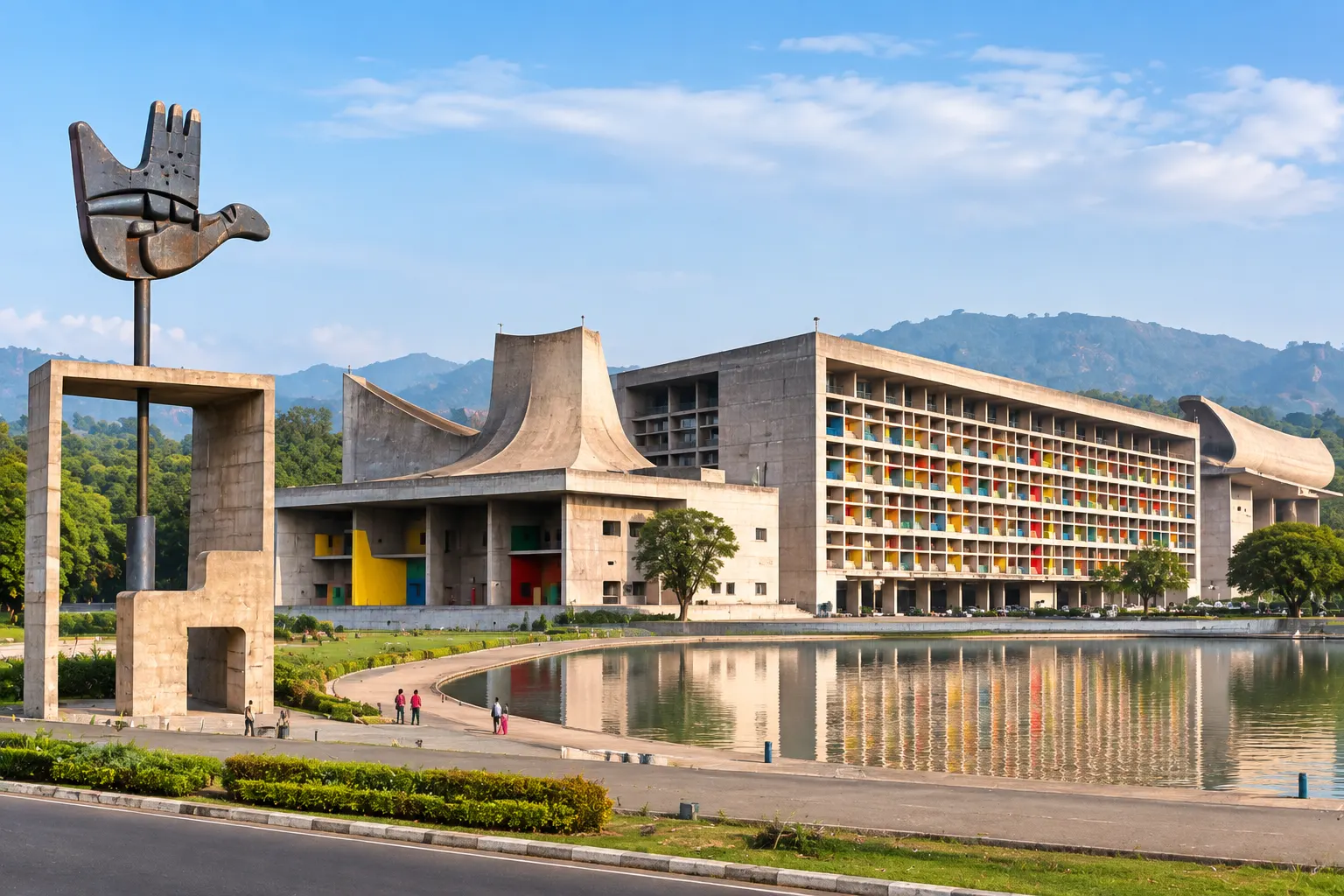
Located at the northern edge of the city, with the Shivalik Hills beyond, it includes the High Court, Secretariat and Palace of Assembly. Le Corbusier treated these institutions as monumental forms rather than conventional government offices.
The buildings are made largely of exposed concrete. Their scale is dramatic. Roof forms, ramps, parasols, deep façades and sculptural elements transform bureaucratic functions into civic spectacle.
The Palace of Assembly is especially striking, with its monumental portico and distinctive roof forms. The High Court uses a vast parasol-like roof. The Secretariat stretches horizontally as an enormous administrative block.
These buildings are not neutral containers.
They make a claim about the state: rational, modern, monumental and self-confident.
The Open Hand
One of Le Corbusier’s most recognisable symbols is the Open Hand—a form he used repeatedly and associated with giving and receiving.
A monumental version was intended for Chandigarh’s Capitol. Although its realisation came much later than the original planning phase, it became one of the city’s most recognisable emblems.
Its appeal lies partly in its ambiguity.
The hand can suggest peace, exchange and openness. It can also function as the personal signature of an architect whose individual identity became unusually dominant in the story of a public city.
UNESCO and global recognition
In 2016, Chandigarh’s Capitol Complex became part of UNESCO’s serial World Heritage property, The Architectural Work of Le Corbusier, an Outstanding Contribution to the Modern Movement.
The inscription includes 17 sites across seven countries.
UNESCO presents these works as evidence of a new architectural language that broke with earlier traditions and influenced modern architecture internationally.
For Chandigarh, the recognition formalised something architects had long understood: the Capitol is not only an Indian governmental precinct but also one of the major surviving monuments of global modernism.
World Heritage status, however, does not freeze a city in time.
Chandigarh remains a working administrative centre. The challenge is to conserve significant architecture while allowing institutions to function and a living city to change.
Heritage versus everyday use
This conflict has become increasingly visible.
Air-conditioning systems, security requirements, parking, new service infrastructure, office needs and traffic pressures can all alter historic modernist buildings and landscapes.
UNESCO has repeatedly raised concerns about development proposals that could affect the outstanding universal value of the Capitol Complex.
The question is difficult because a government complex cannot operate as a museum.
Conservation must therefore negotiate between authenticity and utility.
Was Chandigarh made for cars?
A common criticism of modernist planning is that it privileges automobiles and large-scale road systems over fine-grained street life.
Chandigarh does have broad roads, generous setbacks and relatively low-density areas that can make walking between destinations difficult compared with older compact urban centres.
But the criticism needs nuance.
The plan also incorporated pedestrian paths, green belts, local markets and neighbourhood facilities. Its ambition was not simply to produce highways; it was to separate conflicting forms of movement.
The deeper issue is that the city developed under conditions very different from those of the early 1950s. Vehicle ownership, population growth, peripheral expansion and regional commuting have increased enormously.
A road hierarchy designed for one era must now absorb another.
Social order and the planned city
There is also a social question.
Planned capitals often appear egalitarian in diagrams because every function has a place. Yet housing categories, administrative hierarchies and access to land can encode social differences.
Chandigarh’s government housing was organised by official rank. Different house types and plot sizes reflected bureaucratic status.
This was not unique to Chandigarh, but it reveals a contradiction within modernist planning. Rational order can reproduce hierarchy just as efficiently as it can reduce disorder.
A city can be visually modern while remaining socially stratified.
The shadow of displacement
Every new city occupies land that was not empty before planners drew lines across it.
The Chandigarh project required the acquisition of village land and the reorganisation of an existing rural landscape.
Older celebratory accounts often treated the site as an almost blank field waiting for modernism. Contemporary urban history asks different questions: Who lived there? What land uses existed? Who benefited from appreciation in land values? Who was displaced or absorbed?
These questions do not invalidate the architectural achievement.
They widen the frame.
Le Corbusier’s contradictions
Le Corbusier himself remains a contested figure.
His architectural influence is undeniable. So are the authoritarian tendencies in some of his urban visions and the political compromises in parts of his European career.
Recent scholarship has examined his relationships with the Vichy regime and the political assumptions behind his planning ideas. That debate makes it harder to treat modernism as a purely aesthetic movement.
The Chandigarh project should therefore not become an exercise in hero worship.
Architects do not become historically important because every belief they held was admirable. They become important because their ideas altered practice—and because those ideas can still be examined critically.
Chandigarh beyond Le Corbusier
Perhaps the best measure of Chandigarh’s success is that it escaped its architect.
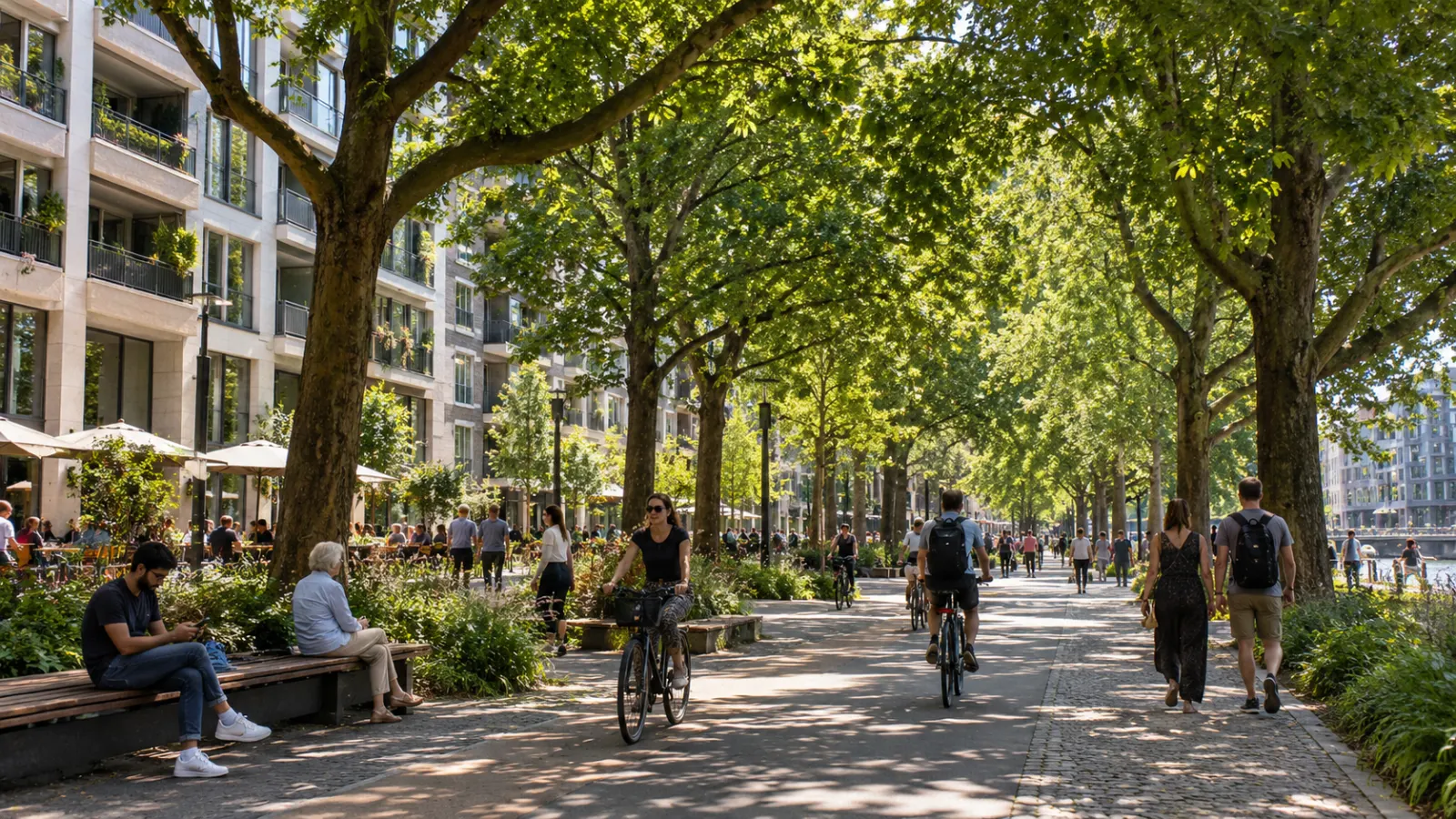
Residents turned sectors into neighbourhoods. Markets developed habits and rhythms that no master plan could prescribe. Trees matured. Buildings were modified. Informal practices appeared. The city became part of a larger metropolitan region with Mohali and Panchkula.
This is what cities do.
Architecture begins with intention. Urban life continues through adaptation.
Chandigarh today is simultaneously a planned object and an improvised environment.
Why Chandigarh still matters
The city remains important because many debates that shaped its creation are still unresolved.
Should cities be dense or spacious?
How should traffic be separated from neighbourhood life?
Can standardised housing coexist with social diversity?
How should public architecture represent democracy?
Can modern heritage be preserved without turning living institutions into monuments?
How much authority should architects have over the behaviour of residents?
These are not historical questions.
They are contemporary planning questions.
Chandigarh also forces India to confront the complexity of “modernity.” The city was designed in part by Europeans, but commissioned by Indian institutions and built for a postcolonial state. It borrowed international modernism while adapting to Indian climate, bureaucracy and politics.
That makes it neither simply foreign nor simply indigenous.
It is a hybrid product of a particular historical moment.
Le Corbusier gave Chandigarh much of its monumental image, but the city’s deeper meaning comes from the tension between plan and life.
The master plan wanted order.
History supplied change.
The result is more interesting than either.