The Social Reformer Jyotirao Phule
Jyotirao Govindrao Phule did not treat education, caste, religion, gender and agriculture as separate problems.
To him, they formed a system.
A society in which knowledge was concentrated among privileged groups would reproduce privilege. A society organised by hereditary status would make education unequal. Religious authority could legitimise social hierarchy, while political administration could preserve it. Peasants who produced wealth could remain poor because the structures governing land, knowledge and bureaucracy worked against them.
This interconnected view made Phule one of nineteenth-century western India's most radical social critics.
Phule was therefore more than a reformer who opened schools.
He developed an argument about who controlled Indian society—and why.
Growing up inside a hierarchy
Jyotirao Phule was born in 1827 and belonged to the Mali community, traditionally associated with gardening and cultivation. His life unfolded in Pune, a city with a powerful Brahman elite and a political culture still shaped by memories of Peshwa rule.
He received an education unusual for many members of socially disadvantaged communities of his time, including study at a missionary school. That exposure gave him access to forms of literacy and political thought that he later turned against entrenched hierarchy.
Popular biographies often identify a humiliating experience at a Brahman friend's wedding as an awakening that sharpened his awareness of caste discrimination.
Such episodes are useful when adequately sourced, but they should not be made to carry an entire intellectual biography.
Phule's politics developed over decades through educational work, organisation, writing and engagement with colonial institutions.
Education as a redistribution of power
The Phule movement's most famous early activity was education.
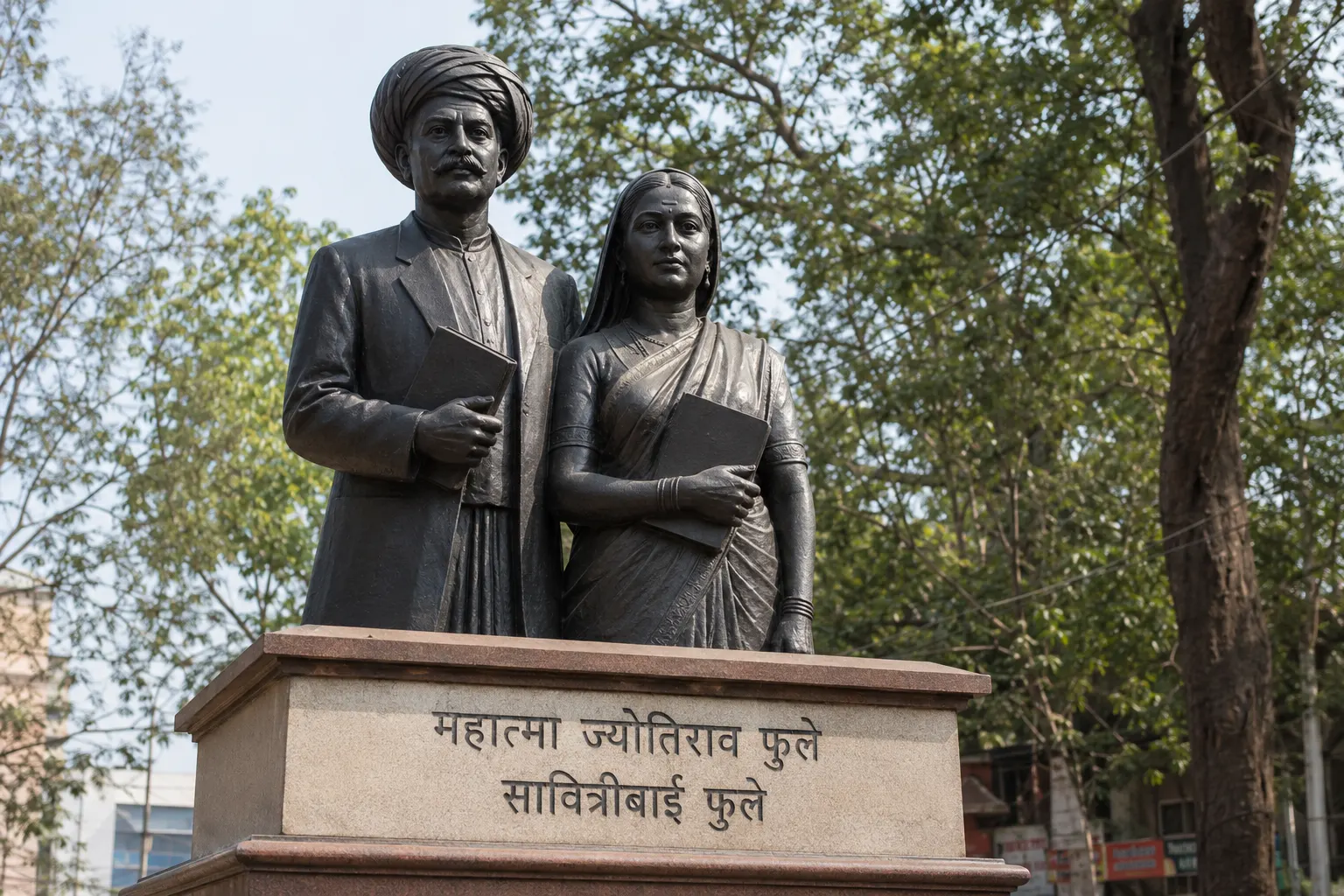
Jyotirao and Savitribai Phule participated in establishing schools for girls and for communities historically excluded from formal learning.
A crucial primary source is Phule's own memorial to the Education Commission, dated 19 October 1882.
Looking back on his educational work, Phule stated that missionaries had already established a female school in Pune but that no indigenous school for girls existed when he began his work. He described himself and his wife as working together in a girls' school and later helping establish schools for Mahar and Mang children.
This is important because modern commemorative language often calls the Phules' school “India's first girls' school.”
That claim is too broad.
Girls' schools run by missionaries and other organisations existed earlier or around the same period.
The more defensible historical description is that the Phules were pioneers of indigenously organised girls' education in Pune and among the most important Indian advocates of education for girls and marginalised caste communities.
That distinction does not reduce their accomplishment.
It makes it historically precise.
Savitribai was not merely an assistant
The educational project cannot be understood as Jyotirao's work alone.
Savitribai Phule became a teacher, organiser, writer and reformer in her own right. Their partnership challenged gender hierarchy within the very movement challenging caste hierarchy.
Phule's own Education Commission memorial explicitly said that he and his wife worked together in the school.
This matters because older biographies often frame Jyotirao as the reformer and Savitribai as the supportive spouse.
That hierarchy reproduces precisely the kind of historical erasure their educational movement opposed.
The argument behind the schools
For Phule, primary education was not simply a charitable service.
It was political.
His 1882 memorial criticised a system that directed substantial resources toward higher education while leaving the mass of the population poorly educated. He argued that government revenue came substantially from cultivators and ordinary people and questioned why public educational expenditure disproportionately benefited higher social groups.
This argument remains strikingly modern.
Who pays for public institutions?
Who receives their benefits?
Does educational policy reduce inherited inequality, or reproduce it?
Phule's answer was that education had to reach the masses if society was to become genuinely more equal.
Gulamgiri: rewriting social history
In 1873, Phule published Gulamgiri, commonly translated as Slavery.
The work attacked Brahmanical domination and attempted to reinterpret Indian history from the perspective of Shudras and Atishudras.
Phule compared caste oppression with other systems of subjugation and dedicated the work in a transnational spirit to those who had opposed slavery in the United States.
The comparison was rhetorically powerful.
His historical reconstruction, however, should not be mistaken for modern professional historiography.
Later interpreters—including sympathetic scholars—have noted that Phule used counter-myth, polemic and speculative history as political tools.
He sought to reverse the moral structure of Brahmanical narratives.
Groups portrayed as naturally subordinate were recast as original inhabitants and victims of conquest.
In this sense, Gulamgiri was not merely history-writing.
It was ideological intervention.
Satyashodhak Samaj
The same year, 1873, Phule established the Satyashodhak Samaj, usually translated as the Society of Truth Seekers.
Its purpose was to organise people outside Brahmanical control and challenge social and religious hierarchy.
The significance of the Samaj lay partly in its effort to create alternatives.
Criticism alone does not necessarily change institutions.
The Satyashodhak movement attempted to develop rituals, organisational networks and forms of social solidarity that reduced dependence on hereditary religious intermediaries.
This transformed Phule from a writer into a movement-builder.
Religion and rational authority
Phule's critique of Brahmanism was intense, sometimes deliberately confrontational.
He believed scriptural authority and priestly monopoly had helped justify social inequality.
Yet it would be inaccurate to describe him simply as “anti-religious.”
His thought sought a morally universal conception of truth and human equality that could stand against hereditary privilege.
The Satyashodhak project was therefore both a critique of religious hierarchy and an attempt to reorganise moral community.
Phule wanted ordinary people to reason about social authority rather than accept it automatically.
That emphasis on independent judgment is one reason scholars have treated him as a significant modern political thinker rather than only as a social worker.
Women, widowhood and social control
Phule's politics also addressed the position of women.
The Phules opposed practices that placed especially severe burdens on widows and worked to create social support for vulnerable women and children.
Their educational programme attacked one root of gender inequality: the assumption that knowledge and public intellectual life belonged principally to men.
This was not merely an extension of his caste politics.
Caste itself was reproduced partly through marriage, family control and regulation of women's sexuality.
Gender and caste hierarchy therefore overlapped.
Later anti-caste thinkers would explore this relationship in much greater theoretical detail, but Phule's reform practices already confronted it.
The peasant question
One of the most important aspects of Phule's political thought is often lost when he is remembered only through caste and education.
He was also deeply concerned with cultivators.
In Shetkaryacha Asud, translated as The Cultivator's Whipcord, Phule examined the poverty and exploitation of farmers in the Bombay Presidency.
Phule did not place all responsibility on one group.
His critique could target Brahman officials, moneyed intermediaries and the failures of colonial administration.
This makes his relationship with British rule more complicated than either supporters or critics sometimes admit.
Phule and colonial rule
Phule frequently regarded British rule as creating political openings that could weaken older structures of caste domination.
This has led some critics to portray him as excessively sympathetic to colonial power.
But his position was strategic rather than simply loyalist.
He could see colonial administration as a potential counterweight to Brahman domination while simultaneously criticising government educational priorities and the suffering of cultivators.
His Education Commission statement openly challenged state policy.
This tension is essential.
Anti-colonial nationalism and anti-caste politics did not always identify the same enemy or prioritise the same immediate problem.
For many later nationalists, British rule was the central contradiction.
For Phule, indigenous social hierarchy could not be postponed until after political independence.
That disagreement would become one of the defining debates of modern Indian politics.
A different idea of emancipation
Phule's political programme can be understood through three forms of emancipation.
First was intellectual emancipation: access to education and the capacity to challenge inherited knowledge.
Second was social emancipation: rejection of hereditary status and priestly monopoly.
Third was economic emancipation: attention to cultivators and the conditions under which productive communities remained poor.
These dimensions reinforced each other.
An illiterate population had little ability to enter administration.
A socially stigmatised community had restricted educational access.
An economically insecure cultivator had fewer opportunities to acquire education.
Phule's originality was to see these relationships as structural.
Limits and contested interpretations
Phule should not be converted into a modern twenty-first-century democrat without qualification.
He lived in a nineteenth-century colonial society and used concepts available to his time.
Some of his historical theories are not accepted as literal history.
His rhetoric could be sharply polarising.
His expectations of colonial authority sometimes appear optimistic in retrospect.
Later political movements also selectively appropriated his legacy, emphasising different aspects of his thought.
But these limitations do not weaken his historical importance.
They help locate it.
A thinker matters not because every proposition survives unchanged, but because he alters the questions politics must answer.
Phule did that.
From Phule to later anti-caste politics
The long-term importance of Phule became especially visible in twentieth-century non-Brahman and Dalit movements.
His insistence that caste inequality was political rather than merely ritual, and that education could become an instrument of collective emancipation, provided intellectual resources for later movements.
B. R. Ambedkar would develop a far more systematic constitutional, legal and economic attack on caste. Yet Phule belonged to an earlier generation that made it possible to imagine subordinated groups as political subjects capable of interpreting history for themselves.
This is why Phule is often placed in an intellectual genealogy extending from nineteenth-century anti-caste mobilisation to modern struggles for social justice.
Why Jyotirao Phule still matters
Modern India is constitutionally committed to equality.
Yet arguments over caste, educational access, representation, social mobility and agrarian inequality remain central.
Phule cannot provide ready-made answers to those contemporary questions.
He can, however, sharpen them.
Who controls knowledge?
Whose history becomes authoritative?
When a government spends public resources on education, who benefits?
Can political freedom coexist with entrenched social hierarchy?
Can a society call itself equal when inherited identity strongly shapes access to opportunity?
Those questions explain why Phule's nineteenth-century writings remain politically alive.
His legacy is not simply that he opened schools or founded an organisation.
It is that he connected education to power.
Once that connection is visible, schooling stops being merely a classroom issue.
It becomes a question about the structure of society itself.