The Chipko Movement: Forest Rights, Women and Environmental Protest in India
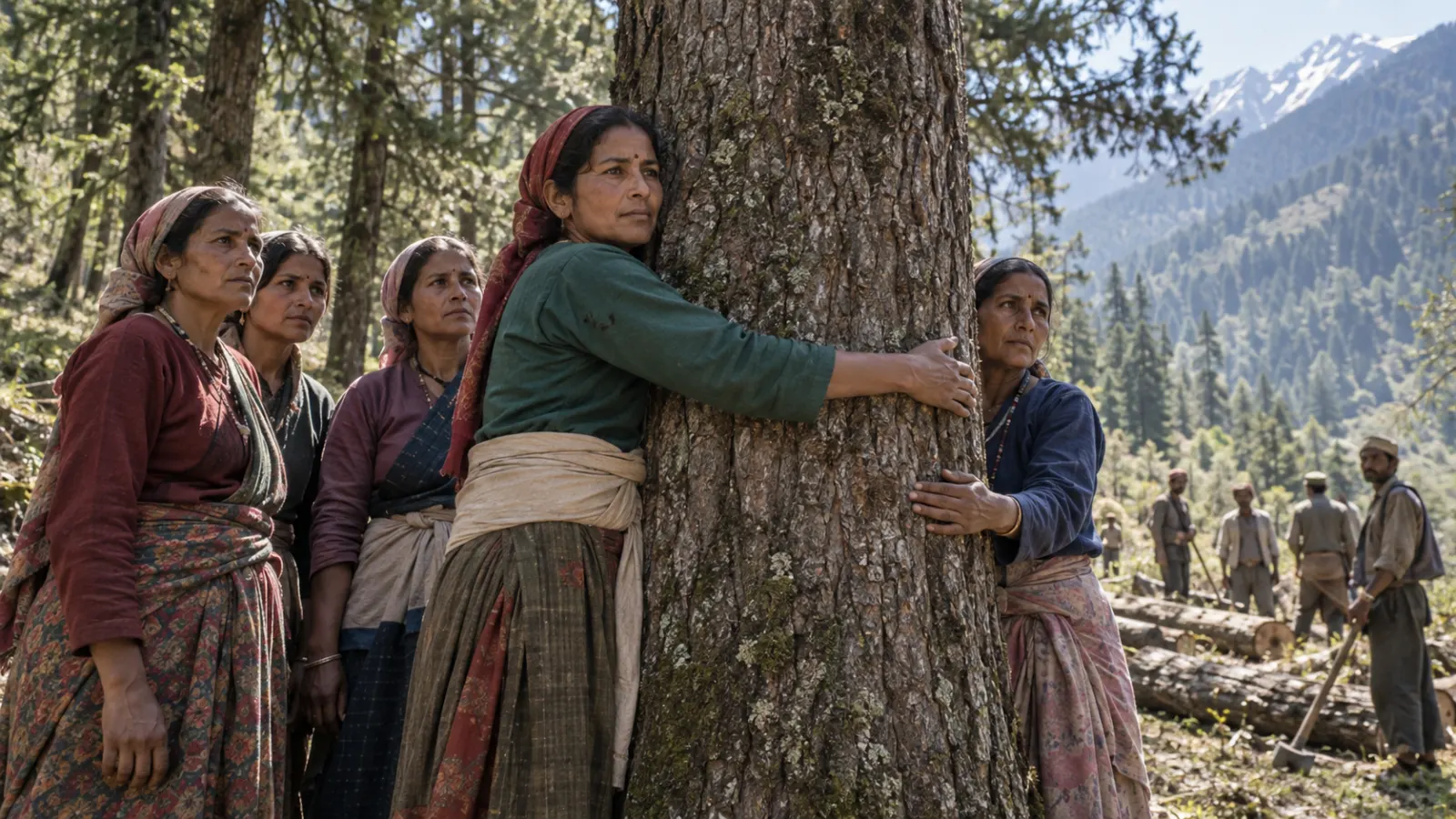
Few environmental movements are remembered through an image as powerful as villagers embracing trees to prevent them from being cut. That image gave the Chipko movement international recognition and eventually turned “tree hugging” into a widely understood symbol of environmental protest.
But the familiar image can also obscure the movement's history.
Chipko was not one protest, one village or the achievement of one leader. It developed through a series of nonviolent struggles in the Himalayan districts of what was then Uttar Pradesh and is now Uttarakhand. Those struggles involved commercial logging, access to forest resources, village employment, soil and water security, and competing ideas about what forests were for.
The word chipko is generally translated as “to cling,” “to stick” or “to embrace.” The possibility of physically placing villagers between trees and logging crews gave the movement its most memorable tactic. Yet historical accounts show that not every Chipko action involved people literally hugging trees. Marches, vigils, meetings, songs, negotiations, satyagraha and the threat of physically protecting forests were also important.
The deeper political question was therefore larger than whether particular trees should be cut.
It was who should control Himalayan forests, who should benefit from them and whose knowledge of their ecological value should count.
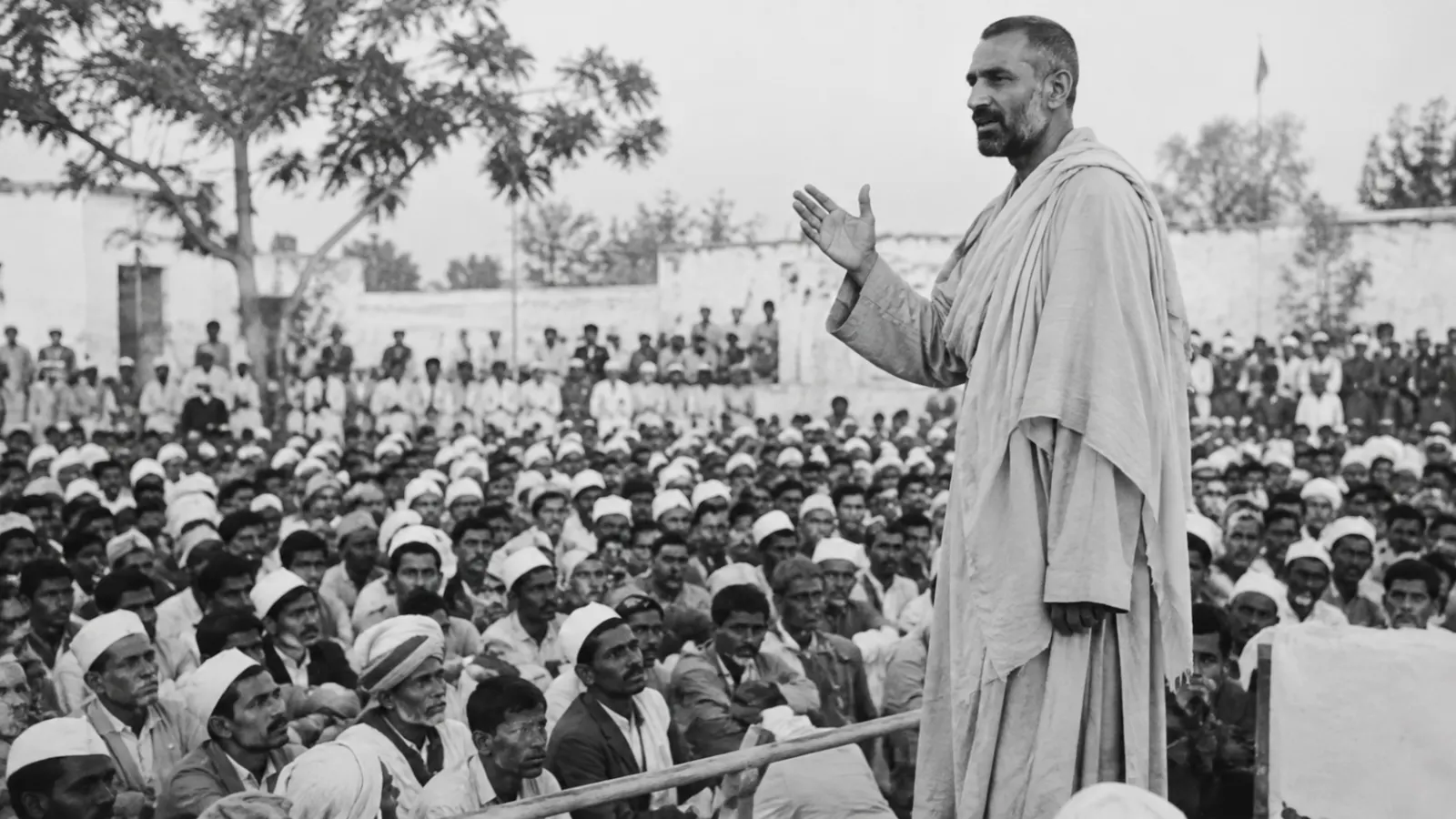
Government accounts of the movement recognise figures including Gaura Devi, Chandi Prasad Bhatt and Sunderlal Bahuguna, while later historical work has emphasised the much broader network of villagers and local organisers who sustained the different campaigns. (pib.gov.in)
The conflict began with different ideas about what a forest was worth
For Himalayan villages, forests were part of the everyday economy.
They provided fuelwood, fodder, leaf litter, small timber and materials used in village households and agriculture. Forest cover also mattered for soil, springs, water regulation and the stability of steep mountain slopes.
State forestry and commercial contractors often valued the same landscape differently.
A commercially useful tree could be measured as timber. A village household might value the forest through dozens of smaller benefits distributed across the year. Those benefits could be difficult to express in a timber auction but essential to daily life.
This created a persistent political contradiction.
Local communities could face restrictions on forest use while outside companies received contracts to remove valuable timber. The economic value left the region, while environmental risks associated with forest degradation remained local.
Chipko therefore cannot be adequately explained by saying simply that villagers “loved nature.”
Livelihoods were central.
So were questions of power.
Who received employment from the forest? Who could obtain raw materials? Who decided which trees would be cut? And who paid the cost if slopes became unstable, streams changed or women had to walk farther for fuel and fodder?
Later retellings sometimes present Chipko principally as a conservation movement seeking to prevent all forest use. Historical accounts complicate that picture. Early demands often concerned local rights over forest wealth, village employment and restrictions on outside commercial exploitation rather than a universal prohibition on using forests. Down To Earth’s retrospective on Chipko, drawing on movement histories and activist testimony, similarly emphasises demands to end the contractor system and strengthen community control and local forest-based economies. (downtoearth.org.in)
The movement became ecological partly because livelihoods and ecology were inseparable.
Chandi Prasad Bhatt helped create the organisational foundation
One of the most important figures in the early history of Chipko was Chandi Prasad Bhatt, a Gandhian social worker associated with the Sarvodaya tradition.
In 1964, Bhatt helped organise the Dasholi Gram Swarajya Sangh in the Chamoli region. The organisation attempted to create village employment through small forest-based industries and local use of forest resources.
That economic programme is crucial to understanding Chipko.
The argument was not that mountain communities should be separated from forests in order to conserve them.
It was that local people should be able to build livelihoods from forests in ways that differed from large-scale commercial extraction.
President Pranab Mukherjee's 2014 speech awarding Bhatt the Gandhi Peace Prize described the Dasholi organisation as an effort to generate employment near people's homes through forest-based industries and identified Bhatt's later Chipko activism with Gandhian nonviolent satyagraha over local rights to wood and fodder and the consequences of deforestation. (pib.gov.in)
A dispute over ash trees helped turn these principles into confrontation.
Bhatt's organisation wanted ash wood for a local workshop, but valuable trees were instead allocated for commercial use by an outside sporting-goods company. Villagers and activists organised resistance in the Mandal area in 1973.
Down To Earth’s later reconstruction identifies Mandal as the site of an early Chipko struggle and describes Bhatt's cooperative as having organised residents when the Allahabad-based Symonds company sought to fell ash trees for sporting goods. (downtoearth.org.in)
This episode matters because it prevents Chipko's history from beginning with the famous women's mobilisation at Reni.
By 1974, an organisational and political struggle was already underway.
Reni made women's leadership impossible to ignore
The most famous Chipko confrontation occurred near Reni village in 1974.
When a logging party arrived while many village men were away, Gaura Devi, who led the local women's organisation, mobilised women from the village to confront the workers and prevent the forest from being felled.
The confrontation became one of the defining stories of Indian environmental history.
Its power came partly from the apparent imbalance in the scene: village women facing a commercial logging operation without weapons and insisting that the forest could not simply be removed.
But the women were not defending an abstract wilderness that existed separately from their lives.
Forest degradation directly affected their work.
Women in Himalayan households commonly carried substantial responsibility for collecting fuelwood, fodder and water. When nearby forests deteriorated, those activities required longer journeys and greater physical labour. Forest decline therefore entered the household through time, distance and unpaid work.
The original article correctly identifies this connection between environmental degradation and women's daily labour as one reason women's participation became so significant.
That does not mean Chipko can be described simply as a women's movement.
Men were deeply involved in its organisation, and leadership differed from place to place. Bhatt was central to its organisational foundations. Bahuguna became crucial to its wider ecological advocacy. Numerous local men and women participated in village-level campaigns.
But Reni changed the public memory of Chipko because it demonstrated that rural women were not passive victims of environmental decline.
They were political actors capable of defining what environmental security meant from the standpoint of everyday survival.
Calling Chipko “ecofeminist” is useful only with qualifications
Chipko later became important in ecofeminist writing because it appeared to demonstrate a direct relationship between women's lives and environmental protection.
There is truth in that interpretation.
Women were often among the people most directly affected when forest degradation increased the distance required to obtain water, fodder or fuel. Their environmental knowledge emerged partly from repeated practical interaction with the landscape.
But describing Chipko only through ecofeminism can oversimplify a complicated movement.
It can imply that women protected forests because women possess some inherently closer or more spiritual relationship with nature. The historical evidence points toward a more material explanation: household responsibilities, livelihood dependence and unequal exposure to the consequences of deforestation made forests especially important to many women.
Historical interpretations also differ over when ecological and gender-focused language became dominant in accounts of Chipko. Recent retrospectives based on Shekhar Pathak's historical work argue that the early movement's economic and community-rights objectives were sometimes overshadowed by later representations emphasising pure conservation and feminism. (downtoearth.org.in)
The most defensible conclusion is therefore not that Chipko “was” or “was not” feminist.
It is that women's participation revealed something politically important: environmental damage is distributed through social roles.
A forest can disappear from a satellite image as hectares.
Inside a household, that same loss can appear as two additional hours of walking every day.
Sunderlal Bahuguna helped transform local struggles into a wider ecological argument
If Chandi Prasad Bhatt was critical to Chipko's local organisational foundations, Sunderlal Bahuguna became one of its most visible national and international advocates.
Bahuguna was also shaped by Gandhian politics. Through travel, public speaking, fasting and advocacy, he carried debates over Himalayan forests beyond individual logging disputes.
This widened the movement's language.
The argument increasingly focused not only on who received forest products but on the ecological functions of forests themselves: soil stability, water, the fragility of Himalayan landscapes and the relationship between environmental protection and long-term economic welfare.
That shift was politically important because it made local forest disputes legible to audiences far beyond the villages where they began.
It also helped generate one of the distortions in Chipko's later memory.
A movement involving many decentralised campaigns gradually became associated with a small number of prominent personalities. Bahuguna's visibility, language skills and ability to communicate with national and international audiences gave him extraordinary influence over how outsiders understood Chipko.
That should not diminish his contribution.
It should clarify what that contribution was.
He helped translate and amplify an environmental argument.
He did not single-handedly create the movement.
Down To Earth’s earlier historical reporting similarly describes differences between the Chamoli campaigns associated with Bhatt and later forest struggles in Tehri in which Bahuguna played an important role. (downtoearth.org.in)
Chipko was powerful partly because it did not depend on one central command.
“Tree hugging” is the symbol, not the full history
The visual simplicity of the Chipko story created its global power.
A person embracing a tree requires almost no explanation.
The body says: to cut this tree, you must confront me first.
But historical movements rarely remain as simple as their symbols.
Not every Chipko confrontation involved villagers physically wrapping their arms around trunks. Bhatt later stated that in some cases the willingness or threat to protect trees was sufficient and actual embracing was unnecessary. Later photographs associated with Chipko have also sometimes been staged or reenacted for visitors and media rather than documenting the original confrontations. (downtoearth.org.in) (downtoearth.org.in)
This does not make the tree-embracing story false.
It means the symbol became larger than the literal tactic.
Chipko included marches, public meetings, village organisation, forest watches, songs, negotiations and Gandhian satyagraha.
The movement was therefore organisational before it was photographic.
That is an important lesson in studying social movements more generally.
A dramatic image may explain why a movement is remembered.
It does not necessarily explain why the movement succeeded.
Chipko changed the political meaning of a forest
Perhaps Chipko's deepest contribution was conceptual.
Commercial forestry can reduce a forest to measurable timber.
Chipko insisted on a broader accounting.
Forests stabilise slopes.
They affect water.
They supply fodder and fuel.
They provide raw materials for local livelihoods.
They hold soil.
They create habitat.
They form part of village economies and cultural landscapes.
Once those functions enter the political calculation, the value of a standing forest can no longer be represented adequately by the sale price of timber alone.
This idea is now familiar in environmental economics and ecosystem management through concepts such as ecosystem services.
In the 1970s, Chipko made similar arguments politically and locally.
Its environmentalism was therefore not only about preserving nature from human beings.
It challenged a particular model of resource use in which commercial extraction captured visible economic value while communities absorbed ecological and social costs.
That is a very different proposition.
It means environmental protection and local development do not always stand on opposing sides.
The central dispute may instead be which form of development is being pursued and who receives its benefits.
The movement influenced policy, but no single government order defines its success
Chipko's campaigns contributed to greater scrutiny of commercial logging in Himalayan forests.
Its political influence extended through the late 1970s and early 1980s as activists pushed for stronger restrictions. Historical reporting records that, after Bahuguna intensified demands for restrictions on Himalayan felling, the central government ultimately instituted a long moratorium on commercial felling in the Uttarakhand Himalaya. (downtoearth.org.in)
Chipko also belonged to a broader political period in which forest conservation moved higher on India's national agenda. In 1980 the central government introduced the legislation that became the Forest (Conservation) Act, restricting diversion and de-reservation of forest land for non-forest purposes without central approval. The government has described the law as a response to rapid forest diversion during the preceding decades. (pib.gov.in)
It would be too simple to say Chipko alone produced national forest policy.
Policy change rarely has one cause.
But the movement changed the political environment in which forest decisions were being debated.
That influence extended beyond Uttarakhand.
The later Appiko movement in Karnataka drew inspiration from Chipko, while Indian campaigns around forests, dams, mining and displacement increasingly treated local communities as political participants rather than passive recipients of development decisions.
Chipko helped make environmental politics part of the language of Indian democracy.
Its greatest legacy may be the question of who counts as an environmental expert
Technical forestry had professional expertise.
Government agencies had legal authority.
Commercial companies possessed capital.
Chipko introduced another kind of knowledge into the debate: the knowledge of people who lived with forests every day.
Village residents knew where fodder came from.
They knew how far water had to be carried.
They understood which slopes became unstable.
They knew which forest products could support local employment.
That knowledge did not make every local preference environmentally correct.
Nor does community control automatically guarantee sustainable resource use.
But it challenged the assumption that environmental expertise existed only inside government departments or scientific institutions.
The original draft captures this shift well: Chipko helped establish rural women, village organisations and small producers as participants with relevant knowledge rather than merely beneficiaries of conservation policy.
That argument remains relevant today.
Contemporary debates about community forestry, protected areas, mining, ecological restoration and renewable-energy infrastructure still ask how technical knowledge should interact with the knowledge and rights of people living in affected landscapes.
Chipko did not solve that problem.
It made it harder to ignore.
Chipko's lasting lesson is about who a forest is for
The question that made Chipko durable is remarkably simple:
What is a forest for?
A timber company may see wood.
A forestry department may see a regulated public resource.
A climate planner may see carbon storage.
A wildlife biologist may see habitat.
A government may see revenue, watershed protection or strategic land.
A mountain household may see fuel, fodder, water security, soil stability, employment and daily survival.
None of these values exists automatically outside politics.
Someone has to decide which will receive priority.
Chipko forced those competing definitions into the same conversation.
That is why describing it simply as the movement in which women hugged trees makes the history smaller than the symbol that preserved it.
Its deeper importance lies in connecting ecology, livelihood and democratic control over natural resources.
Chandi Prasad Bhatt helped build an organisational model around village employment and Gandhian resistance. Gaura Devi and the women of Reni demonstrated that rural women could confront commercial extraction directly. Sunderlal Bahuguna helped carry the ecological argument to national and international audiences. Countless other participants gave the movement its decentralised strength.
Government accounts themselves recognise several of these figures together rather than reducing Chipko to a single leader. (pib.gov.in)
The movement's enduring lesson is therefore not that forests should never be used.
It is that deciding how forests are used requires asking who benefits, who bears the ecological cost, whose knowledge counts and whether the forest can continue performing the functions on which both ecosystems and communities depend.
The embrace made Chipko famous.
The argument behind it is what made Chipko important.