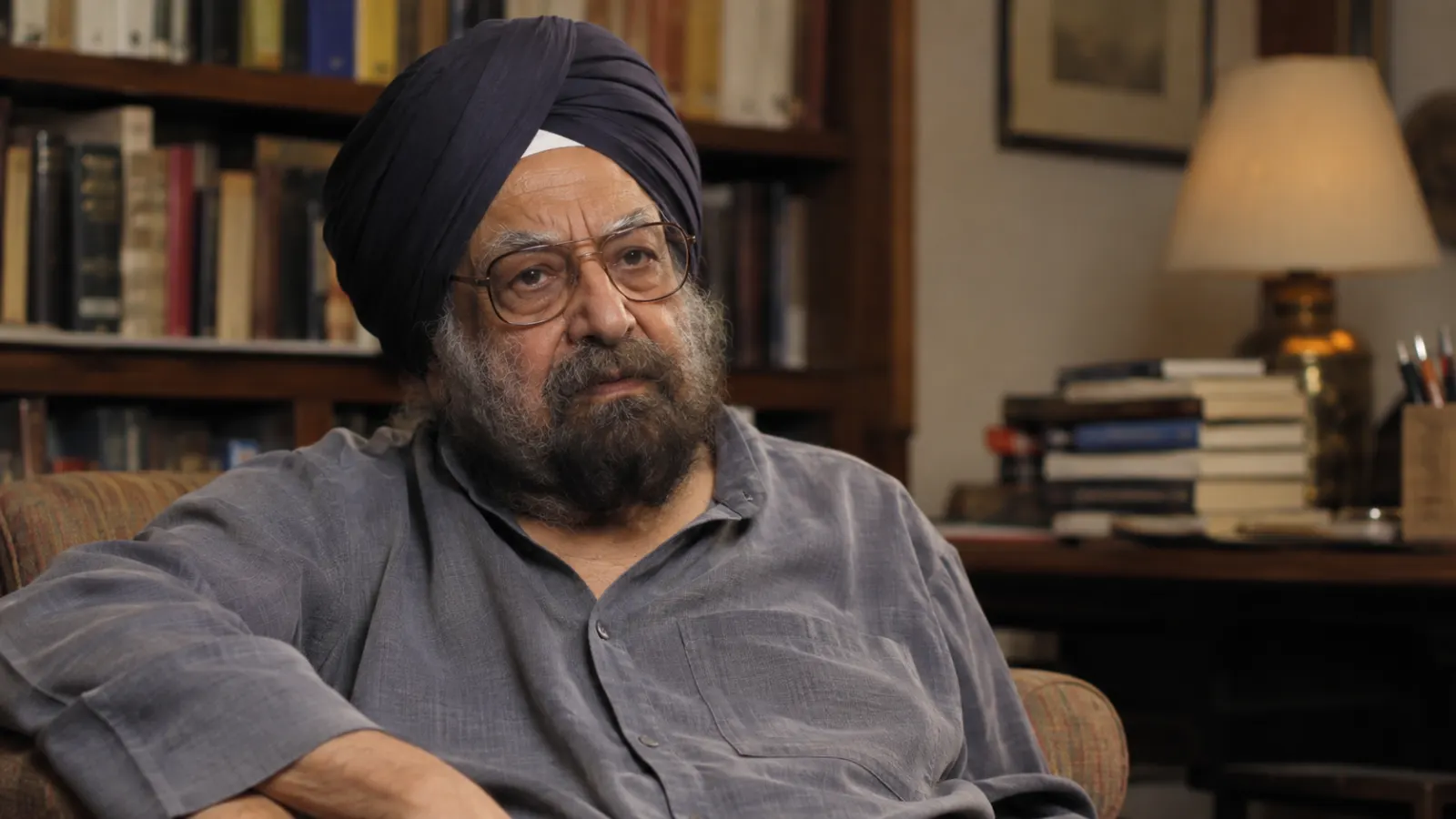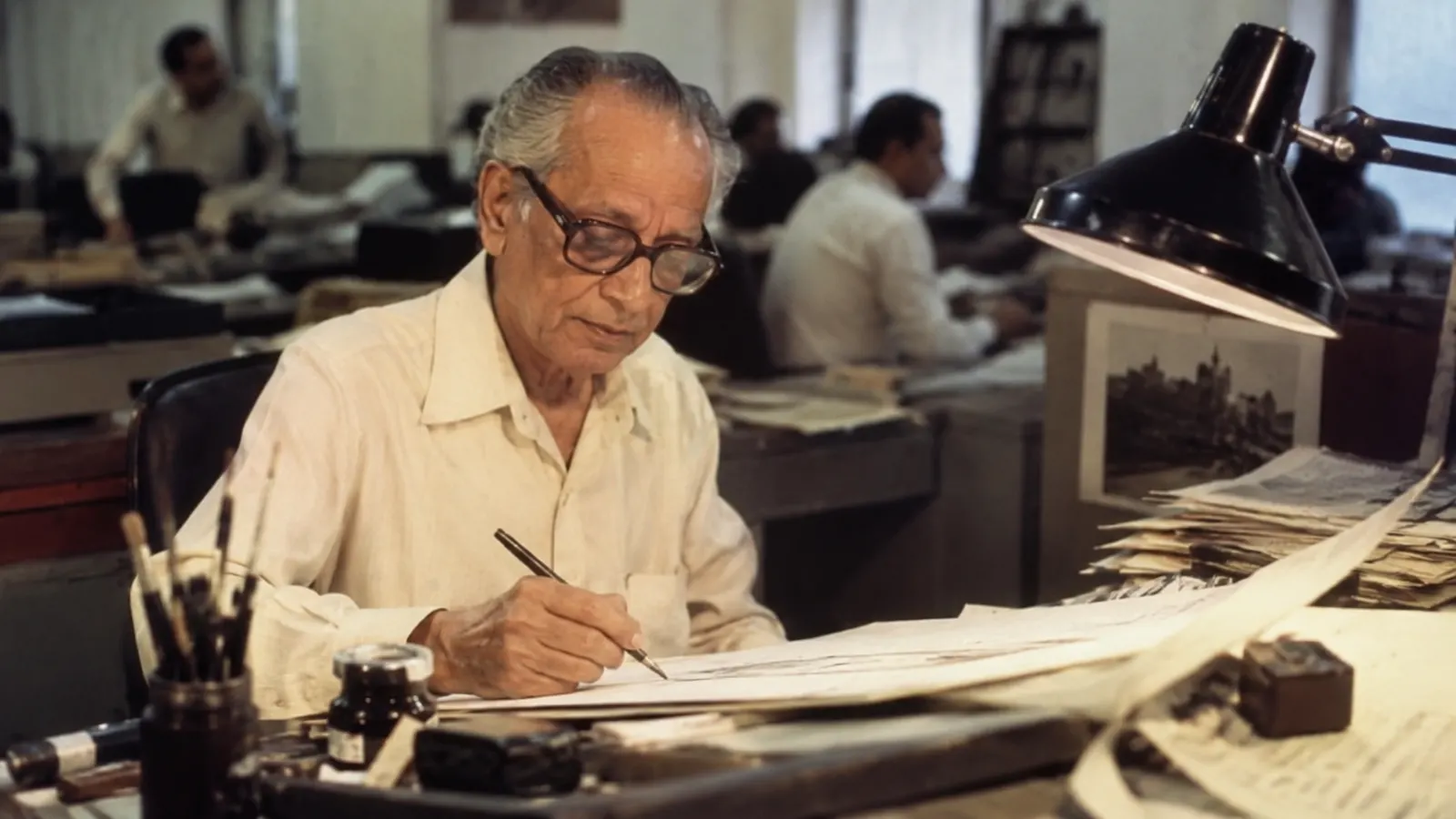
R. K. Laxman: The Cartoons, Common Man and Political Satire of Modern India
For more than half a century, R. K. Laxman made Indian politics readable through a few lines of ink. Ministers announced reforms while roads collapsed behind them. Officials explained why nothing could be done. Citizens waited in queues, struggled with paperwork, watched prices rise and encountered an administration whose language often seemed more elaborate than its solutions. Somewhere nearby stood the Common Man.
Usually silent, slightly bewildered and dressed in his familiar checked coat and dhoti, Laxman’s best-known character became the observer through whom generations of newspaper readers encountered political promises, bureaucratic evasions and the frustrations of everyday civic life. The silence was crucial. Laxman did not need to give the Common Man a long argument because the politician or official usually supplied enough material. The reader recognised the contradiction and completed the judgment.
That economy became one of Laxman’s greatest strengths. Political events can involve legislation, bureaucracy, party competition, budgets and competing claims, while a newspaper cartoon has only seconds to communicate. Laxman repeatedly converted complicated public events into small scenes whose logic could be understood almost immediately. His achievement was therefore larger than drawing recognisable politicians: he developed a visual grammar for political scepticism in post-independence India.
Rasipuram Krishnaswamy Laxman, born in Mysore in 1921 and deceased in 2015, became closely identified with The Times of India, where his long career and the Common Man made him one of India’s most recognisable political cartoonists. Yet familiarity can simplify an artist. The Common Man’s enormous popularity sometimes overshadows the professional discipline, commercial illustration, caricature and social assumptions behind the character. To understand Laxman seriously, it helps to examine not only what made his cartoons funny but also what kind of citizen they imagined, what kind of politics they criticised and what their repetition tells us about Indian public life.
From Mysore to The Times of India
Laxman was born on 24 October 1921 in Mysore. His elder brother, R. K. Narayan, became one of India’s most celebrated English-language novelists, and the relationship between them was more than biographical trivia. Laxman illustrated some of Narayan’s work, while both brothers built careers around close observation of ordinary behaviour. Narayan created fictional towns, families, shopkeepers and schoolchildren through prose; Laxman’s medium demanded even greater compression, where a face, posture, desk, file, road or expression might have to carry an entire argument.
His early career included contributions to college magazines, R. K. Narayan’s books, the Kannada humour publication Koravanji, Gemini Studios and newspapers. These years mattered because political cartooning is partly a discipline of repetition. A newspaper cartoonist cannot wait indefinitely for inspiration. The next edition is coming, a public figure must be recognisable instantly, and the joke has to work within limited space. The cartoonist must understand enough of the news to identify the contradiction and then remove everything that does not help communicate it.
Regional humour publications also exposed Laxman to something essential to satire: shared social knowledge. Bureaucratic rituals are funny only when readers recognise them. A certain posture of authority, an overloaded desk, ceremonial garlands, official language, domestic conversation or municipal confusion works because the audience already understands the social code being exaggerated.
Laxman’s first major full-time newspaper period came with the Free Press Journal in Bombay. Another young cartoonist working there was Bal Thackeray, who later left cartooning for an influential political career. Their later trajectories were radically different, but their early proximity illustrates how closely illustration, journalism and politics could overlap in post-independence urban India. Bombay also gave Laxman a rich visual environment: municipal administration, cinema, industry, traffic, public meetings, class differences, office culture and the routines of a rapidly expanding city could all become material.
In 1951, Laxman joined The Times of India, beginning the association that defined his public identity. His pocket cartoon You Said It eventually became a daily ritual for readers. Sources differ on its precise starting date, with several newspaper and publishing accounts placing it in 1951 while the Ramon Magsaysay Award Foundation gives 1957. What is not disputed is that the feature became the defining platform of Laxman’s career and that the Common Man became its enduring observer.
The Common Man and the craft of visual economy
The Common Man is among the most recognisable characters in Indian newspaper history. His bald head with tufts of hair, large nose, moustache, checked coat, dhoti and permanently alert expression could suggest confusion, disbelief or resignation depending on the scene. But the character’s importance was not merely visual.
A daily political cartoon faces an editorial problem. Politicians change, governments fall, policies become outdated and today’s scandal may disappear from public memory within weeks. Laxman needed a recurring figure who could connect these events without turning the cartoon into a serial narrative. The Common Man solved that problem by placing the citizen inside the scene without requiring him to dominate it.
He could stand beside a politician, official, householder or street scene and simply observe. He did not need a complicated biography because his primary function was witnessing. Accounts of the character’s development describe Laxman initially drawing a wider range of regional figures before gradually simplifying them until one recurring observer remained. The final design was specific enough to recognise instantly but open enough for many readers to project themselves onto him.
His silence also prevented the cartoon from becoming a lecture. A minister could boast about an achievement while the background visibly contradicted the claim. A bureaucrat could explain a regulation so absurdly that the explanation itself became the joke. The Common Man merely watched, and the reader supplied the response.
This is one reason Laxman’s cartoons often appear simple on first viewing. Their efficiency hides how carefully the components were arranged. Political caricature depends on selective distortion: a hairstyle, eyebrow, jaw, pair of spectacles, posture or gesture may be exaggerated until a public figure becomes more recognisable as a cartoon than a realistic drawing would have been. Background detail was equally important. A damaged road, leaning stack of files, crowd at a counter, broken pipe or ceremonial banner could undermine the official statement occupying the foreground. The argument therefore often existed not in the caption alone but in the contradiction between words and surroundings.
Visual economy was not lack of complexity. It was the removal of unnecessary complexity.
Bureaucracy, ordinary inconvenience and the everyday state
Although Laxman caricatured prime ministers and ministers, some of his most characteristic material concerned smaller encounters with government: potholes, electricity, water, inflation, queues, paperwork, municipal services, officials and delays. These might appear trivial compared with wars, elections or constitutional crises, but most citizens encounter government through ordinary services far more frequently than through dramatic national events.
A person may experience the state at a municipal counter, through an electricity bill, while waiting for a permit, during a water shortage or while navigating a damaged road. Laxman repeatedly recognised that these interactions contain their own politics. Bureaucracy also has a visual vocabulary particularly suited to cartooning: enormous files, tiny service windows, rules that contradict circumstances, desks separating citizens from officials and forms demanding information no one appears to use.
By drawing these situations repeatedly, Laxman created something close to an unofficial archive of administrative frustration. One cartoon about a pothole is a joke about a local failure. Similar cartoons over decades become evidence of a recurring public expectation: authorities promise improvement while citizens continue encountering familiar deficiencies.
Cartoons cannot objectively demonstrate that public administration was always incompetent, because satire exaggerates by design. But recurring subjects show what artists and readers found sufficiently familiar to recognise instantly. In that sense, Laxman’s archive documents not only events but expectations. It reveals what readers were already prepared to believe about ministers, bureaucrats, public works, corruption, shortages and government promises.
His satire also generally targeted the habits of power more than one permanent political camp. His career extended across dramatically different governments, and rather than maintaining loyalty to a single opposition ideology, he repeatedly mocked vanity, self-congratulation, evasive explanations, procedural absurdity and the gap between political rhetoric and everyday conditions.
That stance gave his work continuity. Politicians changed, but the comic structure remained useful: a government announces a new scheme, but the citizen cannot access the old one; an official reports progress while the physical surroundings demonstrate failure; a minister promises simplification and the procedure becomes even more complicated.
The approach also raises a legitimate criticism. If every government eventually becomes another version of the same absurdity, political differences can become flattened. Satire that assumes all politics is equally ridiculous can slide from scepticism into cynicism. Laxman’s strongest cartoons avoided this by grounding humour in specific contradictions rather than simply communicating that every politician was foolish. Democratic scepticism asks power to justify itself; cynicism assumes in advance that justification is impossible.
Was the Common Man really universal?
The phrase “Common Man” became so familiar that its assumptions can easily disappear. No single figure can literally represent a country as socially, economically, linguistically, religiously and geographically diverse as India. Laxman’s character is male, adult and visually associated with a particular idea of modest lower-middle or middle-class citizenship. He does not automatically embody the lived experiences of women, Dalits, Adivasis, rural labourers, religious minorities or many other groups.
That limitation does not make the character meaningless. Symbols operate through simplification. The Common Man became powerful not because he statistically represented every citizen but because he embodied a recognisable political position: a person affected by decisions, observant enough to recognise absurdity, yet usually possessing little direct control over the machinery around him.
That position resonated especially strongly within the urban English-language newspaper culture in which Laxman’s work circulated. It also explains one of the more interesting criticisms of the character: the Common Man witnesses much more often than he acts. He does not usually organise neighbours, build a movement or transform the institution confronting him. He watches.
That posture can be interpreted in different ways. It may capture the genuine powerlessness many citizens feel when facing large bureaucracies. It may also reproduce a political imagination in which citizenship consists largely of enduring government rather than collectively shaping it. His silence can therefore signify wisdom, disbelief, frustration or resignation.
Political humour is sometimes called a democratic safety valve because citizens can ridicule leaders instead of treating authority with unquestioned reverence. There is some truth in that description. The ability of a mass newspaper to publish cartoons making prime ministers, ministers and officials look absurd demonstrates an important democratic principle: public authority does not own its public image.
But the metaphor has limits. A safety valve releases pressure while leaving the machine intact. Laughing at a broken system does not necessarily repair it. Repetition can even turn outrage into familiarity. If the same joke about corruption, municipal neglect or bureaucracy remains funny for decades, satire may expose persistence while also making persistence feel inevitable.
Laxman’s cartoons therefore sit somewhere between critique and accommodation. They make contradiction visible, deny power complete control over its self-presentation and give citizens the pleasure of recognition. What happens after recognition lies beyond the cartoon.
Beyond the Common Man: books, advertising and public recognition
The Common Man and political cartoons dominated Laxman’s public identity, but his career extended much further. He illustrated books, including works associated with R. K. Narayan, wrote prose and fiction of his own and produced commercial artwork. His published works included The Hotel Riviera, The Messenger, Servants of India and his autobiography The Tunnel of Time.
One of his best-known commercial creations was Gattu, the mischievous boy associated for decades with Asian Paints. Corporate histories date the character to the 1950s, demonstrating how easily Laxman’s line could move between editorial satire and commercial illustration. That flexibility matters because newspaper cartooning sits at an unusual intersection of art, journalism and mass communication.
A gallery drawing can be judged partly as an autonomous object. A political cartoon depends heavily on context: it appears beside news stories, assumes knowledge of current events and is designed for rapid consumption. Advertising illustration works differently again because its purpose includes memorability and commercial identity. Laxman operated across these environments while maintaining a recognisable visual sensibility.
His career also challenged the idea that cartooning was somehow lighter or less serious than editorials, essays or fine art. Laxman received the Padma Bhushan in 1973, the Ramon Magsaysay Award for Journalism, Literature and Creative Communication Arts in 1984 and the Padma Vibhushan in 2005. The Magsaysay citation praised his ability to illuminate Indian political and social issues through satire and the figure of the ordinary citizen.
The recognition was significant because Laxman’s format could be tiny. A pocket cartoon may occupy less physical newspaper space than a column, yet its argument can be remembered long after the article beside it has been forgotten. Images operate differently from prose. A reader may forget the details of a minister’s statement but remember the visual contradiction Laxman attached to it.
Political caricature can also influence memory of leaders themselves. Long before social-media memes allowed political images to circulate instantly, newspaper cartoonists repeatedly reduced public figures to visual signatures: spectacles, hairstyle, jawline, eyebrows, posture, clothing or gesture. These distortions were not neutral reproductions. A raised chest could suggest vanity, a smile evasion, or a finger raised in speech self-importance. Across decades, Laxman produced an extensive visual gallery of India’s political class seen through one artist’s eye.
The cartoons as social history
A political cartoon should not be used like a photograph or statistical table because its purpose is exaggeration. That does not make it historically useless. Cartoons can reveal which anxieties were publicly recognisable, which stereotypes circulated, what readers were expected to know and which institutional failures had become familiar enough to parody.
Laxman’s exceptionally long career makes his archive particularly valuable. Across his drawings appear recurring concerns about shortages, corruption, elections, inflation, public services, urbanisation, development programmes and bureaucracy. There are also quieter changes. Clothing changes, offices change, technologies appear, political vocabulary shifts, and cars, telephones and computers enter the visual world.
A historian reading these cartoons therefore has to ask at least two questions: what event or issue was the cartoon responding to, and what shared assumptions allowed the joke to work? The second question can be especially revealing. A joke about an official hiding behind paperwork depends on readers already recognising paperwork as a symbol of administrative delay. A joke about a grand announcement beside a broken road requires readers to understand the familiar gap between ceremonial claims and municipal conditions.
Cartoons are therefore evidence not simply of what happened but of how public events were culturally interpreted.
This is also why removing a cartoon from its original newspaper context changes its meaning. A drawing created for a specific morning assumes the reader has seen yesterday’s speech, scandal, budget or election result. Decades later, the picture may survive while the immediate reference disappears. Museums, books and archives preserve the image, but historical interpretation requires reconstructing the news environment in which the joke first appeared.
R. K. Laxman’s legacy
Admiration should not make criticism disappear. The Common Man’s supposed universality was socially limited. Women and marginalised communities were not equally centred in the perspective implied by the character. Urban and middle-class frustrations often occupied more space than many other forms of Indian experience. The repeated image of the helpless citizen can also make political agency appear weaker than it actually is, because people do not only endure institutions; they vote, organise, litigate, protest, bargain and form associations.
These limitations do not invalidate the cartoons. They identify their standpoint. Every political cartoonist works from somewhere. Laxman’s “somewhere” was shaped by the post-independence newspaper public sphere, urban administration, middle-class democratic expectations and the peculiar theatre of bureaucracy. His remarkable achievement was to make that standpoint feel much larger than itself.
Laxman’s importance is therefore difficult to reduce to one ideology or political position. His work was not primarily a programme for government reform. It was an exercise in observation. A minister speaks; the background contradicts him. An official explains; the explanation becomes more absurd than the problem. A citizen waits. The Common Man notices.
Over decades, those scenes became part of India’s political vocabulary. The Common Man survived individual news cycles because his function was not to explain every policy or literally represent every Indian. He occupied the distance between official language and lived reality.
Laxman’s cartoons continually returned to a democratic proposition: authority should not be allowed to describe itself without challenge. Governments may produce reports, speeches, ceremonies and slogans. The political cartoonist looks at the surrounding street, office, queue or citizen and asks whether the picture matches the claim.
For more than half a century, R. K. Laxman made that act of looking into a daily public ritual. His Common Man rarely needed to speak. The contradiction was usually loud enough.