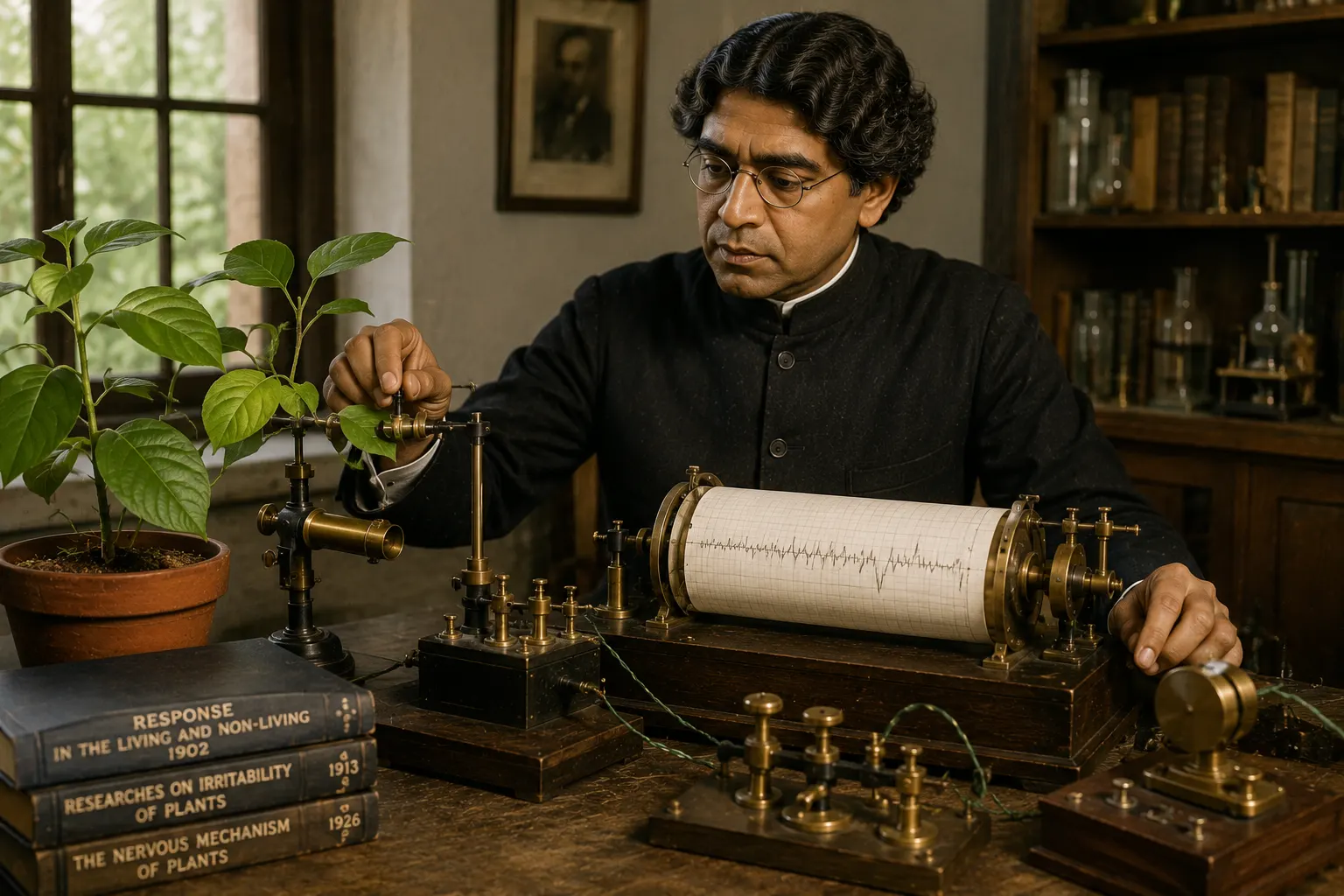
The Botanist Jagadish Chandra Bose
Calling Jagadish Chandra Bose a botanist is both correct and incomplete.
He investigated plants with extraordinary intensity, built instruments capable of recording movements and electrical responses that human senses could not detect, and helped push plant physiology toward increasingly quantitative experimentation.
Yet before Bose became famous for plants, he was performing pioneering experiments with electromagnetic waves. His scientific career passed through physics, instrumentation and biology so fluidly that modern disciplinary labels struggle to contain it.
Bose Institute, the research institution he founded in Calcutta in 1917, remembers him as a scientist whose work ranged across radio communication, semiconductor detection and plant physiology. His own 1902 book Response in the Living and Non-Living brought together experiments seeking similarities and differences in physical responses across biological and non-biological materials.
That breadth is the key to understanding Bose.
His central scientific question was not simply “How do plants grow?”
It was closer to this:
Can phenomena that appear invisible, subtle or subjective be converted into measurable physical signals?
Much of his career was an attempt to make the unseen record itself.
From Bengal to experimental physics
Jagadish Chandra Bose was born in 1858 in Bengal and later studied science in Britain before returning to India. He joined Presidency College in Calcutta, where he taught physics under a colonial educational system in which Indian scholars routinely encountered institutional inequality.
In the late nineteenth century, electromagnetic research was one of the most exciting fields in physics.
James Clerk Maxwell had provided a mathematical theory connecting electricity, magnetism and light. Heinrich Hertz had experimentally demonstrated electromagnetic waves. Researchers began exploring how such waves could be generated, detected, reflected, refracted and transmitted.
Bose joined that international experimental programme.
Bose and very short radio waves
During the 1890s, Bose worked with electromagnetic radiation at extremely short wavelengths—what would now generally be described as microwave or millimetre-wave regions.
He designed generators, detectors, polarising devices and other components to investigate how electromagnetic waves behaved.
IEEE historical material credits Bose with pioneering millimetre-wave systems and recognises his experimental apparatus as an early milestone in wireless and microwave science.
This part of his career is sometimes inflated into the claim that Bose “invented radio.”
That is too simple.
The development of radio emerged from the work of numerous researchers, including Hertz, Oliver Lodge, Alexander Popov, Guglielmo Marconi and others. Different investigators solved different problems: generation, detection, signalling, tuning and long-distance communication.
Bose's contribution was especially important in experimental work with very short electromagnetic wavelengths and detection devices.
That is significant enough without rewriting the history of radio around a single inventor.
A detector ahead of its time
Bose experimented with semiconductor-like detection mechanisms at a time when semiconductor electronics did not yet exist as a recognised technological field.
Later engineering histories have noted the importance of crystal detectors and rectifying contacts in his experiments.
This illustrates a recurring characteristic of Bose's work.
He was often compelled to invent his own instruments because commercial apparatus could not perform the measurements he wanted.
Instrumentation was not secondary to his science.
It was part of the science.
Why Bose moved toward biology
Around the turn of the twentieth century, Bose increasingly investigated physiological responses.
He became interested in whether living tissues responded to external stimuli in ways that could be physically measured.
His 1902 volume Response in the Living and Non-Living examined responses to stimuli across animal, plant and inorganic systems.
Bose was interested in continuity.
Could the same experimental language—electrical response, fatigue, recovery, excitation—be used to compare phenomena that scientists usually placed in completely different categories?
Some of his broader philosophical interpretations went beyond what modern biology would accept straightforwardly.
But the experimental programme itself was important.
Plants do generate electrical signals. They respond dynamically to mechanical injury, temperature, chemicals, light and other environmental stimuli. Contemporary plant electrophysiology is a legitimate scientific field.
What should be rejected is the popular oversimplification that Bose scientifically proved that plants “feel pain” exactly as animals or humans do.
He did not establish plant consciousness in the modern neurological sense.
He measured physiological responses.
Those are not the same claim.
Making plants write their own responses
One of Bose’s most famous achievements was the development of highly sensitive instruments for recording plant movement and growth.
The best known is associated with the term crescograph.
Plant growth can be far too slow for direct observation. An instrument that magnifies tiny movements can turn gradual biological change into visible data.
That transformation was methodologically important.
Instead of writing that a plant “appeared” to respond, the researcher could produce a record.
The plant became, metaphorically, its own graph-maker.
Bose went on to develop increasingly sophisticated experimental methods for examining responses to temperature, chemicals, injury and electrical stimulation.
His 1913 work Researches on Irritability of Plants and later publications documented this expanding programme. In 1926 he published The Nervous Mechanism of Plants, continuing his effort to interpret electrical and physiological signalling in plant tissues.
The danger of reading Bose through modern terminology
Bose's language can sound surprisingly contemporary.
Electrical signalling.
Excitation.
Response.
Fatigue.
Transmission.
Because plant science today also uses some of these concepts, it is tempting to claim that Bose “predicted” entire modern fields.
That should be done cautiously.
Scientific concepts change meaning over time. Similar vocabulary does not necessarily indicate identical theories.
Some of Bose’s experimental observations anticipated questions that remain important in plant physiology, particularly how plants transmit signals after stimulation.
But modern knowledge incorporates cellular biology, membrane ion channels, molecular signalling, genetics and biochemical pathways unavailable to Bose.
His importance lies in helping turn plant responsiveness into an experimentally measurable problem—not in having already discovered everything modern plant neurobiology or electrophysiology would later learn.
Living and non-living: a provocative comparison
Bose’s attempt to compare responses in living tissues and metals was scientifically provocative.
He believed that boundaries often treated as absolute might reveal continuities when studied through sensitive instruments.
Modern biology does not erase the distinction between living organisms and metals merely because both can exhibit physical responses to external forces.
Yet Bose’s experiments belonged to an important scientific instinct: do not assume a difference merely because traditional categories say it must exist.
Measure it.
His 1902 book openly placed “living” and “non-living” in the same experimental frame.
That approach was unusual enough to make him both admired and controversial.
A scientist shaped by colonial institutions
Bose’s career also unfolded within the unequal structures of British India.
Indian scientists had fewer institutional opportunities than their European counterparts and operated within an academic hierarchy closely tied to imperial administration.
This environment has sometimes encouraged heroic biographies in which Bose is portrayed as defeating the entire colonial scientific establishment single-handedly.
The history is more complicated.
He experienced discrimination, but he also participated in international scientific networks, studied in Britain, demonstrated experiments before European audiences and eventually gained significant institutional recognition.
He was elected a Fellow of the Royal Society in 1920, placing him among the relatively small number of Indian scientists to enter one of Britain's most prestigious scientific institutions.
Science, patents and the mythology of selflessness
Another popular story presents Bose as a scientist who rejected patents because he believed all knowledge should be free.
There is some truth behind his reluctance to commercialise inventions, but simplified versions can become misleading.
Bose did in fact receive a United States patent associated with one of his detector technologies.
The lesson is not that Bose was secretly commercial.
It is that historical personalities rarely fit perfectly into modern slogans such as “open science pioneer” or “anti-patent scientist.”
His attitudes toward ownership, scientific publication and commercial exploitation developed within a very different intellectual environment.
The creation of Bose Institute
In 1917, Bose established what became Bose Institute in Calcutta.
The institute represented more than a laboratory bearing its founder's name.
It embodied his aspiration to build a durable research environment in India capable of pursuing fundamental scientific questions across disciplinary boundaries.
Institution-building was essential for Indian science.
An individual scientist might produce discoveries. An institution could train generations.
Bose the instrument-maker
Perhaps the most coherent way to connect the different parts of Bose’s career is through instrumentation.
In physics, he needed ways to generate and detect extremely short electromagnetic waves.
In plant physiology, he needed ways to magnify tiny movements and record subtle electrical changes.
The subjects changed.
The experimental problem remained remarkably similar:
How do we detect something too small, too fast, too slow or too faint for ordinary perception?
That is why Bose's career feels less fragmented than it initially appears.
Radio waves and plants belonged to different disciplines, but both demanded instruments capable of turning invisible processes into evidence.
What he got right—and what should not be exaggerated
A balanced assessment of Bose requires three distinctions.
First, he was genuinely an important early experimentalist in microwave and millimetre-wave physics.
Second, he made substantial contributions to quantitative plant physiology and electrophysiological experimentation.
Third, those facts do not justify every claim later made in his name.
He did not single-handedly invent radio.
He did not demonstrate that plants possess human-like emotions.
He did not discover all modern semiconductor physics.
Historical pride becomes stronger, not weaker, when stripped of exaggeration.
The real Bose is scientifically more interesting than the legend.
Why Jagadish Chandra Bose still matters
Modern science is highly specialised.
A physicist working on electromagnetic propagation and a plant physiologist studying electrical signalling would normally belong to different departments, publish in different journals and attend different conferences.
Bose lived before those boundaries became as rigid.
His work therefore reminds us of an older style of experimental science in which the instrument, rather than the academic discipline, could organise a research programme.
His questions also remain contemporary.
How do living organisms sense their environments?
How are signals transmitted through biological tissue?
How can extremely small physical changes be amplified into measurable data?
How do new instruments reveal phenomena that existing theories overlook?
Bose spent much of his life developing ways to ask those questions experimentally.
His greatest legacy may therefore be neither “radio” nor “plants” taken separately.
It is the conviction that nature becomes more intelligible when the scientist learns how to make subtle processes measurable.