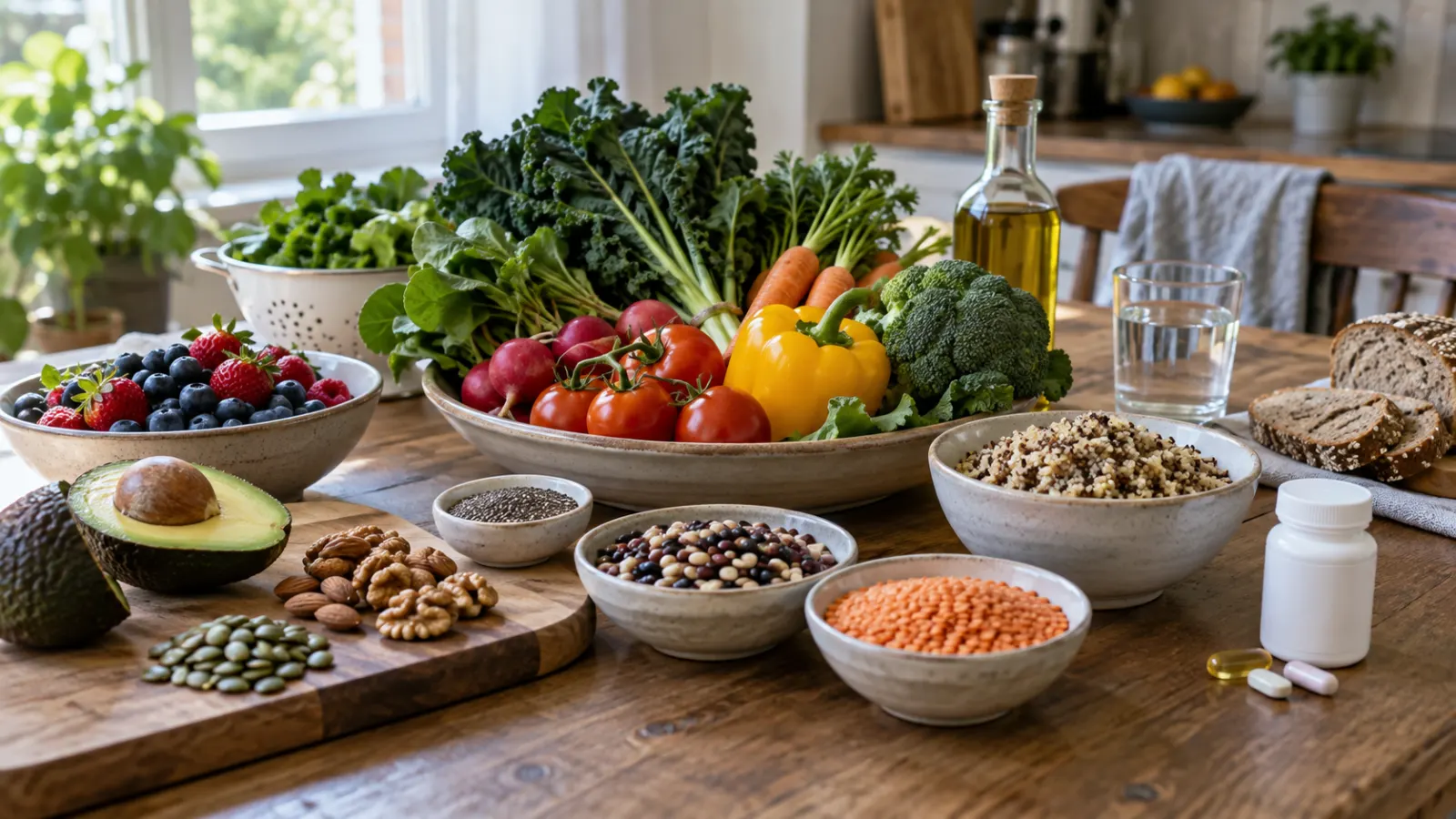
Benefits of Eating Vegetables: Why Variety Matters More Than Superfoods
Vegetables are routinely described as healthy, but that simple statement can hide why they matter. Spinach, carrots, tomatoes, cabbage, okra, onions, peppers and aubergine do not provide identical nutrients or affect a meal in exactly the same way. Some contribute substantial amounts of carotenoids, some are useful sources of folate or vitamin C, many provide potassium, and most non-starchy vegetables contribute water and dietary fibre while providing relatively little energy per gram.
That variation is one of their strengths.
The benefits of eating vegetables do not depend on discovering one “super vegetable” and eating it every day. A varied pattern is more likely to provide a broader mixture of nutrients and plant compounds than repeatedly relying on the same small group of foods. It also makes healthy eating more realistic because vegetables can be selected according to season, price, cuisine and availability rather than according to a rigid hierarchy of supposedly perfect foods.
Current World Health Organization guidance reflects this broader dietary approach. WHO recommends that carbohydrates come primarily from whole grains, vegetables, fruits and pulses and that people older than 10 aim for at least 400 grams of fruits and vegetables combined each day. WHO also emphasises dietary diversity rather than reliance on individual foods.
The useful message is therefore ordinary rather than dramatic: eat vegetables regularly, eat different kinds over time and prepare them in ways that make the habit sustainable.
Vegetables contribute fibre, micronutrients and dietary variety
Dietary fibre is one reason vegetables are valuable, although vegetables are not the only important fibre source. Whole grains, pulses, fruits, nuts and seeds also contribute substantially.
Fibre adds bulk to stool and supports normal bowel function, but its effects extend beyond constipation prevention. Different forms of fibre behave differently in the digestive system. Some slow digestion or influence post-meal glucose responses, while some fermentable fibres are used by intestinal microorganisms, producing metabolites such as short-chain fatty acids.
Vegetable-rich meals can also support fullness because vegetables often contain substantial water and fibre relative to their energy content. Adding vegetables to a meal can increase its physical volume without increasing energy intake as much as adding the same weight of foods dominated by fat or refined carbohydrates.
That does not mean vegetables automatically produce weight loss. Total dietary intake, preparation methods, appetite, physical activity and many other factors still matter. The more defensible point is that vegetables can improve the nutrient density and volume of meals.
Their micronutrient contribution is similarly diverse.
Dark-green leafy vegetables such as spinach, amaranth leaves and kale can contribute folate, vitamin K and carotenoids. Carrots, pumpkin and other orange vegetables provide beta-carotene and related compounds. Peppers and several cruciferous vegetables can contribute vitamin C. Tomatoes are well known as sources of lycopene, while potassium is distributed across many vegetables.
Actual nutrient concentrations vary according to plant variety, growing conditions, maturity, storage and preparation. That variability is another reason not to build a diet around obtaining one nutrient from one food.
Variety provides redundancy.
If several kinds of vegetables appear regularly across meals, the diet becomes less dependent on the exact nutrient content of any single serving.
Vegetables contain useful plant compounds, but they are not medicines
Vegetables also contain a large range of compounds that are not classified as conventional vitamins or minerals.
Carotenoids, flavonoids, glucosinolate-related compounds and many other phytochemicals are studied for their interactions with oxidative processes, cell signalling, inflammation and metabolism.
This research is scientifically important, but it has also created a market for exaggerated claims.
Finding a biologically active compound in broccoli, garlic, tomatoes or another vegetable does not make that food a treatment for disease. Biological activity observed in laboratory experiments may occur at concentrations very different from those produced by eating ordinary portions, and human health outcomes depend on the whole diet, lifestyle, genetics, environment and many other factors.
Terms such as “detox vegetable” are particularly unnecessary. Human bodies already possess organs and metabolic systems—including the liver and kidneys—that process and eliminate many substances. Vegetables support a healthy diet because they provide nutrients, fibre and useful dietary diversity, not because one food performs a special cleansing process.
The same caution applies to cancer claims.
Individual vegetables are frequently promoted as foods that “fight” or “prevent” cancer. Research on compounds in cruciferous vegetables, alliums and colourful produce is legitimate, but no single vegetable provides protection against all cancers.
The European Code Against Cancer recommends a broader dietary pattern rich in whole grains, pulses, vegetables and fruits rather than identifying one protective superfood. That approach reflects evidence linking overall dietary patterns with health outcomes rather than assuming that one ingredient can cancel major risks such as smoking, alcohol use or excess body fat.
The overall dietary pattern matters more than one vegetable
Large nutrition studies frequently find associations between diets rich in fruits, vegetables and other minimally processed plant foods and better cardiovascular and other health outcomes.
But observational findings need careful interpretation. People who eat many vegetables may also differ from people who eat few vegetables in physical activity, smoking, income, education and other dietary habits. Researchers attempt to account for these differences, but no observational study can perfectly isolate every behaviour.
That is another reason public-health recommendations focus on an overall healthy dietary pattern rather than promising that a particular vegetable will prevent a particular disease.
WHO's current guidance recommends that adults and children older than 10 consume at least 400 grams of fruits and vegetables combined per day and at least 25 grams of naturally occurring dietary fibre for those age groups. Younger children have lower age-specific fruit-and-vegetable targets.
The word combined matters.
The 400-gram target does not mean adults must eat exactly 400 grams of vegetables or divide the amount evenly between fruits and vegetables. It is a population-level recommendation intended to encourage substantial intake of these foods as part of a balanced diet.
Nor does one day determine health. A day with relatively few vegetables is not a nutritional failure, just as one enormous salad does not compensate for weeks of consistently low intake.
Dietary patterns accumulate over time.
Raw vegetables are not automatically healthier than cooked ones
The belief that vegetables are healthiest only when raw is too simple.
Cooking can reduce some heat-sensitive nutrients. Vitamin C and folate, for example, can decline with prolonged heating, particularly when vegetables are boiled in large amounts of water that is then discarded.
But cooking can also make vegetables easier to chew and digest and can increase the availability of some compounds by softening plant structures. Carotenoids in certain vegetables can become more accessible after cooking, and eating carotenoid-rich vegetables with some dietary fat can assist absorption.
The practical conclusion is not that cooked vegetables are superior either.
A combination of raw and cooked vegetables provides variety in texture, flavour and preparation while avoiding unnecessary rules.
Steaming, microwaving, roasting, sautéing, pressure cooking and lightly boiling vegetables can all fit within a healthy dietary pattern. Different cuisines use different methods, and the method people enjoy and can maintain consistently may be more valuable than a theoretically ideal preparation they rarely use.
Preparation should also be considered in the context of the whole dish.
Cooking vegetables with oil does not make them unhealthy. Some fat improves flavour and can support absorption of fat-soluble compounds. Problems arise when vegetables become vehicles for very large quantities of sodium, saturated fat or energy—for example through repeated deep frying or extremely rich sauces.
The aim is not to make vegetables tasteless.
It is to keep the vegetable an important part of the dish.
Frozen and canned vegetables can be nutritious choices
“Fresh” is often treated as synonymous with nutritious, but that can create unnecessary cost and inconvenience.
WHO's updated healthy-diet guidance explicitly notes that frozen and canned vegetables and fruits can be good choices, provided they are not loaded with excess sodium or added sugars.
Frozen vegetables are commonly processed soon after harvest and can retain nutrients well. They can also reduce household food waste because people can use only the amount required and keep the remainder frozen.
Canned vegetables have additional advantages: long shelf life, convenience and often low cost. Sodium content varies substantially among products, so choosing lower-sodium options where available can be useful. Draining and rinsing some canned vegetables may also remove part of the sodium present in the packing liquid.
These practical options matter because nutritional advice is useful only when households can follow it.
A recommendation built entirely around daily purchases of expensive fresh produce may be unrealistic for someone with limited refrigeration, irregular working hours, disability, seasonal shortages or restricted access to food shops.
Seasonal produce, frozen vegetables and canned options can all contribute to a healthy diet.
Eating a variety of vegetables is more useful than chasing colours perfectly
Advice to “eat the rainbow” can be a helpful reminder that vegetables differ nutritionally, but it can also become another unnecessary rule if people believe every meal must contain several colours.
It does not.
Across a week, a household might rotate among leafy greens, cabbage or cauliflower, carrots or pumpkin, tomatoes and peppers, onions, okra, aubergine and whatever other vegetables are affordable and locally available.
Broad categories can help explain why variety is useful. Dark-green vegetables often provide different nutrient combinations from orange vegetables, while cruciferous vegetables contain compounds different from those characteristic of onions and garlic.
But these categories overlap.
No vegetable category performs a unique function that makes it mandatory at every meal, and nobody needs to calculate a perfect colour distribution.
The goal is simply to avoid allowing the vegetable component of the diet to become extremely narrow.
Traditional cuisines already make this easier. Indian meals, for example, can incorporate vegetables through sabzi, sambar, mixed dals, curries, stir-fries, stuffed breads, vegetable pulao and many other familiar preparations. Other cuisines have their own vegetable-rich soups, stews, sauces and mixed dishes.
Improving vegetable intake therefore does not require replacing familiar cuisine with imported salads.
Often the more sustainable change is increasing the quantity and variety of vegetables inside foods people already know how to cook and enjoy.
Starchy and non-starchy vegetables play somewhat different dietary roles
The everyday category “vegetable” does not always match botanical or nutritional classification.
Tomatoes, peppers and aubergines are botanical fruits but function as vegetables in ordinary meals. Potatoes, cassava and other starchy roots are vegetables in everyday language but provide substantially more starch than leafy greens, tomatoes or cabbage.
WHO's older and current guidance around fruit-and-vegetable targets typically distinguishes starchy roots from the non-starchy vegetables counted toward those recommendations.
That does not mean potatoes or other starchy roots are inherently unhealthy. They can provide carbohydrate, potassium, vitamin C and other nutrients depending on the food and preparation. They simply perform a different role in a meal from lower-starch vegetables.
Similarly, pulses such as lentils, chickpeas and beans deserve special mention. Depending on the classification system, they may not always be grouped with vegetables, but nutritionally they are highly valuable sources of fibre, protein and micronutrients. WHO recommends vegetables, fruits, pulses and whole grains together as major sources of high-quality dietary carbohydrate.
Ordinary eaters do not need to become experts in botanical classification. What matters is building meals around a broad range of minimally processed plant foods.
Accessibility matters more than culinary perfection
Nutrition advice can become detached from reality when it assumes everybody has the same money, time, kitchen equipment and food supply.
Vegetable intake can be affected by price, seasonality, transport, refrigeration, physical ability, cooking skills, household preferences and the amount of time available for food preparation.
These constraints matter.
A vegetable that is inexpensive, familiar and cooked regularly is nutritionally more useful than an expensive “superfood” purchased once because it appeared on a health list.
Simple strategies can make regular intake easier: buying seasonal vegetables, using frozen mixed vegetables, cooking larger batches of vegetable dishes, adding vegetables to soups and stews, keeping longer-lasting produce available and choosing canned products when they fit the household's needs.
Health advice should also respect culture.
Food carries family traditions, religious practices and social meaning. A healthy dietary pattern does not require erasing those traditions. In many cases, traditional meals already contain strong nutritional foundations that can be improved by altering proportions or increasing vegetable variety.
The sustainable diet is usually the one people can afford, prepare, enjoy and repeat.
Food safety is part of healthy vegetable consumption
Nutritional value means little if food is contaminated.
Raw vegetables can acquire microorganisms through soil, water, transport, markets, kitchens or contact with contaminated surfaces. Basic food-safety practices therefore remain important: use safe water, wash produce appropriately, keep raw vegetables separate from raw meat and refrigerate cut or perishable produce when necessary.
Raw should not be assumed to mean safer or healthier.
Some vegetables are commonly eaten raw and can form part of a healthy diet. Others are better cooked for digestibility, palatability or food safety.
The objective is to balance nutrient preservation with safe preparation rather than treating minimal cooking as a virtue in itself.
Food safety also reinforces the broader theme of this article: nutrition operates in real households, not in laboratory isolation. A theoretically nutrient-maximising practice that is expensive, unsafe or unpleasant may not improve health in practice.
The best vegetable habit is regular, varied and sustainable
The nutritional case for vegetables is strong without exaggeration.
They contribute dietary fibre, water, vitamins, minerals and a wide range of plant compounds. They can increase the volume and nutrient density of meals. Different vegetable groups offer different nutritional profiles, which makes variety useful.
But vegetables should not be treated as medicine, detox products or magical protection against disease.
Current public-health guidance places them alongside fruits, pulses, whole grains and other nutritious foods within a diverse dietary pattern. WHO specifically identifies diversity as one of the core principles of a healthy diet and recommends substantial regular intake of fruits and vegetables rather than reliance on one type.
Fresh vegetables count. Frozen vegetables count. Canned vegetables can count. Raw and cooked vegetables can both contribute.
The useful goal is therefore regularity plus variety.
Eat vegetables often enough that they become an ordinary part of meals. Rotate among different types when practical. Choose preparation methods you enjoy and can sustain. Use local and affordable foods rather than chasing nutritional fashion.
The health value of vegetables is cumulative and unglamorous.
It comes from many different vegetables, eaten repeatedly as part of an overall diet that works in everyday life.
Medical Note
This article provides general nutrition information and is not a substitute for individual medical or dietetic advice. Nutritional needs can differ during pregnancy and with conditions including kidney disease, gastrointestinal disorders, diabetes, diagnosed deficiencies, food allergies and eating disorders. Some medicines can also affect dietary requirements or interact with particular foods. Individual concerns should be discussed with an appropriately qualified healthcare or nutrition professional.