In July 1856, the government of British India enacted a law whose formal purpose was narrow but whose social implications were explosive. Act XV of 1856 declared that marriages contracted by Hindu widows would not be legally invalid merely because custom or interpretation of Hindu law had prohibited them.
The statute did not end the suffering of widows. It did not erase social stigma. It did not create gender equality. Yet its existence marked the success of a public controversy in which Ishwar Chandra Vidyasagar had become the most prominent Indian advocate of widow remarriage in Bengal.
That episode is the part of his life most often remembered.
It is also too small a frame.
Vidyasagar was a Sanskrit scholar, educator, administrator, Bengali prose stylist, textbook author, printer-publisher, institution-builder and philanthropist. His reform campaigns were inseparable from his belief that knowledge had to be made accessible through language, schools and institutional change.
His career therefore offers a useful corrective to the idea that social reform is mainly a matter of enlightened opinion. Vidyasagar repeatedly tried to turn argument into infrastructure.
A difficult beginning and an extraordinary education
Ishwar Chandra Bandyopadhyay was born on 26 September 1820 in Birsingha, in the Bengal Presidency. Later biographies emphasised his family’s limited means and the hardships associated with his education in Calcutta.
Some of those stories acquired a legendary quality: the poor boy studying under street lamps, the scholar whose discipline overcame every obstacle. Modern historians such as Brian A. Hatcher have shown why Vidyasagar’s afterlife as a moral icon needs to be separated from the documentary reconstruction of his life.
What is beyond dispute is that he became an exceptional student at Sanskrit College in Calcutta and earned the honorific “Vidyasagar,” usually rendered as “Ocean of Learning” or “Ocean of Knowledge.”
His mastery of Sanskrit was important not simply as an academic achievement. It later gave him authority in debates where reformers had to confront orthodox opponents on the terrain of Hindu textual tradition itself.
Sanskrit College and the politics of education
Vidyasagar’s early professional career was closely connected with Sanskrit education. He worked at Fort William College and later at Sanskrit College, eventually serving as principal during the 1850s.
His approach to education was reformist but not anti-classical.
He valued Sanskrit learning while questioning methods and institutional rules that made education unnecessarily narrow. He supported curricular changes, greater attention to modern subjects and a more practical administrative structure.
This is an important distinction. Nineteenth-century reform in India did not always divide cleanly into “Western education” versus “traditional learning.” Vidyasagar’s own intellectual formation was deeply Sanskritic, yet he believed inherited institutions could be reorganised.
His goal was not to destroy classical knowledge but to prevent reverence for tradition from becoming an excuse for intellectual stagnation.
Bengali prose as public infrastructure
Vidyasagar’s educational influence extended beyond institutions because he worked on the language through which education itself was delivered.
His name is closely associated with Barnaparichay, a Bengali primer that became enormously influential in elementary learning. He also wrote, adapted and translated texts intended for students.
The importance of a primer can be easy to underestimate.
Mass education depends on standardisation: alphabets, spelling conventions, graded lessons, affordable books and a prose style that ordinary learners can understand. A brilliant university lecture reaches dozens. A school primer can shape millions of encounters with literacy.
Vidyasagar’s contribution to Bengali prose emerged partly from this educational problem. He helped develop a style that could be formal without being needlessly obscure.
Later celebrations sometimes describe him as the single creator of modern Bengali prose. That is too absolute. Language changes through many writers, printers, schools and readers. But his influence on prose standardisation and school literature was substantial.
Printing, publishing and independence
Vidyasagar understood that educational reform required control over the production of books.
He became deeply involved in printing and publishing, including through the Sanskrit Press. This was not merely a commercial side project. Publishing gave reformers a way to circulate textbooks, polemics and literary works outside the constraints of government institutions.
Modern scholarship has drawn attention to the economic significance of this part of his career. Earnings from successful publications helped support his independence and philanthropy.
That matters because reform is easier to imagine than to finance.
Schools require buildings and salaries. Campaigns require printing. Poor students need assistance. Widows who remarry may require financial support when families withdraw it.
Vidyasagar’s identity as author-publisher therefore reinforced his identity as reformer.
The condition of Hindu widows
The widow-remarriage controversy placed Vidyasagar at the centre of one of the most bitter social disputes of nineteenth-century Bengal.
Among several upper-caste Hindu communities, especially those in which child marriage was common, widowhood could begin when a girl was still very young. A widow might face restrictions on clothing, food, sexuality, remarriage and participation in ordinary domestic life.
The exact condition of widows differed across caste, region and class. It would be wrong to treat all Hindu communities as following one uniform practice.
But the problem was severe enough to become a major reform issue.
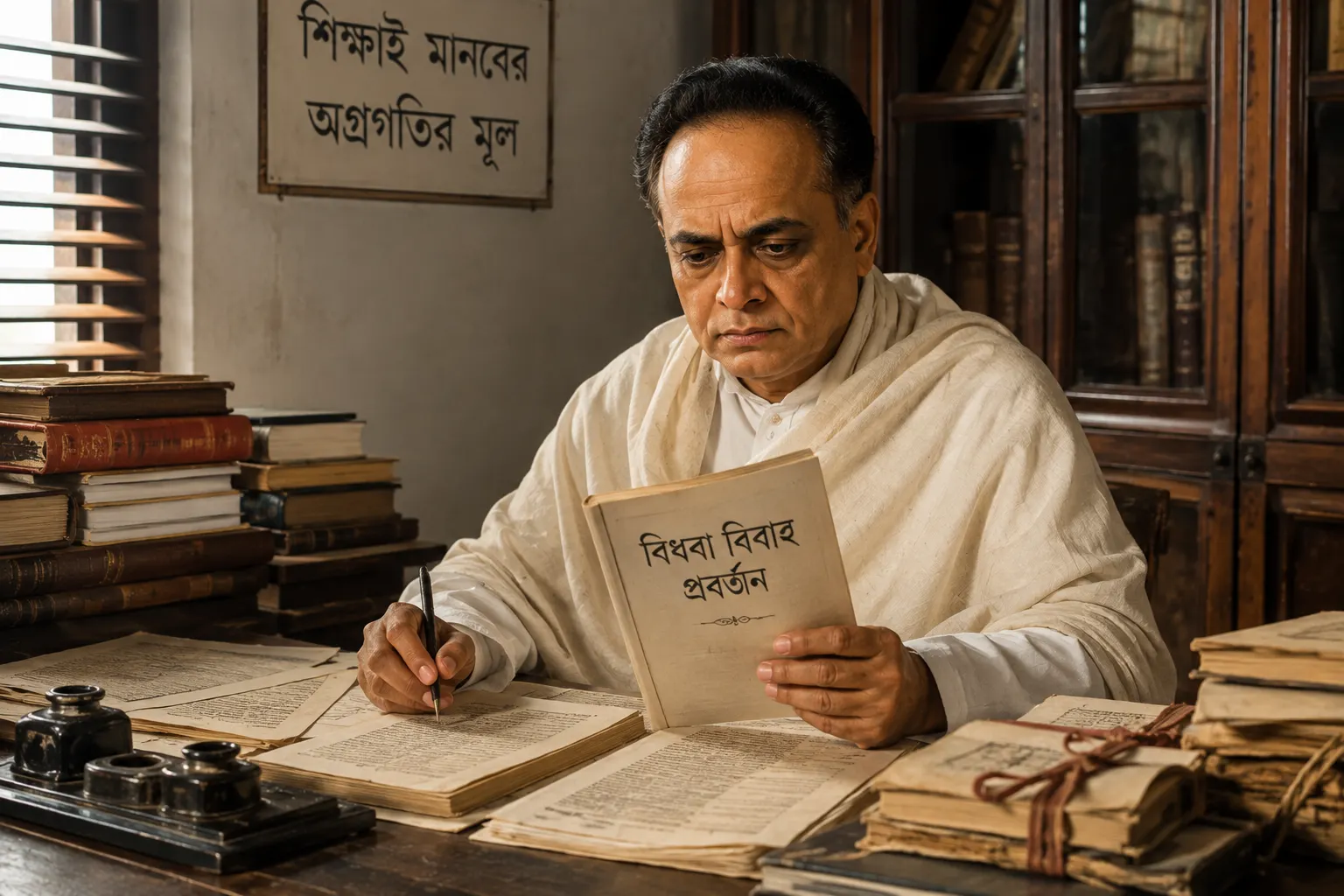
Vidyasagar’s strategy was significant. Rather than arguing only from abstract individual rights, he turned to Sanskrit texts and attempted to show that Hindu scripture permitted widow remarriage under relevant circumstances.
This was partly a tactical choice.
A reform that could be presented as scripturally defensible was harder for opponents to dismiss as mere imitation of European morality.
Argument, petition and law
Vidyasagar published Bengali tracts on widow remarriage and petitioned the colonial government.
Orthodox opponents organised against the proposal and submitted counter-petitions. The debate therefore became more than an exchange among intellectuals; it became a contest over who could legitimately interpret Hindu tradition and whether the colonial state should intervene in matters of personal law.
Act XV of 1856 eventually removed legal obstacles to Hindu widow remarriage. India Code preserves the original statute, whose opening purpose was explicitly to remove legal obstacles to such marriages.
The wording is revealing.
The law did not command widows to remarry. It did not declare custom morally wrong. It established legal validity where customary interpretations had denied it.
This distinction explains both the reform’s importance and its limits.
Law could make remarriage possible without making it socially accepted.
The first remarriages and the limits of legislation
After the Act, Vidyasagar helped support actual widow remarriages.
This practical involvement mattered because opponents could otherwise ensure that a legal reform remained symbolic. Families might refuse consent, social networks could impose sanctions, and prospective husbands could fear ostracism.
Accounts of the early remarriages describe intense public controversy and personal attacks on Vidyasagar and participants.
The experience revealed something central to the sociology of reform: changing formal law is often easier than changing social incentives.
Widow remarriage remained uncommon among many groups even after legalisation.
It would therefore be misleading to claim that Vidyasagar “solved” widowhood through one Act. His achievement was to shift the boundary between prohibition and possibility.
Women’s education
Vidyasagar’s commitment to women’s education was at least as important as his widow-remarriage campaign.
He was associated with efforts to expand girls’ schooling and, while serving in educational administration, promoted the establishment of schools in Bengal.
Popular accounts often give precise numbers of schools “founded by Vidyasagar.” Such figures vary depending on whether a writer counts schools he personally established, inspected, encouraged, financed or helped administer.
The safer historical conclusion is broader: he was one of the major nineteenth-century advocates and organisers of institutional education for girls in Bengal.
His reasoning was practical. A society could not plausibly claim improvement while keeping women deliberately uneducated.
Yet female education generated resistance because it threatened family arrangements and social assumptions. Opponents worried that schooling would disrupt domestic roles, religious customs and marriage patterns.
Vidyasagar’s educational reform therefore touched the same structures challenged by widow remarriage.
Reform from inside and outside institutions
One of the most distinctive features of Vidyasagar’s career was his willingness to work within government institutions and then leave them when bureaucratic limits became intolerable.
He was not a political nationalist in the later mass-movement sense. His central battles concerned education, language, social custom and institutional autonomy.
But his work helped create forms of Indian civil society that reduced dependence on colonial administration.
The Metropolitan Institution is a good example.
The institution that eventually became Vidyasagar College developed under his leadership as an Indian-managed educational project. Vidyasagar College’s own institutional history connects its development directly to his determination to build an independent centre of learning.
This made education not only a means of individual advancement but also a field in which Indians could demonstrate organisational capacity.
The social reformer and the social conservative
Modern readers often want reformers to possess a consistent set of contemporary progressive beliefs.
Historical figures rarely cooperate.
Vidyasagar was radical on some questions and cautious on others. His reasoning could be humanitarian, scriptural and paternalistic at the same time. He did not reject Hindu society as a whole; he tried to alter practices he believed were cruel, irrational or unsupported by authoritative texts.
This placed him differently from later anti-caste thinkers such as Jyotirao Phule or B. R. Ambedkar, whose critiques attacked the structure of caste hierarchy more fundamentally.
Comparing them is useful precisely because “social reform” was not one ideology.
Vidyasagar’s model was often reform through education, moral persuasion, institutional innovation and selective legal change.
Beyond widow remarriage: polygamy, child marriage and the structure of reform
Widow remarriage was the campaign in which Vidyasagar achieved the clearest legislative result, but his social thought was not confined to one custom. He criticised practices that left women vulnerable inside arranged and unequal marriages, including polygamy among sections of upper-caste society and the consequences of very early marriage.
These campaigns were harder to translate into immediate legal success. They also expose the limits of describing nineteenth-century reform through a sequence of statutes. Social customs were sustained by kinship, property, religious authority and status. A law could alter formal validity without automatically changing the incentives facing a family.
Vidyasagar therefore moved repeatedly between different instruments: textual argument, public controversy, petition, schooling, publishing and private financial support. This repertoire explains why his career is more useful than a simple story of a reformer persuading a government to pass a law.
It also shows the political ambiguity of colonial social legislation. Reformers could use state power to weaken a harmful custom, while opponents could answer that foreign rulers lacked moral authority to reshape Hindu life. The same dilemma later appeared in debates involving the Age of Consent legislation and figures such as Bal Gangadhar Tilak.
For Vidyasagar, the answer was not to abandon law. It was to ground reform in arguments that could also be defended within Indian intellectual traditions.
Philanthropy and the making of a moral legend
Stories of Vidyasagar’s generosity became central to his public memory.
He supported students, widows, poor families and educational institutions, often at considerable personal cost. Later biographies made compassion almost as important to his image as scholarship.
The danger is that repeated anecdotes can turn a person into a moral fable.
Brian Hatcher’s modern scholarship is especially valuable here because it examines not only Vidyasagar’s life but also the construction of “Vidyasagar” as an exemplary Bengali figure after his death.
That afterlife matters.
A society chooses what to remember. Vidyasagar became a symbol of rationality, courage, learning, simplicity and benevolence because those virtues were useful to later educational and nationalist cultures.
The symbolism was not invented from nothing, but it amplified selected aspects of a more complicated life.
Later years away from Calcutta
Vidyasagar increasingly withdrew from the intensely contested institutional life of Calcutta.
Accounts of his later years emphasise his time in Karmatar, in present-day Jharkhand, where he had contact with local Santal communities and continued charitable activity.
This later phase has often been incorporated into the image of the reformer who grew disillusioned with elite society but continued serving ordinary people.
Again, the moral narrative should not replace evidence. What is historically significant is that his public influence did not depend on holding high colonial office.
By then, his books, institutions and reputation had acquired lives of their own.
He died on 29 July 1891.
Vidyasagar and the Bengal Renaissance
Vidyasagar is often grouped under the broad label “Bengal Renaissance.”
The term is useful if it refers to the extraordinary nineteenth-century transformation of education, print, literature, religious debate and social reform in Bengal.
It becomes misleading if it suggests a simple Indian copy of the European Renaissance or if it hides conflict beneath a story of uninterrupted progress.
Vidyasagar’s life itself demonstrates the contradictions.
Colonial institutions created new educational opportunities while maintaining racial hierarchy.
Western legal forms could assist social reform while also allowing the colonial state to claim moral superiority over Indian society.
Sanskrit learning could be used both to defend custom and to challenge it.
Print culture could spread reform and intensify conservative mobilisation at the same time.
The “renaissance” was therefore a contested transformation, not a single movement.
The legal legacy of 1856
The Hindu Widows’ Remarriage Act has a complicated legal afterlife.
Its historical role was major because it removed a specific legal disability. But independent India later transformed Hindu family law more comprehensively, and the 1856 Act itself was eventually repealed in 1983 after its operative framework had been superseded.
That repeal does not make the law historically irrelevant.
Laws can be important because of the barrier they first break, even when later statutes replace them.
For Vidyasagar, the Act’s deeper importance was that it demonstrated the possibility of forcing a social question into public law through scholarship, petition and organised advocacy.
Why Ishwar Chandra Vidyasagar still matters
Vidyasagar’s legacy is strongest when separated from exaggerated hero worship.
He did not single-handedly modernise Bengali. He did not create women’s education by himself. He did not end the misery of widows through one statute. He did not represent every current idea of equality.
What he did was more concrete.
He used scholarship to challenge an entrenched custom.
He turned linguistic reform into schoolbooks.
He moved between government colleges and Indian-managed institutions.
He treated publishing as an educational technology.
He spent money and reputation on reforms that generated serious social opposition.
And he understood that humane ideas become historically consequential only when they acquire texts, laws, classrooms and institutions.
That combination of intellectual argument and administrative practice is why Vidyasagar remains one of the most consequential reformers of nineteenth-century India.