The lender countries meet when choices narrow
The International Monetary Fund is often mentioned only when a country is in trouble. A currency collapses, foreign exchange reserves fall, debt repayments become difficult, inflation becomes politically unbearable, and suddenly the IMF appears in the national conversation. For many citizens, the institution is associated with crisis, austerity and external pressure. For others, it represents rescue, discipline and the last line of global financial support.
Both images are incomplete. The IMF is neither a charity nor a world government. It is an international financial institution created to support monetary cooperation, financial stability and crisis management among member countries. Its work ranges from economic surveillance and technical advice to emergency lending and research. But because its loans often arrive when countries are desperate, its influence can feel larger than its formal mandate.
To understand the IMF properly, readers must move beyond the simple question of whether it is good or bad. The deeper question is why countries need the IMF at all. Why do sovereign governments, with their own currencies, parliaments and central banks, sometimes turn to an external institution for help? The answer lies in the hard constraints of global finance: debt, foreign exchange, investor confidence, import dependence and the inability of any country to print another country's currency.
Why the IMF was created
The IMF was born from the breakdowns that marked the first half of the twentieth century. Competitive devaluations, financial instability, the Great Depression and the devastation of the Second World War convinced policymakers that the world needed institutions to manage monetary cooperation. The idea was not simply to prevent financial chaos; it was to prevent financial chaos from becoming political extremism and geopolitical conflict.
The IMF became part of the Bretton Woods architecture. Its central purpose was to help countries manage balance-of-payments problems without destroying their economies or destabilising the international system. In simple terms, a balance-of-payments problem arises when a country does not have enough foreign currency to meet its external obligations. It may need dollars, euros, yen or other reserve currencies to pay for imports, repay debt or stabilise its exchange rate. If those reserves run low, economic policy becomes constrained.
This is the key to understanding the IMF. A country can create its own domestic currency, but it cannot create unlimited foreign currency accepted by global creditors and suppliers. A government may be able to pay salaries in its own money, but it needs foreign exchange to import oil, medicines, machinery or food. When that external account breaks down, the domestic economy begins to feel the pressure quickly.
What the IMF actually does
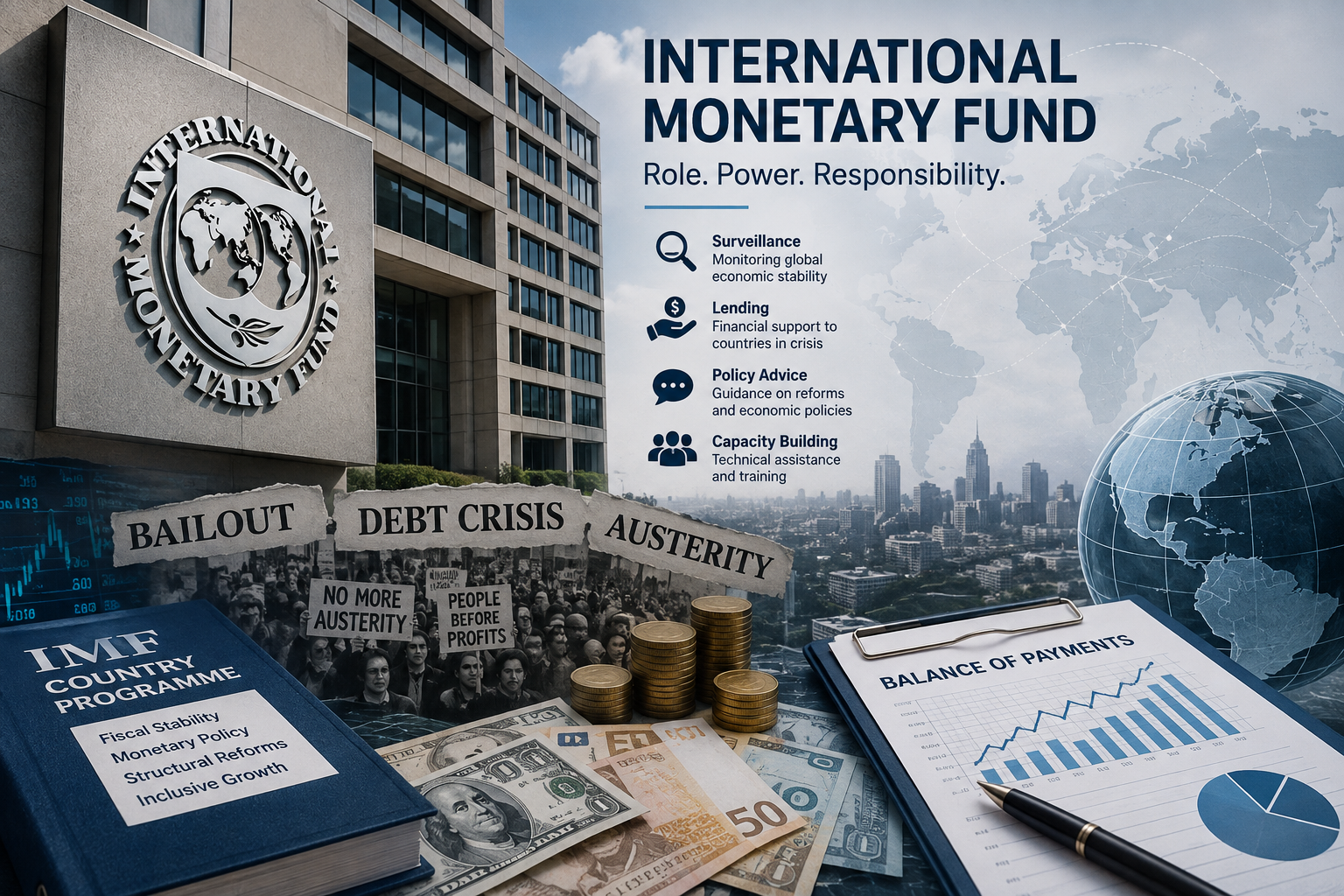
The IMF performs three broad functions. The first is surveillance. It studies member economies, publishes assessments, examines fiscal policy, monetary policy, debt sustainability, exchange rates, inflation and financial-sector risk. This surveillance is meant to warn countries before problems become crises. In practice, its influence depends on whether governments listen before the market forces them to listen.
The second function is lending. When a country faces a serious external financing gap, the IMF can provide financial assistance. This lending is not like a normal commercial bank loan. It is tied to a programme - a set of policy commitments designed to restore stability, rebuild reserves, reduce fiscal stress, improve the financial system or correct structural weaknesses. The money gives the country time. The conditions are meant to ensure that the time is not wasted.
The third function is capacity development. Many states need help strengthening tax systems, central banking, public finance management, statistics, financial regulation or debt management. These areas may sound technical, but they are deeply political because weak institutions make crises more likely. A country with poor fiscal data, weak bank supervision or unrealistic budgets can walk into a debt problem without seeing the warning lights early enough.
Why countries borrow from the IMF
Countries usually approach the IMF when their options have narrowed. Foreign investors may refuse to roll over debt. Import bills may rise faster than export earnings. The currency may come under attack. The central bank may burn through reserves trying to defend the exchange rate. Domestic banks may hold too much government debt. A sovereign default may become possible. At that point, the IMF becomes a way to restore credibility and unlock additional funding from other lenders.
IMF financing is not only about the money itself. It can act as a signal. When the IMF approves a programme, other creditors may believe that the country has a credible adjustment plan. Multilateral lenders, bilateral partners and private investors may become more willing to provide support. This catalytic effect is one reason countries accept the political cost of an IMF programme.
But the political cost is real. IMF programmes often require difficult adjustments: reducing fiscal deficits, raising revenue, cutting inefficient subsidies, reforming state-owned enterprises, strengthening central bank independence, allowing exchange-rate flexibility or improving debt transparency. Even when these measures are economically defensible, they can create pain for citizens if implemented too sharply or without social protection.
The controversy around conditionality
The most debated word in IMF politics is conditionality. Conditionality means that IMF lending comes with policy commitments. Supporters argue that this is necessary because the IMF lends public international resources and must ensure that countries can repay. A loan without reform may only delay collapse. If the underlying imbalance remains, the country returns to crisis with more debt and less credibility.
Critics argue that conditionality can become excessive, rigid or socially damaging. They point to cases where austerity deepened recessions, public spending cuts hurt vulnerable groups, and external prescriptions failed to account for domestic political realities. The criticism is not merely ideological. Economic adjustment is always a distributional question. Who pays for stabilisation? Workers, taxpayers, pensioners, importers, consumers, banks, creditors or political elites?
The strongest analysis must hold both truths together. Some countries reach the IMF because years of domestic mismanagement made adjustment unavoidable. But adjustment can be designed well or badly. A reform package that restores stability while protecting the poor is different from one that balances accounts by weakening public health, education or social trust. The quality of conditionality matters.
The India lens
India's own economic history shows why IMF debates matter. The 1991 balance-of-payments crisis remains one of the most important turning points in modern Indian economic policy. India faced severe foreign exchange pressure, and the crisis created the political space for liberalisation, deregulation and external-sector reforms. The lesson is not that crisis is desirable. The lesson is that weak external buffers can force a country to change under pressure rather than by design.
Today, India's situation is very different from 1991. Foreign exchange reserves, capital markets, external-sector management and policy capacity are much stronger. But the logic of vulnerability has not disappeared. Oil imports, global interest rates, currency volatility, capital flows and geopolitical shocks still affect India. A country with India's ambitions must understand the IMF not as a distant institution for failed economies, but as part of the architecture that shapes global financial confidence.
For Indian readers, the IMF also matters because many neighbouring and partner countries have depended on IMF support. Sri Lanka, Pakistan and several developing economies have faced debt or balance-of-payments stress. Their crises affect India through migration, trade, security, regional stability and diplomatic choices. Economic instability is never contained neatly within borders.
What the IMF gets right and wrong
The IMF gets one major thing right: macroeconomic denial is costly. Governments can postpone hard choices, but markets, reserves and debt schedules eventually impose discipline. Unsustainable fiscal deficits, fixed exchange rates without adequate reserves, opaque borrowing and weak banking systems cannot be hidden forever. The IMF forces the conversation to deal with arithmetic.
But the IMF can be weaker when arithmetic becomes separated from legitimacy. A stabilisation programme that citizens view as externally imposed can face resistance even if the numbers make sense. Reform cannot survive only on spreadsheets. It needs communication, sequencing, social protection and credible domestic ownership. If citizens believe that elites caused the crisis while ordinary people pay the cost, the programme becomes politically fragile.
The institution has evolved over time, especially in its attention to poverty, inequality, climate risk, financial-sector spillovers and social spending. Yet the tension remains: the IMF is asked to move fast in crises, but the causes of crises are often slow, structural and political. A loan can create breathing room. It cannot substitute for national governance.
Final takeaway
The International Monetary Fund should be understood as a crisis institution, a policy adviser and a mirror. It reflects what countries do not want to admit about debt, reserves, inflation, public finance and external dependence. Its arrival in a national crisis is rarely the beginning of the problem. Usually, it is the moment when the problem can no longer be denied.
For readers, the important lesson is not to treat the IMF as a villain or saviour. The IMF is a tool in the global financial system. Like any tool, its effect depends on how it is used, who controls the national policy process, who bears the adjustment burden and whether reforms address causes rather than symptoms. A country that builds strong institutions, credible budgets, resilient reserves and honest data reduces the chance of needing the IMF under pressure.
The most mature view is therefore practical: the IMF matters because economic sovereignty is strongest before crisis, not during it. Once a country runs out of reserves, credibility and time, policy choices shrink. The real lesson of the IMF is that nations must govern their finances before markets and creditors start governing the options for them.