India’s demand for a permanent seat on the United Nations Security Council is often misunderstood as a question of ambition.
It is treated as if India simply wants a higher chair, a larger nameplate, greater prestige and diplomatic recognition equal to its rising economic and strategic weight. There is truth in that, but it is not the full truth. India’s claim is not only about India. It is also about the fairness of global governance itself.
The deeper question is simple: can a global institution claim legitimacy if one of the world’s largest countries, one of its biggest economies, a major contributor to peacekeeping, a nuclear power, a civilisational state, a democracy and a leading voice of the Global South remains permanently outside its highest security decision-making body?
That question is uncomfortable because the answer exposes the central contradiction of the post-1945 order.
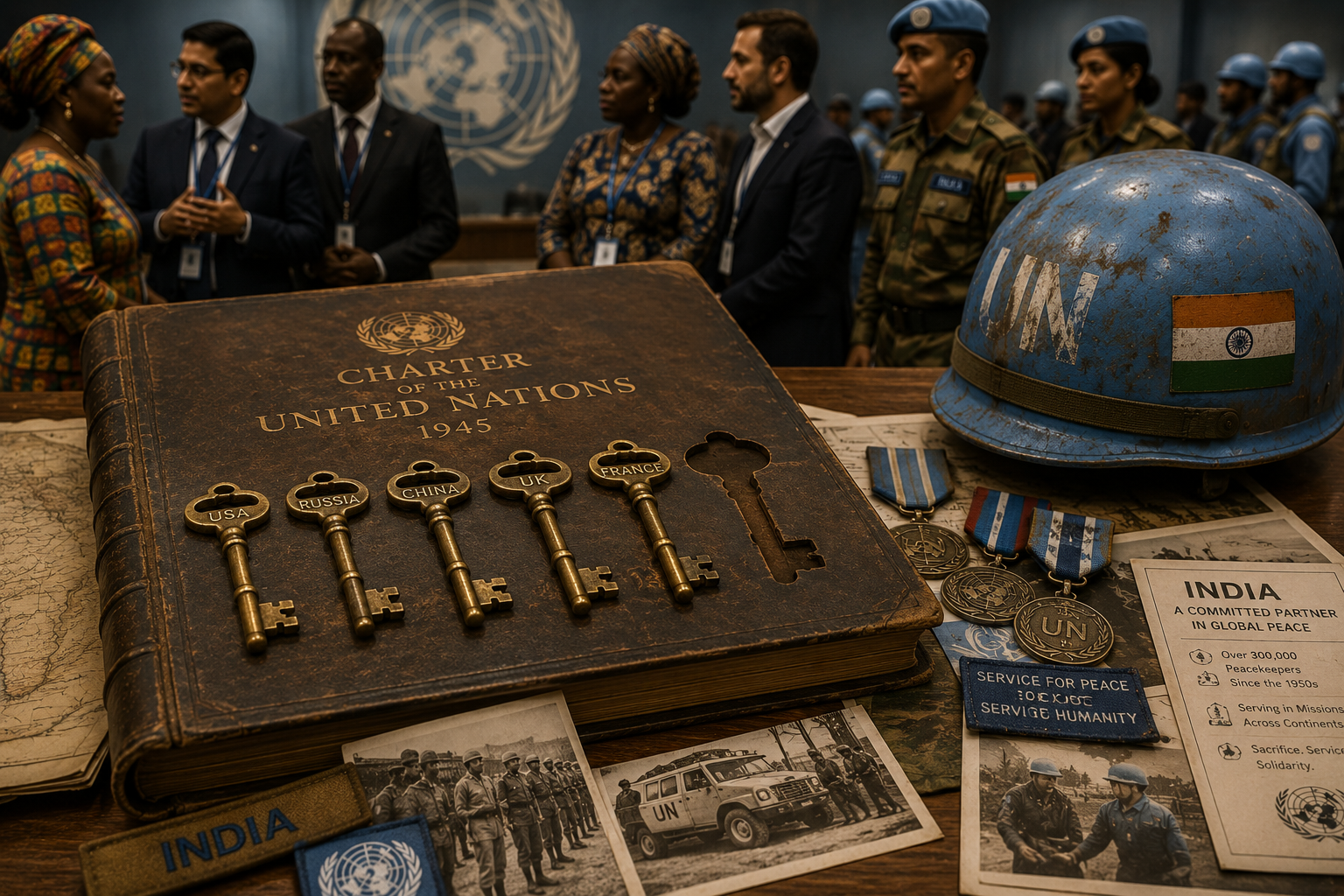
The United Nations Security Council still has five permanent members: China, France, Russia, the United Kingdom and the United States. Alongside them sit ten non-permanent members elected for two-year terms. The permanent five possess veto power; the elected members do not. The UN Security Council’s own membership page confirms this basic structure of five permanent members and ten elected non-permanent members.
This structure reflects the power realities of 1945, not the realities of the twenty-first century.
India’s permanent seat demand tests whether the world is willing to admit this fact honestly.
India’s Claim Is Larger Than Prestige
Every rising power wants recognition. That is normal in international politics. But India’s case goes beyond symbolic recognition.
India represents nearly one-sixth of humanity. The IMF’s India profile lists India’s population at about 1.476 billion and projects 2026 real GDP growth at 6.5%, while its DataMapper lists India’s GDP at current prices at about $4.15 trillion. These figures matter because global governance cannot ignore demographic and economic scale indefinitely.
But numbers alone do not make the case.
India’s claim rests on a combination of population, economy, military capability, democratic experience, development record, peacekeeping contribution, diplomatic reach and Global South credibility. It is not merely a large state. It is a state whose domestic challenges and global aspirations connect many debates that come before the UN: development, poverty, climate finance, technology access, terrorism, maritime security, peacekeeping, food security, health security and reform of multilateral institutions.
A Security Council that excludes India permanently is not simply excluding one country. It is excluding a major perspective from the formal architecture of global security.
The Security Council Still Lives in 1945
The Security Council was created in the aftermath of the Second World War. Its permanent membership reflected the victorious powers and the geopolitical settlement of that era. At the time, many countries that are now UN members were still colonised or newly independent. Africa was not represented as a sovereign continent. India was not yet independent. The world economy, global population distribution and strategic map were radically different.
Today, the UN has 193 member states. Africa, Asia and Latin America are central to global politics. India is independent, populous, economically significant and strategically active. The Global South is not a passive recipient of rules; it is demanding a voice in making them.
Yet the highest security institution in the UN system remains structurally tied to a world that no longer exists.
This is why India’s permanent seat demand is not only a national demand. It is a historical correction.
The question is whether global governance should remain a museum of old power or become an institution of current legitimacy.
India’s Peacekeeping Record Strengthens Its Moral Claim
India’s case is not built only on power. It is also built on contribution.
India has been one of the strongest contributors to UN peacekeeping. In 2025, India’s Press Information Bureau stated that India had sent more than 290,000 peacekeepers to over 50 missions since the 1950s, making it the largest contributor to UN peacekeeping efforts, with more than 5,000 Indian troops then serving in nine of eleven active missions. In October 2025, India’s External Affairs Minister stated that India had cumulatively contributed over 300,000 troops, making it the world’s largest troop-contributing country.
This matters because peacekeeping is one of the most concrete ways a country serves the UN system.
India has not merely argued for international peace from a distance. It has sent soldiers, police personnel, medical units and experts into difficult missions. Indian peacekeepers have served in conflict zones far from home, often under dangerous conditions. Some have died under the UN flag.
A country that helps carry the burden of global peace has a stronger moral claim to help shape the decisions that define peace and security.
The current system creates a strange imbalance. Some countries send large numbers of personnel to implement UN mandates, while others hold permanent authority to shape or block those mandates. India’s demand challenges that imbalance.
The Global South Argument
India’s permanent seat demand is strongest when framed not merely as an Indian demand, but as a Global South demand.
For decades, developing countries have complained that global institutions are dominated by a narrow group of rich or historically powerful states. The Security Council reflects this imbalance sharply. Africa has no permanent seat. Latin America has no permanent seat. India has no permanent seat. Much of the world’s population remains outside permanent decision-making.
This is why India’s claim resonates beyond Indian nationalism.
India is not a small elite power asking for status. It is a developing country that has experienced colonialism, poverty, food insecurity, development challenges and unequal global rules. It has built democratic institutions under social complexity. It has argued for climate justice, equitable development, vaccine access, debt concerns and reform of global governance.
That gives India a distinctive voice. It can speak as a major power, but also as a country shaped by the constraints of the developing world.
This dual identity is important. The Security Council already has powerful countries. What it lacks is a permanent voice that combines scale, development experience and Global South legitimacy.
Why India Cannot Be Treated as an Ordinary Applicant
The Security Council cannot add every deserving country as a permanent member. That is a real institutional problem. But India is not an ordinary applicant.
India has population scale, economic weight, military capacity, nuclear status, diplomatic reach, peacekeeping record, technological capability and civilisational depth. It is active in the G20, BRICS, Quad, SCO, Global South platforms, climate negotiations, maritime security dialogues and development partnerships. Its decisions affect the Indian Ocean, South Asia, West Asia, Africa, global supply chains, energy markets and technology governance.
India is also one of the few countries that engages simultaneously with the West, Russia, the Global South, West Asia, Africa, Southeast Asia and Indo-Pacific partners. This diplomatic flexibility gives India a role that is different from alliance-bound powers.
A permanent Security Council without India does not merely look unfair. It looks strategically incomplete.
The Fairness Test
India’s demand tests the fairness of global governance in three ways.
First, it tests representational fairness. Can a body responsible for international peace and security remain credible when large regions and major populations have no permanent voice?
Second, it tests historical fairness. Can institutions created in the shadow of empire and world war continue unchanged after decolonisation, economic transformation and demographic shifts?
Third, it tests procedural fairness. Can a system in which five states hold permanent veto power over reform itself be considered genuinely open to change?
The UN Charter makes reform difficult. Article 108 says amendments come into force only after adoption by a two-thirds vote of the General Assembly and ratification by two-thirds of UN members, including all permanent members of the Security Council. This means the existing permanent members must approve changes that could reduce the exclusivity of their own privilege.
That is the core problem. The fairness of global governance is being judged by a system where the powerful hold the lock and the key.
Support Exists, but Support Is Not Enough
India has received support from many countries for permanent membership in a reformed Security Council. India’s Ministry of External Affairs has stated that the Government accords highest priority to obtaining permanent membership in an expanded Security Council, and that India believes it has all the credentials for permanent membership in a reformed Council reflecting contemporary global realities.
But diplomatic support is not the same as institutional change.
Many countries support India in speeches. Some do so strongly. Others do so politely. Some support India bilaterally but avoid pushing the issue to a decisive institutional confrontation. Some support reform in principle but oppose expansion of veto power. Some support a larger Council but not new permanent seats. Some regional rivals oppose India directly.
This is why India’s campaign remains unfinished despite wide recognition of its claim.
In global politics, being deserving is not enough. Reform requires coalitions, timing, pressure and the willingness of existing powers to accept dilution of privilege.
The China-Pakistan Factor
India’s claim is also complicated by regional politics.
Pakistan opposes India’s permanent membership because it sees India’s elevation as a threat to regional balance. China’s position is more cautious and strategic. Beijing often speaks in favour of greater representation for developing countries, but it has not offered unconditional support to India’s permanent seat. China’s hesitation is shaped by Asian power politics, India-China rivalry, border tensions and Beijing’s own desire to remain the dominant Asian permanent member.
This creates an uncomfortable reality.
India’s path to permanent membership is not blocked only by procedural complexity. It is also blocked by geopolitical rivalry.
This is common in Security Council reform. Almost every aspiring permanent member faces regional resistance. Japan faces Chinese and Korean historical concerns. Germany’s claim raises questions in Europe. Brazil faces hesitation in Latin America. African contenders face the challenge of continental consensus. India’s case is therefore part of a wider pattern: regional politics often prevents global reform.
The existing permanent members can exploit this division by saying that reform must wait until regions agree. Delay then becomes a diplomatic strategy.
The Veto Question
The hardest issue is not whether India should become a permanent member. The hardest issue is whether India should receive veto power.
India’s position has historically favoured equality among permanent members. If new permanent members are added without veto power, they would be permanent in name but unequal in authority. That would create a second tier of permanent membership.
At the same time, expanding veto power could make the Council even more paralysed. Critics argue that adding more veto holders would worsen deadlock. This argument has force, but it also contains hypocrisy. Existing veto powers ask new claimants to accept restraint while refusing to surrender their own privilege.
This is the moral problem.
If the veto is dangerous, why should the existing five keep it?If the veto is necessary, why should new permanent members be denied it?If equality matters, why create second-class permanent seats?If efficiency matters, why tolerate paralysis caused by current veto users?
India’s demand exposes the contradiction.
The best solution may be a broader veto reform: either gradual restriction of veto use, especially in cases of mass atrocities and conflicts involving a permanent member, or a transitional model where new permanent members initially do not exercise veto but move toward equality under a review mechanism. But without serious movement by the existing P5, any veto compromise will look unfair.
India’s Democracy Argument
India often presents itself as the world’s largest democracy. This matters, but it must be used carefully.
Democratic identity strengthens India’s legitimacy because the Security Council’s permanent membership includes both democratic and authoritarian systems. A democratic India would add a large representative polity to the Council. It would also demonstrate that scale and democracy can coexist in global decision-making.
But India should not rely only on the democracy argument.
Democracy alone does not guarantee permanent membership. Many democracies are not permanent members. Nor should global governance become a club of democracies only, because the UN system includes all sovereign states. India’s stronger claim is broader: democracy, population, economy, peacekeeping, Global South voice, development experience and strategic weight together create a compelling case.
The democracy argument should be part of India’s case, not the entire case.
India’s Development Experience Matters
India’s permanent seat demand also has developmental significance.
The Security Council increasingly deals with conflicts linked to poverty, climate stress, terrorism, state collapse, food insecurity, migration, health emergencies and resource competition. These are not purely military problems. They require development understanding.
India’s experience gives it practical insight into such issues. It has dealt with poverty reduction, federal governance, food security, digital public infrastructure, public health campaigns, disaster management, democratic elections, social diversity and development at continental scale.
This does not make India perfect. It makes India relevant.
A Council dominated by traditional military powers may interpret security too narrowly. India can help broaden the understanding of security to include development, technology, climate resilience, food systems, health and human capacity. That does not mean turning the Security Council into a development agency. It means recognising that modern insecurity often begins where development fails.
The Strategic Autonomy Factor
India’s foreign policy tradition gives it another distinctive quality.
India is not formally part of a military alliance system like NATO. It has deep partnerships with the United States and Europe, long-standing ties with Russia, complex relations with China, strong engagement with West Asia, growing ties with Africa, and a major role in Indo-Pacific politics. This strategic autonomy sometimes frustrates other powers, but it also gives India diplomatic flexibility.
In a polarised world, that flexibility can be valuable.
The Security Council often suffers from bloc politics. If India becomes a permanent member, it may not automatically align with any one camp. That could make diplomacy more complex, but also more representative of the multipolar world.
India’s presence would not magically solve Council deadlock. But it would add a major non-Western, non-Chinese, non-Russian voice with independent diplomatic weight. That itself would make the Council more reflective of reality.
Critics of India’s Claim
No serious article should ignore criticism.
Some critics argue that adding India would make the Council too large and less efficient. Others say India’s regional disputes, especially with Pakistan and China, would complicate Council functioning. Some question whether India would consistently defend human rights and international law when its own interests are involved. Others argue that reform should focus on elected representation rather than new permanent members.
These objections deserve engagement.
A larger Council could become more complex, but the current Council is already paralysed when the P5 disagree. Efficiency without legitimacy is not enough. India’s regional disputes are real, but existing permanent members also have disputes, wars, alliances and strategic interests. No permanent member is neutral. The Council is not a gathering of saints. It is a body of powerful states expected to manage global security despite interests.
As for human rights and international law, India would face scrutiny like every permanent member should. Permanent status should not mean immunity from criticism. In fact, one argument for reform is that all permanent members should face stronger accountability.
The strongest criticism is not that India lacks credentials. The strongest criticism is that the permanent membership model itself may be outdated. But if permanent membership continues to exist, excluding India becomes increasingly indefensible.
India and Africa: Linked Claims, Not Competing Claims
India should avoid framing its claim in a way that appears to compete with Africa’s demand.
Africa’s exclusion from permanent membership is perhaps the clearest injustice in the current Security Council structure. The African Union’s demand for permanent representation is morally powerful because Africa has 54 UN member states and is frequently the subject of Security Council action.
India’s claim and Africa’s claim should be presented as linked.
A reformed Council must include India and Africa. It must not become a bargain where one is used to delay the other. The Global South needs broader representation, not a narrow reshuffling of elite seats.
India’s strongest reform strategy is therefore coalition-based. It should support Africa’s permanent representation clearly and consistently. It should also work with Latin America, small island states and middle powers. The goal should be a Council that is more representative overall, not merely more favourable to India.
The Symbolism of India’s Seat
Symbols matter in international politics.
If India becomes a permanent member of the Security Council, it would signal that the post-colonial world has finally entered the highest chamber of global security in a structurally meaningful way. It would show that power has shifted from the Atlantic-centred order toward a more plural world. It would tell developing countries that reform, though slow, is possible.
But if India remains excluded indefinitely, the opposite message becomes stronger: global governance talks about reform but protects hierarchy.
This symbolic effect matters because international institutions depend on belief. Countries obey rules partly because they believe institutions have legitimacy. When legitimacy weakens, compliance weakens. States begin to look for alternative forums and coalitions. The UN remains physically present, but its moral centrality declines.
India’s permanent seat demand therefore tests whether the UN can renew its legitimacy before frustration becomes disengagement.
What India Must Do Better
India has a strong case, but it must also strengthen its diplomatic strategy.
First, India must frame the demand as global governance reform, not only national recognition.
Second, India must deepen support among African states, Latin American states, small island states and middle powers.
Third, India must reassure smaller countries that a permanent Indian seat will not reduce their voice but strengthen broader representation.
Fourth, India must continue contributing to peacekeeping, development partnerships, climate solutions, digital public infrastructure and humanitarian assistance.
Fifth, India must be consistent in defending international law, sovereignty and civilian protection. A country demanding permanent authority must also demonstrate principled responsibility.
Sixth, India must avoid triumphalist language. Permanent membership should be presented as responsibility, not entitlement.
The tone matters. The world is more likely to support India if India appears as a reformer of global governance, not merely as a claimant to great-power status.
What the P5 Must Understand
The permanent five must understand that legitimacy is not a decorative asset. It is strategic capital.
A Security Council that loses legitimacy will not collapse immediately. It will continue to meet. It will issue statements. It will vote. It will maintain protocol. But more countries will increasingly treat it as one forum among many, not the central forum of global security.
That is already happening.
The G20, BRICS, regional organisations, minilateral coalitions and issue-based partnerships are gaining importance partly because the UN system has failed to adapt. If the Security Council remains unreformed, global governance will become more fragmented.
The P5 may preserve formal privilege but lose practical authority.
Supporting India’s permanent membership, along with African and broader Global South representation, is not charity by the existing powers. It is institutional self-preservation.
The Real Question: Can the System Share Power Peacefully?
The demand for India’s permanent seat is part of a larger historical test.
Can international institutions adapt peacefully when power shifts? Or do they wait until crisis forces change?
History shows that orders become unstable when rising powers feel permanently excluded and established powers refuse accommodation. Reform is the peaceful method of adjustment. If institutions do not reform, states seek influence outside them.
India is not asking to destroy the UN system. It is asking the system to recognise reality.
That makes its demand moderate, not radical.
The radical position is to pretend that five countries can permanently monopolise global security authority while the rest of the world changes around them.
Conclusion: India’s Claim Is a Test of the World’s Honesty
Should global institutions reflect the world as it is, or the world as it was?
If the answer is the world as it is, India’s exclusion is impossible to justify. A country of India’s population, economy, peacekeeping record, diplomatic reach, development experience and Global South voice cannot remain permanently outside the Security Council’s highest category.
If the answer is the world as it was, then the language of reform is only performance.
India’s demand is therefore not only about a chair in New York. It is about whether global governance can evolve without hypocrisy. It is about whether representation matters. It is about whether contribution matters. It is about whether the Global South matters. It is about whether old power can share authority before legitimacy erodes further.
A reformed Security Council will not solve every global crisis. India’s permanent membership will not magically end wars, veto politics or great-power rivalry. But it would make the Council more representative, more credible and more aligned with contemporary realities.
The world does not need India in the Security Council because India wants prestige.
The world needs India there because a global security system that excludes India is no longer globally credible.
That is the fairness test.
And at present, the system is failing it.