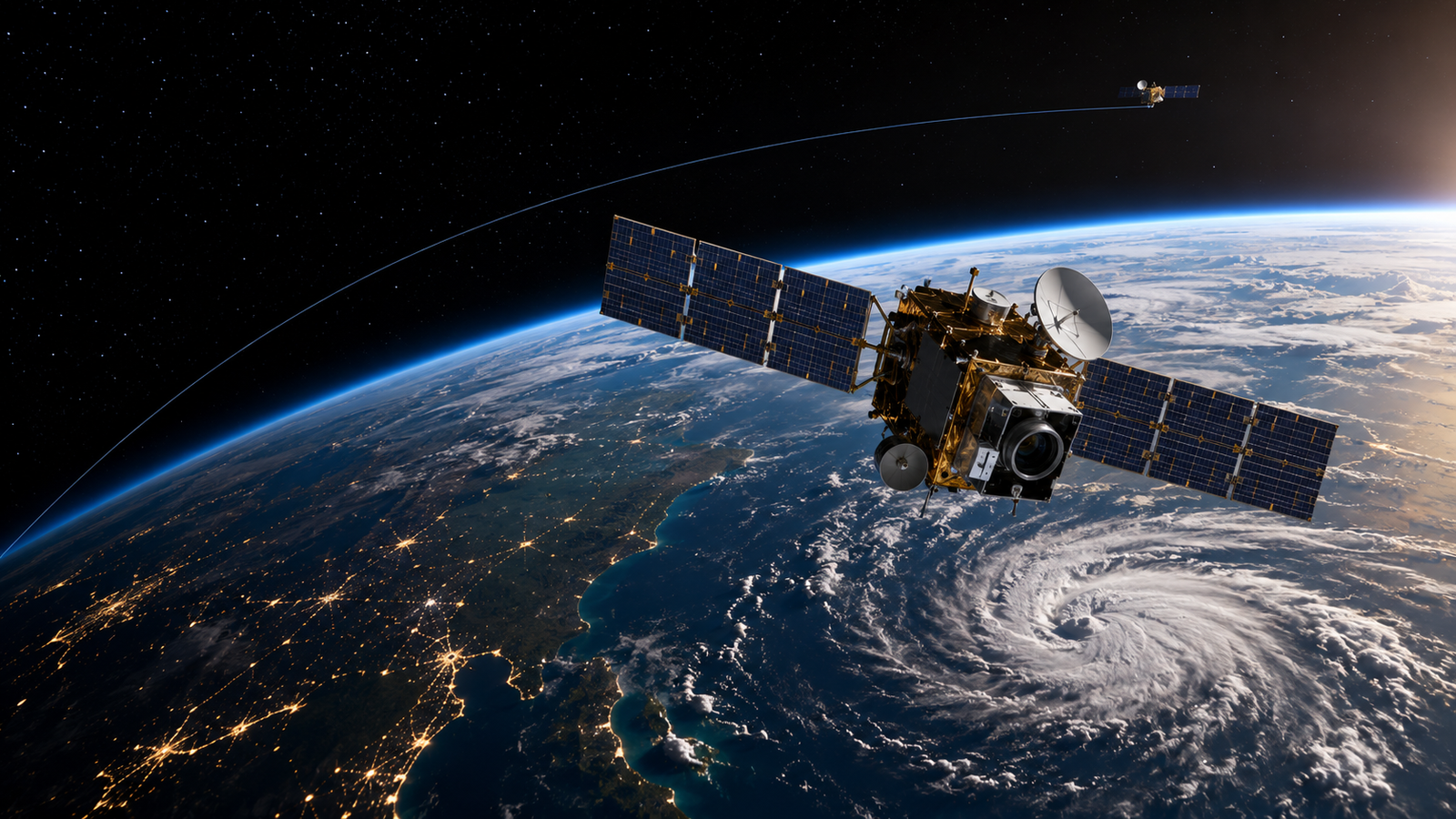
A satellite looks calm from the ground: a silent machine moving above clouds, oceans and cities. But its stillness is an illusion. A working satellite is travelling at enormous speed while gravity keeps pulling it inward. The reason it does not crash immediately is not that gravity has disappeared. The reason is that the satellite is moving forward fast enough to keep missing Earth as it falls.
The Simple Meaning of Orbit
Orbit is continuous falling around a larger body. When a satellite is launched, the rocket does more than lift it upward. It also gives the satellite horizontal speed. If the satellite moved too slowly, gravity would pull it back into the atmosphere. If it moved too fast, it could escape the planet’s control. At the right speed for its altitude, gravity bends the satellite’s path into a curve around Earth.
Why Gravity Is Still Important
Many people imagine space as a place where gravity ends. In reality, gravity extends far beyond the atmosphere. The Moon is held by Earth’s gravity, and artificial satellites are also held by Earth’s gravity. Astronauts and objects inside orbiting spacecraft feel weightless because they are falling together, not because gravity has switched off. The spacecraft, the people inside it and loose objects are all in the same free-fall motion.
The Cannonball Idea
A classic way to understand orbit is to imagine firing a cannonball from a very tall mountain. If it is fired slowly, it lands nearby. If fired faster, it travels farther before landing because Earth curves away beneath it. If it is fired fast enough and air resistance is ignored, the ground keeps curving away at the same rate that the cannonball falls. That is the basic idea of orbit. A satellite is like a cannonball moving so fast sideways that it keeps falling around Earth.
Why Altitude Changes the Speed Needed
A satellite’s required speed depends on its altitude. Closer to Earth, gravity is stronger and the satellite must move faster to maintain orbit. Low Earth orbit satellites, including many imaging and communication satellites, travel quickly and circle Earth many times per day. Farther out, satellites move more slowly. A geostationary satellite is placed high above the equator so that its orbital period matches Earth’s rotation, making it appear fixed above one region.
Different Orbits for Different Jobs
Satellites are not all placed in the same path. A weather satellite may need a broad view of cloud systems. A navigation satellite must maintain predictable timing and position. An Earth observation satellite may use a polar orbit so the rotating Earth passes beneath it, allowing repeated coverage of different regions. Communication satellites may use high orbits to cover large geographic areas. Orbit design is therefore a mission decision, not a random placement.
What Can Pull a Satellite Down
Satellites do not remain in perfect orbit forever without management. In low Earth orbit, traces of atmosphere still exist. These thin particles create drag, slowly reducing the satellite’s speed and altitude. Solar activity can expand the upper atmosphere and increase drag. Small corrections may be needed to maintain orbit. If a low-orbit satellite slows enough, it re-enters the denser atmosphere and burns up or breaks apart.
How Satellites Adjust Their Position
Many satellites carry small thrusters for station-keeping. These thrusters can correct drift, maintain orientation or move the spacecraft at the end of its life. Some satellites need very precise positioning because their instruments, antennas or cameras must point accurately. Others must avoid collisions with debris or other spacecraft. Orbit is therefore a managed environment, especially as space becomes more crowded.
Final Takeaway
Satellites stay in orbit because of a careful relationship between speed and gravity. They are not floating outside the influence of Earth. They are falling around Earth in a controlled path, moving forward fast enough that the planet curves away beneath them. This simple idea supports weather forecasting, GPS, television, internet links, mapping, climate research and much of the modern digital world.