How Museums Preserve History: Collections, Conservation, Provenance and Cultural Memory
Museums cannot preserve the past itself.
A historical event cannot be placed in a display case. A vanished neighbourhood cannot be stored on a shelf. A person's life cannot be reconstructed completely from the objects they left behind.
What museums can preserve is evidence of the past.
That evidence may take the form of:
-
archaeological objects;
-
paintings;
-
clothing;
-
tools;
-
scientific specimens;
-
photographs;
-
manuscripts;
-
recordings;
-
household objects;
-
machinery;
-
oral histories;
-
digital files;
-
artworks;
-
religious objects; and
-
everyday material that once seemed too ordinary to save.
Preserving history therefore involves much more than keeping old objects behind glass.
Museums must decide what to collect, establish where objects came from, document them, conserve their physical material, store them safely, research them, interpret them and make them accessible without destroying what they are trying to preserve.
They must also confront a harder problem:
whose history was collected, whose was ignored, and who has the authority to interpret what survives?
That is why modern museum preservation is both a technical process and an ethical one.
How Do Museums Preserve History?
A useful way to understand museum preservation is as an eight-stage system:
| Stage | What the museum does | Why it matters |
|---|---|---|
| 1. Selection | Decides what should enter the collection | Determines which evidence has a chance to survive |
| 2. Provenance | Investigates where the object came from and how it changed hands | Establishes context, ownership history and possible ethical issues |
| 3. Documentation | Creates catalogues, identification numbers and records | Prevents objects from becoming separated from their meaning |
| 4. Conservation | Slows physical deterioration and stabilises damage | Protects original material |
| 5. Storage | Maintains appropriate environmental and security conditions | Most collections spend far more time in storage than on display |
| 6. Research | Studies objects using old and new questions and technologies | Allows preserved evidence to generate new knowledge |
| 7. Interpretation | Connects objects through exhibitions, labels and other narratives | Turns collections into understandable public history |
| 8. Access and transmission | Provides exhibitions, loans, digitisation, education and community access | Allows preserved evidence to remain socially meaningful |
These stages are connected.
An object that is physically preserved but poorly documented may lose much of its historical meaning.
An extensively catalogued object that deteriorates because it was stored badly may eventually become unusable.
A perfectly conserved collection that nobody can study or interpret preserves material but contributes little to public memory.
Museums preserve history through systems, not simply through possession.
1. Museums Decide What to Collect
Every collection begins with selection.
Someone decides:
This object is worth keeping.
That decision may be based on:
-
historical significance;
-
artistic value;
-
scientific importance;
-
rarity;
-
association with a person or event;
-
relevance to a community;
-
usefulness for research;
-
representative value; or
-
the museum's collecting mission.
This seems obvious until we consider the consequences.
Museums have limited:
-
storage;
-
staff;
-
conservation capacity;
-
money; and
-
time.
They cannot preserve everything.
Every acquisition therefore competes with other possible acquisitions for long-term institutional resources.
What enters the collection gains a greater chance of surviving.
What is repeatedly ignored may eventually disappear.
Selection is therefore one of the first ways museums shape cultural memory.
Museums Use Collection Policies
Modern museums generally do not collect simply because an individual curator finds something interesting.
A collections policy establishes what the institution intends to collect and how collections should be managed.
A policy may define:
-
geographic scope;
-
historical period;
-
subject areas;
-
acquisition procedures;
-
legal requirements;
-
provenance standards;
-
conservation responsibilities;
-
documentation requirements;
-
ethical restrictions;
-
loan procedures;
-
deaccessioning rules; and
-
conditions governing use.
For example, a city history museum may decide that its mission is to document the social, economic and cultural history of one metropolitan area.
A natural-history museum may focus on geological, biological and environmental specimens.
A design museum may collect products, drawings, prototypes and digital design records.
A collections policy provides institutional continuity.
Without one, a museum can gradually become a storage facility containing unrelated objects accumulated according to the personal interests of successive staff members.
Museums Cannot Collect Everything
This creates an unavoidable problem.
If preservation depends on selection, then every museum collection is incomplete.
Museums historically collected some kinds of evidence far more systematically than others.
Institutions often preserved:
-
royal objects;
-
weapons;
-
fine art;
-
elite clothing;
-
religious treasures;
-
scientific specimens;
-
official documents; and
-
objects associated with powerful people.
The everyday lives of:
-
workers;
-
domestic servants;
-
migrants;
-
women;
-
children;
-
minority communities;
-
poor households;
-
rural populations; and
-
marginalised groups
were often documented less systematically.
That imbalance matters.
If future historians rely only on what institutions chose to collect, preserved history can become disproportionately the history of people who possessed wealth, political power or cultural prestige.
Modern collecting increasingly tries to identify these gaps.
Ordinary Objects Can Become Historical Evidence
An object does not need to be beautiful or expensive to become important.
Consider an ordinary bus ticket.
At the moment it is used, it may seem disposable.
Fifty years later, it could reveal:
-
transportation prices;
-
typography;
-
local government systems;
-
route structures;
-
technology;
-
currency;
-
everyday mobility; and
-
changing urban geography.
A supermarket package can later reveal changes in:
-
diet;
-
branding;
-
consumer culture;
-
manufacturing;
-
environmental regulation; and
-
household life.
A cheap mobile phone may eventually become evidence about the transformation of communication.
Museums therefore have to anticipate a difficult question:
What ordinary thing today will help somebody understand our society tomorrow?
There is no perfect answer.
2. Provenance Preserves an Object's Story
An object has a physical form.
It also has a history.
Provenance refers broadly to the history of an object's ownership, custody, origin and movement.
Researchers may ask:
-
Who made it?
-
Where was it made?
-
Who first owned it?
-
How was it used?
-
Who sold or donated it?
-
Was it excavated legally?
-
Did it leave another country lawfully?
-
Was it stolen?
-
Was it looted during war?
-
Was it acquired under colonial rule?
-
Were previous owners forced to sell?
-
Has documentation been lost?
Without provenance, an object can lose much of its meaning.
Imagine two identical ceramic vessels.
One was excavated scientifically from a documented archaeological context.
The other arrived on the art market with no reliable history.
They may look similar.
But the first can potentially tell researchers where it was found, what objects surrounded it and how it related to a particular historical environment.
The second has lost much of that contextual information.
Preservation therefore includes preserving relationships and evidence, not simply objects.
Why Provenance Research Has Become So Important
Museum provenance has become one of the most important ethical issues in the sector.
Many collections contain objects whose histories involve:
-
colonial extraction;
-
wartime looting;
-
illicit excavation;
-
theft;
-
forced sale;
-
unequal exchange;
-
missionary activity;
-
military campaigns; or
-
questionable antiquities markets.
An object may have sat safely inside a museum for a century while the circumstances through which it arrived there remain disputed.
Investigating those histories does not weaken preservation.
It makes the historical record more accurate.
The revised international museum ethics framework adopted in 2026 places renewed emphasis on responsible collections management while addressing challenges including colonial legacies and digital technologies.
Modern preservation therefore increasingly asks two questions:
Can we keep this object safe?
and
Do we have the ethical and legal right to keep it?
Provenance Can Change Interpretation
Suppose a museum owns an elaborate ceremonial object.
An old label might say:
“Ceremonial object, acquired 1890.”
Provenance research discovers that it was removed during a military expedition after a local political centre was destroyed.
The object itself has not changed.
Its interpretation has.
A revised label may now need to explain:
-
who made it;
-
what it meant;
-
how it was used;
-
how it left its original community;
-
who acquired it; and
-
why its ownership is now disputed.
Preservation therefore includes preserving the history of how the museum acquired its own collection.
3. Documentation Turns Objects Into Knowledge
Imagine a museum containing one million objects.
Now remove every catalogue.
Remove every identification number.
Remove the acquisition records.
Remove the photographs.
Remove the location database.
The objects physically remain.
But the museum may no longer know:
-
what they are;
-
where they came from;
-
who donated them;
-
which object belongs to which record;
-
what condition they were in;
-
where they are stored; or
-
whether anyone has permission to reproduce their images.
That is why documentation is one of the hidden foundations of museums.
A typical museum record may contain:
-
accession number;
-
object name;
-
description;
-
maker;
-
date;
-
material;
-
dimensions;
-
place of origin;
-
provenance;
-
acquisition method;
-
donor or seller;
-
legal status;
-
copyright information;
-
cultural restrictions;
-
condition;
-
storage location;
-
exhibition history;
-
conservation history;
-
bibliography;
-
related photographs; and
-
research notes.
Documentation transforms a room full of things into a research collection.
What Is an Accession Number?
When an object formally enters a permanent museum collection, it is commonly assigned a unique identification number.
This may be called an:
-
accession number;
-
registration number; or
-
object number,
depending on the institution.
That number connects the physical object with its documentation.
If the object moves from:
storage → conservation laboratory → photography studio → exhibition → loan → storage
the institution should be able to track it throughout that journey.
This is called location control.
An object that physically exists but cannot be found is not being effectively preserved.
Cataloguing Makes Collections Searchable
Catalogues allow museum workers and researchers to discover relationships among objects.
A researcher might search for:
-
all objects from one town;
-
every photograph made by one photographer;
-
objects associated with migration;
-
textiles using a particular fibre;
-
specimens collected before industrialisation;
-
objects donated by one family; or
-
all items connected to a historical event.
Without consistent cataloguing, those patterns remain hidden.
A good museum collection is therefore not merely accumulated.
It is structured information.
Metadata Can Preserve Old Biases
Museum records are not neutral simply because they exist in databases.
Catalogues were written by people operating within particular historical contexts.
Older records may contain:
-
colonial terminology;
-
racist classifications;
-
outdated scientific names;
-
incorrect ethnic labels;
-
assumptions about gender;
-
names imposed by collectors rather than communities;
-
inaccurate geographic descriptions; or
-
euphemisms hiding violent acquisition.
Modern museums face a difficult task.
They may need to correct terminology without deleting evidence showing how the institution previously described the object.
This can require maintaining:
historical record + corrected contemporary interpretation
at the same time.
That approach preserves both the object and the history of museum knowledge itself.
4. Conservation Slows Physical Deterioration
Objects deteriorate.
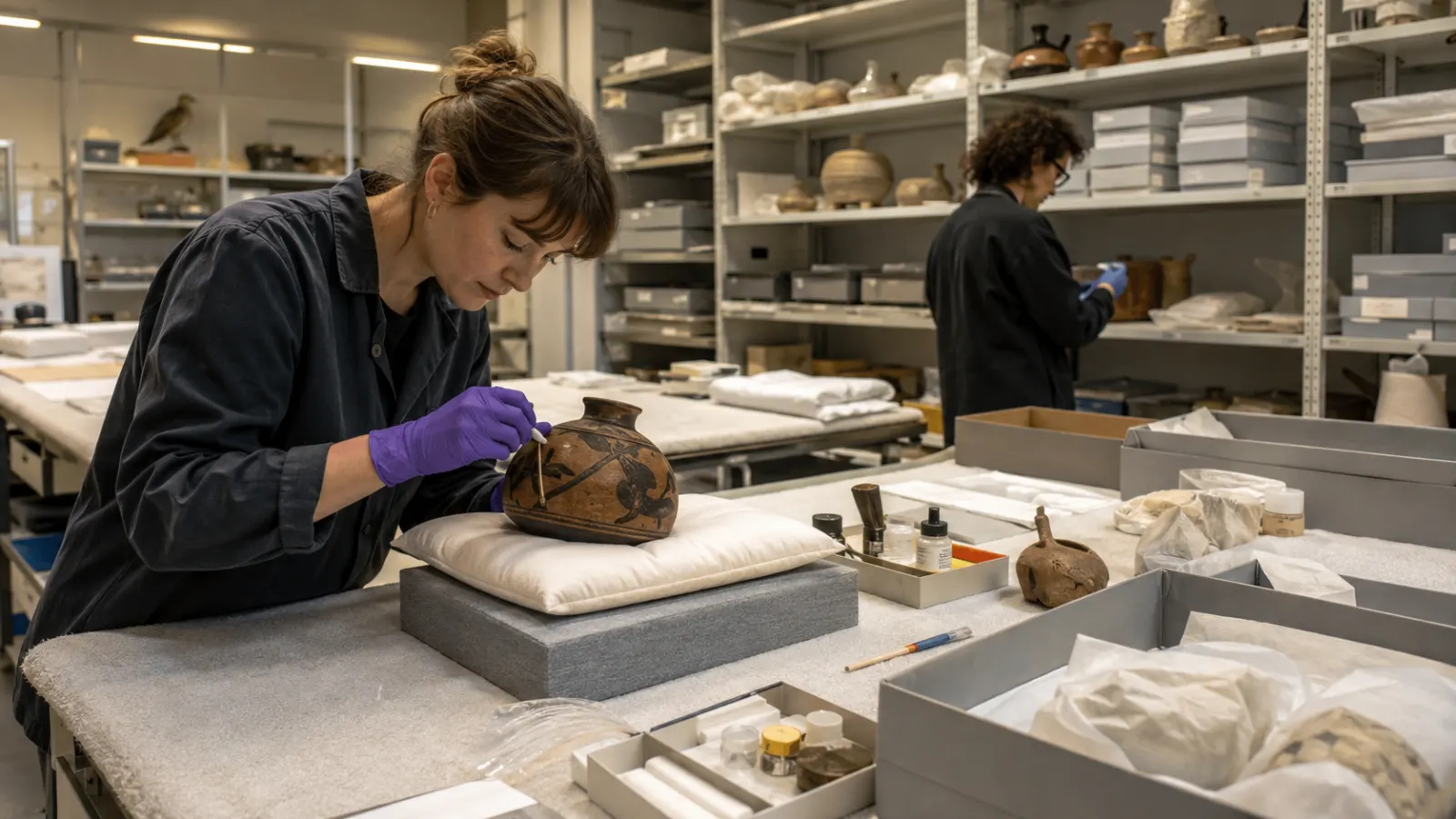
Museum conservation attempts to slow that deterioration while protecting as much original evidence as possible.
Different materials face different threats.
Paper
Can become brittle, fade or develop mould.
Textiles
Can weaken through light exposure, insects, handling and chemical deterioration.
Metals
Can corrode.
Paintings
Can crack, fade, flake or respond to environmental changes.
Photographs
Can fade, chemically deteriorate or become unstable.
Wood
Can crack, warp or be attacked by insects.
Plastics
Can yellow, become sticky, crack or release chemical compounds as they age.
Biological specimens
May require preservation fluids, freezing, drying or other specialised care.
There is therefore no single museum climate suitable for every collection.
Preventive Conservation Comes Before Repair
One of the most important principles of conservation is that preventing damage is usually better than repairing damage later.
Preventive conservation includes managing:
-
temperature;
-
relative humidity;
-
light;
-
ultraviolet exposure;
-
pests;
-
pollutants;
-
dust;
-
vibration;
-
handling;
-
storage materials;
-
security;
-
water leaks; and
-
fire risk.
Consider a historic textile.
A conservator might be able to repair a tear.
But once light permanently fades its original colour, restoration cannot recreate the lost historical material without introducing something new.
The better strategy is to limit damaging exposure before irreversible change occurs.
Conservation Is Not the Same as Restoration
These words overlap in ordinary language but have different emphasis.
Conservation
Focuses on stabilising and preserving surviving material.
Restoration
May involve interventions intended to return an object closer to an earlier appearance or state.
Modern conservation generally tries to avoid unnecessary alteration.
A historic chair may have:
-
scratches;
-
repaired legs;
-
worn fabric; and
-
faded surfaces.
Those marks may themselves be evidence.
Aggressively making the chair look new could erase information about its use and history.
The goal is therefore not:
“Make everything beautiful again.”
It is:
“Preserve as much authentic evidence as reasonably possible.”
Conservators Document Their Work
Conservation should leave records.
Before treatment, conservators may document:
-
damage;
-
materials;
-
previous repairs;
-
structural weakness;
-
colour;
-
corrosion;
-
cracks;
-
stains; and
-
earlier alterations.
Photographs are often taken.
After treatment, the institution records:
-
what was done;
-
which materials were used;
-
which parts were removed;
-
which parts were added; and
-
what future monitoring is needed.
A future conservator can then distinguish:
historical material
from
earlier conservation intervention.
Condition Reports Create an Object Biography
Museums often create condition reports when an object:
-
enters the collection;
-
goes on exhibition;
-
returns to storage;
-
receives conservation treatment; or
-
travels on loan.
Repeated reports form a timeline.
A tiny crack documented in 2010 can be compared with photographs from 2026.
If it has not changed, the object may be stable.
If the crack has grown, the museum knows deterioration is continuing.
Condition documentation therefore creates a medical-style history for the object.
5. Storage Is Where Most Museum Preservation Happens
Visitors experience museums through galleries.
Collections often spend most of their lives somewhere visitors rarely see:
storage.
Many museums display only a small fraction of their total holdings at any one time.
Storage areas may contain:
-
shelves;
-
archival boxes;
-
racks;
-
cabinets;
-
painting screens;
-
cold storage;
-
specimen containers;
-
oversized-object areas; and
-
specialised vaults.
Good storage protects objects from:
-
unnecessary handling;
-
dust;
-
light;
-
pests;
-
unstable environments;
-
water;
-
theft; and
-
accidental damage.
Storage is therefore not passive.
It is an active preservation system.
Why Museums Do Not Display Everything
People sometimes ask:
“If the museum owns it, why isn't it on display?”
Several reasons are possible.
Space
The collection may be much larger than available gallery space.
Conservation
Some materials cannot tolerate continuous exposure to light.
Research
Objects may be held primarily for scientific or historical research.
Rotation
Museums may change exhibitions regularly.
Cultural restrictions
Certain objects may not be appropriate for unrestricted public display.
Condition
An object may be too fragile to exhibit.
Relevance
The object may not fit the current exhibition narrative.
An object does not stop being useful because it is not on display.
Stored collections support research, loans, education and future exhibitions.
Light Can Destroy What Visitors Want to See
Exhibition creates an unavoidable tension.
People want to see objects.
Seeing an object requires exposing it to an environment.
For many materials, particularly:
-
textiles;
-
watercolours;
-
manuscripts;
-
photographs; and
-
works on paper,
light causes cumulative irreversible damage.
Museums may therefore limit:
-
brightness;
-
exhibition duration; or
-
frequency of display.
A rare manuscript may appear for several months and then return to dark storage.
This is not withholding heritage.
It is an attempt to ensure future generations can see it too.
6. Museums Research What They Preserve
Preservation matters partly because future researchers may ask questions nobody anticipated when an object was collected.
A specimen gathered in 1900 might later help researchers investigate:
-
environmental contamination;
-
genetic change;
-
species distribution;
-
climate history; or
-
biodiversity decline.
A worker's uniform collected as industrial history may later become evidence for:
-
gender history;
-
migration;
-
labour relations;
-
textile production; or
-
occupational health.
An old photograph may unexpectedly document:
-
a demolished building;
-
an extinct transport route;
-
street signage;
-
fashion;
-
vegetation; or
-
social segregation.
Preserving material allows future questions to be asked of old evidence.
That is one of the strongest arguments for museum collections.
New Technology Can Reveal Old Evidence
Objects sometimes contain information earlier researchers could not detect.
Modern techniques can include:
-
X-ray imaging;
-
infrared photography;
-
ultraviolet imaging;
-
microscopy;
-
chemical analysis;
-
isotope analysis;
-
CT scanning;
-
DNA analysis;
-
3D scanning; and
-
digital image processing.
A painting may reveal an earlier composition beneath its surface.
A sealed archaeological object may be examined without opening it.
A specimen collected generations ago may provide genetic information.
Preserving originals therefore retains possibilities that digitisation alone cannot always predict.
Museum Knowledge Can Change
A catalogue entry is not the final word on an object.
Research may discover that:
-
an artist was misidentified;
-
an object is older or younger than believed;
-
a specimen belongs to another species;
-
a supposed ceremonial tool had an everyday function;
-
a historical person owned the object;
-
an object was looted; or
-
an old ethnic classification was incorrect.
A museum should therefore preserve not merely knowledge, but the ability to correct knowledge.
Good collections remain open to reinterpretation.
7. Museums Preserve Memory Through Interpretation
Objects do not explain themselves.
Imagine seeing an old metal machine without a label.
You may not know:
-
what it did;
-
who used it;
-
when it was made;
-
why it mattered; or
-
what historical process it represents.
Museums interpret objects through:
-
labels;
-
exhibitions;
-
catalogues;
-
tours;
-
audio;
-
video;
-
digital interactives;
-
educational programmes;
-
publications; and
-
public events.
Interpretation connects evidence to meaning.
But interpretation is also selective.
Exhibitions Are Arguments
An exhibition may appear simply to present objects.
In reality, it makes dozens of decisions.
Curators choose:
-
which objects appear;
-
which remain in storage;
-
what comes first;
-
which objects are compared;
-
whose quotations are included;
-
what terminology is used;
-
what historical context is provided;
-
how much space each subject receives; and
-
where the narrative ends.
Two exhibitions using the same collection could therefore tell very different stories.
A museum exhibition should be understood as an interpretation constructed from evidence, not as a complete reproduction of history.
This is closely connected to the broader question explored in Why Museums Matter.
Museums Also Preserve Their Own Interpretive History
Exhibitions themselves eventually become historical evidence.
A museum may preserve:
-
old labels;
-
exhibition photographs;
-
floor plans;
-
catalogues;
-
posters;
-
educational materials;
-
visitor research; and
-
curatorial correspondence.
Why keep them?
Because a museum exhibition from 1950 may reveal how people in 1950 understood:
-
empire;
-
race;
-
gender;
-
archaeology;
-
science;
-
national identity; or
-
Indigenous cultures.
Museum interpretation changes.
Preserving old interpretation allows future researchers to study those changes.
Oral Histories Can Restore Missing Context
Objects often enter collections without the voices of the people who used them.
Consider an industrial machine.
The museum might know:
-
manufacturer;
-
model;
-
date;
-
dimensions; and
-
factory location.
A retired worker may explain:
-
how the machine actually operated;
-
which shortcuts workers used;
-
what hazards it created;
-
what sounds it made;
-
who was allowed to operate it;
-
what management expected; and
-
how workers felt when it was replaced.
That information may exist nowhere in official documentation.
Oral-history programmes can therefore restore context that objects alone cannot provide.
Community Knowledge Can Correct Museum Records
Curators are experts.
They are not experts in every community represented by every collection.
A community member may recognise:
-
the correct name of an object;
-
an incorrect translation;
-
the identity of a person in a photograph;
-
a ceremonial restriction;
-
a regional technique;
-
an object used differently from the museum's description; or
-
a colonial name imposed by an earlier collector.
Modern museum practice increasingly emphasises participation and collaboration with communities connected to collections.
The ICOM museum definition adopted in 2022 explicitly places community participation alongside research, collection, conservation, interpretation and exhibition.
This changes the model from:
museum speaks → public listens
toward:
museum + evidence + communities + researchers → continuing interpretation
Intangible Heritage Cannot Be Stored Like an Object
Not all heritage has a physical form.
Examples include:
-
oral traditions;
-
music;
-
dance;
-
ritual;
-
craftsmanship;
-
languages;
-
performance;
-
food traditions; and
-
practical knowledge.
A museum can collect:
-
recordings;
-
costumes;
-
instruments;
-
tools;
-
photographs;
-
interviews; and
-
documentation.
But recording a dance is not the same as preserving a living dancing tradition.
The video preserves evidence of the performance.
The living heritage survives through people who continue practising, adapting and teaching it.
Museums therefore need to distinguish:
documenting a tradition
from
keeping the tradition alive.
The latter depends fundamentally on communities.
8. Museums Preserve History by Providing Access
Preservation without access creates another problem.
Why protect evidence if nobody can learn from it?
Museums make collections accessible through:
-
exhibitions;
-
study rooms;
-
archives;
-
online databases;
-
publications;
-
school programmes;
-
public lectures;
-
loans;
-
travelling exhibitions;
-
digitisation;
-
research access; and
-
community partnerships.
Access transforms preservation from private storage into social memory.
But access must sometimes be balanced against conservation, privacy, cultural rights and safety.
Not Everything Should Be Open to Everyone
Open access is an important principle.
It is not absolute.
Collections may contain:
-
human remains;
-
sacred objects;
-
restricted ceremonial knowledge;
-
private correspondence;
-
sensitive archaeological information;
-
personal medical information;
-
culturally restricted images; or
-
material whose publication could create security risks.
In such cases, ethical stewardship may require controlled access.
Preservation involves balancing:
public knowledge
with
dignity, rights and cultural responsibility.
Universal visibility is not always the most ethical form of access.
Digitisation Expands Museum Access
Digitisation can dramatically increase access to collections.
Museums may create:
-
high-resolution photographs;
-
3D models;
-
scanned documents;
-
digital catalogues;
-
virtual exhibitions;
-
searchable databases; and
-
online educational resources.
This can allow a student thousands of kilometres away to study an object that would otherwise require international travel.
Digitisation can also reduce unnecessary handling of fragile originals.
A researcher may first inspect a high-resolution scan before deciding whether physical access is necessary.
Digital collections therefore have enormous preservation and educational value.
But Digitisation Does Not Replace the Original
A high-resolution image of a manuscript can preserve:
-
colour;
-
layout;
-
handwriting; and
-
visible damage.
It cannot perfectly preserve:
-
texture;
-
thickness;
-
weight;
-
smell;
-
binding structure;
-
material composition;
-
hidden layers;
-
three-dimensional surface; or
-
information future scientific techniques might detect.
Likewise, a 3D scan of a sculpture records geometry.
It is not the sculpture.
UNESCO specifically advises that digitisation of museum collections is highly important but should not be regarded as a replacement for conservation of the collection itself.
The digital surrogate expands access.
The original preserves additional evidence.
Digital Heritage Needs Preservation Too
Some modern museum objects are born digital.
Examples include:
-
digital photographs;
-
video art;
-
interactive artworks;
-
software-based installations;
-
databases;
-
websites;
-
digital design files;
-
virtual environments; and
-
social-media archives.
Digital objects do not decay like paper.
They have different vulnerabilities.
A file can become inaccessible because:
-
storage media fail;
-
software disappears;
-
operating systems change;
-
file formats become obsolete;
-
passwords are lost;
-
servers close;
-
links break; or
-
databases become corrupted.
Digital preservation can therefore require:
-
backups;
-
integrity checking;
-
file migration;
-
emulation;
-
metadata;
-
format management;
-
documentation of software dependencies; and
-
preservation planning.
Digital does not mean permanent.
Museums Preserve Memory Through Redundancy
Strong preservation systems do not rely on one thing working forever.
An object may be protected through several layers:
physical object
catalogue record
condition reports
conservation photographs
research publications
digital images
database backups
exhibition records
Redundancy reduces the chance that one accident destroys all knowledge associated with an object.
If a database fails, paper or backup records may help reconstruction.
If an object is damaged, previous photographs still preserve information about its earlier condition.
If a researcher discovers new information, that knowledge can be stored independently of the individual expert.
Museum memory is resilient when it exists in multiple connected forms.
Disaster Planning Is Part of Preservation
Museum collections can be lost quickly.
Threats include:
-
fire;
-
flood;
-
earthquake;
-
war;
-
theft;
-
vandalism;
-
pest outbreaks;
-
storms;
-
infrastructure failure; and
-
water-pipe breaks.
Conservation is therefore not only about gradual deterioration.
Museums need emergency plans.
These may identify:
-
evacuation procedures;
-
priority objects;
-
emergency contacts;
-
salvage equipment;
-
freezer facilities for wet material;
-
temporary storage;
-
fire response;
-
security procedures; and
-
documentation processes.
A museum containing hundreds of thousands of objects cannot decide what to rescue only after floodwater enters the building.
Preparedness is preservation.
Climate Change Creates New Museum Risks
Museums are also adapting to changing environmental conditions.
Risks can include:
-
extreme heat;
-
flooding;
-
wildfire;
-
stronger storms;
-
changing humidity;
-
energy disruption; and
-
coastal hazards.
Climate control itself consumes energy.
Museums therefore face a growing challenge:
how to protect collections while reducing the environmental impact of protecting them.
The revised ICOM ethics framework adopted in 2026 explicitly recognises the climate crisis as one of the contemporary challenges shaping museum responsibilities.
Preservation now includes thinking about the conditions under which museums themselves can remain sustainable.
Loans Allow Collections to Travel
Museums frequently lend objects to other institutions.
Loans can:
-
expand public access;
-
support exhibitions;
-
reconnect objects with source communities;
-
enable research;
-
create international cooperation; and
-
reduce the need for every museum to own equivalent material.
But moving an object creates risk.
Loan procedures may therefore require:
-
condition reports;
-
environmental standards;
-
secure packing;
-
specialist transportation;
-
insurance or indemnity;
-
courier supervision;
-
display restrictions; and
-
security review.
The object must remain traceable throughout the process.
A loan temporarily changes location.
It should not break the chain of documentation.
Museums Preserve Memory Through Institutional Continuity
A museum collection may outlive the curator who acquired it by centuries.
That means memory cannot depend only on individual expertise.
Institutions need:
-
procedures;
-
inventories;
-
records;
-
professional standards;
-
staff handovers;
-
funding;
-
training;
-
databases;
-
archives; and
-
long-term governance.
Imagine a curator who knows everything about a specialist collection but records almost none of it.
When that curator retires, part of the collection's meaning leaves with them.
Institutional preservation therefore requires converting personal knowledge into records that survive personnel changes.
Museums preserve history partly by preserving organisational memory about their own collections.
Museums Also Forget
No museum collection is complete.
Every collection contains absences.
An archive may preserve thousands of official government papers but few accounts from ordinary residents.
A fashion collection may contain expensive formal clothing but little cheap workwear.
A colonial-era collection may document colonised communities extensively while preserving far less evidence about the collectors' own assumptions and violence.
These silences matter.
Historians increasingly ask not only:
“What does the museum have?”
but also:
“What is missing, and why?”
Absence itself can become evidence of historical power.
Colonialism Shaped Many Museum Collections
Museums expanded rapidly during eras of colonial conquest and imperial collecting.
Objects entered institutions through many routes:
-
scientific expeditions;
-
archaeological excavation;
-
purchase;
-
donation;
-
missionary networks;
-
military campaigns;
-
colonial administration;
-
collectors; and
-
art markets.
Some acquisitions were legal under the rules operating at the time.
Others involved theft, coercion, unequal power or circumstances now considered ethically unacceptable.
Modern museums increasingly revisit these collections through:
-
provenance research;
-
consultation;
-
reinterpretation;
-
restitution;
-
repatriation;
-
long-term loans; and
-
partnership with source communities.
Preserving history honestly requires preserving the difficult history of collecting too.
What Is Restitution?
Restitution generally refers to returning an object or cultural property to a previous owner, community, country or other rightful claimant where ownership or acquisition circumstances justify return.
Related terms include repatriation, particularly when cultural heritage or human remains are returned to a community or country of origin.
Return does not necessarily mean historical knowledge disappears.
Museums can maintain scholarly relationships through:
-
research;
-
digital documentation;
-
collaborative exhibitions;
-
loans;
-
publications; and
-
shared databases.
Restitution can change where an object lives and who holds authority over it while allowing historical knowledge to continue circulating.
Human Remains Require Special Ethical Treatment
Human remains are not simply another category of museum object.
Collections may include:
-
archaeological remains;
-
anatomical collections;
-
mummified bodies;
-
skeletal material; and
-
remains obtained through colonial or medical institutions.
Modern museums increasingly address questions involving:
-
consent;
-
dignity;
-
cultural belief;
-
descendant communities;
-
research ethics;
-
display;
-
storage; and
-
repatriation.
A museum's responsibility to preserve evidence does not automatically override the rights or wishes of communities connected with the dead.
Ethical stewardship sometimes means returning material rather than preserving possession.
What Is Deaccessioning?
Museums do not necessarily keep every object forever.
Deaccessioning is the formal process through which an object is removed from a permanent collection.
Possible reasons may include:
-
duplication;
-
severe deterioration;
-
irrelevance to the museum's mission;
-
legal problems;
-
ethical concerns;
-
repatriation;
-
lack of provenance;
-
transfer to a more appropriate institution; or
-
acquisition errors.
Because removing an object reshapes the historical record, deaccessioning requires formal policy.
It should not be an informal decision such as:
“We don't like this object anymore.”
Ethical museum governance requires transparency, documentation and consistency.
Who Owns Cultural Memory?
This is one of the hardest questions museums face.
A museum may legally own an object.
A community may consider that object part of its living cultural identity.
Researchers may view it as evidence belonging to humanity's shared intellectual heritage.
A government may classify it as national heritage.
Religious practitioners may consider it sacred.
Descendants may see it as family property.
These claims can conflict.
Modern museum practice increasingly rejects the assumption that physical ownership automatically grants unlimited authority over interpretation, access and display.
Cultural stewardship can involve multiple stakeholders.
Who Gets to Tell the Story?
Preservation becomes public memory through interpretation.
That gives museums significant narrative power.
Consider an exhibition on migration.
Whose viewpoint dominates?
-
government officials?
-
border authorities?
-
employers?
-
migrants?
-
families?
-
activists?
-
local residents?
No exhibition can contain every perspective.
But museums can make interpretation more transparent by:
-
identifying sources;
-
distinguishing fact from interpretation;
-
acknowledging disagreement;
-
including multiple voices;
-
showing uncertainties;
-
consulting affected communities; and
-
explaining why particular objects were selected.
The best museum does not pretend interpretation disappears.
It makes interpretation visible enough to question.
Why Museums Matter to Historical Research
Museums provide historians with evidence that written archives alone cannot supply.
Objects can reveal:
-
technology;
-
craftsmanship;
-
consumption;
-
trade;
-
clothing;
-
warfare;
-
diet;
-
religious practice;
-
household life;
-
labour;
-
childhood;
-
design;
-
status;
-
migration; and
-
environmental change.
A written account might describe how a worker lived.
A preserved uniform, tool, lunch container and photograph can provide different kinds of evidence.
Material culture therefore expands the historical record.
This is one reason museums connect naturally with broader heritage institutions explored in Why We Protect the Past, What Heritage Really Means and Why Historical Monuments Matter.
Museums Preserve Scientific Memory Too
Not every museum is primarily historical.
Natural-history collections preserve:
-
plants;
-
insects;
-
animals;
-
fossils;
-
minerals;
-
rocks;
-
DNA samples; and
-
environmental specimens.
These collections can become evidence about environmental change.
Scientists can compare specimens collected decades apart to investigate:
-
changing species distributions;
-
pollution;
-
morphology;
-
genetic diversity;
-
disease;
-
invasive species; and
-
climate effects.
A specimen collected long ago for taxonomy may become useful for questions its collector could never have imagined.
Museums therefore preserve not only cultural memory but scientific baselines.
Museums Preserve Memory Through Education
A collection becomes socially meaningful when people can learn from it.
Museums use:
-
school visits;
-
workshops;
-
lectures;
-
guided tours;
-
digital resources;
-
family programmes;
-
research access;
-
exhibitions; and
-
publications
to connect evidence with audiences.
This educational role matters because preservation is intergenerational.
One generation keeps something partly because another generation may need to understand it.
Museums therefore operate across time:
past evidence → present interpretation → future knowledge
Frequently Asked Questions
How do museums preserve history?
Museums preserve history by collecting significant objects and evidence, researching provenance, documenting collections, conserving physical material, storing objects safely, conducting research, interpreting collections and providing controlled public and scholarly access.
Why are museums important for preserving history?
Museums preserve physical and documentary evidence that might otherwise deteriorate, disappear or lose its context. They also make that evidence available for research, education and future reinterpretation.
What do museums preserve?
Museums can preserve artworks, archaeological objects, household goods, clothing, photographs, manuscripts, scientific specimens, machinery, recordings, digital files, oral histories and other forms of tangible and intangible heritage.
How do museums protect old objects?
Museums control risks including light, humidity, temperature, pests, pollutants, water, handling and theft. Conservators also stabilise damaged materials and document treatments.
What is museum conservation?
Museum conservation is the professional practice of preserving and stabilising objects and collections while retaining as much original material and historical evidence as possible.
What is the difference between conservation and restoration?
Conservation prioritises long-term stability and preservation of surviving evidence. Restoration may involve intervention intended to return an object closer to an earlier appearance or condition.
Why are museum objects kept in storage?
Museums often own far more objects than they can display. Storage protects collections, supports research and allows objects to be rotated into future exhibitions.
Why can't museums display everything they own?
Gallery space is limited, some objects are too fragile for continuous display, some contain restricted material and many are primarily held for research or future exhibitions.
What is provenance in a museum?
Provenance is the documented history of an object's origin, ownership, custody and movement. It can help establish historical context, legal ownership and whether an object was looted or acquired unethically.
Why is provenance research important?
Provenance research can recover lost context, identify previous owners, expose theft or colonial extraction and determine whether restitution or further investigation is necessary.
What is an accession number?
An accession or object number is a unique identifier connecting a museum object to its documentation and location records.
How do museums know where millions of objects are?
Museums use catalogues and collection-management systems that record each object's identification and physical location as it moves between storage, conservation, exhibition, photography or loans.
What is preventive conservation?
Preventive conservation manages environmental and physical risks before they cause damage. It includes control of light, humidity, temperature, pests, pollutants, handling and storage.
Why do museums limit light in galleries?
Light can permanently fade or weaken sensitive materials such as textiles, manuscripts, photographs and works on paper. Exposure is therefore carefully controlled.
Do museums repair damaged objects?
Yes, conservators can stabilise or treat damaged objects, but modern conservation generally avoids unnecessary alteration and documents all interventions.
How does digitisation preserve museum collections?
Digitisation creates accessible copies, helps document condition and can reduce handling of fragile originals. It also allows people around the world to study collections online.
Can digital copies replace museum objects?
No. Digital copies cannot preserve every physical property or future research possibility contained in an original object. They complement physical conservation rather than replace it.
How do museums preserve digital objects?
Digital preservation can require backups, integrity checks, metadata, file migration, emulation and documentation of the hardware or software needed to access a work.
How do museums preserve oral traditions?
Museums may record interviews, performances and community knowledge, but living traditions ultimately survive through the people and communities who continue practising and transmitting them.
Why do museums collect oral histories?
Oral histories preserve experiences and context that may not appear in written records. They can also help identify and interpret objects already in collections.
How do museums prepare for disasters?
Museums create emergency plans, inventories, salvage priorities, staff procedures and risk controls for threats such as fire, floods, earthquakes, storms, conflict and theft.
What happens if a museum discovers an object was stolen?
The institution may investigate provenance, consult relevant parties and authorities, restrict use and, where appropriate, return or restitute the object according to legal and ethical processes.
Why are museums returning some objects?
Restitution or repatriation may occur when objects were stolen, looted, illegally exported, acquired coercively or where ethical and cultural considerations support returning them to source communities or countries.
Does returning an object destroy historical knowledge?
Not necessarily. Research, digital records, loans and collaboration can allow knowledge to continue while ownership or custody changes.
What is deaccessioning?
Deaccessioning is the formal removal of an object from a museum's permanent collection under established ethical and institutional procedures.
Are museum catalogues always correct?
No. Research can change identifications, dates, classifications and interpretations. Museum records should be treated as knowledge systems capable of correction.
Are museum exhibitions objective?
No exhibition is completely neutral. Curators select objects, organise them and provide interpretation. Strong museums distinguish evidence from interpretation and acknowledge uncertainty or disagreement where relevant.
Why do museums involve communities in exhibitions?
Community participation can restore context, correct institutional records, identify culturally restricted material and provide perspectives unavailable from catalogues alone.
Do museums preserve everything from history?
No. Collections are selective. Museums have limited resources, and historical collecting practices have often overrepresented some communities while neglecting others.
How do museums help future generations?
Museums maintain physical evidence, documentation and knowledge so future researchers and communities can study the past using questions and technologies that may not exist today.
Museums Preserve the Possibility of Remembering Differently
A museum's responsibility is sometimes described as preserving memory.
That phrase is useful, but it needs qualification.
Memory is not an object.
It changes.
New evidence appears.
Old interpretations are challenged.
Communities reclaim names and meanings.
Objects are reattributed.
Scientific techniques reveal things earlier researchers could not see.
Provenance investigations expose histories institutions once ignored.
A museum that attempted to freeze one interpretation forever would not preserve history well.
It would preserve one generation's understanding of history.
The stronger model is different.
Preserve the object.
Preserve its provenance.
Preserve the documentation.
Preserve evidence of earlier interpretation.
Protect the physical material.
Record interventions.
Invite further research.
Listen when communities identify mistakes.
Correct records without pretending earlier mistakes never occurred.
Digitise where useful without assuming a digital copy replaces the original.
Return objects when legal and ethical responsibilities require it.
And preserve enough evidence that future generations remain capable of asking questions we have not imagined.
That is how museums become memory institutions.
They do not keep the past alive by freezing it.
They protect the evidence that allows society to reconstruct, question and reinterpret the past again and again.
The best museum therefore does not tell future generations exactly what they must remember.
It gives them something more valuable:
enough trustworthy evidence to remember differently tomorrow.