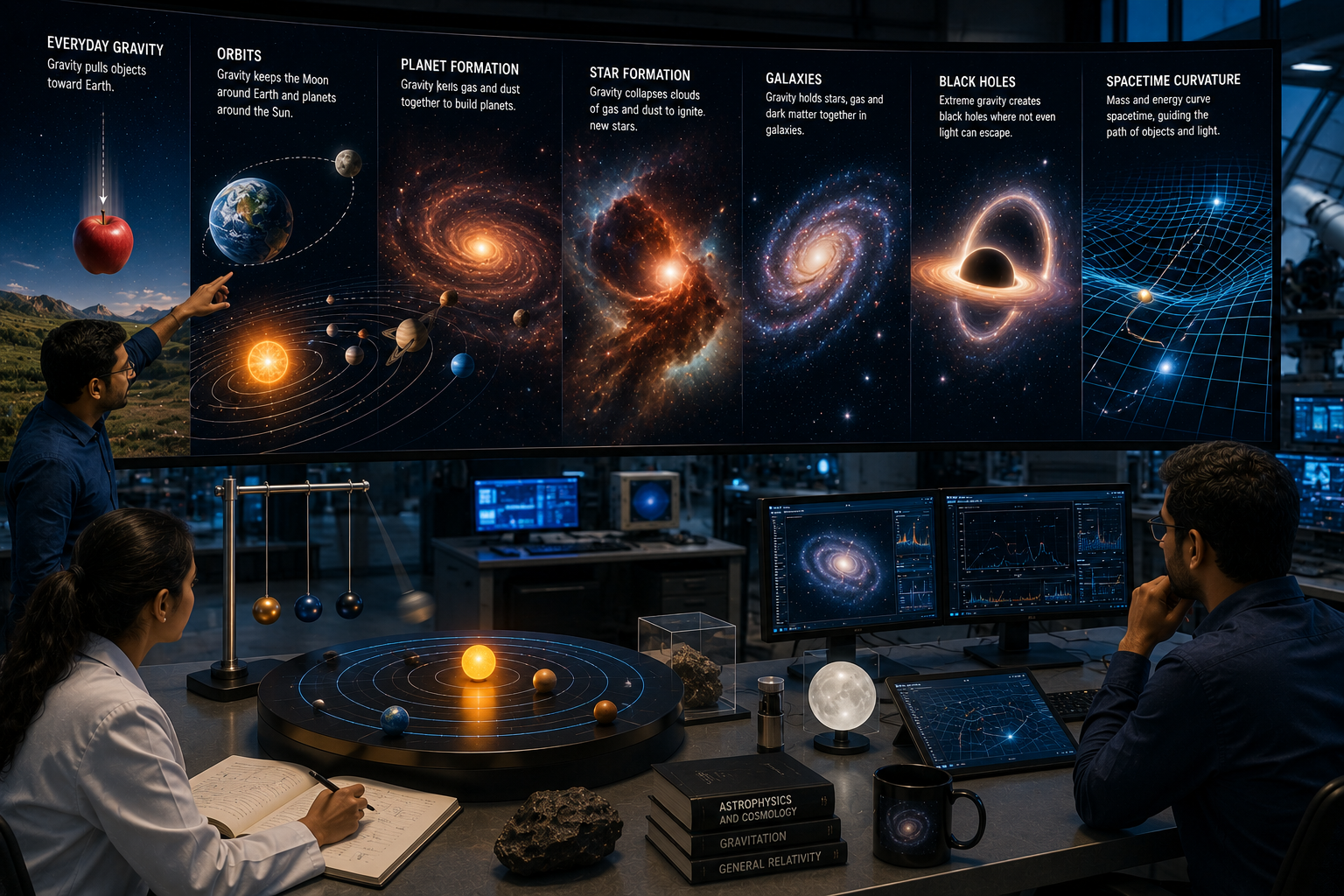
Gravity is so familiar that it can feel ordinary. It keeps people on the ground, makes rain fall and gives weight to objects. Yet the same force also builds planets, ignites stars, holds galaxies together and creates black holes. Without gravity, the universe would not have the large structures we recognize. Matter would not gather into worlds, stars would not form from clouds, and galaxies would not hold their shape. Gravity is the quiet architect of cosmic order.
Gravity in Everyday Life
On Earth, gravity appears as weight and falling motion. A dropped object accelerates downward because Earths mass attracts it. But Earth is also attracted by the object; the effect is simply too small to notice because Earth is vastly more massive. This mutual attraction is the same basic idea that explains why the Moon orbits Earth and why Earth orbits the Sun. Everyday gravity is therefore a local example of a universal interaction.
Gravity and Orbits
An orbit is not a state of no gravity. It is a continuous fall around a larger body. The Moon is falling toward Earth, but it also moves sideways fast enough that it keeps missing Earth. Satellites work the same way. Planets orbit the Sun because solar gravity pulls them inward while their forward motion carries them around. This balance between attraction and motion creates stable paths, though real orbits can be disturbed by other bodies.
Building Planets and Solar Systems
Gravity helped build the solar system from a rotating cloud of gas and dust. Small particles stuck together, larger bodies attracted more material, and collisions gradually produced planetesimals and planets. Gravity also sorted matter into disks, moons and orbital systems. It does not work alone; heat, chemistry, collisions, magnetism and radiation all matter. But gravity provides the large-scale gathering mechanism that turns scattered material into worlds.
Making Stars
Stars form when gravity pulls regions of gas and dust into dense clouds. As a cloud contracts, pressure and temperature rise. If the core becomes hot and dense enough, nuclear fusion begins, and a star is born. Gravity continues to matter throughout a stars life because it pulls inward while pressure from heat and radiation pushes outward. A star is a long contest between gravitational collapse and internal pressure. When that balance changes, the star evolves.
Holding Galaxies Together
Galaxies are vast collections of stars, gas, dust, planets and dark matter. Gravity binds these components into structures such as spiral galaxies, elliptical galaxies and irregular galaxies. Stars orbit within galaxies, and galaxies interact with one another gravitationally. Collisions between galaxies are not usually star-to-star crashes because the distances are enormous, but gravity can reshape them, trigger star formation and eventually merge them into new systems.
Black Holes and Extreme Gravity
When enough mass is compressed into a small enough region, gravity becomes so strong that a black hole forms. Near a black hole, escape velocity exceeds the speed of light, so beyond the event horizon nothing can return to outside observers. Black holes are not cosmic vacuum cleaners that suck up everything from unlimited distances. They obey gravity like other masses, but their compactness makes their nearby gravitational effects extreme. They test physics under conditions impossible to reproduce on Earth.
Gravity, Light and Spacetime
Modern physics deepens the story. Einstein described gravity not only as a force between masses but as the curvature of spacetime. Matter and energy shape spacetime, and objects follow paths through that curved geometry. This is why massive objects can bend light, producing gravitational lensing. Telescopes use such lensing to study distant galaxies. Gravity therefore shapes not only matter but also the path of light by which we observe the universe.
Final Takeaway
Gravity shapes the universe by gathering, binding and bending. It pulls dust into planets, gas into stars, stars into galaxies and collapsed matter into black holes. It keeps moons, planets and satellites in orbit. It even bends light through curved spacetime. The same phenomenon that makes a ball fall also organizes the largest structures humans can observe. Gravity is not just a downward pull; it is the framework of cosmic architecture.