The card is not free money
A credit card is one of the most misunderstood financial products in everyday life. It looks simple: swipe, tap or enter details online, and the bank pays the merchant immediately. You pay the bank later. Used carefully, the card gives convenience, fraud protection, short-term liquidity, reward points, travel benefits and a clean payment record. Used carelessly, it can become one of the fastest routes into expensive consumer debt.
The confusion begins because credit cards mix three different things in one product. They are payment instruments, because they help you transact. They are credit instruments, because the issuer lends you money for a short period. They are marketing instruments, because rewards, cashback, discounts and lifestyle benefits encourage spending. The user often sees the first and third functions, but forgets the second.
A credit card works best when you treat it as a payment tool, not as extra income. The issuer gives you a credit limit. You spend within that limit. At the end of the billing cycle, a statement is generated. If you pay the full outstanding amount by the due date, you usually avoid interest on regular purchases. If you pay only part of the bill, the card becomes revolving credit, and that is where the real cost begins.
The basic credit-card cycle
To understand a credit card, start with the billing cycle. Suppose your billing cycle runs from the first day of the month to the last day. Purchases made during that cycle appear in the statement. The issuer then gives a due date, usually after a grace period. This creates an interest-free window on eligible purchases if you pay the entire statement amount on time.
This interest-free period is the attractive part of credit cards. It means you can use the bank’s money for a few weeks without paying interest, provided you follow the rules. But the condition is strict: the full amount must be paid by the due date. Not the minimum amount. Not most of the amount. The full outstanding amount.
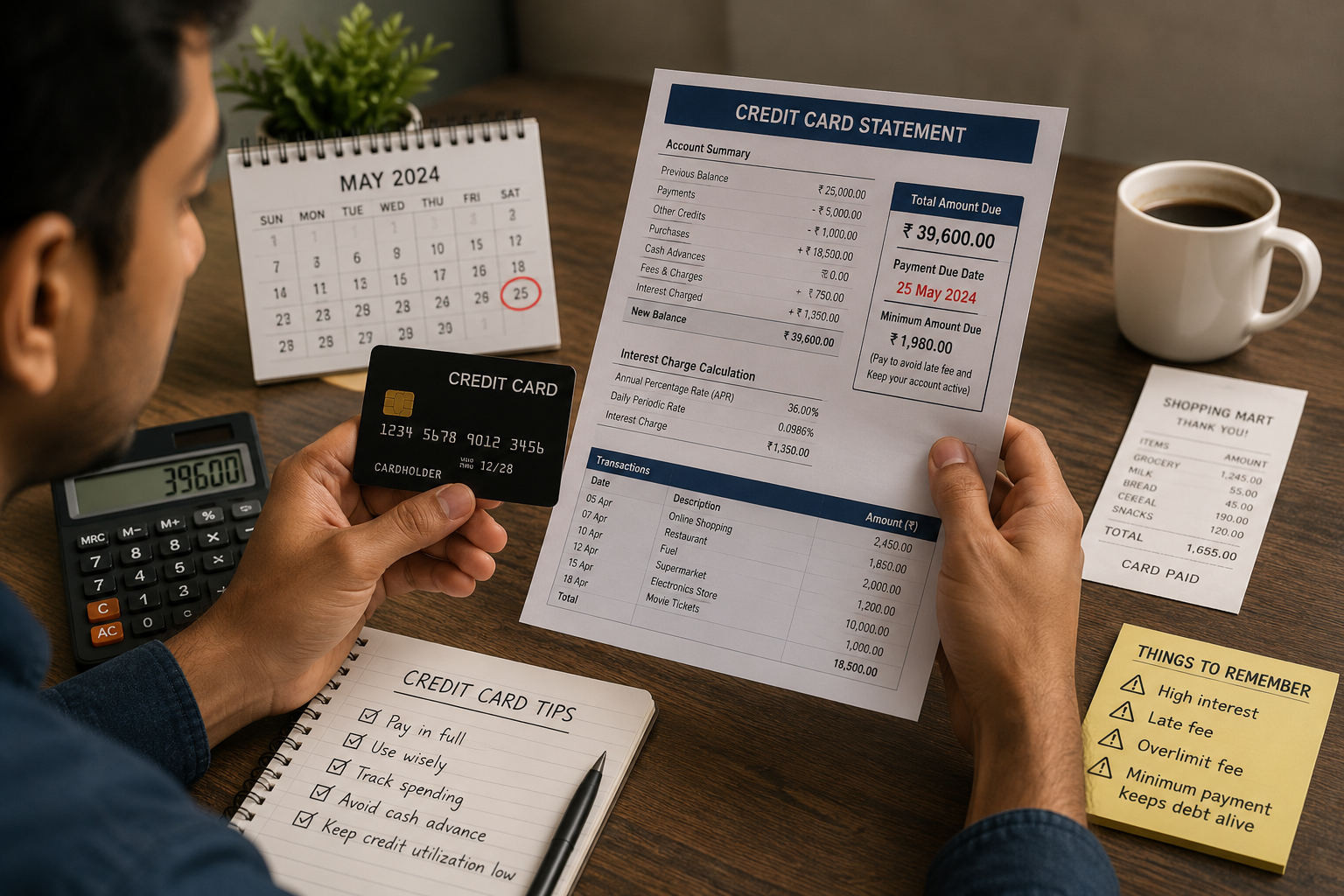
If you miss the due date or roll over a balance, interest can apply. Depending on the issuer and card terms, the interest cost may be expressed monthly but becomes much larger when annualised. The card statement may show a finance charge, late fee, taxes, overlimit charges where applicable, cash advance fees and other charges. The convenience product suddenly becomes an expensive loan.
Why the minimum amount due is dangerous
The most common trap is the minimum amount due. A credit card statement usually allows you to pay a small portion of the total bill to avoid being classified as a complete defaulter. This can look like relief. If the total bill is Rs 50,000 and the minimum amount due is much lower, the user may think the pressure has reduced.
In reality, the minimum payment is not a discount. It is a signal that you are rolling over debt. Once you revolve the balance, interest starts working against you. New purchases may also lose the practical benefit of the interest-free period depending on card terms. The outstanding amount can stretch for months or years if only minimum payments are made.
Regulators have repeatedly emphasised that cardholders must be warned about the consequences of paying only the minimum amount. The logic is obvious: minimum payments preserve the account, but they do not solve the debt. They can make the debt feel manageable while interest quietly expands the cost.
The hidden costs people ignore
Credit-card costs are not always hidden because issuers never disclose them. Often, they are hidden because users do not read them. The most important cost is finance charge or interest on unpaid balances. The second is late payment fee. The third is cash advance cost. The fourth is foreign-currency markup. The fifth is annual or renewal fee. The sixth is GST or applicable tax on fees and charges. The seventh is the psychological cost of spending more because payment feels painless.
Cash withdrawal from a credit card is particularly costly. Many users assume it works like withdrawing from a bank account. It does not. Cash advances often attract fees and interest from the date of withdrawal, without the normal interest-free period. Using a credit card for cash is usually a sign of liquidity stress and should be treated with caution.
Reward points can also mislead. A card may offer points, miles or cashback, but the benefit is often small compared with interest charges if the bill is not paid in full. Spending Rs 10,000 to earn a small reward is irrational if the purchase was unnecessary or if the outstanding balance will be revolved at high cost.
How credit cards affect credit scores
Credit cards can help build a credit history because they create a record of borrowing and repayment. Paying bills on time, keeping utilisation reasonable and maintaining a stable account can support a healthy credit profile. For someone new to formal credit, a basic card used responsibly can become an entry point into the credit system.
But the same card can damage a credit score. Late payments, defaults, settlements, high utilisation and repeated applications can signal risk. Utilisation means how much of your credit limit is being used. A person who constantly uses almost the entire limit may appear financially stretched even if payments are eventually made.
The safest behaviour is simple: spend only what you can repay in full, set automatic reminders, keep utilisation moderate, avoid unnecessary cards, and never treat the limit as available income. The credit limit is the bank’s risk limit, not your spending capacity.
The psychology of card spending
Credit cards change behaviour because they separate the pleasure of buying from the pain of paying. When people pay in cash, the cost is visible. When they pay by card, the cost is postponed. The brain experiences the purchase now and the consequence later. This gap encourages overspending.
Marketing adds another layer. Limited-time discounts, reward multipliers, airport lounge access, premium metal cards and festival offers all create the feeling that spending is smart. Sometimes it is. If you were going to make a necessary purchase and can pay in full, the reward is a bonus. But if the offer creates the purchase, the card has influenced behaviour rather than saved money.
The discipline is to reverse the mental model. Do not ask, “Can this fit within my credit limit?” Ask, “Can I pay this fully from money I already have?” If the answer is no, the card is not convenience. It is borrowing.
How to use a credit card well
A good credit-card routine is boring but powerful. Use one or two cards at most. Track spending weekly. Pay the full bill before the due date. Do not withdraw cash. Avoid converting every purchase into EMI unless the total cost is clear. Check the statement for wrong charges. Read the most important terms: interest rate, annual fee, foreign markup, late fee, cash advance fee, reward expiry and dispute process.
It also helps to separate categories. Use the card for predictable expenses like groceries, fuel, subscriptions or business travel only if those expenses are already budgeted. Avoid using it for emotional purchases, status spending or impulse shopping. A card cannot damage your finances unless it changes your behaviour or hides the cost of your behaviour.
If debt has already accumulated, the priority should be repayment strategy. Stop new spending on the card, list balances and interest rates, pay more than the minimum, consider lower-cost consolidation only if it genuinely reduces cost, and avoid taking fresh loans to maintain lifestyle spending. The first rule of escaping card debt is to stop adding to it.
Final takeaway
A credit card is useful when it is used as a payment tool and dangerous when used as an income substitute. The interest-free period is real, but it depends on full and timely payment. Rewards are real, but they are rarely worth the cost of revolving debt. A credit limit is real, but it is not the same as affordability.
The hidden costs of credit cards are interest, fees, cash advance charges, taxes, behavioural overspending and credit-score damage. Most of these costs become visible only after discipline fails. That is why the best credit-card users are not the ones with the highest limits or fanciest benefits. They are the ones who pay in full, understand the statement and refuse to let marketing define their budget.
Credit cards do not create financial problems by themselves. They amplify habits. In disciplined hands, they are convenient. In impulsive hands, they are expensive. The difference is not the plastic card; it is the behaviour behind it.