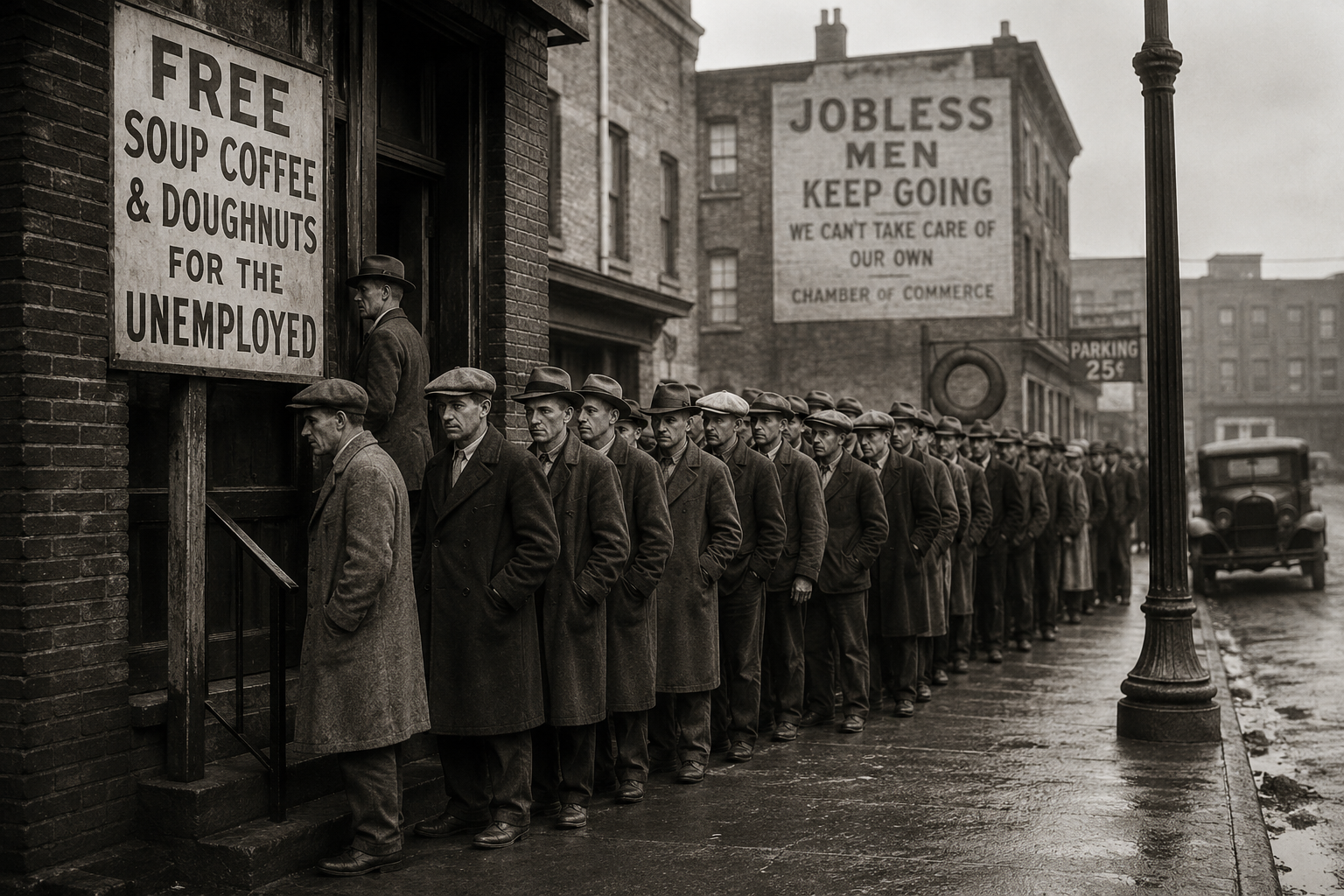
The Great Depression is often remembered through black-and-white images: unemployed workers standing in breadlines, anxious crowds outside banks, abandoned farms, closed factories and families trying to survive with dignity after the collapse of work. But the Great Depression was not only a human tragedy. It was also one of the most important lessons in economic policy.
Its first lesson is that a financial crisis can become a social crisis very quickly. The stock market crash of 1929 is the famous symbol, but the Depression was deeper than a market fall. Share prices collapsed, confidence broke, banks failed, credit contracted, businesses reduced production, and consumers cut spending. Once these forces began reinforcing one another, the downturn became self-feeding.
A normal recession hurts income and employment. The Great Depression showed what happens when recession, banking panic, deflation and policy paralysis meet at the same time. When banks failed, households lost savings. When households lost savings, spending fell. When spending fell, businesses cut jobs. When jobs disappeared, loan repayments weakened. When loans weakened, more banks came under pressure. The economy did not simply slow; it lost the institutions that allowed trust and credit to function.
The second lesson is that banking stability is not a technical side issue. It is central to economic survival. Banks convert savings into loans, process payments and support business working capital. When depositors fear that banks are unsafe, they withdraw money. But no banking system can satisfy all depositors at once because banks lend a large part of deposits onward. That is why panic can destroy even institutions that might have survived under calmer conditions.
The Great Depression therefore helped shape modern thinking on deposit insurance, lender-of-last-resort functions and bank supervision. A society cannot ask ordinary citizens to trust banks while leaving them completely exposed to sudden institutional collapse. Trust must be supported by rules, capital, liquidity and credible public backstops.
The third lesson is that deflation can be as dangerous as inflation. Inflation reduces the purchasing power of money. Deflation appears attractive at first because prices fall. But deep deflation can become destructive. If people expect prices to keep falling, they delay purchases. If businesses expect lower prices, they cut investment. If incomes fall while debts remain fixed in nominal terms, the real burden of debt rises. Borrowers become weaker exactly when the economy needs spending and investment.
During the Depression, falling prices increased the weight of debt and worsened financial distress. Farmers, households and businesses had to repay loans with money that had become harder to earn. This is why central banks today watch not only high inflation but also dangerous disinflation and deflationary spirals. Price stability means avoiding both runaway price increases and collapsing prices.
The fourth lesson is that monetary policy can fail if it is constrained by rigid ideas or external commitments. The gold standard limited the freedom of central banks during the early 1930s. Countries committed to gold convertibility often prioritised defending the currency over expanding credit or supporting domestic demand. In theory, the gold standard created discipline. In crisis, it could transmit deflation and restrict policy response.
This lesson still matters. Any exchange-rate regime, fiscal rule or monetary commitment can be useful in normal times, but it becomes dangerous if it prevents policymakers from responding to collapse. Credibility is important, but credibility without flexibility can become a trap.
The fifth lesson is that delayed action makes crises more expensive. Early intervention is politically difficult because the problem may not yet look catastrophic. But once panic spreads, the cost of stabilisation rises sharply. A bank rescue before panic may look unpopular. A bank rescue after collapse may become unavoidable and far more expensive. The Great Depression taught governments that waiting for markets to heal themselves can be disastrous when the market mechanism itself has broken.
The sixth lesson is that unemployment is not only an economic statistic. It is a social wound. Prolonged unemployment damages skills, family stability, mental health, local businesses and political trust. When people lose work for long periods, they lose more than income. They lose bargaining power, confidence and a sense of future. This is why modern governments treat deep recessions as emergencies requiring fiscal support, public works, social insurance and demand management.
The New Deal in the United States did not solve every problem, and historians still debate its exact economic effects. But it changed the relationship between the state and the economy. It recognised that government could not remain passive when mass unemployment, financial collapse and social distress threatened the foundations of public life. Public works, relief programmes, financial reforms and labour protections became part of a broader attempt to rebuild confidence.
The seventh lesson is that inequality and weak demand can make economies fragile. In the 1920s, gains were unevenly distributed, credit expanded and speculation rose. When asset prices fell, many households did not have strong buffers. A consumption-driven economy needs broad purchasing power. If prosperity is concentrated while debt expands among weaker households, apparent growth can hide fragility.
The eighth lesson is that global crises require global thinking. The Depression spread across countries through trade, gold flows, financial linkages and protectionist reactions. As demand collapsed, countries raised tariffs and defended domestic interests. Protectionism may appear politically useful during crisis, but when many countries restrict trade simultaneously, everyone suffers. The lesson is not that borders do not matter. The lesson is that economic nationalism can deepen a global downturn if coordination fails.
The ninth lesson is that economic narratives shape recovery. If the public believes banks are unsafe, it behaves differently. If businesses believe demand will not return, they do not invest. If workers believe the future is closed, social anger rises. Policy is not only about money supply, budgets and interest rates. It is also about restoring credible expectations.
This is why communication from governments and central banks matters during crisis. People need to believe that authorities understand the problem, possess tools and will act decisively. Uncertainty cannot be eliminated, but leadership can reduce panic.
The tenth lesson is that financial innovation and speculation must be supervised before crisis. The 1920s boom included margin lending, speculative enthusiasm and weak oversight. Every generation believes its boom is different. Every generation creates new instruments, new confidence and new stories about why old risks no longer apply. The Depression warns that finance can outrun real income, real productivity and real repayment capacity.
For India and other emerging economies, the Great Depression is not merely American history. It is a reminder that external shocks, commodity cycles, capital flows, trade contraction and policy mistakes can affect domestic welfare. It teaches why financial regulation, social protection, employment generation, credible monetary policy and fiscal flexibility all matter.
The greatest lesson is that economies are built on trust. Trust in banks, wages, prices, employment, government, money and the future. When that trust collapses, spreadsheets become human suffering. Recovery then requires more than technical repair. It requires institutional rebuilding.
The Great Depression still matters because it proved that economic systems are not self-healing machines under all conditions. Markets allocate resources, but they can also freeze. Banks create credit, but they can also transmit panic. Prices guide decisions, but falling prices can deepen distress. Governments can make mistakes by doing too much, but they can also make catastrophic mistakes by doing too little.
The final lesson is humility. Economic stability should never be taken for granted. A prosperous decade can contain the seeds of collapse. A small panic can become systemic. A financial shock can become a political shock. The responsibility of policy is therefore not only to celebrate growth in good times, but to build buffers before bad times arrive.
Disclaimer
This article is for general educational and editorial use. It is not investment, legal, banking, lending or policy advice. Historical interpretation and crisis chronology should be verified from primary and institutional sources before publication.